
Market Insights
Global Capacitive Modulation Encoders Market size was valued at USD 1.14 billion in 2025. The market is projected to grow from USD 1.25 billion in 2026 to USD 2.18 billion by 2032, exhibiting a CAGR of 9.9% during the forecast period.
Capacitive modulation encoders are precision measurement devices that convert mechanical motion into electrical signals using capacitive sensing technology. These components feature rotor disks or linear scales with periodic electrode patterns, stator-side excitation arrays, and specialized ASICs for signal processing. They offer high resolution (up to 24-bit absolute values), robust performance across industrial temperature ranges (-40°C to +105°C), and vibration-resistant operation meeting military standards.
The market growth is driven by increasing automation across manufacturing sectors, rising demand for high-precision motion control in robotics and semiconductor equipment, and advancements in Industry 4.0 technologies. A six-axis industrial robot typically incorporates 6-7 capacitive encoders, while medical imaging systems like CT scanners utilize 1-3 units per device. Key manufacturers including Heidenhain, Netzer Precision Instruments, and Posital-Fraba are expanding their product portfolios to address emerging applications in collaborative robotics and autonomous mobile vehicles.
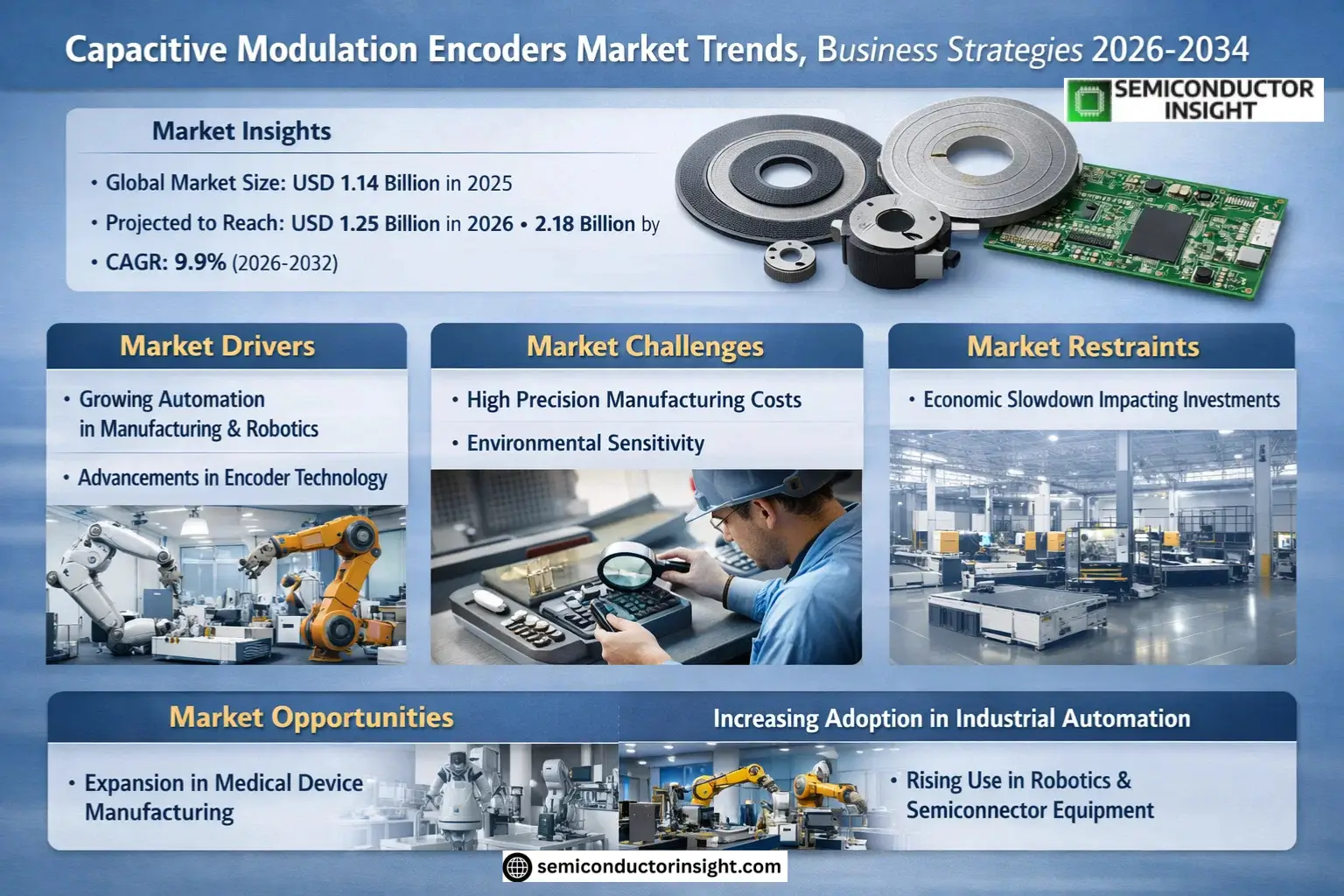
MARKET DRIVERS
Growing Automation Across Industries
Capacitive Modulation Encoders Market is experiencing significant growth due to increasing automation in manufacturing, robotics, and automotive sectors. These encoders provide high-precision position feedback, essential for modern automated systems. Global industrial automation market is projected to grow at 8.3% CAGR, directly boosting demand for reliable encoder solutions.
Advancements in Encoder Technology
Recent innovations in capacitive sensing technology have enhanced the accuracy and durability of modulation encoders, making them preferable over traditional optical encoders in harsh environments. Manufacturers are developing encoders with higher resolution (up to 24-bit) and improved signal integrity for critical applications.
Expanding applications in renewable energy systems, particularly in wind turbine pitch control, are creating new revenue streams for capacitive modulation encoder manufacturers.
MARKET CHALLENGES
High Precision Manufacturing Requirements
Capacitive modulation encoders require extremely tight manufacturing tolerances, leading to higher production costs compared to conventional encoders. This creates barriers for small and medium-sized manufacturers looking to enter the market.
Other Challenges
Environmental Sensitivity
Despite improvements, capacitive encoders still face challenges in extremely dusty or humid environments where contamination can affect performance. Solutions involving advanced sealing technologies add 15-20% to product costs.
MARKET RESTRAINTS
Economic Slowdown Impacting Capital Investments
The current global economic uncertainty has led to delayed capital expenditures in industrial sectors, particularly affecting the adoption of high-end encoder solutions. Many manufacturers are opting to extend the lifespan of existing equipment rather than invest in new precision components.
MARKET OPPORTUNITIES
Expansion in Medical Device Manufacturing
The increasing precision requirements in medical robotics and diagnostic equipment present significant growth opportunities for capacitive modulation encoders. The medical device sector is expected to account for 18% of encoder demand growth through 2028, driven by minimally invasive surgical technologies.
Capacitive Modulation Encoders Market Trends
Increasing Adoption in Industrial Automation
Capacitive modulation encoders are witnessing growing demand in industrial automation due to their high resolution and reliability. Industrial robots increasingly integrate 6-7 units per system for joint positioning, while semiconductor equipment utilizes 3-6 encoders per platform. The technology’s vibration resistance and ±10-±60 arcsecond accuracy make it suitable for harsh manufacturing environments. Key manufacturers are expanding production capacities to meet this demand.
Other Trends
Material and Component Innovations
Manufacturers are optimizing electrode materials (copper/aluminum) and dielectric substrates (PCB/glass) to improve signal stability. New capacitance measurement ASICs with lower noise floors enable resolutions up to 24-bit absolute for high-end robotics applications. These advancements reduce interpolation errors in high-speed operations (3,000-10,000 RPM).
Medical Imaging Applications Growth
Medical device manufacturers are adopting capacitive modulation encoders for CT/Gantry systems (1-3 units per device) due to their non-contact operation and EMI resistance. The technology’s ±1 arcsecond accuracy in premium models meets precision requirements for patient positioning systems, driving innovation in healthcare robotics and diagnostic equipment interfaces.
Regional Market Development
Asia-Pacific shows accelerated adoption, particularly in Chinese industrial robotics. North America maintains strong demand in aerospace applications where extreme temperature tolerance (-40°C to +105°C) is critical. European manufacturers lead in high-precision encoder solutions for semiconductor capital equipment.
Standardization of Communication Protocols
Industry convergence toward BiSS-C and SSI interfaces promotes encoder interoperability across motion control systems. This trend accompanies broader integration of industrial Ethernet (EtherCAT, PROFINET) in next-generation capacitive encoder designs for Industry 4.0 applications, further solidifying their position in smart manufacturing ecosystems.
COMPETITIVE LANDSCAPE
Key Industry Players
Global Leaders Drive Innovation in Precision Motion Control
Capacitive Modulation Encoders Market is dominated by specialized manufacturers with strong R&D capabilities in precision measurement technologies. Heidenhain and Netzer Precision Instruments lead the high-end segment, offering industrial-grade encoders with resolutions up to 24-bit, primarily serving aerospace, semiconductor, and robotics applications. These leaders account for approximately 30% of the global market revenue in 2025, with TR Electronic, Posital-Fraba, and SICK constituting another 25% market share collectively.
Emerging players like Kappasense and Same Sky are gaining traction through innovative cost-effective solutions for collaborative robots and medical devices. Regional specialists such as Hengstler and Georg Schlegel maintain strong positions in European machine tool markets, while Bourns and Micro-Epsilon cater to North American automotive and industrial automation sectors. The market sees increasing competition from Asian manufacturers developing localized solutions for China’s growing robotics industry.
List of Key Capacitive Modulation Encoders Companies Profiled
- Heidenhain
- Netzer Precision Instruments
- TR Electronic
- Posital-Fraba
- SICK AG
- Bourns
- Hengstler GmbH
- Georg Schlegel
- Micro-Epsilon
- Same Sky
- Kappasense
- PoLabs
- Celera Motion
- Dynapar
- MTI Instruments
Segment Analysis:
| Segment Category | Sub-Segments | Key Insights |
| By Type |
|
Absolute Encoders dominate due to their position retention capabilities and high precision:
|
| By Application |
|
Industrial Automation shows strongest demand due to:
|
| By End User |
|
OEM Manufacturers drive the majority of market demand:
|
| By Operating Environment |
|
Standard Industrial environments account for the largest share:
|
| By Interface Type |
|
Digital Interfaces are becoming standard:
|
Regional Analysis: Global Capacitive Modulation Encoders Market
China accounts for the largest share of Asia-Pacific’s capacitive modulation encoder market, driven by its massive industrial sector. The country’s focus on upgrading aging factory equipment and developing advanced robotics creates consistent demand for high-precision encoder solutions supporting automation needs.
Japan remains at the forefront of capacitive encoder innovation, with domestic manufacturers developing cutting-edge products for CNC machines and precision instrumentation. The country’s strong robotics industry and emphasis on quality control drive demand for high-resolution capacitive modulation encoders.
South Korea’s thriving semiconductor manufacturing sector creates specialized demand for capacitive modulation encoders used in chip fabrication equipment. The country’s advanced electronics industry requires encoders that can operate reliably in clean room environments with nanometer-level precision.
Countries like Vietnam, Thailand, and Malaysia are witnessing growing adoption of capacitive modulation encoders as they expand automation in electronics assembly and automotive parts production. These markets present opportunities for mid-range encoder solutions balancing performance and affordability.
North America
North America maintains strong demand for premium capacitive modulation encoders, particularly in aerospace, defense, and medical equipment applications. The region’s focus on high-reliability solutions and stringent quality requirements drives preference for advanced encoder technologies. U.S. manufacturers lead in developing ruggedized capacitive encoders for harsh environments, while Canada sees growing adoption in renewable energy applications. The presence of major industrial automation companies and ongoing investments in manufacturing digitization continue to support market growth.
Europe
European markets emphasize precision engineering and energy efficiency in capacitive modulation encoder applications. Germany’s strong industrial base drives demand for encoders in machine tools and factory automation systems. The region sees increasing adoption in electric vehicle production lines and renewable energy systems, with strict EU regulations promoting high-efficiency motion control solutions. Eastern European countries are gradually adopting capacitive encoder technologies as they modernize manufacturing facilities.
South America
South America represents a developing market for capacitive modulation encoders, with Brazil and Argentina as primary adopters. The region shows potential in mining equipment, agricultural machinery, and food processing automation applications. Market growth is constrained by economic volatility but benefits from increasing foreign investments in industrial automation across key sectors. Local manufacturers are beginning to recognize the advantages of capacitive encoders over traditional optical solutions in challenging environments.
Middle East & Africa
The Middle East exhibits growing interest in capacitive modulation encoders for oil & gas applications and infrastructure development projects. Africa’s market remains nascent but shows potential in mining operations and beverage production automation. Both regions present opportunities for durable encoder solutions capable of withstanding extreme temperatures and harsh operating conditions prevalent in local industries.
Report Scope
This market research report provides a comprehensive analysis of the Capacitive Modulation Encoders Market , covering the forecast period 2025–2032. It offers detailed insights into market dynamics, technological advancements, competitive landscape, and key trends shaping the industry.
Key focus areas of the report include:
- Market Overview: The report begins with an overview outlining its current market scenario, key growth indicators, and industry transformation drivers. It discusses macroeconomic factors, demand–supply balance, regulatory landscape, and the strategic role of semiconductors in powering advancements across industries such as automotive, telecommunications, consumer electronics, and industrial automation.
- Market Size & Forecast: Historical data and future projections for revenue, unit shipments, and market value across major regions and segments.
- Segmentation Analysis: Detailed breakdown by product type, technology, application, and end-user industry to identify high-growth segments and investment opportunities.
- Regional Insights: Insights into market performance across North America, Europe, Asia-Pacific, Latin America, and the Middle East & Africa, including country-level analysis where relevant.
- Competitive Landscape: Profiles of leading market participants, including their product offerings, R&D focus, manufacturing capacity, pricing strategies, and recent developments such as mergers, acquisitions, and partnerships.
- Technology Trends & Innovation: Assessment of emerging technologies, integration of AI/IoT, semiconductor design trends, fabrication techniques, and evolving industry standards.
- Market Drivers & Restraints: Evaluation of factors driving market growth along with challenges, supply chain constraints, regulatory issues, and market-entry barriers.
- Stakeholder Insights: Insights for component suppliers, OEMs, system integrators, investors, and policymakers regarding the evolving ecosystem and strategic opportunities.
Primary and secondary research methods are employed, including interviews with industry experts, data from verified sources, and real-time market intelligence to ensure the accuracy and reliability of the insights presented.
FREQUENTLY ASKED QUESTIONS:
What is the current market size of Capacitive Modulation Encoders Market?
-> Capacitive Modulation Encoders Market size was valued at USD 1.14 billion in 2025. The market is projected to grow from USD 1.25 billion in 2026 to USD 2.18 billion by 2032, exhibiting a CAGR of 9.9% during the forecast period.
Which key companies operate in Capacitive Modulation Encoders Market?
-> Key players include Kappasense, Same Sky, Netzer, TR Electronic, Heidenhain, PoLabs, Posital-Fraba, Hengstler, Bourns, SICK, Georg Schlegel, and Micro-Epsilon.
What are the key growth drivers?
-> Key growth drivers include increasing automation in industrial robotics, demand for high-precision motion control in semiconductor manufacturing, and expanding applications in medical imaging and aerospace equipment.
What is the average unit price of capacitive modulation encoders?
-> In 2025, based on system design and purchase orders, the unit price was approximately USD 52.4, with a gross profit margin of approximately 28%–38%.
What are typical applications for these encoders?
-> Typical applications include industrial robots (6-7 encoders per unit), semiconductor equipment (3-6 encoders), servo motor test benches (1-2 encoders), and medical imaging devices like CT/Gantry systems (1-3 encoders).

Get Sample Report PDF for Exclusive Insights
Report Sample Includes
- Table of Contents
- List of Tables & Figures
- Charts, Research Methodology, and more...
 Download Sample Report PDF




