

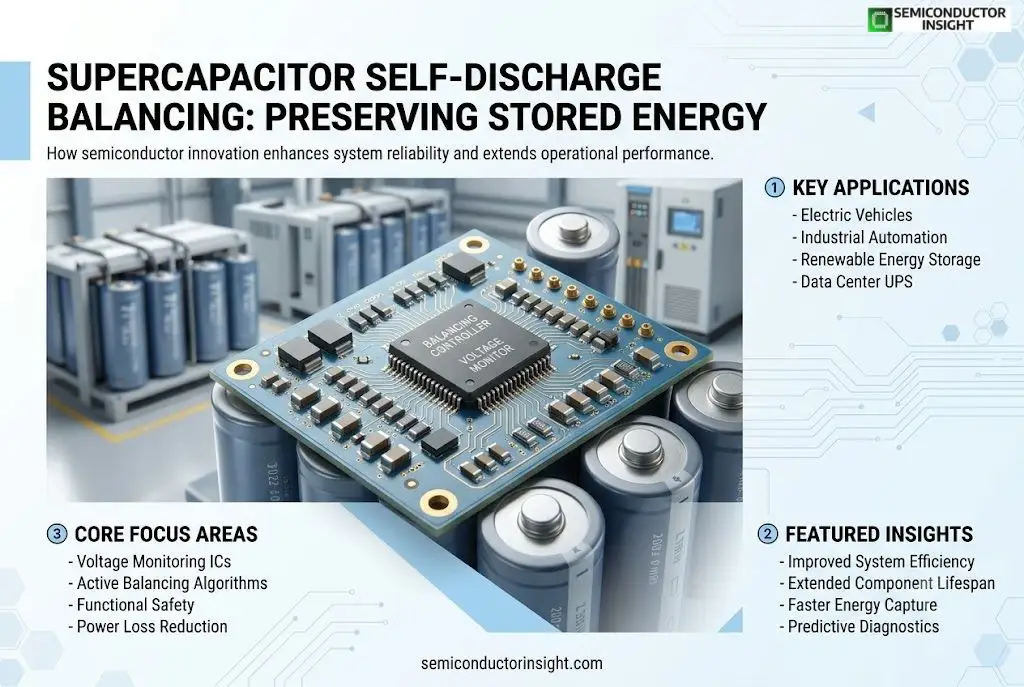
Can the Super capacitor Self Discharge Balancing Market Redefine Power Stability for AI Devices EVs and Industrial Automation?
Power electronics is entering a phase where efficiency is measured not only by processing capability but also by how effectively stored energy is preserved. This shift is placing Supercapacitor Self Discharge Balancing Market at the center of semiconductor innovation. Supercapacitors are already valued for rapid charging, exceptional power density, and millions of charging cycles.
However, self-discharge remains a technical limitation that affects system reliability. Semiconductor-enabled balancing technologies are emerging as practical solutions by monitoring voltage variations, minimizing leakage currents, and extending operational performance in electric vehicles, industrial automation, renewable energy storage, aerospace electronics, and intelligent consumer devices.
Why Self Discharge Is Becoming a Semiconductor Design Priority?
Modern semiconductor architectures increasingly combine processors, sensors, and energy storage within compact electronic systems. Even small voltage imbalances between supercapacitor cells can reduce efficiency and shorten component lifespan.
Recent balancing integrated circuits now include intelligent voltage monitoring, low-power analog front ends, adaptive switching algorithms, and digital diagnostics. These semiconductor functions enable stable energy distribution while reducing unnecessary energy losses.
As electronics become smaller yet more powerful, balancing circuits are evolving from optional protection features into core semiconductor components integrated directly into advanced power management systems.
The Technology Momentum in Numbers
Several technology indicators demonstrate why balancing technologies are attracting global attention.
- More than 18 million electric vehicles were operating worldwide during 2025, increasing demand for fast-response energy storage modules.
- Modern commercial supercapacitors typically support 500,000 to over 1 million charge-discharge cycles, significantly exceeding conventional lithium-ion batteries.
- Individual supercapacitor cells generally operate around 2.7 volts, requiring sophisticated balancing circuits when connected into higher-voltage modules reaching 48 V, 400 V, or even 800 V power architectures.
- Large renewable energy installations increasingly deploy hybrid storage systems combining batteries with supercapacitors capable of delivering power bursts within milliseconds.
These operating characteristics explain why semiconductor balancing controllers are becoming essential rather than optional components in advanced energy storage systems.
Innovation Spotlight Where Industry Is Investing Today
Several breakthrough developments are redefining balancing technologies.
Wide-bandgap semiconductor devices using silicon carbide (SiC) and gallium nitride (GaN) enable faster switching with reduced energy losses. Digital power controllers increasingly integrate machine-learning-assisted diagnostics that predict voltage drift before imbalance occurs.
Automotive manufacturers are also incorporating intelligent balancing electronics into regenerative braking systems, allowing supercapacitors to efficiently capture sudden bursts of recovered energy while maintaining stable cell voltages.
Research institutions are additionally exploring self-calibrating balancing circuits capable of adjusting automatically to capacitor aging throughout operational life.
Emerging Applications Expanding Commercial Adoption
The technology is finding opportunities well beyond transportation.
Industrial robots rely on supercapacitors to maintain motion during temporary power interruptions.
Smart electricity meters increasingly use miniature supercapacitors for backup operation during communication failures.
Data centers are evaluating supercapacitor balancing modules for instantaneous backup power supporting AI servers where milliseconds determine service continuity.
In aerospace, satellites and launch systems continue adopting supercapacitor modules because of their high reliability across extreme temperature environments.
Medical imaging systems, automated guided vehicles, warehouse robotics, and intelligent factory equipment are also expanding semiconductor demand for precision balancing controllers.
Engineering Evolution from Passive Circuits to Intelligent Power Management
Traditional passive balancing dissipated excess energy through resistors, providing simple yet inefficient operation.
Current semiconductor solutions are moving toward intelligent active balancing that redistributes energy between cells rather than wasting it. Advanced controllers combine voltage sensing, MOSFET switching, embedded firmware, and real-time diagnostics into highly integrated semiconductor platforms.
Some new balancing ICs consume only a few microamps during standby operation, making them suitable for long-duration energy storage systems deployed in remote industrial infrastructure.
This engineering evolution significantly improves energy utilization while reducing maintenance requirements over extended operating periods.
Industry Developments worth Watching
- Governments continue expanding investments in renewable energy infrastructure, electric mobility, and smart manufacturing, indirectly accelerating balancing technology adoption.
- Growing deployment of AI-enabled industrial equipment requires uninterrupted burst power during peak computational workloads. Semiconductor suppliers are responding with compact balancing controllers supporting higher voltage architectures and enhanced functional safety.
- Universities and technology laboratories are also investigating graphene-enhanced supercapacitors, solid-state electrolytes, and advanced balancing algorithms capable of improving long-term energy retention without increasing hardware complexity.
Stay connected for additional in-depth information right here: https://semiconductorinsight.com/report/supercapacitor-self-discharge-balancing-market/
Final Takeaway
Supercapacitor Self Discharge Balancing Market is becoming an enabling technology for the next generation of semiconductor-powered energy systems. Rather than focusing solely on storing electricity, industry attention is shifting toward preserving every unit of stored energy with greater intelligence.
As electric mobility, AI infrastructure, industrial automation, and renewable power systems continue expanding, semiconductor-based balancing solutions are expected to become fundamental building blocks for efficient, reliable, and highly responsive electronic architectures.

Comments (0)