
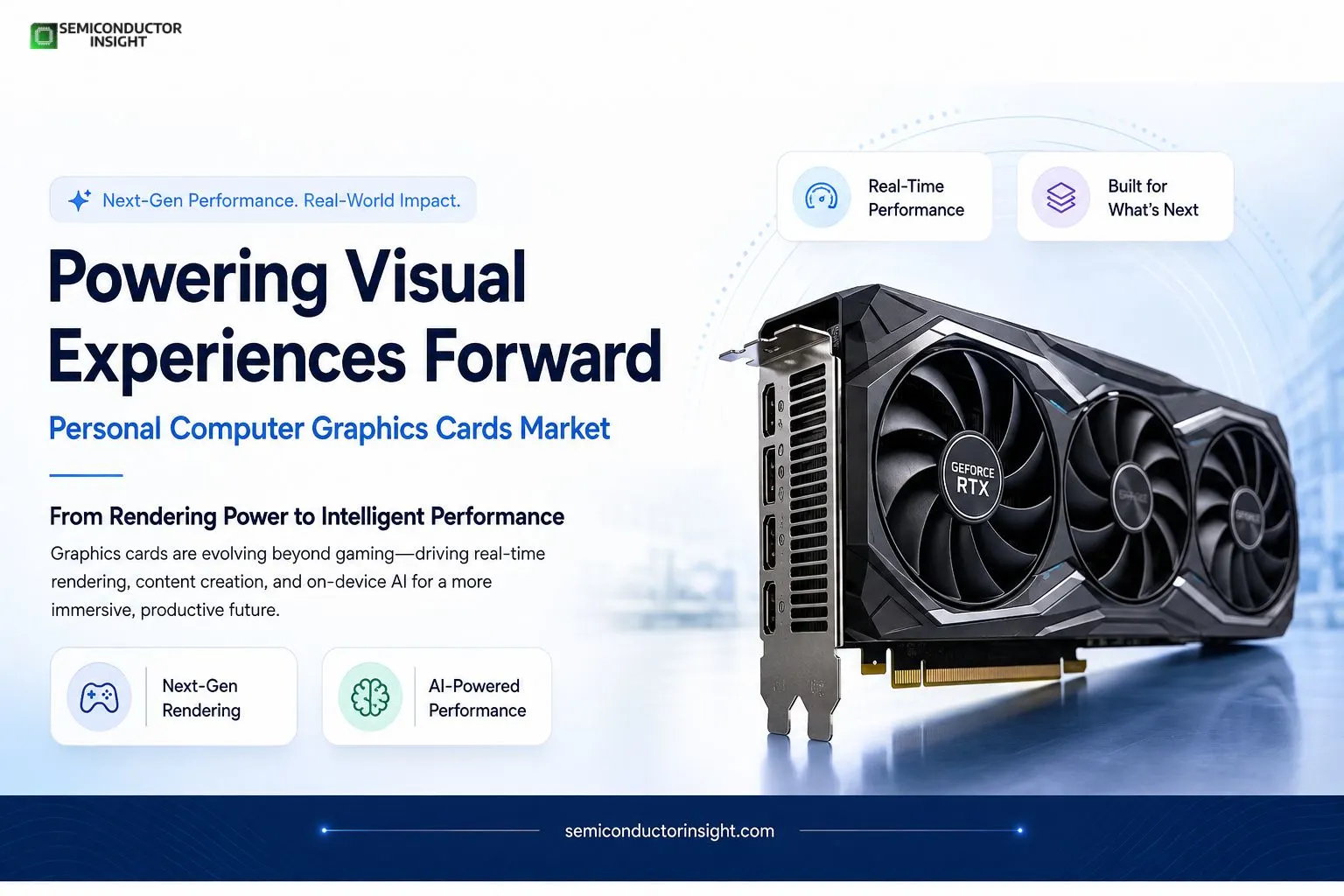
Blackwell Architecture Advances Reshape Personal Computer Graphics Cards Market Capabilities in 2026
Personal computer graphics cards continue to evolve as discrete accelerators that handle real-time rendering, content creation, and increasingly local AI inference. These add-in boards and laptop modules translate complex visual and computational tasks into frame rates and response times that integrated solutions cannot match for demanding workloads.
Recent product cycles center on architectures that combine traditional rasterization with neural techniques, reflecting broader shifts in how users interact with digital content.
Architecture Transitions Visible in Active Installations
- The latest generation builds on prior designs by integrating higher transistor densities and specialized cores for ray tracing and AI upscaling.
- NVIDIA’s Blackwell-based GeForce RTX 50-series cards, launched across desktop and laptop form factors, introduce refined neural rendering pipelines.
- Company reports show Gaming segment revenue reaching a full-year record of 16.0 billion dollars in the fiscal period ending early 2026, supported by strong uptake of these new models after holiday demand cycles.
- Public hardware surveys from Steam reveal that earlier RTX 40-series and even some 30-series cards still occupy leading positions among surveyed systems, with individual models such as the RTX 3060 and RTX 4060 variants each appearing in roughly 3 to 4% of the active player base in mid-2026 snapshots.
- Newer 50-series entries are climbing the rankings as supply stabilizes.
Local Inference Workloads Expanding Card Utilization
Beyond gaming, graphics cards increasingly serve as local accelerators for generative models and real-time effects. Users run smaller language models, image tools, and upscaling features directly on the GPU rather than relying solely on cloud services. This dual-purpose role extends the practical lifespan of a card and changes upgrade calculus.
Feature sets such as DLSS variants now support dozens to hundreds of titles and applications, allowing higher internal resolutions while maintaining playable frame rates on mid-range hardware. The same silicon that renders game worlds also accelerates creative pipelines in video editing and 3D design software.
Memory Configurations Meeting Rising Content Demands
Modern titles and professional applications push frame-buffer requirements higher. Cards with 12 GB, 16 GB, and larger capacities have become more common in the upper mid-range and enthusiast tiers to accommodate high-resolution textures, complex scenes, and concurrent AI workloads.
Bandwidth improvements through newer memory standards help sustain performance when multiple data streams compete for access. Laptop implementations balance these capacities against thermal and power envelopes, often delivering desktop-class features in thinner chassis through optimized power states.
Software Feature Layers Amplifying Hardware Value
- Driver and application-level technologies multiply the effective capability of the silicon.
- Frame-generation techniques, AI-based anti-aliasing, and latency-reduction tools allow older or mid-tier cards to deliver experiences previously reserved for higher-end models.
- These software layers receive regular updates that expand compatibility, effectively extending the usable life of installed hardware.
- Creators benefit similarly when export and rendering times drop through hardware-accelerated encoding paths that have matured across successive generations.
Supply Chain Realities Influencing Availability Cycles
Production of advanced graphics processors remains concentrated among a limited set of foundry partners operating at leading process nodes. Packaging, testing, and board-partner assembly introduce additional steps that can create temporary imbalances between demand spikes and available inventory.
Channel data reflected in quarterly updates shows periods of strong sell-through followed by natural moderation as retailers and distributors normalize stock levels. Global distribution networks adapt by prioritizing regions with the highest immediate demand while managing allocation for both desktop and mobile variants.
For More Detailed Insights, You Can Surf Our Latest Report Here: https://semiconductorinsight.com/report/personal-computer-graphics-cards-market/
Community Hardware Profiles from Public Surveys
- Valve’s ongoing Steam Hardware Survey provides one of the largest public windows into actual installed bases.
- Mid-2026 results consistently place NVIDIA discrete cards in the large majority of surveyed systems that report dedicated graphics, with individual popular models holding multi-percentage shares.
The personal computer graphics cards space therefore reflects a combination of architectural refinement, expanding software utility, and real-world usage patterns captured in both company disclosures and large-scale public surveys.
Cards that once served primarily as gaming accelerators now routinely support mixed creative and inference tasks, sustaining relevance across multiple product cycles.

Comments (0)