

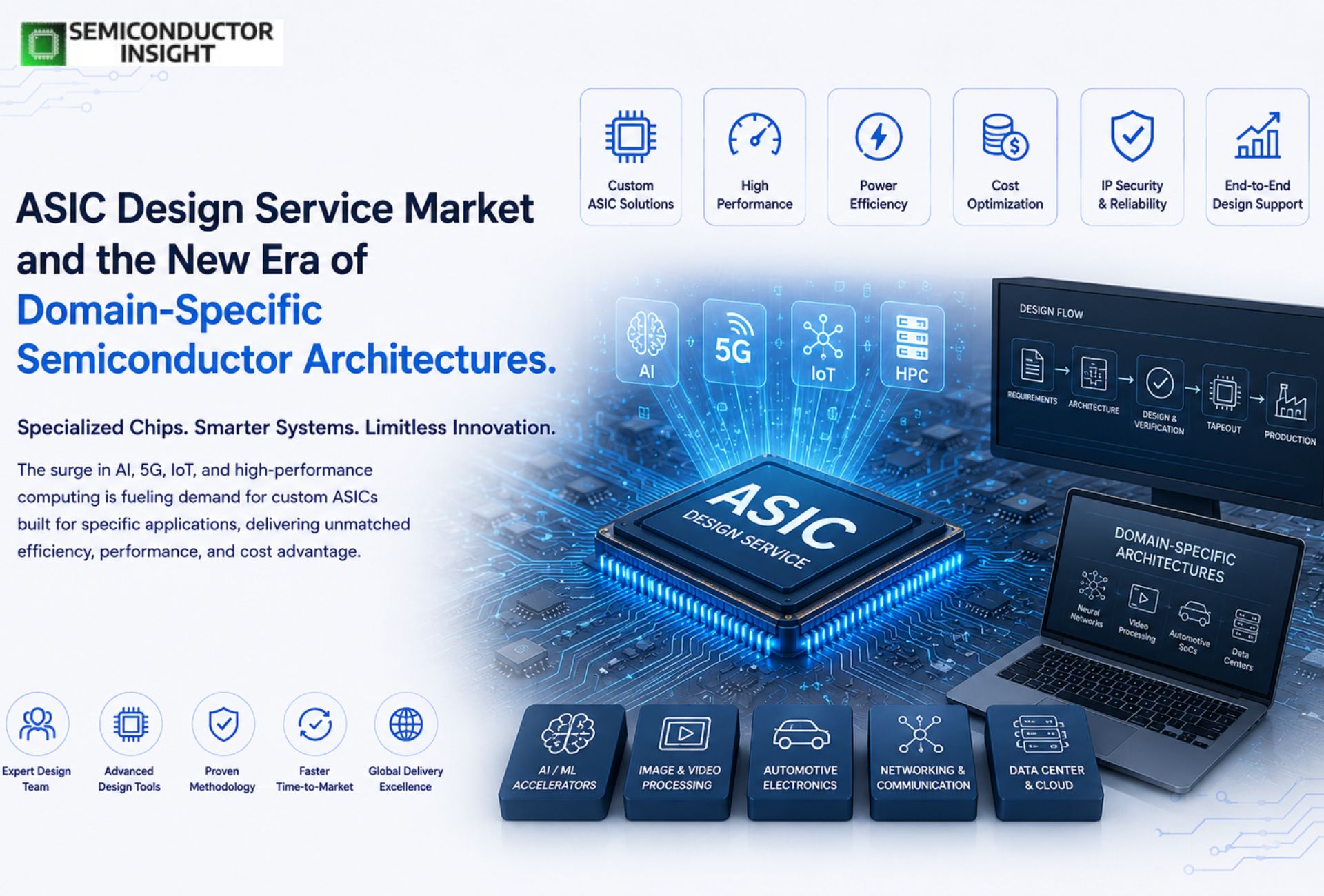
ASIC Design Service Market and the New Era of Domain-Specific Semiconductor Architectures
ASIC Design Service Market refers to the global industry focused on providing specialized engineering and semiconductor design services for the development of Application-Specific Integrated Circuits (ASICs).
The semiconductor industry is moving rapidly toward specialized chip architectures designed for specific computing workloads rather than general-purpose processing. This transition has placed ASIC design service market at the centre of advanced semiconductor development, especially as artificial intelligence, automotive electronics, cloud infrastructure, and edge computing continue to expand globally.
Application-Specific Integrated Circuits, commonly known as ASICs, are customized chips engineered for dedicated functions. Unlike traditional processors that support multiple computing tasks, ASICs are optimized for performance efficiency, power management, and workload acceleration. This efficiency is becoming increasingly important as modern technologies demand faster processing with lower energy consumption.
ASIC design service providers support the complete chip development lifecycle, which may include:
- Architecture planning
- RTL (Register Transfer Level) design
- Front-end and back-end chip design
- Verification and validation
- Physical layout design
- Prototyping and testing
AI Infrastructure Is Reshaping ASIC Engineering Priorities
Artificial intelligence has become one of the strongest forces accelerating ASIC design activity worldwide. Major cloud companies and AI infrastructure providers are increasingly developing proprietary chips to support machine learning training and inference workloads.
Companies including NVIDIA, Google, Amazon, and Microsoft continue investing in custom accelerator architectures designed to improve computing efficiency inside hyper scale data centres.
- Google’s Tensor Processing Units (TPUs) remain one of the most recognized examples of ASIC-based AI acceleration.
- These chips were specifically designed to optimize neural network workloads more efficiently than conventional CPUs. Similar approaches are now appearing across enterprise AI infrastructure projects globally.
- According to data published by the U.S. Department of Energy and multiple semiconductor engineering publications, advanced AI servers can consume several kilowatts of power per rack, increasing the need for workload-specific silicon that improves computational efficiency while reducing energy demand.
Automotive Electronics Are Expanding Custom Chip Development
The automotive industry is becoming a major growth centre for ASIC design services as vehicles integrate advanced driver assistance systems, infotainment platforms, sensor fusion technologies, and autonomous driving capabilities.
Modern electric vehicles contain thousands of semiconductor components supporting battery systems, radar modules, cameras, connectivity platforms, and onboard computing systems. ASICs are increasingly used because automotive manufacturers require optimized chips tailored for specific functions with high reliability standards.
- In 2025, automotive semiconductor demand continued rising as electric vehicle production expanded across China, Europe, South Korea, and the United States. According to the International Energy Agency (IEA), global electric car sales surpassed 17 million units in 2024, significantly increasing the need for specialized automotive semiconductor solutions.
Automotive-grade ASIC development now involves advanced safety certifications, thermal optimization, and real-time processing capabilities, especially for autonomous mobility platforms.
Advanced Nodes Are Increasing Engineering Complexity
ASIC design services are becoming more technically demanding as semiconductor manufacturing transitions toward smaller process nodes. Advanced fabrication technologies such as 5nm, 3nm, and emerging 2nm architectures require highly specialized engineering expertise.
Taiwan Semiconductor Manufacturing Company, commonly known as TSMC, and Samsung Electronics continue expanding advanced fabrication capabilities to support next-generation semiconductor demand.
Smaller transistor architectures improve performance density and energy efficiency, but they also increase design verification complexity, packaging requirements, and manufacturing precision. ASIC design firms are now heavily involved in thermal analysis, chiplet integration, power optimization, and advanced verification workflows.
The increasing use of high-bandwidth memory, heterogeneous integration, and 3D packaging technologies is also changing how custom chips are engineered for AI and data-intensive workloads.
Edge Computing Is Creating Demand for Smaller Intelligent Chips
- Beyond large-scale data centres, ASIC development is expanding rapidly in edge computing environments. Smart factories, healthcare devices, industrial robotics, telecom infrastructure, and surveillance systems increasingly require compact chips capable of local AI processing.
- Edge AI applications prioritize low latency and energy efficiency because many systems operate in environments with limited connectivity or strict power constraints. ASICs are well suited for these conditions because they can be optimized for dedicated workloads without unnecessary processing overhead.
- Healthcare imaging systems, wearable medical devices, industrial inspection equipment, and smart city infrastructure are among the sectors adopting specialized edge processors. Semiconductor developers are increasingly designing compact ASIC architectures capable of supporting localized machine learning tasks in real time.
Lastly, for more in-depth information, don’t forget to read our most recent exclusive related report: https://semiconductorinsight.com/report/retinal-implant-stimulator-asic-market/
Semiconductor Partnerships Are Becoming More Collaborative
ASIC design service market is evolving through deeper collaboration between foundries, IP providers, software developers, cloud companies, and system integrators. Semiconductor innovation is no longer isolated within a single engineering segment.
Open-source hardware movements, including RISC-V architecture adoption, are also influencing ASIC development strategies. Many startups and research institutions are exploring customizable chip architectures that reduce dependency on traditional proprietary processor ecosystems.
Universities, national semiconductor programs, and government-backed manufacturing initiatives are additionally supporting custom chip innovation. The U.S. CHIPS and Science Act, European semiconductor investment programs, and Asia-Pacific fabrication expansions are contributing to a more competitive and geographically diversified semiconductor ecosystem.

Comments (0)