
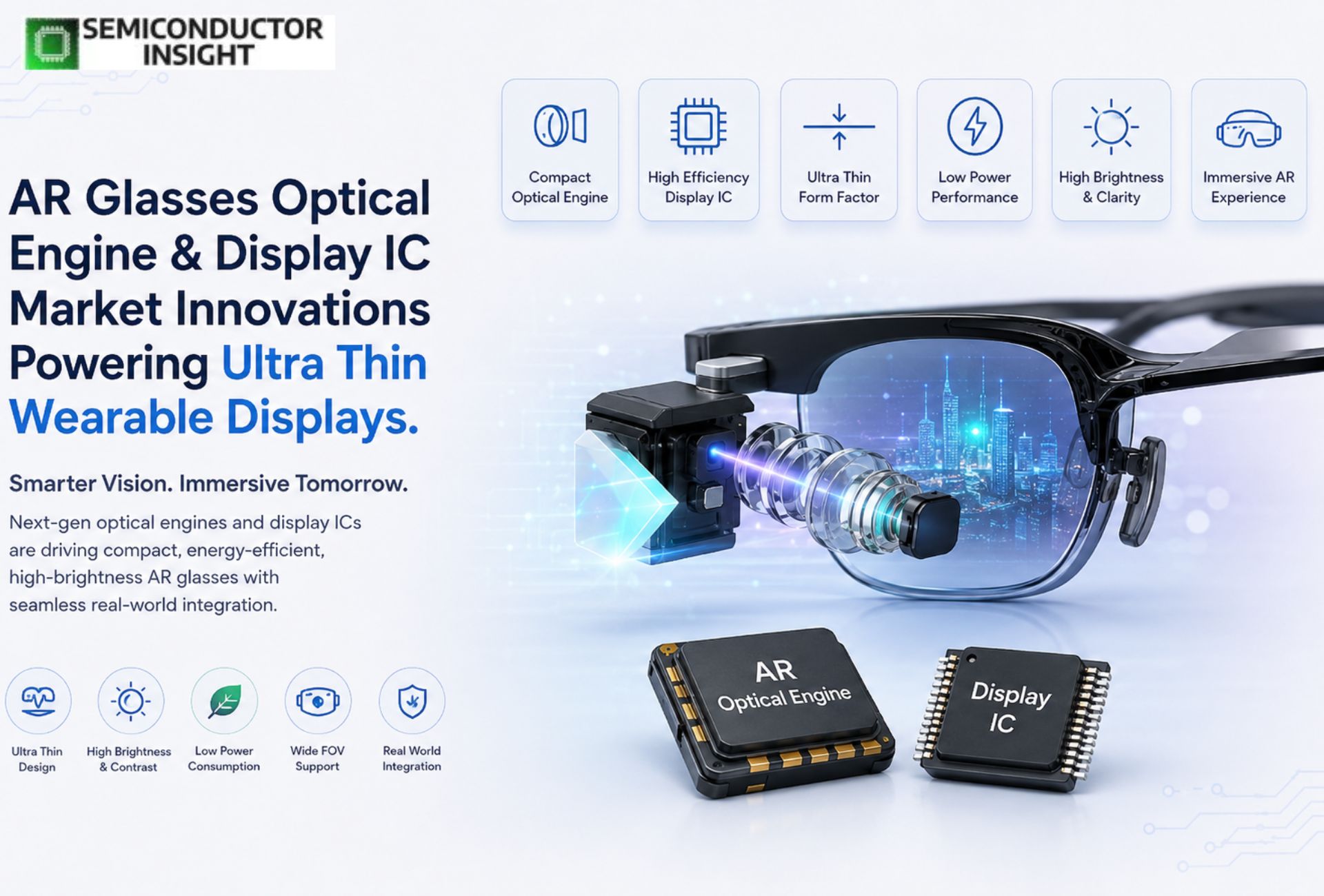
AR Glasses Optical Engine & Display IC Market Innovations Powering Ultra Thin Wearable Displays
Augmented reality glasses are no longer experimental gadgets reserved for technology expos. They are gradually evolving into compact computing platforms supported by sophisticated semiconductor architectures, advanced optical engines, and ultra-efficient display ICs.
From industrial warehouses and healthcare training labs to gaming ecosystems and military visualisation systems, AR glasses are finding practical applications that demand better image quality, lower latency, and lightweight form factors.
The latest generation of AR wearables is pushing semiconductor manufacturers to redesign display processing pipelines entirely. Optical engines are becoming thinner, brighter, and more energy efficient, while display ICs are handling increasingly complex rendering workloads in real time.
Explore the full report details in our recently refreshed edition anytime: https://semiconductorinsight.com/report/ar-glasses-optical-engine-display-ic-market/
MicroOLED and MicroLED Chips Move Into the Spotlight
- One of the most significant developments inside the AR glasses ecosystem is the growing shift toward MicroOLED and MicroLED displays. These technologies deliver higher brightness levels while consuming less power compared to traditional LCD
- Sony’s MicroOLED panels used in enterprise visualisation headsets now exceed 3000 pixels per inch, enabling sharper text rendering and improved spatial overlays. Meanwhile, several semiconductor startups are investing heavily in MicroLED wafer integration because of its ability to deliver brightness levels above 5000 nits, a critical requirement for outdoor AR visibility.
- According to publicly available manufacturing updates from display industry publications and electronics conferences, global MicroLED investment commitments crossed USD 1.5 billion between 2023 and 2025, reflecting strong momentum in wearable display innovation.
- Apple’s Vision Pro ecosystem also accelerated supplier investments in compact display drivers, advanced backplanes, and power management ICs. This ripple effect has expanded opportunities for semiconductor fabs specialising in sub-micron display architectures.
Optical Engines Are Becoming Smaller Than Ever
Earlier AR glasses struggled with bulky optics and heavy frames. Current optical engines are rapidly shrinking due to breakthroughs in waveguide technology and silicon photonics integration.
Companies working on pancake optics and diffractive waveguides are reducing component thickness while maintaining high image fidelity. Some enterprise AR devices released in 2025 achieved optical modules weighing below 90 grams, significantly improving user comfort during long industrial sessions.
This miniaturisation trend directly affects semiconductor demand. Compact optical engines require highly integrated display ICs capable of thermal optimisation, low voltage operation, and real-time image correction.
Several Japanese and Taiwanese semiconductor suppliers are now focusing on wafer-level optics packaging to support this transition. The packaging layer itself is becoming a critical innovation zone within the AR hardware ecosystem.
AI Processing Inside Smart Glasses Is Reshaping IC Design
AR glasses are increasingly integrating AI acceleration directly into wearable hardware. Real-time object recognition, live translation, gesture tracking, and contextual overlays all depend on specialised processing architectures.
- Qualcomm’s Snapdragon AR platforms and newer edge AI processors now support simultaneous localisation and mapping functions with lower power consumption.
- Some smart glasses prototypes demonstrated at CES 2026 were capable of translating multilingual conversations in under 200 milliseconds using on-device AI acceleration.
- This demand is influencing display IC development. Chipmakers are now designing hybrid processors where graphics rendering, neural processing, and power management work together within compact semiconductor footprints.
The semiconductor opportunity extends beyond consumer devices. Logistics firms, remote maintenance operators, and defence agencies increasingly require AI-enabled AR systems for hands-free operations.
Defence and Healthcare Are Expanding Real-World Adoption
Military simulation and healthcare visualisation are becoming two major commercial pathways for AR semiconductor growth.
The United States Department of Defence continues investing in AR-assisted battlefield visualisation systems designed to improve navigation, targeting, and situational awareness. Healthcare institutions are also experimenting with AR-assisted surgery planning and medical education platforms.
In 2025, several hospitals in Europe tested AR-guided surgical overlays for orthopaedic procedures, helping surgeons visualise anatomical positioning more accurately during operations. These systems rely heavily on low-latency display ICs and precision optical modules.
The healthcare sector’s adoption creates additional demand for high-resolution imaging chips capable of maintaining clarity under extended operational conditions.
Semiconductor Supply Chains Are Adapting to Wearable Demand
The AR ecosystem is changing how semiconductor supply chains operate. Unlike smartphones, AR glasses require simultaneous coordination between optics manufacturers, chip designers, display fabs, and software developers.
- Taiwan remains central to advanced display driver manufacturing, while South Korea continues to strengthen OLED fabrication capabilities.
- At the same time, India is emerging as a semiconductor assembly and testing destination due to government-backed electronics manufacturing initiatives.
- According to India’s Ministry of Electronics and Information Technology, semiconductor and display fabrication investments announced under national incentive programs crossed INR 1.5 lakh crore by early 2026.
- This broader semiconductor expansion may eventually support AR component localisation in Asia.
The next phase of the AR glasses optical engine and display IC market will likely depend on how efficiently manufacturers can balance brightness, thermal performance, battery life, and AI computing within extremely compact wearable designs.

Comments (0)