Low Voltage Directive (LVD) Testing Market Insights
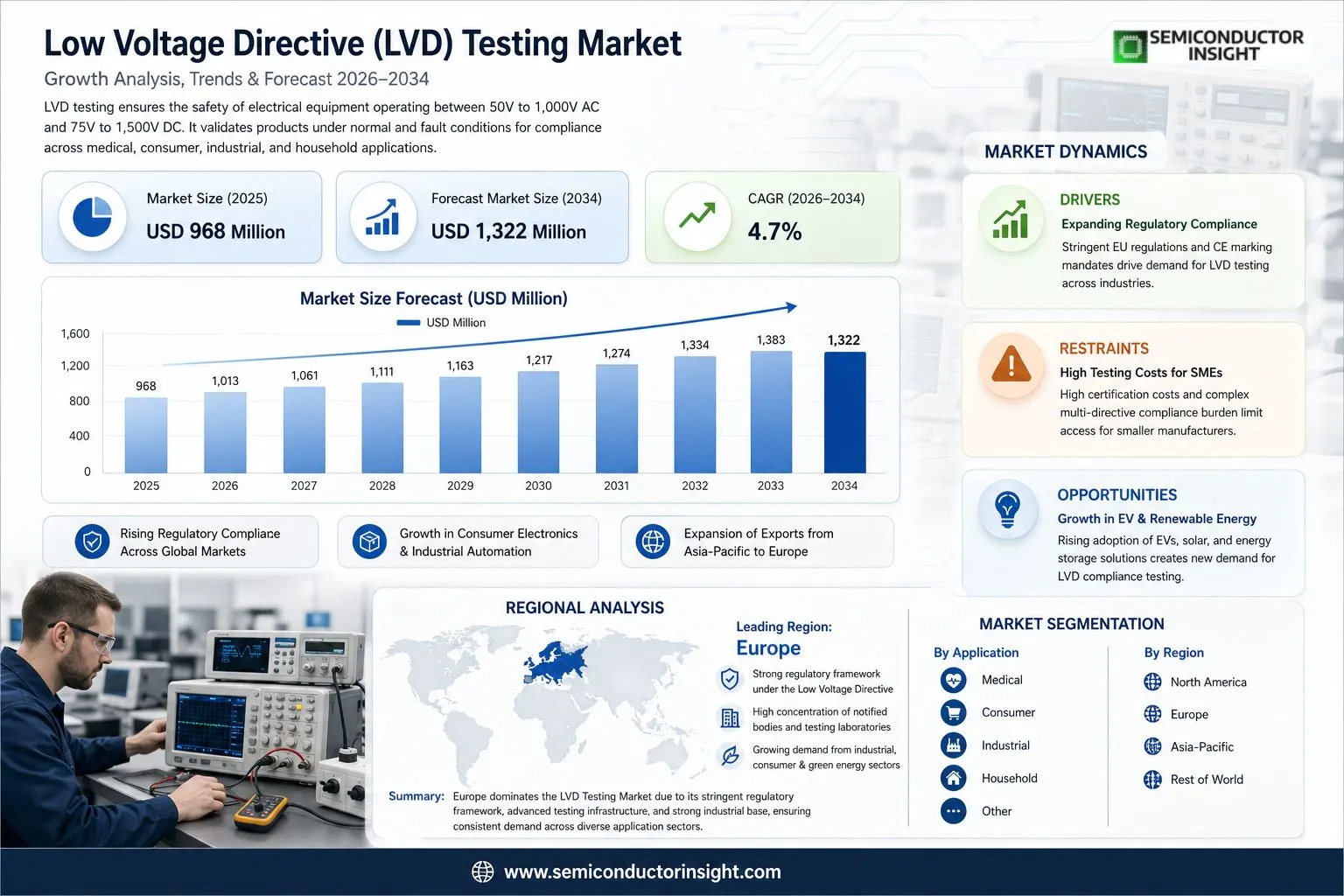
Global Low Voltage Directive (LVD) Testing market size was valued at USD 968 million in 2025. The market is projected to grow from USD 1,013 million in 2026 to USD 1,322 million by 2034, exhibiting a CAGR of 4.7% during the forecast period.
Low Voltage Directive (LVD) testing is an essential compliance and safety evaluation process for electrical products operating at voltages between 50V to 1,000V AC and 75V to 1,500V DC. These tests are specifically designed to verify that electrical equipment does not pose a hazard to users under both normal operating and fault conditions. The scope of LVD testing encompasses Physical and Structural Safety Testing, Electrical Safety Testing, Environmental and Reliability Testing, and other specialized assessments, covering a broad range of end-use applications including medical, consumer electronics, industrial equipment, and household appliances.
The market is experiencing steady growth driven by increasingly stringent regulatory requirements across global markets, rapid expansion of the consumer electronics and industrial automation sectors, and the rising complexity of electrical product portfolios requiring mandatory CE marking in the European Union. Furthermore, the growing adoption of smart home devices and IoT-connected electrical equipment has significantly expanded the volume of products requiring LVD compliance testing. Leading testing, inspection, and certification organizations such as SGS, UL Solutions, TUV SUD, and Intertek continue to strengthen their global service capabilities, further supporting market development across key regions including North America, Europe, and Asia-Pacific.
MARKET DRIVERS
Expanding Regulatory Compliance Requirements Across the European Union
Low Voltage Directive (LVD) Testing Market continues to gain momentum as manufacturers and importers operating within the European Economic Area are mandated to demonstrate compliance with the Low Voltage Directive 2014/35/EU. This directive governs electrical equipment operating between 50V and 1,000V AC and between 75V and 1,500V DC, making LVD testing an indispensable step in product commercialization. As the European Union intensifies its market surveillance activities and imposes stricter penalties for non-compliant products, demand for certified LVD testing services has increased substantially across product categories including consumer electronics, industrial machinery, and household appliances.
Rapid Growth in Consumer Electronics and Electrical Equipment Manufacturing
The proliferation of smart home devices, IoT-enabled appliances, and portable electronic equipment is a significant driver for Low Voltage Directive (LVD) Testing Market. As product development cycles shorten and manufacturers accelerate their time-to-market strategies, testing and certification laboratories are witnessing a growing influx of new product submissions. The increasing complexity of modern electrical products , incorporating wireless connectivity, embedded processors, and advanced power management , necessitates comprehensive safety evaluations under LVD frameworks to ensure both user safety and regulatory approval before CE marking can be affixed.
➤ The integration of LVD compliance into early-stage product design is increasingly recognized as a competitive advantage, reducing costly redesigns and accelerating market entry for manufacturers targeting EU markets.
Emerging economies in Asia-Pacific, particularly China, India, and South Korea, represent a growing source of demand for Low Voltage Directive testing services, as manufacturers in these regions seek CE certification to access European markets. This cross-border compliance dynamic is broadening the global footprint of the LVD testing ecosystem and encouraging investment in accredited third-party testing laboratories with EU-recognized capabilities.
MARKET CHALLENGES
Complexity of Multi-Directive Compliance and Overlapping Standards
One of the most persistent challenges facing Low Voltage Directive (LVD) Testing Market is the intricate overlap between the LVD and other EU directives such as the Electromagnetic Compatibility (EMC) Directive, the Radio Equipment Directive (RED), and the Machinery Directive. Manufacturers often face difficulty determining which directive takes precedence for a specific product category, leading to delays, duplicated testing efforts, and increased compliance costs. Testing bodies must continually update their technical expertise and laboratory capabilities to address this multi-directive complexity, which strains operational resources and requires ongoing staff training and infrastructure investment.
Other Challenges
Shortage of Accredited Testing Professionals
The LVD testing landscape is constrained by a limited pool of qualified engineers and technical assessors who possess in-depth knowledge of harmonized standards such as EN 61010, EN 60335, and EN 60950/62368. As demand for LVD compliance services accelerates, the industry faces a growing skills gap that can extend testing turnaround times and reduce overall laboratory throughput, potentially delaying product launches for manufacturers.
Frequent Updates to Harmonized Standards
Harmonized standards underpinning LVD compliance are subject to periodic revision by standards bodies such as CENELEC and IEC. Keeping pace with these updates requires testing laboratories to continuously validate their methodologies and update their equipment, introducing operational disruptions and adding to the cost burden of maintaining accreditation. Manufacturers must also monitor transitional periods to ensure their products remain compliant with the most current applicable standards.
MARKET RESTRAINTS
High Cost of Testing and Certification for Small and Medium Enterprises
A notable restraint impacting Low Voltage Directive (LVD) Testing Market is the considerable financial burden that comprehensive LVD testing and CE certification places on small and medium-sized enterprises (SMEs). The cost of engaging accredited Notified Bodies, procuring test reports, and preparing thorough technical documentation can represent a disproportionate share of product development budgets for smaller manufacturers. This financial pressure may lead some SMEs to delay market entry, limit product variants submitted for testing, or, in some cases, attempt to self-declare conformity without adequate technical rigor , outcomes that can undermine market integrity.
Geopolitical and Trade Uncertainties Affecting Market Access
The post-Brexit regulatory divergence between the United Kingdom and the European Union has introduced additional complexity for manufacturers previously relying on UKCA and CE marks interchangeably. Changes in mutual recognition agreements and evolving trade policies create uncertainty around the portability of LVD test results across jurisdictions. This restraint affects global testing laboratories that must now maintain separate accreditation pathways and documentation protocols to serve clients operating in both markets, increasing administrative overhead and reducing the scalability of testing operations across regions.
MARKET OPPORTUNITIES
Rising Adoption of Electric Vehicles and Renewable Energy Infrastructure
The accelerating global transition toward electric vehicles (EVs), solar energy systems, and energy storage solutions presents substantial growth opportunities for Low Voltage Directive (LVD) Testing Market. Charging infrastructure components, inverters, battery management systems, and related electrical assemblies operating within LVD voltage thresholds require rigorous safety certification prior to deployment in European markets. As EU member states expand incentive programs and infrastructure mandates tied to the European Green Deal, the volume of LVD-applicable products entering the certification pipeline is expected to grow considerably over the coming years.
Digital Transformation of Testing Laboratories and Remote Assessment Capabilities
The integration of digital tools, automation, and remote testing methodologies into laboratory operations represents a transformative opportunity for participants in Low Voltage Directive (LVD) Testing Market. Investment in AI-assisted test result analysis, digital twin simulations, and cloud-based compliance management platforms can significantly reduce testing cycle times and expand laboratory capacity without proportional increases in physical infrastructure. Additionally, the acceptance of remote or witnessed audits by certain regulatory bodies, accelerated during the post-pandemic period, is enabling testing organizations to serve international clients more efficiently, broadening their addressable market and improving overall service scalability.
Low Voltage Directive (LVD) Testing Market Trends
Rising Regulatory Compliance Driving Demand in Low Voltage Directive (LVD) Testing Market
Low Voltage Directive (LVD) Testing Market continues to witness sustained momentum as manufacturers of electrical equipment operating within the defined voltage thresholds , 50V to 1000V AC and 75V to 1500V DC , face increasingly stringent safety certification requirements. Regulatory bodies across Europe and beyond are reinforcing compliance frameworks, compelling manufacturers to invest in rigorous testing protocols before their products reach end users. This regulatory pressure is one of the most consistent and defining trends shaping the direction of the global LVD testing landscape. Testing service providers such as SGS, UL Solutions, TUV SUD, Intertek, and VDE remain central to this compliance ecosystem, offering accredited evaluation across physical, electrical, and environmental safety parameters.
Other Trends
Expansion Across Industrial and Consumer Applications
A notable trend in Low Voltage Directive (LVD) Testing Market is the broadening scope of applications requiring certification. Demand from industrial, consumer, household, and medical sectors is growing in parallel, each bringing unique testing challenges. Medical electrical equipment, in particular, demands heightened scrutiny due to patient safety implications, while the proliferation of smart home and consumer electronics products is expanding the volume of devices requiring LVD compliance. This diversification across end-use segments is encouraging testing laboratories to expand their service portfolios and invest in advanced test infrastructure.
Growth of Electrical Safety Testing and Environmental Reliability Assessments
Among the various testing types, Electrical Safety Testing and Environmental and Reliability Testing are gaining increased attention alongside Physical and Structural Safety Testing. As products are deployed in more varied and demanding environments, manufacturers are prioritizing testing that validates performance under both normal operating and fault conditions. Environmental reliability assessments, including thermal cycling, humidity resistance, and vibration testing, have become integral to the LVD compliance process, reflecting a more holistic approach to product safety validation.
Asia-Pacific Emerging as a Key Growth Region for LVD Testing Services
Geographically, Asia-Pacific , particularly China, Japan, South Korea, and India , is emerging as a significant contributor to global Low Voltage Directive (LVD) Testing market activity. The rapid scaling of electronics manufacturing in these countries, combined with growing export ambitions targeting European markets, is driving demand for LVD certification services. Manufacturers exporting to the European Union must demonstrate conformity with the LVD framework, making third-party testing an operational necessity rather than an optional investment. This export-driven compliance requirement is expected to remain a strong structural trend across the Asia-Pacific region in the coming years.
COMPETITIVE LANDSCAPE
Key Industry Players
Low Voltage Directive (LVD) Testing Market: A Highly Specialized Regulatory Compliance Arena Dominated by Global Testing, Inspection, and Certification Giants
The global Low Voltage Directive (LVD) Testing market, valued at approximately USD 968 million in 2025 and projected to reach USD 1,322 million by 2034 at a CAGR of 4.7%, is characterized by a concentrated competitive landscape where a handful of internationally recognized Testing, Inspection, and Certification (TIC) organizations command a dominant share of revenues. SGS, UL Solutions, TÜV SÜD, Intertek, and VDE collectively accounted for a substantial portion of the global market in 2025, leveraging their expansive laboratory networks, deep regulatory expertise, and established reputations within the European CE marking ecosystem. These market leaders offer end-to-end LVD compliance services spanning Physical and Structural Safety Testing, Electrical Safety Testing, and Environmental and Reliability Testing , covering a broad range of electrical equipment operating between 50V–1000V AC and 75V–1500V DC. Their ability to serve diverse application segments including medical, industrial, consumer, and household electronics gives them a significant competitive advantage over smaller, regionally focused peers.
Beyond the dominant TIC multinationals, the LVD Testing market also features a growing cohort of specialized and regional certification and testing bodies that cater to niche verticals and geographically specific compliance requirements. Players such as CVC, STC, GRGT, MCM, GTS-lab, Uonetest, HX-lab, and Guide-cert have carved out meaningful positions, particularly within the Asia-Pacific region where manufacturing output drives high volumes of LVD pre-compliance and type-testing demand. These organizations compete primarily on turnaround time, cost efficiency, and proximity to manufacturing hubs across China, South Korea, and Southeast Asia. As global supply chains continue to prioritize speed-to-market for electrically powered products destined for European markets, these regional players are expected to capture incremental market share, intensifying competition and prompting consolidation activity across the mid-tier testing services segment.
List of Key Low Voltage Directive (LVD) Testing Companies Profiled
- SGS
- UL Solutions
- TÜV SÜD
- Intertek
- Repower
- VDE
- CVC
- STC
- GRGT
- MCM
- GTS-lab
- Uonetest
- HX-lab
- Guide-cert
Segment Analysis:
| Segment Category | Sub-Segments | Key Insights |
| By Type |
|
Electrical Safety Testing holds the leading position within the LVD Testing market by type, driven by the fundamental mandate to verify that electrical equipment operating within designated voltage ranges does not pose hazards under normal or fault conditions.
|
| By Application |
|
Industrial applications represent the dominant segment in the LVD Testing market, underpinned by the extensive use of high-voltage machinery, control panels, switchgear, and automation equipment that must meet stringent safety benchmarks before deployment.
|
| By End User |
|
Original Equipment Manufacturers (OEMs) constitute the leading end-user segment in the LVD Testing market, as they bear the primary legal and commercial responsibility for ensuring their products comply with the Low Voltage Directive prior to CE marking and market placement.
|
| By Service Mode |
|
Outsourced / Third-Party Testing is the dominant service mode in the LVD Testing market, as the majority of manufacturers, particularly small and medium-sized enterprises, lack the specialized laboratory infrastructure, accredited instrumentation, and technical expertise required to conduct comprehensive LVD compliance assessments internally.
|
| By Certification Standard |
|
IEC / EN Harmonized Standards represent the leading certification framework driving LVD testing demand, as compliance with harmonized European standards such as those under the EN 61010, EN 60950, and EN 62368 series provides manufacturers with a presumption of conformity with the Low Voltage Directive, streamlining the path to CE marking.
|
Regional Analysis: Low Voltage Directive (LVD) Testing Market
Europe
Europe’s regulatory environment is the most mature globally for LVD compliance. The EU’s harmonized standards, developed in alignment with the Low Voltage Directive, are routinely updated to reflect technological advancements. National accreditation bodies across member states ensure that testing laboratories maintain the highest levels of competence, making Europe the global benchmark for LVD testing rigor and methodological consistency.
The European industrial and consumer electronics sectors are prolific generators of LVD testing demand. From household appliances and lighting systems to complex industrial control equipment, the diversity of product categories subject to the Low Voltage Directive ensures that testing service providers operate across a broad and resilient demand base, with no single product segment dominating the requirement landscape.
Europe hosts a dense network of notified bodies officially designated by EU member states to assess product conformity under the Low Voltage Directive. This institutional infrastructure provides manufacturers with accessible, high-quality third-party testing and certification pathways. The presence of globally recognized organizations strengthens Europe’s position as the primary hub for LVD conformity assessment expertise and international reference standards.
Europe’s accelerating transition toward renewable energy systems and smart grid infrastructure is expanding the scope of LVD testing requirements significantly. Electrical components integrated into solar installations, battery storage systems, and smart metering networks must meet stringent LVD compliance thresholds, broadening the addressable market for testing service providers and driving innovation in testing methodologies across the region.
North America
North America represents a highly significant market for LVD-equivalent testing and electrical product safety compliance, driven predominantly by the United States and Canada. While the Low Voltage Directive is specific to the European regulatory context, North American manufacturers and exporters targeting EU markets rely heavily on LVD testing services to secure CE marking and facilitate international trade. Domestically, regulatory frameworks administered by bodies such as UL, CSA, and the FCC establish parallel safety requirements for low voltage electrical equipment, fostering a robust and technically sophisticated testing services ecosystem. The United States, as a global hub for electronics innovation, medical device manufacturing, and industrial automation, generates extensive demand for electrical safety testing that aligns with or interfaces with LVD requirements. Growing transatlantic trade relationships and the increasing globalization of supply chains ensure that North American manufacturers maintain a consistent and expanding need for LVD testing expertise, particularly as product complexity and connected device proliferation continue to accelerate through the forecast horizon.
Asia-Pacific
Asia-Pacific is emerging as one of the fastest-growing regions in the global Low Voltage Directive (LVD) Testing Market, propelled by its massive manufacturing base and increasing orientation toward European export markets. China, Japan, South Korea, India, and Southeast Asian economies collectively produce a substantial volume of electrical and electronic products destined for EU distribution, necessitating comprehensive LVD compliance testing prior to market entry. The expansion of local testing infrastructure, growing awareness of CE marking requirements among manufacturers, and the proliferation of multinational testing service providers establishing regional laboratories are collectively elevating the sophistication of LVD testing capabilities across the region. Governments across Asia-Pacific are also reinforcing domestic electrical safety regulations, creating a dual compliance demand dynamic that benefits testing service providers. As regional manufacturers increasingly compete on quality and regulatory adherence rather than cost alone, investment in LVD testing is expected to intensify considerably through 2034.
South America
South America occupies a developing but progressively important position within Low Voltage Directive (LVD) Testing Market. Brazil, as the region’s dominant industrial economy, leads demand for LVD-related testing services, particularly among manufacturers with active export relationships with European Union markets. Argentina, Chile, and Colombia are also witnessing gradual growth in electrical safety testing awareness, supported by improving regulatory frameworks and increasing foreign direct investment in manufacturing infrastructure. South American companies exporting electrical equipment, industrial machinery, and consumer electronics to the EU face the same LVD compliance obligations as manufacturers in any other region, making access to quality testing services a strategic commercial necessity. Regional testing capacity remains comparatively limited, leading many manufacturers to engage international laboratories for LVD conformity assessments. This dependency presents both a challenge and a significant opportunity for global testing service providers seeking to expand their presence across South American industrial centers.
Middle East & Africa
The Middle East and Africa region represents an early-stage but gradually evolving participant in Low Voltage Directive (LVD) Testing Market. While domestic regulatory mandates for LVD compliance remain less formalized compared to European or North American counterparts, the region’s growing export ambitions toward EU markets are creating meaningful and increasing demand for LVD testing services. Countries such as the United Arab Emirates, Saudi Arabia, South Africa, and Egypt serve as regional manufacturing and distribution hubs, with a portion of their electrical equipment output directed toward European end markets requiring full LVD conformity. Infrastructure development programs, energy sector expansion, and rapid urbanization across the region are also amplifying the volume and diversity of low voltage electrical products requiring safety assessment. International testing organizations are selectively establishing service points across key Middle Eastern and African economic centers, signaling confidence in the region’s long-term growth trajectory within the broader LVD testing landscape through 2034.
Report Scope
This market research report provides a comprehensive analysis of Low Voltage Directive (LVD) Testing Market, covering the forecast period 2026–2034. It offers detailed insights into market dynamics, technological advancements, competitive landscape, and key trends shaping the industry.
Key focus areas of the report include:
- Market Overview: The report begins with an overview outlining its current market scenario, key growth indicators, and industry transformation drivers. It discusses macroeconomic factors, demand–supply balance, regulatory landscape, and the strategic role of LVD testing in powering advancements across industries such as medical, consumer electronics, industrial automation, and household appliances.
- Market Size & Forecast: Historical data and future projections for revenue, unit shipments, and market value across major regions and segments.
- Segmentation Analysis: Detailed breakdown by product type, technology, application, and end-user industry to identify high-growth segments and investment opportunities.
- Regional Insights: Insights into market performance across North America, Europe, Asia-Pacific, Latin America, and the Middle East & Africa, including country-level analysis where relevant.
- Competitive Landscape: Profiles of leading market participants, including their product offerings, R&D focus, manufacturing capacity, pricing strategies, and recent developments such as mergers, acquisitions, and partnerships.
- Technology Trends & Innovation: Assessment of emerging technologies, integration of AI/IoT, testing design trends, fabrication techniques, and evolving industry standards.
- Market Drivers & Restraints: Evaluation of factors driving market growth along with challenges, supply chain constraints, regulatory issues, and market-entry barriers.
- Stakeholder Insights: Insights for component suppliers, OEMs, system integrators, investors, and policymakers regarding the evolving ecosystem and strategic opportunities.
Primary and secondary research methods are employed, including interviews with industry experts, data from verified sources, and real-time market intelligence to ensure the accuracy and reliability of the insights presented.
FREQUENTLY ASKED QUESTIONS:
What is the current market size of Low Voltage Directive (LVD) Testing Market?
-> Global Low Voltage Directive (LVD) Testing Market was valued at USD 968 million in 2025 and is expected to reach USD 1322 million by 2034, growing at a CAGR of 4.7% during the forecast period.
Which key companies operate in Low Voltage Directive (LVD) Testing Market?
-> Key players include SGS, UL Solutions, TUV SUD, Intertek, Repower, VDE, CVC, STC, GRGT, MCM, GTS-lab, Uonetest, HX-lab, and Guide-cert, among others.
What are the key growth drivers?
-> Key growth drivers include rising demand for electrical product safety compliance, stringent regulatory requirements under the Low Voltage Directive, and increasing adoption of electrical equipment across medical, industrial, consumer, and household applications. LVD testing ensures electrical products operating between 50V to 1000V AC and 75V to 1500V DC do not pose hazards under normal operating and fault conditions.
Which region dominates the market?
-> Europe remains a dominant market given its strong regulatory framework under the Low Voltage Directive, while Asia-Pacific is among the fastest-growing regions driven by rapid industrialization and expanding electronics manufacturing in countries such as China, Japan, South Korea, and India.
What are the emerging trends?
-> Emerging trends include increased focus on Physical and Structural Safety Testing, Electrical Safety Testing, and Environmental and Reliability Testing, alongside the growing integration of digital testing technologies and rising compliance requirements across medical, consumer, industrial, and household end-use segments.

Get Sample Report PDF for Exclusive Insights
Report Sample Includes
- Table of Contents
- List of Tables & Figures
- Charts, Research Methodology, and more...