
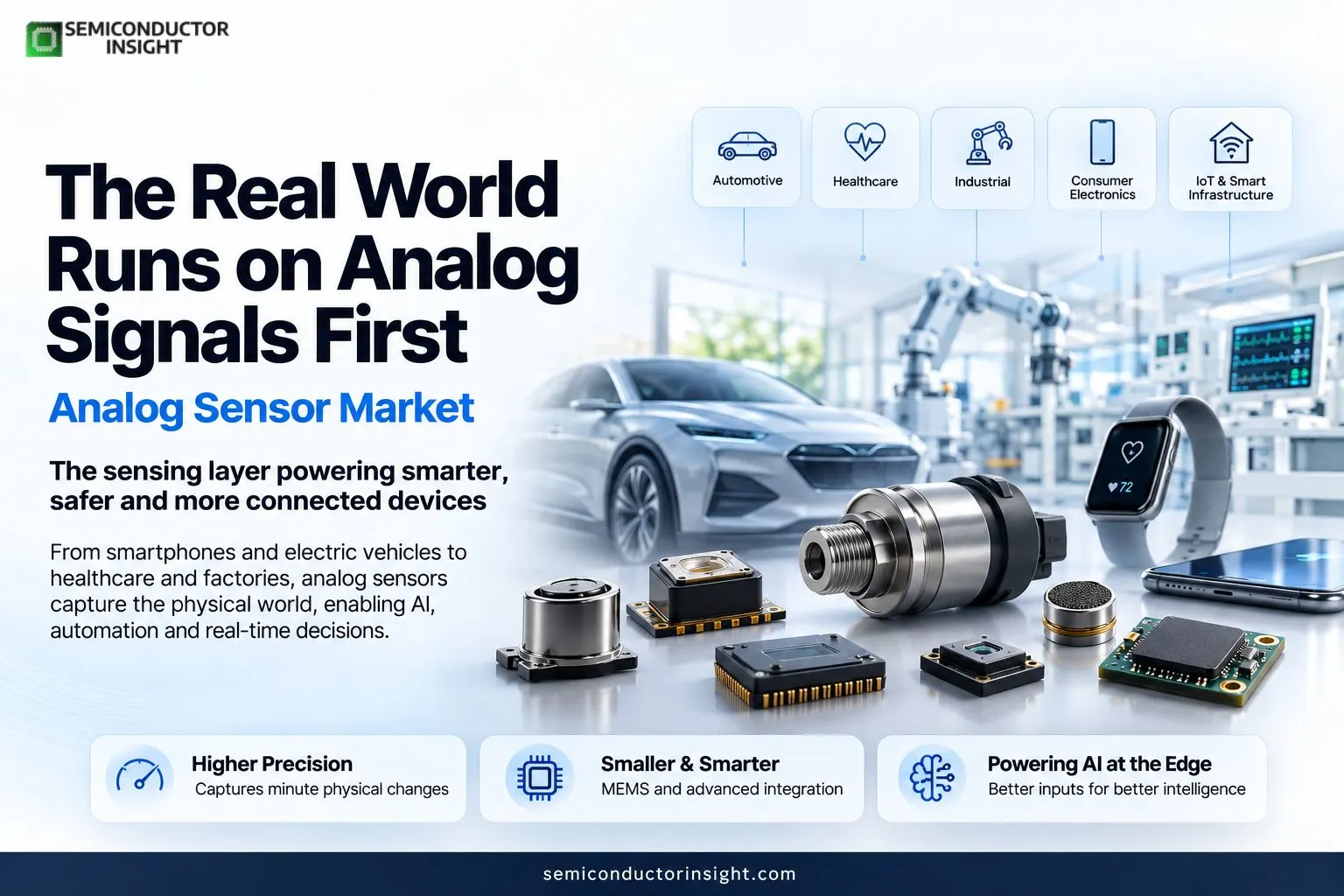
Analog Sensors vs. Digital Sensors: Which Technology Fits Modern Semiconductor Systems Better?
Every intelligent electronic system begins with a simple task understanding the physical world. Before artificial intelligence models can make predictions, before processors execute instructions, and before cloud platforms analyze data, sensors must first detect temperature, pressure, motion, light, sound, humidity, magnetic fields, or chemical changes. This is where analog sensors continue to play a defining role in modern semiconductor technology.
Analogue sensors produce continuous electrical impulses that retain minute environmental changes, in contrast to digital sensors that instantly translate data into binary information. These signals are essential for consumer electronics, automotive electronics, industrial automation, healthcare devices, aerospace systems, and robotics because they offer more fidelity at the sensing stage. Analogue sensing continues to be one of the most important links between the real and digital worlds as semiconductor manufacturers create increasingly intelligent edge devices.
Every Smart Device Starts with an Analog Signal
- Although today’s electronics are dominated by digital processors, nearly every physical phenomenon begins as an analog event.
- Semiconductor engineers therefore continue investing heavily in analog front-end circuits capable of capturing extremely small electrical changes before analog-to-digital conversion takes place.
- This design philosophy has become especially important in electric vehicles, autonomous driving platforms, wearable health monitors, factory automation equipment, and smart energy infrastructure.
- A modern premium automobile can incorporate 100 to more than 300 sensors, while advanced industrial robots often integrate dozens of analog sensing modules for force, vibration, temperature, and position monitoring.
- According to the International Federation of Robotics (IFR), more than 540,000 industrial robots were installed globally in a recent year, illustrating the growing need for highly accurate sensing technologies.
Miniaturization Is Expanding Sensor Intelligence
Semiconductor fabrication advances are enabling analog sensors to become smaller, more energy-efficient, and increasingly integrated with mixed-signal chips. Modern Micro-Electro-Mechanical Systems (MEMS) technologies allow manufacturers to combine accelerometers, gyroscopes, pressure sensors, microphones, and environmental sensors within compact packages suitable for smartphones, medical wearables, and IoT modules.
Industry analysis from technical publications and IEEE research indicates that flagship smartphones commonly integrate 15 to 25 individual sensors, many of which rely on analog signal acquisition before digital processing. These compact sensing platforms support features such as adaptive brightness, image stabilization, motion tracking, proximity detection, and environmental monitoring without significantly increasing power consumption.
From Physical Events to Intelligent Decisions
Physical Environment
│
▼
Analog Sensor Detection
│
▼
Signal Conditioning Circuit
│
▼
Analog-to-Digital Conversion
│
▼
Microcontroller or AI Processor
│
▼
Real-Time Action
This chain demonstrates why analog sensors remain indispensable even in highly digital semiconductor architectures.
For More Detailed Insights, You Can Surf Our Latest Report Here: https://semiconductorinsight.com/report/analog-sensor-market/
Healthcare Electronics Are Raising the Precision Standard
Medical technology is becoming one of the strongest innovation areas for analog sensing. Portable electrocardiogram devices, continuous glucose monitoring systems, blood pressure monitors, respiratory sensors, and patient monitoring equipment depend on accurate analog signal acquisition to detect subtle physiological changes.
The World Health Organization estimates that cardiovascular diseases account for approximately 17.9 million deaths each year, encouraging healthcare providers to expand the adoption of continuous monitoring technologies. Analog biosensors capable of detecting microvolt-level electrical activity enable clinicians to identify abnormalities with greater confidence while supporting remote patient care and wearable diagnostics.
Researchers are also developing flexible analog sensors embedded into smart patches and electronic skin, opening new possibilities for long-term health monitoring outside traditional clinical settings.
AI Hardware Is Increasing the Value of Better Sensor Inputs
- Artificial intelligence receives significant attention for its processing capabilities, yet AI systems are only as reliable as the data entering them. Poor-quality sensor inputs inevitably reduce prediction accuracy regardless of computational power.
- Manufacturers developing AI-enabled cameras, collaborative robots, drones, autonomous vehicles, and industrial inspection systems are therefore investing in higher-resolution analog sensing technologies capable of reducing electrical noise while improving signal integrity. IEEE publications increasingly emphasize that edge AI performance depends not only on processor efficiency but also on the quality of analog data acquisition at the hardware level.
- As inference moves closer to edge devices, analog sensors are evolving into intelligent front-end systems capable of preprocessing information before transmission to AI accelerators.
Semiconductor Packaging Is Quietly Enhancing Sensor Performance
Recent advances in wafer-level packaging, heterogeneous integration, and system-in-package architectures are changing how analog sensors are manufactured and deployed. Instead of functioning as isolated components, sensors are now integrated with processors, memory, wireless communication modules, and power management circuits inside compact semiconductor packages.
This integration shortens signal paths, reduces electromagnetic interference, lowers energy consumption, and improves overall device reliability. These improvements are especially valuable for aerospace electronics, industrial automation, advanced driver assistance systems, and precision instrumentation where measurement accuracy directly affects operational safety.
Rather than becoming less relevant in the digital era, analog sensing is becoming more sophisticated. As semiconductor innovation continues pushing toward autonomous systems, intelligent healthcare, advanced manufacturing, and AI-enabled edge computing, analog sensors remain the essential starting point for every meaningful interaction between electronics and the physical world.

Comments (0)