
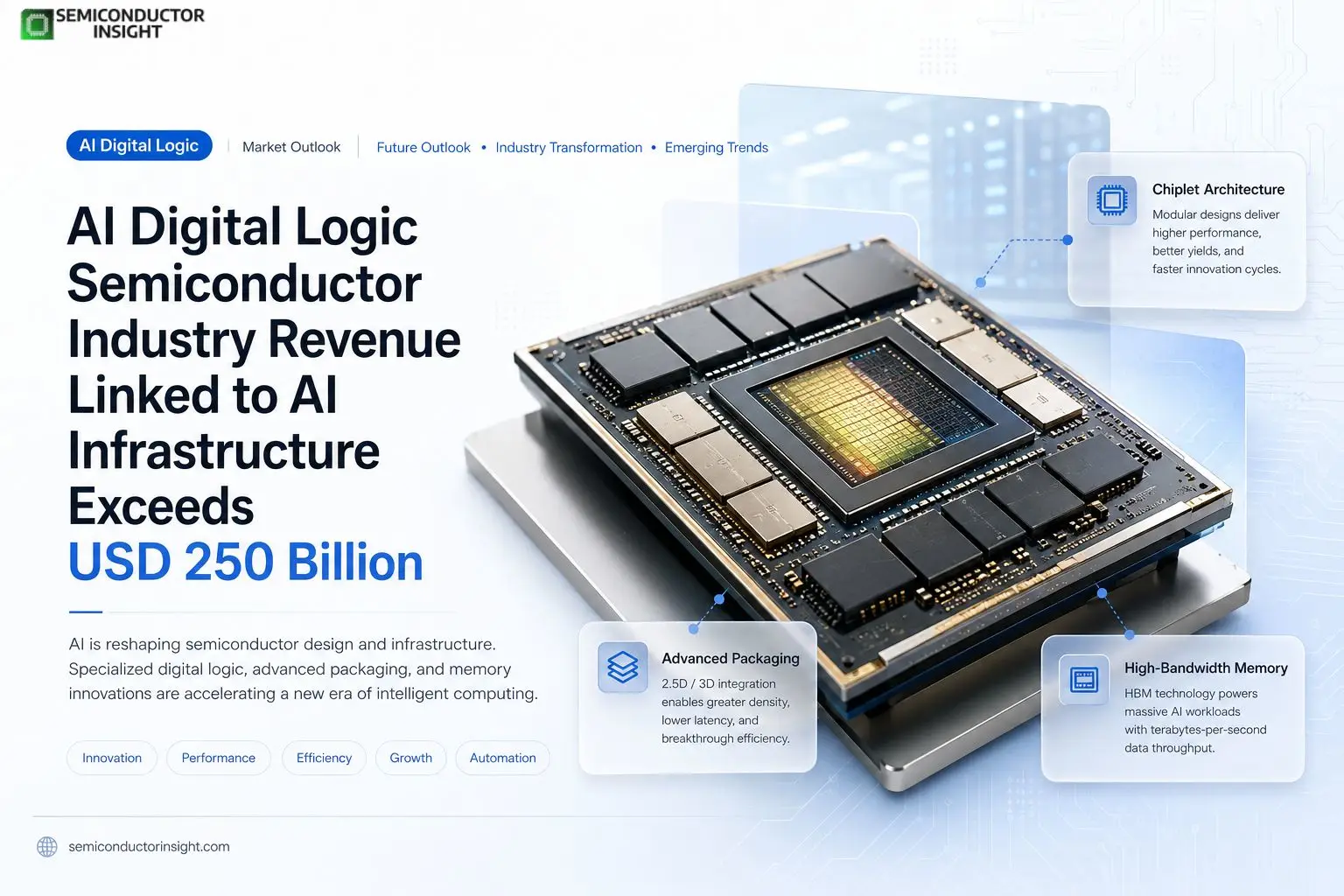
AI Digital Logic Market 2026: Semiconductor Industry Revenue Linked to AI Infrastructure Exceeds USD 250 Billion
Artificial intelligence has shifted the semiconductor industry’s center of gravity from general-purpose processing toward highly optimized digital logic architectures. AI Digital Logic Market now sits at the intersection of advanced chip design, data center expansion, edge intelligence, and next-generation manufacturing technologies.
Today’s innovation race centers on accelerating data transfer, lowering power consumption, and optimising inference and training efficiency, in contrast to earlier semiconductor cycles that were mainly concerned with transistor density. Organisations are rethinking computing infrastructure around AI-centric logic systems, from automakers to hyperscale cloud providers.
Why Logic Design Has Become the Core of AI Hardware?
Modern AI workloads require billions of mathematical operations every second. Traditional processor architectures struggle to efficiently handle large neural networks, creating demand for specialized digital logic blocks optimized for matrix multiplication, parallel processing, and memory access.
According to industry data published by the Semiconductor Industry Association and public company filings, global semiconductor sales exceeded USD 600 billion in recent years, with AI-related hardware representing one of the fastest-growing investment areas. Major cloud providers continue expanding AI clusters containing tens of thousands of specialized processors operating simultaneously.
As a result, logic design is increasingly focused on workload-specific performance rather than universal computing tasks.
Chiplets Are Rewriting the Rules of Processor Construction
- One of the most influential developments in semiconductor engineering is the adoption of chiplet-based architectures.
- Instead of manufacturing a processor as a single large die, companies now combine multiple smaller dies into a unified package. This approach improves manufacturing yields, enables faster design cycles, and supports greater scalability.
- Recent AI processors from leading semiconductor manufacturers incorporate multiple compute dies, memory components, and interconnect technologies within a single package.
- This modular strategy allows designers to upgrade specific functions without redesigning an entire processor.
- For AI workloads requiring massive computational throughput, chiplets have become a practical pathway toward higher performance and lower production complexity.
High-Bandwidth Memory Is Becoming a Strategic Resource
AI systems spend enormous amounts of time moving data between processors and memory. Consequently, memory bandwidth has become nearly as important as raw computing power.
- High-Bandwidth Memory (HBM) technology has emerged as a critical component of modern AI infrastructure.
- Advanced HBM stacks can deliver bandwidth measured in terabytes per second, allowing processors to feed increasingly complex neural networks.
- Recent demand for HBM components has led major memory manufacturers to expand production capacity as AI infrastructure projects continue growing globally.
The relationship between memory architecture and digital logic performance is now one of the most closely watched areas in semiconductor engineering.
Advanced Packaging Is Creating New Performance Pathways
Semiconductor innovation is no longer confined to transistor scaling alone.
Advanced packaging technologies such as 2.5D integration, 3D stacking, and hybrid bonding are enabling greater component density and shorter communication pathways between chips.
Recent AI accelerators incorporate thousands of interconnected logic elements linked through sophisticated packaging structures. These technologies help reduce latency while increasing overall computational efficiency.
Government-supported semiconductor initiatives in the United States, Europe, Japan, South Korea, and Taiwan have also highlighted advanced packaging as a strategic technology area for future manufacturing competitiveness.
You Can Go Through Our Latest Updated Insights Here: https://semiconductorinsight.com/report/ai-digital-logic-market/
AI Factories Are Expanding Demand for Specialized Logic
A growing number of technology companies are constructing dedicated AI computing environments often referred to as AI factories. These facilities are optimized specifically for model training, inference, and large-scale data processing.
Publicly announced deployments now include clusters containing tens of thousands of AI accelerators connected through ultra-high-speed networking infrastructure.
Such environments require custom digital logic optimized for workload orchestration, memory management, networking, and energy efficiency. This trend is creating new opportunities for specialized semiconductor design beyond traditional CPUs and GPUs.
Power Efficiency Is Emerging as a Design Metric Equal to Performance
- As AI infrastructure expands, electricity consumption has become a major engineering consideration.
- Data centers supporting advanced AI applications can consume hundreds of megawatts of power. Consequently, semiconductor designers are increasingly measured by performance-per-watt metrics rather than raw speed alone.
- New digital logic architectures focus on reducing unnecessary data movement, optimizing instruction execution, and improving energy utilization across AI workloads.
- This shift is encouraging innovation in low-power logic design, adaptive computing systems, and intelligent workload scheduling.
Research Laboratories Are Influencing Commercial Chip Roadmaps
Many breakthroughs shaping today’s AI Digital Logic Market originated in university laboratories, government-funded semiconductor programs, and collaborative research initiatives.
Organizations such as the Semiconductor Research Corporation, imec, national laboratories, and leading academic institutions continue advancing transistor technologies, interconnect systems, and AI-focused architectures.
These research ecosystems increasingly influence commercial product development, shortening the path between scientific discovery and market deployment.
From Logic Gates to Intelligent Infrastructure
AI Digital Logic Market is evolving into one of the most strategically important segments of the semiconductor industry. Chiplet architectures, advanced packaging, high-bandwidth memory, AI factories, and energy-efficient design principles are collectively redefining how modern computing systems are built.
As governments, cloud providers, semiconductor manufacturers, and research institutions continue investing in AI infrastructure, digital logic technologies are becoming foundational components of the global computing ecosystem, supporting everything from generative AI platforms to autonomous systems and industrial intelligence applications.

Comments (0)