

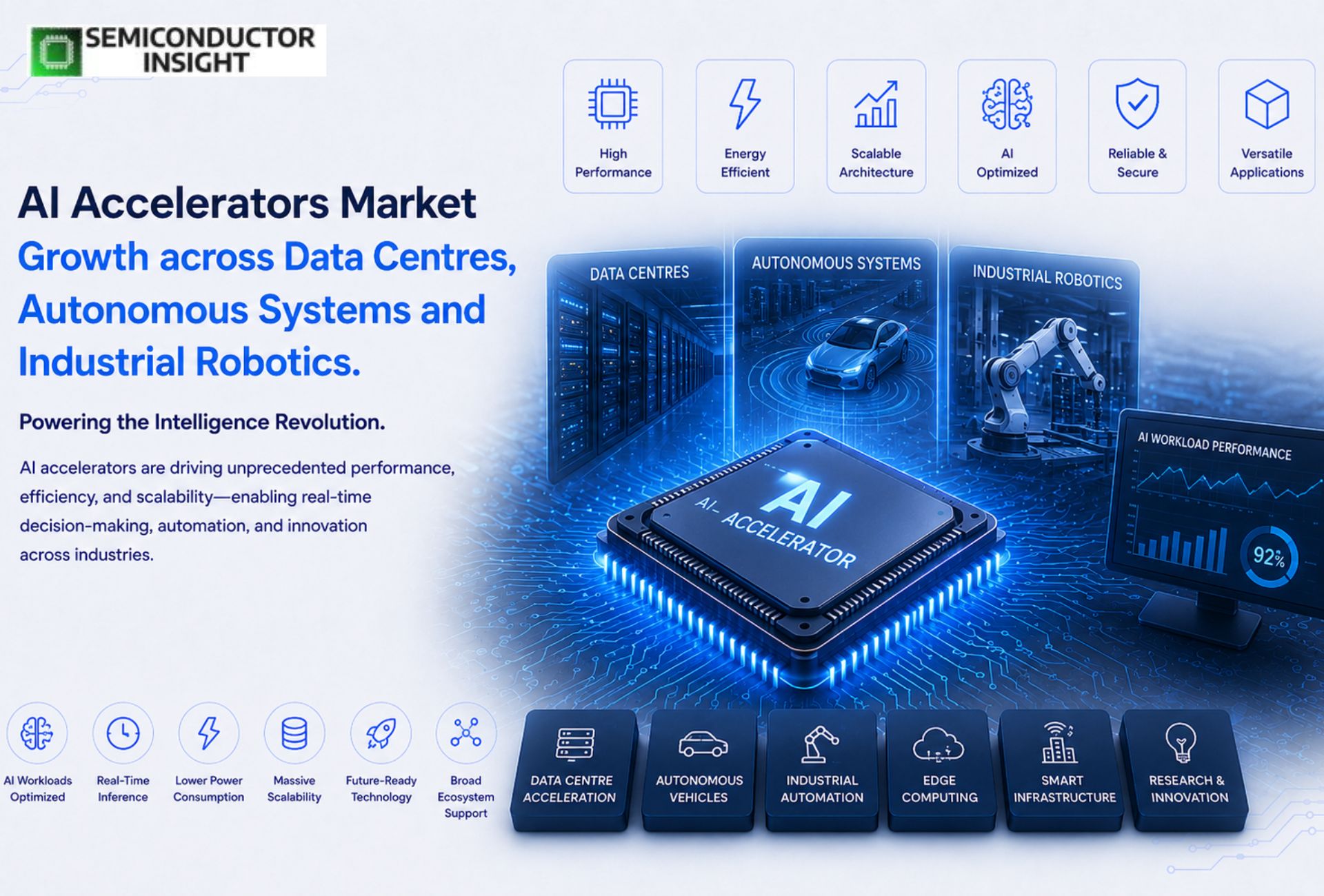
AI Accelerators Market Growth across Data Centres, Autonomous Systems and Industrial Robotics
Artificial intelligence is no longer operating as a software-only revolution. The rapid rise of generative AI, autonomous systems, industrial automation, and real-time analytics has shifted global attention toward specialised semiconductor hardware capable of handling massive computational workloads. This transition has placed AI accelerators market at the centre of semiconductor innovation in 2026.
- GPUs (Graphics Processing Units): Originally built for graphics, their massive parallel processing cores make them excellent for handling AI training and large-scale computing.
- ASICs (Application-Specific Integrated Circuits): Custom-built silicon chips tailored for specific AI algorithms. Examples include Google’s TPUs (Tensor Processing Units) and AWS’s Trainium.
- FPGAs (Field-Programmable Gate Arrays): Highly flexible hardware chips that can be reprogrammed after manufacturing to adapt to evolving AI models.
- NPUs (Neural Processing Units): Specialised microprocessors integrated directly into client devices (like phones and laptops) to handle local AI and computer vision tasks with very low power usage.
In order to handle massive language models, robotics, medical imaging systems, and AI-enabled cloud infrastructure, technology companies are rapidly creating specialised semiconductor platforms.
The explosive adoption of AI applications has transformed semiconductor priorities from general-purpose performance to parallel computing efficiency, memory bandwidth, and energy-aware processing.
AI Factories Are Becoming the New Semiconductor Battleground
- One of the biggest ongoing developments in AI accelerators market is the rise of AI factories, hyperscale data centre ecosystems built specifically for training and deploying AI models.
Companies including NVIDIA, AMD, Intel, Google, and Amazon Web Services are investing heavily in AI-centric infrastructure.
- According to public statements released by NVIDIA in 2025, demand for Blackwell AI GPUs significantly exceeded earlier deployment expectations as cloud providers scaled AI clusters for enterprise and generative AI workloads.
- Modern AI servers now integrate advanced GPU clusters, liquid cooling systems, and high-bandwidth memory technologies to process increasingly larger datasets.
- Data centre operators are also redesigning facilities around power density requirements. Some next-generation AI server racks now consume over 100 kilowatts per rack, reflecting the growing intensity of AI training environments.
AI Accelerators Are Expanding Beyond Cloud Infrastructure
AI accelerators market is no longer limited to hyperscale computing. Semiconductor companies are aggressively targeting edge AI applications where real-time processing is essential.
- Smartphones, laptops, industrial robots, medical diagnostic systems, drones, and autonomous vehicles now incorporate dedicated AI acceleration hardware. Neural Processing Units (NPUs) are becoming standard components inside AI PCs and mobile chipsets.
- In 2025, several semiconductor manufacturers introduced AI-enabled processors optimised for on-device inference rather than cloud dependency. This shift allows AI applications to operate with lower latency, reduced bandwidth usage, and improved privacy protection.
Automotive semiconductor platforms are also rapidly evolving. AI accelerators are increasingly used for driver monitoring, sensor fusion, advanced driver-assistance systems (ADAS), and autonomous navigation processing.
For More Detailed Insights, You Can Surf Our Latest Related Report Here: https://semiconductorinsight.com/report/automotive-dram-for-autonomous-driving-market/
Advanced Packaging Is Quietly Becoming the Industry’s Most Important Innovation
- As transistor scaling becomes increasingly complex, semiconductor companies are focusing heavily on advanced packaging technologies to improve AI accelerator performance.
- Chiplet-based architectures, 2.5D packaging, CoWoS integration, and high-bandwidth memory stacking are becoming critical to AI chip performance scaling.
- Taiwan Semiconductor Manufacturing Company expanded its advanced packaging capacity significantly to meet surging AI chip demand. CoWoS packaging technology, widely used for AI accelerators, became one of the semiconductor industry’s most discussed supply chain bottlenecks during 2025 and 2026.
- This packaging transition is changing semiconductor manufacturing economics. Instead of relying entirely on monolithic chip scaling, companies are combining multiple specialised chiplets into unified AI computing systems.
Semiconductor Energy Consumption Has Become a Strategic Concern
AI accelerator deployment is creating substantial energy infrastructure discussions across the semiconductor ecosystem.
Training large AI models requires enormous computational power. According to estimates from academic and industry publications, training advanced frontier AI models can involve thousands of GPUs operating continuously for weeks or months.
This has intensified industry focus on power-efficient semiconductor design. Companies are now prioritising:
- Low-power inference architectures
- Memory optimization techniques
- AI-specific interconnect systems
- Energy-aware cooling infrastructure
- Silicon photonics research
Several governments are also examining the long-term energy implications of AI infrastructure growth, especially as national AI programs expand globally.
New Semiconductor Alliances Are Reshaping Global Supply Chains
AI accelerators market is also influencing geopolitical semiconductor strategies.
Countries including the United States, Japan, South Korea, India, and members of the European Union are increasing investments in semiconductor manufacturing resilience and AI infrastructure independence.
The U.S. CHIPS and Science Act continues to support domestic semiconductor production and advanced research initiatives. Meanwhile, major foundries and OSAT providers are expanding facilities to address AI accelerator demand.
Global semiconductor supply chains are increasingly being reorganised around advanced node manufacturing, HBM memory production, and AI packaging capabilities.
The Next Phase of AI Accelerators Is Moving Toward Specialised Intelligence
The semiconductor industry is gradually shifting from universal AI compute models toward domain-specific acceleration.
Instead of relying solely on general-purpose GPUs, companies are developing chips optimised for:
- Healthcare imaging AI
- Financial modeling
- Industrial automation
- Robotics
- Scientific computing
- Edge surveillance systems
- Generative AI inference
Neuromorphic computing and in-memory processing architectures are also attracting growing research attention because of their potential to improve computational efficiency dramatically.
AI accelerators market is no longer simply about faster chips. It is becoming a broader transformation involving semiconductor architecture, energy systems, cloud infrastructure, packaging technology, and global industrial policy.

Comments (0)