
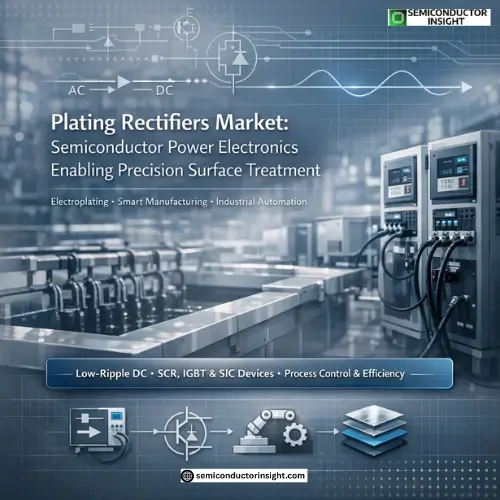
Advances in Plating Rectifiers Market Show Digital Transformation and Modernization of Production
Plating rectifiers are specialized semiconductor-based power electronics used to convert AC (alternating current) to controlled DC (direct current) for electroplating and surface treatment applications. Plating rectifiers are designed to provide stable, low-ripple DC output with precise control over current density. This is important for evenly depositing metal on a wide range of surfaces, from printed circuit boards to aerospace parts.
As global industries shift toward automation, precision manufacturing, and higher throughput expectations, plating rectifiers have moved from niche industrial tools to core process enablers across semiconductor fabrication, electronics assembly, automotive surface finishing, and consumer appliance manufacturing.
Semiconductor Advancements Driving Rectifier Performance
- High-Performance Silicon Controlled Rectifiers (SCRs): Provide precise control over DC output for plating processes that demand consistent current delivery over long durations.
- IGBT and MOSFET Integration: Enables faster switching, reduced power loss, and finer control over voltage and current profiles.
- Wide Band gap Materials (SiC and GaN): Though more commonly associated with high-power industrial drives, wide band gap semiconductors are increasingly integrated into rectifier designs to improve thermal performance and efficiency, especially in heavy-duty plating applications.
These semiconductor advances have broadened the capabilities of rectifier systems, supporting faster response times, enhanced reliability, and increased operational lifespans that align with the uptime expectations of modern production lines.
Industrial Growth Patterns and Market Demand
- Electronics and Semiconductor Manufacturing:
With the global semiconductor market exceeding $600 billion annually, advanced packaging and surface finishing are essential stages that rely on precise electroplating. Electroplating is used for under-bump metallurgy (UBM), solder plating, and conductive layer formation all requiring rectifiers with tight current control and low noise to ensure reliability and performance at the microscopic scale.
- Automotive and EV Drivetrains: Automotive component suppliers use plating rectifiers in surface treatment processes for corrosion protection, decorative finishes, and functional coatings. As electric vehicle (EV) penetration reaches over 20% of new car sales in key markets, the demand for precise and efficient plating rectifier systems for battery pack components, connectors, and motor parts is rising.
- Industrial Machinery and Aerospace: High-value sectors such as aerospace rely on plating for wear resistance and environmental protection. Here, reliability and power quality mediated by semiconductor rectifiers are non-negotiable.
Market Expansion through Digital and Smart Manufacturing
A major trend in recent years has been the integration of smart manufacturing principles with power electronics, including plating rectifiers. Digital interfaces, IoT connectivity, and real-time monitoring are increasingly expected features. Rather than standalone power supplies, modern rectifier systems often include:
- Digital control panels for recipe storage and retrieval
- Feedback loops that adjust current based on bath conditions
- Connectivity to factory data networks for performance analytics
Customers are placing a premium on rectifier systems that provide predictive maintenance indicators, automatically adjusting output to avoid over-plating, minimize defects, and continuously optimize quality capabilities that are rooted in semiconductor control logic and embedded software.
Innovation and Competitive Differentiation
Innovation in the plating rectifier space today is not limited to power electronics hardware. Competitive differentiation increasingly hinges on software, user experience, and service offerings:
- Touchscreen interfaces that guide operators through plating recipes
- Remote support capabilities allowing vendors to diagnose issues and update system parameters offsite
- Modular scalability for multi-line production environments
Semiconductor control units embedded in rectifier systems play a key role in enabling these features. Vendors that combine robust hardware with intelligent control systems capable of storing, replicating, and optimizing process profiles are gaining preference among modern packaging and finishing operations.
At Last before Ending, Don’t Forget to Browse Our Recent Exclusive Report for Detailed Insights:
https://semiconductorinsight.com/report/plating-rectifiers-market/
Environmental and Efficiency Considerations
Plating operations are subject to tightening environmental standards, particularly around energy use, waste reduction, and chemical handling. Rectifier efficiency in terms of reducing wasted power and minimizing heat generation contributes directly to lower operational costs and environmental footprint.
Semiconductor devices such as SiC transistors help reduce switching losses and improve thermal performance, allowing rectifiers to operate more efficiently and with less auxiliary cooling. As regulatory pressure increases globally around energy efficiency and emissions, rectifier designs that leverage advanced semiconductors are becoming essential for compliance and cost control.
Recent Market Developments and Industry Signals
Some notable recent trends include:
- Rising integration of digital controls and connectivity in rectifier systems, reflecting global smart factory adoption
- Increased use of wide bandgap semiconductors in high-power rectifier units to improve efficiency and reliability
- Expansion of aftermarket services including remote diagnostics and firmware updates to extend equipment life and performance
- Growing partnership models between rectifier manufacturers and OEMs in automotive and electronics sectors to standardize power delivery platforms
These developments reinforce the notion that the plating rectifiers market is no longer about raw power conversion alone, but about intelligent, connected, and highly controllable power systems.

Comments (0)