Plating Rectifiers Market Insights
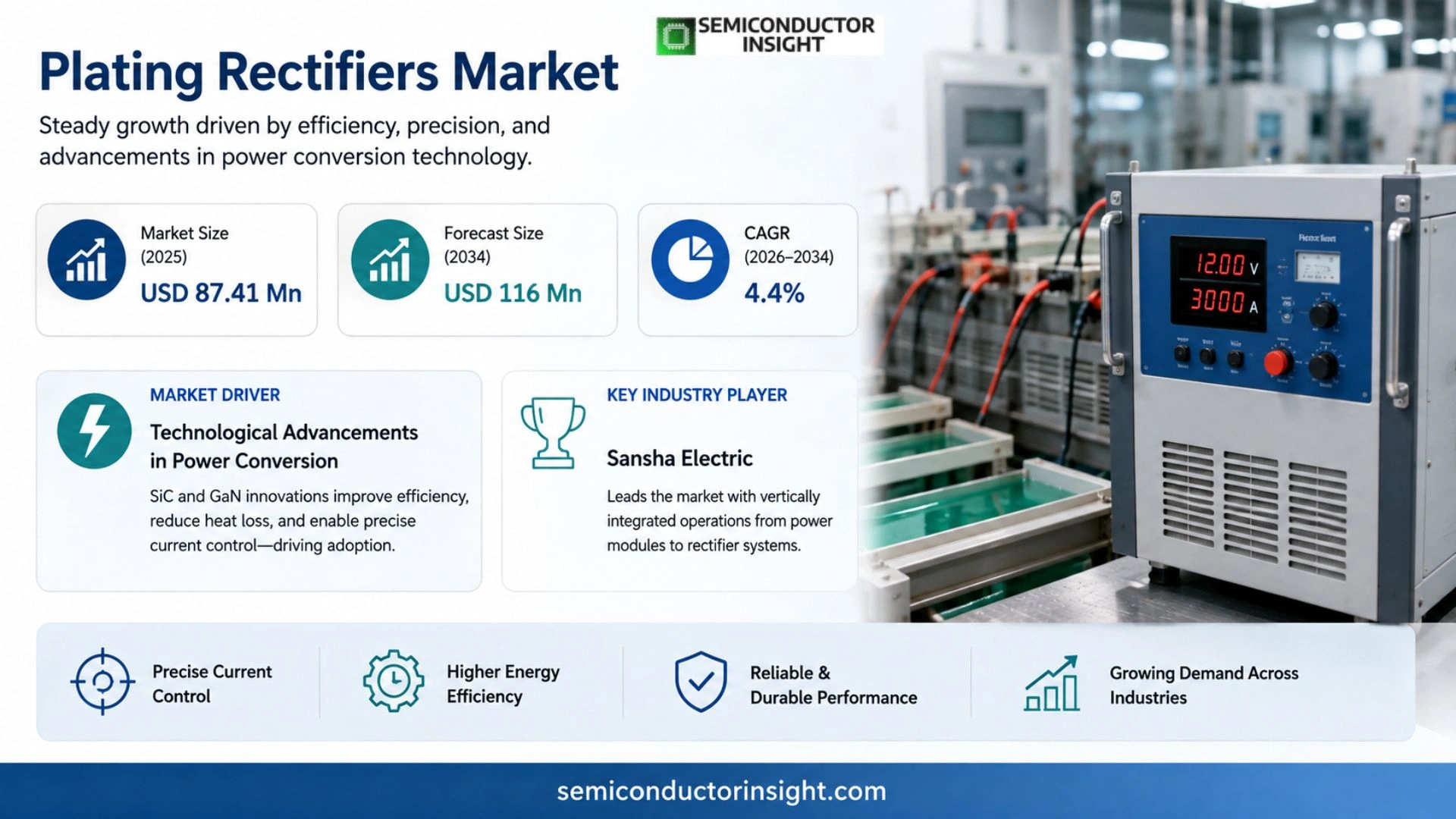
Plating Rectifiers market was valued at USD 87.41 million in 2025 and is forecasted to reach USD 116 million by 2034, reflecting a compound annual growth rate of approximately 4.4% over the forecast horizon.
Plating rectifiers are specialized power‑supply units that transform standard grid‑derived AC into a stable, precisely controlled DC output required for electroplating operations. By acting as the “heart” of the plating line, they drive metal ions from electrolyte baths onto conductive substrates, thereby enhancing durability, corrosion resistance and aesthetic appearance of finished parts.
The sector is expanding because automotive manufacturers, consumer‑electronics producers and industrial equipment makers increasingly rely on high‑quality metal coatings for components such as fasteners, battery contacts and printed‑circuit boards. At the same time, aerospace, medical‑device and semiconductor firms demand rectifiers capable of ultra‑low ripple and programmable waveforms to meet stringent surface‑finish specifications. Energy‑efficiency standards further push operators toward modern IGBT‑based units that deliver superior power factor and lower operating costs, prompting several original equipment manufacturers,including Sansha Electric, Kraft Powercon and American Plating Power,to accelerate product development and broaden their global distribution networks.
MARKET DRIVERS
Technological Advancements in Power Conversion
Recent breakthroughs in silicon carbide and gallium nitride devices have lifted conversion efficiency to levels previously thought unattainable. For manufacturers that rely on precise plating currents, the ability to reduce heat loss translates into tighter process control and lower operating expense. This efficiency edge fuels investment in newer rectifier families within Plating Rectifiers market.
Stringent Surface‑Treatment Standards
Regulators across automotive and aerospace sectors are tightening specifications for coating uniformity and corrosion resistance. End‑users consequently demand rectifiers that can deliver stable, ripple‑free DC under demanding load cycles. Meeting these specifications drives OEMs to upgrade legacy equipment, creating a measurable uplift in component orders.
➤ “Efficiency gains of just 2 % can shave millions off annual plating line costs, making the switch to next‑gen rectifiers a decisive competitive move.”
Overall, the convergence of higher performance devices and tighter quality mandates pushes firms to re‑evaluate their power‑supply architecture, positioning Plating Rectifiers market for sustained procurement activity.
MARKET CHALLENGES
Cost Pressures from Raw Material Volatility
Fluctuating prices of silicon, copper and specialty alloys erode margins for equipment integrators. When bill‑of‑materials spikes, buyers often defer capital projects, opting for incremental upgrades instead of full‑scale replacements. This cost sensitivity curtails the pace at which new rectifiers penetrate existing plating lines.
Other Challenges
Regulatory Compliance
Compliance audits now require documented traceability of every voltage source used in critical coating processes. The added paperwork and validation steps extend lead times, discouraging smaller firms from adopting the most advanced rectifier models.
MARKET RESTRAINTS
Limited Availability of High‑Voltage Components
Supply chains for high‑voltage silicon carbide modules remain constrained, with manufacturers operating at 80 % capacity. This bottleneck forces plating equipment producers to stockpile inventory or settle for lower‑spec units, both of which dampen the overall adoption rate of cutting‑edge rectifiers.
Furthermore, the niche nature of plating applications means that distributors lack a deep pool of specialized service technicians, creating additional friction for end‑users seeking prompt installation and warranty support.
MARKET OPPORTUNITIES
Emerging Applications in Renewable Energy Storage
Electrochemical storage systems for grid‑scale renewable integration increasingly rely on electrodeposition processes that mirror traditional plating. The need for highly reliable DC sources opens a new avenue for rectifier suppliers to tailor solutions for battery manufacturers, effectively expanding the addressable base of Plating Rectifiers market.
In parallel, aftermarket retro‑fit services that upgrade legacy plating lines with smart monitoring and adaptive control modules present a lucrative revenue stream. Companies that bundle hardware with advanced analytics can differentiate themselves and capture a larger share of post‑sale service contracts.
Plating Rectifiers Market Trends
Automotive and Electronics Manufacturing Drives Demand
The surge in vehicle assembly lines, consumer‑electronics production, and industrial machinery fabrication has tightened the link between output volume and the reliability of electroplating equipment. In 2025, manufacturers shipped roughly 142 k units of plating rectifiers, averaging US$ 670 each, a clear indicator that scaling production translates directly into higher rectifier consumption. Automotive fasteners, EV battery casings, and PCB copper layers all depend on a steady DC supply to achieve corrosion‑resistant and conductive coatings. As OEMs push for tighter tolerances and shorter cycle times, the market responds with rectifiers capable of delivering larger currents while preserving waveform stability, thereby reducing rework and scrap rates.
Other Trends
High‑Precision Surface Finishing Requirements
Industries such as aerospace, medical devices, and advanced semiconductor packaging demand surface finishes that meet stringent uniformity and grain‑size criteria. Modern rectifiers equipped with IGBT modules and programmable pulse‑reverse profiles provide the low ripple and rapid response essential for these applications. The shift toward digitally controlled power supplies not only raises the average selling price but also elevates the technical expertise required from suppliers, prompting a wave of joint development projects between equipment makers and rectifier manufacturers.
Energy‑Efficiency Regulations Shape Procurement
Escalating electricity tariffs and tightening carbon‑emission standards have forced plating facilities to scrutinize total cost of ownership. Contemporary high‑efficiency rectifiers achieve power‑factor improvements of up to 0.95, curbing heat dissipation and lowering ancillary cooling expenses. Compared with legacy SCR‑based units, these newer designs deliver measurable savings over a typical five‑year operational horizon, making them attractive investments for plants operating in regions with aggressive energy policies. The resulting market tilt favors vendors that bundle real‑time monitoring, adaptive control algorithms, and compatibility with automated line management systems.
COMPETITIVE LANDSCAPE
Key Industry Players
Global Competitive Landscape of Plating Rectifiers, 2025
Sansha Electric continues to dominate the upper tier of the market, leveraging a vertically integrated supply chain that stretches from silicon‑based power modules to finished rectifier units. Its IGBT‑based product line commands premium pricing because of superior current stability and low‑ripple performance, attributes that major automotive OEMs and PCB manufacturers prize. Kraft Powercon and American Plating Power occupy the second‑largest tier, each reinforcing its position through strategic acquisitions of niche technology firms and an expansive service network across North America, Europe and Southeast Asia. These three firms together account for roughly half of global revenue, shaping pricing trends and setting technical benchmarks that smaller rivals must follow.
Beyond the top tier, a cluster of specialized manufacturers supplies differentiated capabilities that keep the market dynamic. Dynapower and VOLTEQ focus on ultra‑compact, water‑cooled rectifiers aimed at aerospace and medical device plating lines, where footprint and thermal management are decisive. Kexiong Power, Taision and Munk have carved out regional strongholds in China, South Korea and Germany respectively, offering custom programmable waveforms that address the precision‑finishing demands of semiconductor and jewelry plating. Liyuan, Spang Power Electronics and CRS Industrial Power Equipment provide cost‑effective SCR‑based options for high‑volume, low‑margin hardware surface‑treatment shops. Green Power, Plating Lab, Germarel GmbH, YISHENG and Technic Inc. round out the field, each contributing niche innovations,such as AI‑driven load monitoring or modular retrofit kits,that allow end‑users to upgrade legacy equipment without a full capital outlay.
List of Key Plating Rectifiers Companies Profiled
- Sansha Electric
- Kraft Powercon
- American Plating Power
- Dynapower
- VOLTEQ
- Kexiong Power
- Taision
- Munk
- Liyuan
- Spang Power Electronics
- CRS Industrial Power Equipment
- Green Power
- Plating Lab
- Germarel GmbH
- YISHENG
- Technic Inc.
Segment Analysis:
| Segment Category | Sub-Segments | Key Insights |
| By Type |
|
IGBT Rectifiers are emerging as the preferred technology because they deliver superior pulse control, lower harmonic distortion, and higher energy efficiency.
|
| By Application |
|
Automotive component finishing drives the most vigorous demand for high‑current, low‑ripple rectifiers.
|
| By End User |
|
Electronics assemblers prioritize rectifiers with ultra‑stable DC output for fine‑pitch PCB plating.
|
| By Technology Trend |
|
Digital‑control platforms are reshaping the market by offering fine‑tuned current profiles.
|
| By Energy Efficiency Requirement |
|
High‑efficiency rectifiers are becoming a decisive factor as manufacturers confront stricter carbon‑emission norms.
|
Regional Analysis: Plating Rectifiers Market
North America
Advanced driver‑assist systems, data‑center converters, and renewable‑energy inverters all rely on precise voltage control, stimulating appetite for higher‑efficiency rectifiers. Manufacturers respond by tailoring devices to meet the tighter tolerance specifications set by Tier‑1 automotive and telecom customers.
Federal energy‑policy initiatives incentivize equipment that reduces overall power loss. Compliance pressures encourage design houses to adopt silicon‑carbide architectures, which deliver lower conduction losses and superior thermal performance.
The transition from traditional silicon to wide‑bandgap materials accelerates as costs fall. Early adopters gain a competitive edge by delivering lighter, more reliable power modules, prompting the broader supply chain to follow suit.
A limited set of global firms dominate production, yet niche players exploit specialized applications such as defense‑grade rectifiers. Consolidation activity continues, with strategic acquisitions aimed at expanding material expertise and customer reach.
Europe
European manufacturers benefit from a harmonised standards environment, which eases cross‑border component certification. Automotive OEMs in Germany and France prioritize rectifiers that can operate under stringent emissions regulations, driving suppliers to emphasize durability and low‑loss designs. Meanwhile, the renewable‑energy sector, especially offshore wind, calls for rectifiers capable of handling fluctuating grid inputs, nudging vendors toward modular solutions that can be retrofitted with minimal downtime.
Asia‑Pacific
The Asia‑Pacific region showcases a blend of high‑volume production and rapid technology adoption. Chinese and Korean fabs invest heavily in next‑generation wafer processes, creating a downstream demand for rectifiers that match their high‑density power architectures. In India, expanding telecom infrastructure and electrification projects generate new use cases, compelling local manufacturers to align with global efficiency benchmarks while managing cost pressures.
South America
South American markets are shaped by a growing emphasis on energy‑efficiency in mining and agribusiness equipment. Although overall volumes lag behind more mature regions, the push for modernising legacy power systems opens avenues for retro‑fit projects. Companies that can deliver rugged rectifiers tolerant to harsh environmental conditions find a receptive customer base, particularly in Brazil and Chile.
Middle East & Africa
In the Middle East, oil‑field electrification and emerging solar‑farm deployments drive interest in rectifiers that can withstand high temperatures and sand‑laden atmospheres. African economies, still scaling industrial capacity, view reliable power conversion as a cornerstone of infrastructure development. Suppliers focusing on durability and simplified maintenance cycles stand to capture early market share as utilities upgrade their grid‑level conversion equipment.
Report Scope
This market research report provides a comprehensive analysis of the Plating Rectifiers Market , covering the forecast period 2026–2034. It offers detailed insights into market dynamics, technological advancements, competitive landscape, and key trends shaping the industry.
Key focus areas of the report include:
- Market Overview: The report begins with an overview outlining its current market scenario, key growth indicators, and industry transformation drivers. It discusses macroeconomic factors, demand–supply balance, regulatory landscape, and the strategic role of semiconductors in powering advancements across industries such as automotive, telecommunications, consumer electronics, and industrial automation.
- Market Size & Forecast: Historical data and future projections for revenue, unit shipments, and market value across major regions and segments.
- Segmentation Analysis: Detailed breakdown by product type, technology, application, and end-user industry to identify high-growth segments and investment opportunities.
- Regional Insights: Insights into market performance across North America, Europe, Asia-Pacific, Latin America, and the Middle East & Africa, including country-level analysis where relevant.
- Competitive Landscape: Profiles of leading market participants, including their product offerings, R&D focus, manufacturing capacity, pricing strategies, and recent developments such as mergers, acquisitions, and partnerships.
- Technology Trends & Innovation: Assessment of emerging technologies, integration of AI/IoT, semiconductor design trends, fabrication techniques, and evolving industry standards.
- Market Drivers & Restraints: Evaluation of factors driving market growth along with challenges, supply chain constraints, regulatory issues, and market-entry barriers.
- Stakeholder Insights: Insights for component suppliers, OEMs, system integrators, investors, and policymakers regarding the evolving ecosystem and strategic opportunities.
Primary and secondary research methods are employed, including interviews with industry experts, data from verified sources, and real-time market intelligence to ensure the accuracy and reliability of the insights presented.
FREQUENTLY ASKED QUESTIONS:
What is the current market size of Plating Rectifiers Market?
-> Plating Rectifiers market is forecasted to reach USD 116 million by 2034, reflecting a compound annual growth rate of approximately 4.4%
Which key companies operate in Plating Rectifiers Market?
-> Key players include Sansha Electric, Kraft Powercon, American Plating Power, Dynapower, VOLTEQ, Kexiong Power, Taision, Munk, Liyuan, Spang Power Electronics, CRS Industrial Power Equipment, Green Power, Plating Lab, Germarel GmbH, YISHENG, Technic Inc.
What are the key growth drivers?
-> Key growth drivers include Growth of automotive, electronics, and industrial manufacturing; Rising demand for high‑precision and high‑quality surface finishing; Energy‑efficiency regulations and cost‑optimization pressure.
Which region dominates the market?
-> Asia holds the largest share of Plating Rectifiers market, driven by extensive automotive, electronics, and industrial manufacturing activities.
What are the emerging trends?
-> Emerging trends include Digital‑controlled IGBT and high‑frequency rectifiers, increased adoption of energy‑efficient designs, and integration of intelligent monitoring for process optimization.

Get Sample Report PDF for Exclusive Insights
Report Sample Includes
- Table of Contents
- List of Tables & Figures
- Charts, Research Methodology, and more...
 Download Sample Report PDF