

Advanced Microprinting Market where Nanotechnology Meets Semiconductor Fabrication
Microprinting may appear rooted in traditional security printing, but its transformation into semiconductor ecosystems has been rapid and strategic. Today, this technology operates at the intersection of nanofabrication, precision printing, and electronics authentication, enabling manufacturers to embed microscopic identifiers directly onto chips, substrates, and packaging materials.
In contrast to traditional printing, microprinting creates incredibly thin text and patterns that are undetectable to the human eye, making duplication practically impossible without specific tools. Because of this, it is very compatible with semiconductor needs, where traceability and miniaturisation are crucial.
What is particularly striking is its growing integration into consumer electronics and semiconductor components, where space constraints demand high-density marking solutions.
Rapid Overview of Extensive Market Analyses: https://semiconductorinsight.com/report/global-microprinting-market/
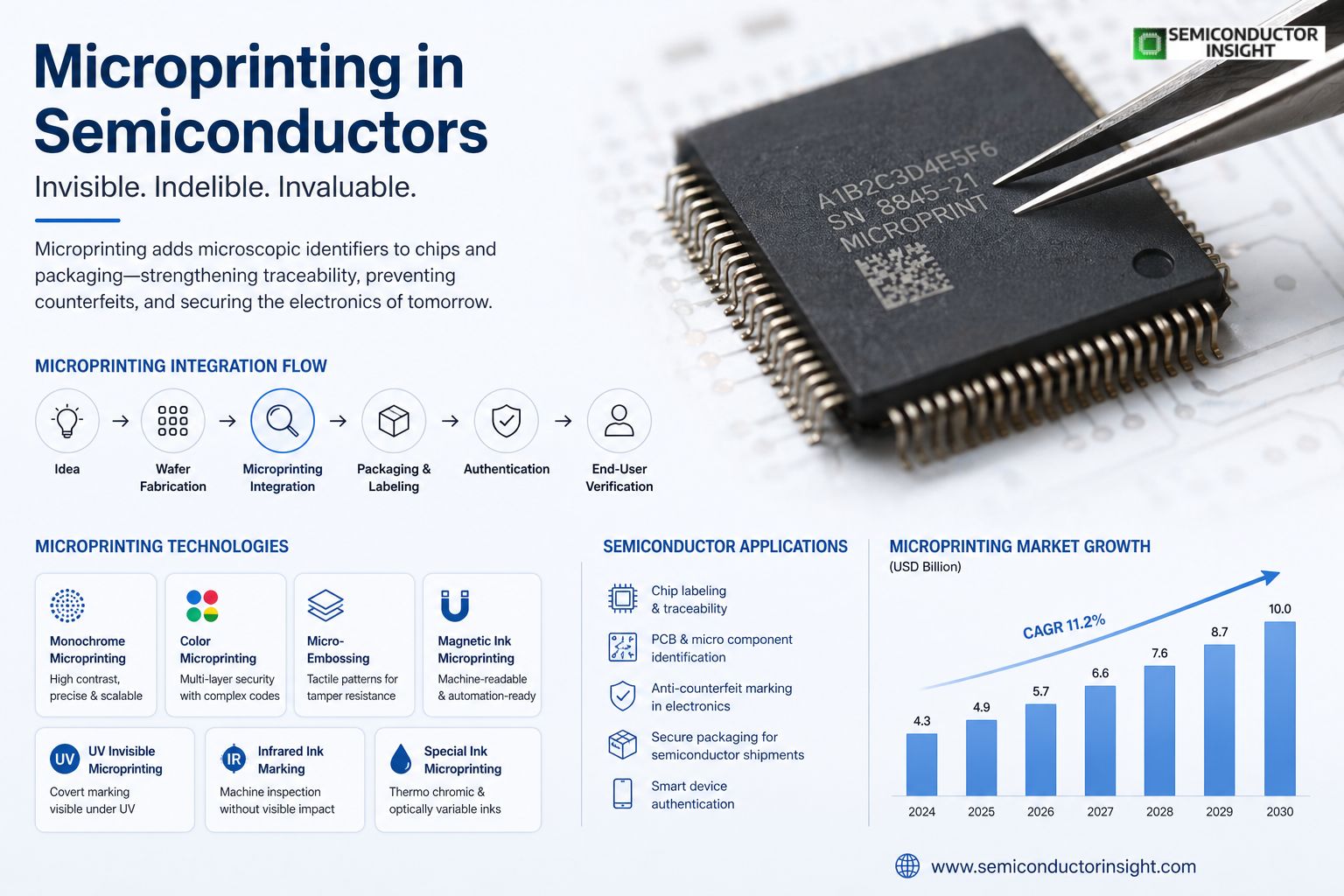
Flow of Microprinting Integration in Semiconductor Value Chain
Idea → Wafer Fabrication → Microprinting Integration → Packaging & Labeling → Authentication → End-User Verification
Types of Microprinting Technologies Transforming Semiconductor Use
- Monochrome Microprinting
This is the most widely adopted format due to its high contrast, precision, and cost efficiency, making it suitable for semiconductor labels, IC markings, and industrial packaging. It accounted for a dominant share of nearly 60% in earlier adoption phases due to scalability.
- Color Microprinting
Color-based microprinting enhances multi-layer authentication, allowing semiconductor firms to embed complex visual codes that are extremely difficult to duplicate. It is gaining traction in high-value electronics and branded chipsets.
- Micro-Embossing
A tactile form of microprinting, this creates raised microscopic patterns on surfaces. It is widely used for semiconductor packaging and secure hardware labeling, with strong growth driven by its tamper-resistant properties.
- Magnetic Ink Microprinting (MICR-Based)
Magnetic inks allow machine-readable encoding, enabling automated verification systems in electronics manufacturing and logistics tracking.
- UV Invisible Microprinting
This technique uses inks visible only under ultraviolet light, making it ideal for covert semiconductor authentication and anti-counterfeit measures.
- Infrared Ink Marking
Used in advanced electronics, this method supports machine-based inspection systems without affecting visible design aesthetics.
- Special Ink Microprinting
Includes thermo chromic and optically variable inks used in next-generation semiconductor security features.
Semiconductor-Centric Applications Driving Market Demand
Microprinting has moved far beyond banknotes and ID cards. In semiconductor ecosystems, it is now embedded in:
- Chip labelling and traceability
- PCB and micro component identification
- Anti-counterfeit marking in consumer electronics
- Packaging security for semiconductor shipments
- Smart device authentication
The electronics and packaging segments are among the fastest-growing applications, largely due to rising counterfeit risks in global supply chains.
Why Microprinting is scaling in Semiconductor Industry?
- Counterfeiting Crisis in Electronics
Fake semiconductors are a growing global issue, pushing companies to adopt multi-layer security systems like microprinting.
- Miniaturization Trends
As chips shrink, labeling space becomes limited. Microprinting enables high-density data encoding in microscopic formats.
- Regulatory Compliance
Governments are enforcing stricter traceability norms, especially in electronics and defense sectors.
- E-commerce Expansion
With rising global shipments, microprinting supports secure labeling and tracking across supply chains.
Top Global Companies Leading the Microprinting Market
- Xerox Corporation
- HP Development Company
- Canon Inc.
- Ricoh Company Ltd.
- Zebra Technologies
- Brady Corporation
- Videojet Technologies
- Matica Technologies
- Others
These companies are actively investing in high-resolution printing systems, specialty inks, and semiconductor-compatible marking technologies, strengthening their presence in both security printing and electronics manufacturing.
Emerging Innovation: Microprinting Meets Semiconductor Fabrication
One of the most exciting developments is the integration of microprinting into flexible electronics and 2D semiconductor materials, enabling direct electrode printing and micro-pattern formation.
This convergence is opening new doors in:
- Flexible electronics
- Wearable semiconductor devices
- Nano-scale circuit printing
- Smart sensors and IoT chips
Microprinting is no longer confined to paper-based security. It is becoming a core component of semiconductor infrastructure, blending precision engineering with authentication technologies.
As semiconductor devices become smaller, smarter, and more globally distributed, microprinting will play a defining role in ensuring security, traceability, and authenticity at microscopic levels.
One clear concept holds the key to this market’s long-term success:
What cannot be seen easily, cannot be copied easily and that is exactly where microprinting wins.

Comments (0)