

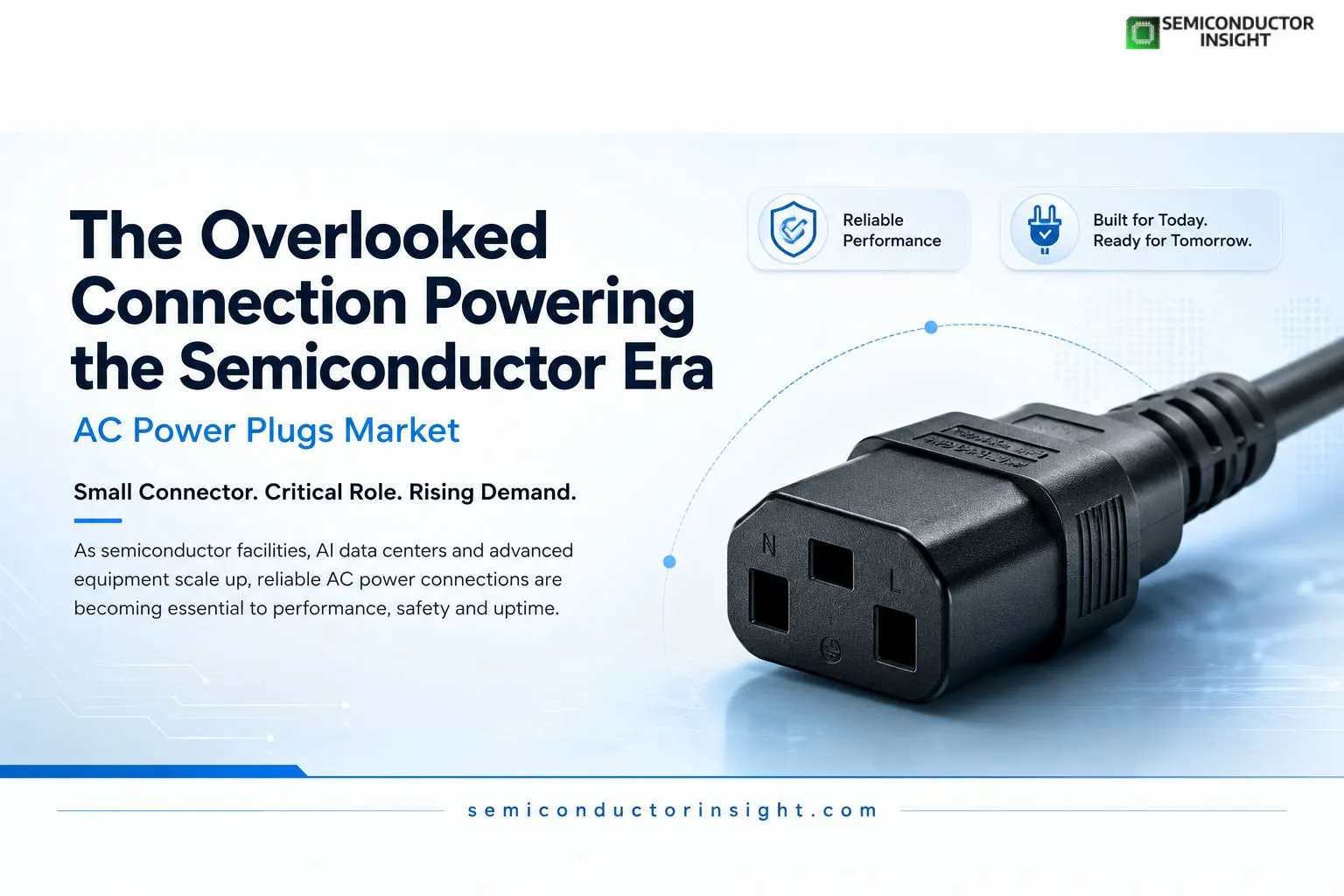
AC Power Plugs Market 2026: 16A Connectivity Gains Importance across High Density Electronics
The AC power plug is easy to overlook in a semiconductor facility. The attention usually goes to advanced chips, wafer equipment, AI processors and sophisticated power-management systems. Yet every one of these systems ultimately depends on a dependable connection to electrical power.
In 2026, that basic connection is becoming more important as semiconductor factories, test laboratories, data centers and electronics production lines operate with higher equipment density. The International Electrotechnical Commission’s IEC 60320-1 standard covers appliance couplers for electrical devices with rated voltage up to 250 V AC and current up to 16 A, providing a widely used framework for connecting equipment to mains power.
The Plug Is Becoming Part of the Equipment Architecture
- Modern semiconductor equipment is rarely designed around a simple plug-and-play electrical arrangement. Test instruments, inspection systems, fabrication tools, servers and laboratory equipment may require detachable cords, grounding contacts, locking mechanisms or specific connector geometries.
- This makes the AC plug more than a commodity accessory. Connector selection can influence equipment installation, maintenance cycles, operator safety and compatibility with facility infrastructure.
- IEC 60884-1:2022 covers AC plugs and socket-outlets for household and similar applications above 50 V and up to 440 V, with rated current up to 32 A. The standard received a corrected version in July 2026, highlighting the continuing importance of keeping power-interface specifications aligned with evolving electrical equipment requirements.
A Small Connector Facing a Much Bigger Power Problem
The semiconductor industry’s electricity requirements are rising alongside factory expansion and AI infrastructure. The IEA expects global electricity demand to increase 3.6% in 2026, followed by another 3.8% in 2027. Industrial activity, data centers, air conditioning, electric vehicles and other electrification trends are contributing to this expansion.
The connection between semiconductor manufacturing and power demand is particularly relevant. The IEA identifies new semiconductor fabrication facilities as major emerging industrial electricity loads.
For AC power plug manufacturers, this translates into a market where reliability, thermal performance and secure mating become increasingly important.
Why 16A and 250V Specifications Still Matter?
Numbers such as 10 A, 16 A, 250 V, 50 Hz and 60 Hz remain highly relevant when specifying AC connectivity.
IEC 60320 standards, for example, establish requirements for appliance couplers used to connect electrical equipment to mains supplies, with IEC 60320-1 covering systems up to 250 V AC and 16 A. Specialized versions also address protection against water ingress and other operating conditions.
Meanwhile, IEC 60884-2-2:2025 addresses AC socket-outlets integrated into or incorporated into appliances, covering equipment up to 250 V and 16 A. The standard was published in February 2025 and replaced the earlier 2006 edition.
AI Data Centers Are Changing the Power Interface Conversation
- The strongest new application story comes from AI infrastructure.
- Global data-center electricity consumption increased around 17% in 2025, according to the IEA. Its latest analysis expects data-center electricity consumption to roughly double from 485 TWh in 2025 to 950 TWh by 2030.
- The physical density of AI hardware is also rising quickly. The IEA reports that AI-server power density increased 11 times between 2020 and 2025, with another fourfold increase expected by 2027.
- This creates demand for dependable power-entry components across servers, networking equipment, storage systems and supporting infrastructure. AC plugs therefore remain relevant even as internal systems increasingly rely on sophisticated DC power architectures.
USB-C Is Growing, but It Does Not Replace AC Mains
One of the most visible power-interface developments is USB-C. USB Power Delivery can now support up to 240 W, compared with the earlier 100 W ceiling for the relevant USB PD implementation.
The European Union has also expanded common-charger requirements. USB-C requirements applied to several categories of portable electronics from December 28, 2024, while laptops came under the requirements from April 28, 2026. The European Commission estimates that the rules could reduce electronic waste by approximately 980 tonnes annually.
However, USB-C operates in a different part of the power ecosystem. High-power semiconductor tools, servers, industrial electronics and manufacturing equipment still require mains-level AC input architectures. USB-C is therefore expanding alongside AC connectivity rather than eliminating it.
Our most recent updated related study is available for free at this link: https://semiconductorinsight.com/report/ac-power-plugs-market/
Semiconductor Equipment Is Pushing Reliability beyond Basic Compatibility
For semiconductor applications, an acceptable plug must do more than physically fit a socket. Equipment designers have to consider grounding, contact resistance, heat generation, mechanical retention, repeated mating cycles and environmental conditions.
This becomes especially important in manufacturing environments where equipment may run continuously and an unexpected power interruption can affect production schedules or test operations.
The latest IEC standards activity reflects this continuing specialization. IEC 60884-2-6:2025, for example, addresses switched socket-outlets with interlock and covers AC systems above 50 V up to 440 V and rated currents up to 32 A.
Where the AC Power Plug Market Is Finding Its Next Applications
- The opportunity is broadening across semiconductor fabrication plants, automated test equipment, laboratory instruments, industrial computers, power supplies, data-center servers and electronics manufacturing systems.
- The important shift is that power connectors are increasingly being selected as part of complete equipment architectures rather than treated as inexpensive standalone components.
- As semiconductor facilities become more automated and computational workloads become more power intensive, manufacturers are paying closer attention to every connection between equipment and the electrical infrastructure.
The 2026 Market Story Is About Dependable Connections
AC power plugs market is moving quietly alongside some of the semiconductor industry’s biggest changes. AI computing is increasing power density, new fabrication facilities are adding industrial electricity loads, and global equipment manufacturers are navigating a growing mix of electrical standards.
That makes proven specifications such as 250 V, 16 A, 50 Hz and 60 Hz still relevant while newer requirements around modularity, safety, thermal management and equipment integration gain importance.
For semiconductor applications, the winning power interface is unlikely to be the most technologically complicated one. It will be the connection that delivers dependable electrical performance, fits the equipment architecture and continues working reliably under demanding operating conditions.

Comments (0)