

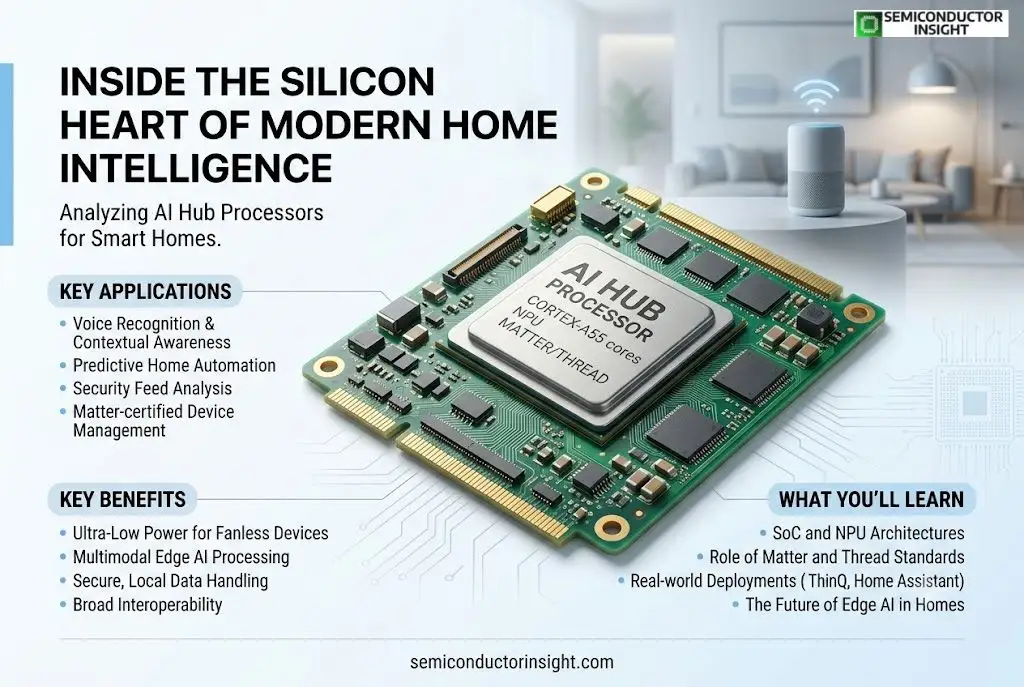
7 Breakthrough AI Chip Innovations Transforming Smart Home Hubs in 2026
The landscape of home technology is evolving rapidly as AI smart home hub processors become the silent orchestrators of daily life. These specialized chips handle everything from voice recognition to predictive automation, turning ordinary residences into responsive environments that anticipate needs without constant cloud reliance.
Inside the Silicon Heart of Modern Home Intelligence
At the core of today’s AI smart home hubs sit advanced system-on-chip (SoC) designs that integrate central processing units, neural processing units (NPUs), and efficient connectivity options. Arm-based architectures dominate this space, with Cortex-A series processors delivering the balanced performance needed for always-on intelligence while keeping power consumption low enough for compact, fanless devices.
- For instance, solutions like NXP’s i.MX 93W combine a dual-core Arm Cortex-A55 with a dedicated Ethos NPU offering up to 1.8 TOPS of AI performance, along with integrated tri-radio wireless support for Matter, Thread, Wi-Fi 6, and Bluetooth. This level of integration slashes component counts dramatically replacing up to 60 discrete parts making it ideal for sleek hub designs in smart buildings and homes.
MediaTek’s Genio platform similarly targets smart home hubs, voice assistants, and appliances with built-in AI acceleration and robust connectivity, powering seamless automation across ecosystems.
Deployments in the Real World Affecting Daily Life
- Consider LG’s ThinQ ON AI Home Hub, unveiled with a high-performance AI chipset that supports natural language understanding and contextual awareness. The cylindrical device blends into living spaces while managing Matter-certified devices, learning user preferences to streamline routines like adjusting lighting or climate based on conversation cues.
- In privacy-focused setups, Home Assistant Green runs on a Rockchip RK3566 SoC with a quad-core Arm Cortex-A55 at 1.8 GHz, paired with 4GB RAM and 32GB storage. This enables fully local processing, appealing to users wary of data leaving the home.
- SwitchBot’s AI Hub takes it further by incorporating vision-language models (VLMs) for intuitive control, allowing users to manage devices through descriptive commands processed on-device.
To Stay Tuned with More meaningful and In-Depth Insights, Do Visit here: https://semiconductorinsight.com/report/ai-smart-home-hub-processor-market/
Edge AI: Bringing Smarts Closer to Home
One of the most significant shifts involves moving AI inference to the edge. Instead of sending every command to distant servers, modern processors execute tasks locally for near-instant responses and enhanced privacy. This is crucial for security cameras that analyze video feeds in real time without constant streaming, or voice assistants that respond even during internet outages.
Nordic Semiconductor’s nRF54LM20B SoC, with its Axon NPU, delivers substantial gains in energy efficiency for tasks like sound classification and keyword spotting up to 8 times better than previous approaches perfect for battery-conscious or always-listening hubs.
Multimodal sensing further elevates this, combining inputs from microphones, cameras, and environmental sensors for richer context awareness, such as distinguishing between a family member arriving and an intruder.
Sustainability and Efficiency in Processor Design
AI smart home hub processors increasingly emphasize low-power operation to support eco-friendly homes. Features like dynamic voltage scaling and specialized accelerators allow devices to run advanced models while minimizing electricity use, aligning with broader goals of energy management in connected living spaces.
Government initiatives worldwide promote domestic semiconductor capabilities, indirectly boosting innovation in these consumer-facing chips through investments in advanced manufacturing and R&D.
Interoperability Driving Broader Adoption
- Standards like Matter and Thread play a pivotal role, enabled by processors with multi-protocol radios.
- This reduces fragmentation, letting a single hub from one brand control lights, locks, thermostats, and appliances from many others without proprietary bridges.
- Apple’s rumored home hub with robotic features and Google’s on-device Gemini processing in Nest devices highlight how major players are embedding more capable silicon for contextual, proactive assistance.
Security Built into the Silicon
With connectivity comes responsibility. Leading processors incorporate hardware-level security features secure enclaves, encrypted storage, and isolated execution environments to protect against threats. LG Shield, for example, safeguards data in its AI hubs, while Arm architectures provide foundational trust elements.
The Road Ahead for Processor Innovation
Looking forward, expect tighter integration of larger language models on-device, hybrid edge-cloud architectures, and even more efficient NPUs capable of handling billion-parameter models in compact form factors. Advances in 5G and beyond will complement these chips, enabling richer experiences while processors keep critical functions local.
From luxury installations using Josh.ai’s local processing to mainstream devices, AI smart home hub processors are quietly powering a more intuitive, private, and efficient way of living. As these technologies mature, the line between home and intelligent companion continues to blur, promising homes that truly understand and adapt to their inhabitants.

Comments (0)