Voice Recognition Semiconductor Market Insights
Global voice recognition semiconductor market size was valued at USD 6.9 billion in 2025. The market is projected to grow from USD 7.3 billion in 2026 to USD 15.4 billion by 2034, exhibiting a CAGR of 7.8% during the forecast period.
Voice recognition semiconductors are integrated circuits that capture acoustic signals, perform on‑chip digitization and run AI‑driven speech models to translate spoken words into actionable commands.The market is experiencing rapid growth because consumer devices increasingly rely on voice interfaces, automotive infotainment systems demand hands‑free operation, and enterprise solutions seek secure edge processing; however, power efficiency and multilingual accuracy remain technical challenges that drive ongoing innovation among leading vendors such as Qualcomm Technologies, Apple’s custom silicon division, MediaTek and NXP Semiconductors.
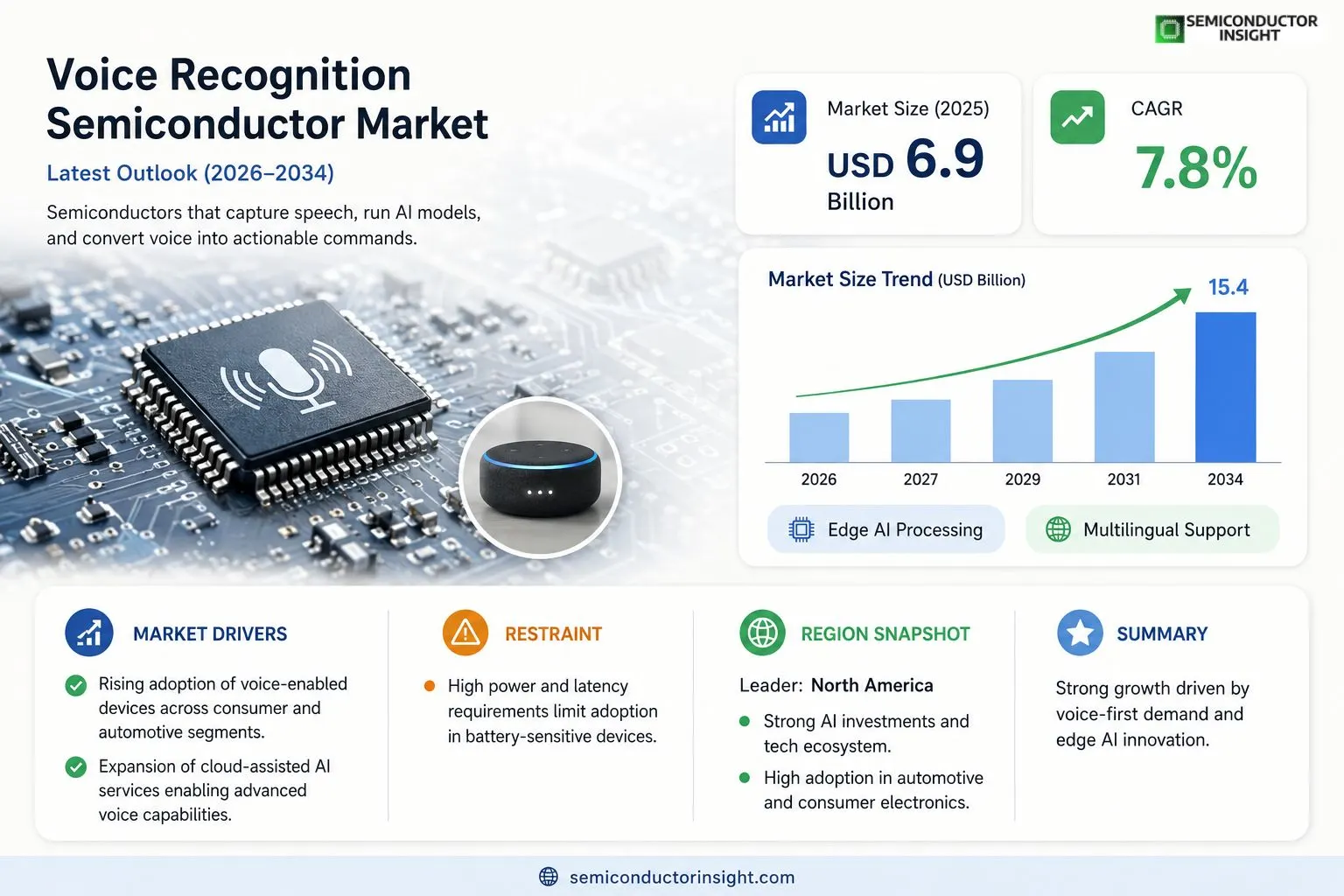
MARKET DRIVERS
Rising Adoption of Voice‑Enabled Devices
Voice Recognition Semiconductor Market is being propelled by the rapid integration of voice interfaces in smartphones, wearables, and automotive infotainment systems. Consumers expect instant, hands‑free interaction, driving OEMs to source low‑power, high‑accuracy chips that can operate on limited battery budgets.
Expansion of Cloud‑Assisted AI Services
Cloud‑based AI platforms are reducing on‑device processing constraints, allowing manufacturers to embed more sophisticated neural‑network accelerators. This synergy has accelerated market growth, with industry estimates indicating a compound annual growth rate of around 7% through 2032.
➤ “The convergence of edge AI and voice technology is creating a new generation of semiconductors that deliver both speed and energy efficiency.”
Furthermore, enterprise deployments of voice‑controlled robotics and smart‑building solutions are expanding the addressable market, providing additional revenue streams for chip designers focused on privacy‑preserving on‑device processing.
MARKET CHALLENGES
Stringent Power and Latency Requirements
Designers face the difficulty of balancing ultra‑low power consumption with sub‑20 ms response times. Failure to meet these parameters can limit adoption in battery‑sensitive wearables and automotive safety systems.
Other Challenges
Supply Chain Volatility
Recent geopolitical tensions have led to component shortages, elevating lead times for specialized analog front‑ends and increasing production costs for manufacturers.
MARKET RESTRAINTS
Regulatory and Privacy Concerns
Data‑privacy regulations, such as GDPR and emerging voice‑data standards, compel companies to implement on‑device processing. While this drives innovation, it also raises development costs and extends time‑to‑market for new chips.The need for extensive validation under safety‑critical standards (e.g., automotive ISO‑26262) further restricts rapid deployment, especially for smaller semiconductor startups lacking compliance resources.Lastly, the high cost of advanced fabrication nodes limits the ability of some manufacturers to produce cutting‑edge acoustic signal‑processing units at scale.
MARKET OPPORTUNITIES
Emerging Edge‑AI Applications
Edge‑AI workloads in industrial automation and health‑care monitoring present a sizeable growth avenue. Devices that can recognize voice commands locally without cloud reliance are becoming a differentiator, opening new revenue channels for specialized semiconductor solutions.In addition, the rollout of 5G networks enhances bandwidth for hybrid edge‑cloud architectures, enabling more complex voice models to run on modest silicon footprints. Companies that can capitalize on this synergy are positioned to capture significant market share.Finally, regional expansion, particularly in Southeast Asia and Latin America, where consumer adoption of smart speakers is accelerating, offers untapped opportunities for vendors offering cost‑effective, multilingual voice chips.
Voice Recognition Semiconductor Market Trends
AI‑Driven Edge Processing Gains Traction
Voice Recognition Semiconductor Market is increasingly shaped by the shift toward on‑device AI inference. Leading chip designers are embedding low‑latency neural engines directly into semiconductor die, allowing voice commands to be processed without relying on cloud connectivity. This architectural change improves response time, preserves user privacy, and reduces bandwidth costs for manufacturers of smartphones, automotive infotainment units, and industrial controllers. Recent product roadmaps reveal a focus on heterogeneous compute blocks that combine digital signal processors with specialized tensor cores, enabling real‑time speech decoding while maintaining power budgets suitable for battery‑powered devices.
Other Trends
Power Efficiency Advances
Power consumption remains a decisive factor for widespread adoption. Vendors are adopting sub‑threshold voltage operation and dynamic voltage‑frequency scaling to lower idle draw below one milliwatt. In parallel, novel 3D‑stacked packaging reduces interconnect resistance, further trimming energy loss. These efficiency gains support the proliferation of always‑listening assistants in wearables and smart home hubs, where prolonged standby periods are critical.
Multilingual Model Integration Expands
Global consumers demand voice interfaces that understand multiple languages and dialects. To meet this expectation, semiconductor manufacturers are integrating on‑chip acoustic front‑ends capable of handling diverse phonetic inventories, followed by compact multilingual acoustic models. By compressing model parameters through knowledge‑distillation techniques, companies can fit several language packs onto a single chip without sacrificing accuracy. This capability is especially important for automotive and enterprise deployments, where a single device may serve users from varied linguistic backgrounds.
COMPETITIVE LANDSCAPEKey Industry Players
Voice Recognition Semiconductor Market Competitive Overview
The voice recognition semiconductor segment is dominated by a handful of large‐scale integrated circuit manufacturers that combine advanced analog front‑end designs with on‑chip AI accelerators. Qualcomm Technologies leads the market by leveraging its Snapdragon digital signal processors and AI‑focused Neural Processing Units (NPUs), which are embedded in flagship smartphones, wearables, and automotive infotainment solutions. Apple’s custom silicon division, notably the Apple S series, reinforces a vertically integrated ecosystem that tightly couples voice‑activated Siri capabilities with power‑efficient hardware. Intel and AMD have entered the space through dedicated AI inference chips, while NXP Semiconductors supplies automotive‑grade voice modules that meet stringent functional safety standards. This concentration of resources creates a layered market structure where a few Tier‑1 players set performance baselines and dictate pricing dynamics for downstream OEMs.Beyond the dominant Tier‑1 vendors, a vibrant cohort of niche innovators contributes specialized expertise that broadens the competitive landscape. MediaTek offers cost‑effective solutions for emerging markets, emphasizing multilingual support and low‑power operation. STMicroelectronics and Renesas deliver mixed‑signal voice front‑ends optimized for industrial IoT devices. Texas Instruments focuses on precision analog interfaces, whereas Analog Devices provides high‑resolution audio acquisition front‑ends. Smaller but agile firms such as Cirrus Logic and Synaptics supply dedicated voice DSP cores for consumer electronics, and Google’s Tensor SoC integrates proprietary speech models directly into its Pixel hardware line, illustrating a growing trend of ecosystem‑specific silicon design.
List of Key Voice Recognition Semiconductor Companies Profiled
- Qualcomm Technologies
- Apple (Custom Silicon Division)
- MediaTek
- NXP Semiconductors
- Intel
- AMD
- STMicroelectronics
- Renesas Electronics
- Texas Instruments
- Analog Devices
- Cirrus Logic
- Synaptics
- Google (Tensor SoC)
Segment Analysis:
| Segment Category | Sub-Segments | Key Insights |
| By Type |
|
Analog Front‑End ICs drive market adoption through high‑fidelity acoustic capture and ultra‑low power consumption. – Enables seamless integration in battery‑constrained devices. – Provides robust noise‑cancellation that enhances voice clarity in diverse environments. – Forms the foundational signal path for downstream AI processing, making it a critical differentiator for manufacturers. |
| By Application |
|
Consumer Electronics represent the most visible deployment of voice recognition semiconductors. – Integration into smart speakers and wearables creates intuitive, hands‑free experiences. – Continuous demand for seamless voice activation fuels innovation in chip miniaturization. – The convergence of voice control with other sensors amplifies device ecosystems and user loyalty. |
| By End User |
|
Vehicle Drivers increasingly rely on voice‑enabled infotainment for safe, distraction‑free interaction. – Voice commands enable navigation, media control, and climate adjustments without manual input. – Integration with vehicle‑wide networks encourages consistent user experiences across models. – Emerging safety regulations promote robust, reliable speech processing as a core vehicle feature. |
| By Technology |
|
Edge AI Processing is reshaping the value proposition of voice chips. – Processing speech locally reduces latency and preserves user privacy. – Enables sophisticated language models to run on constrained devices without reliance on cloud connectivity. – Drives competitive advantage for vendors that can embed advanced inference within a tiny silicon footprint. |
| By Market Driver |
|
Voice‑First Interfaces are redefining how users interact with technology. – Consumers expect instantaneous, natural speech interaction across devices. – Enterprises prioritize voice solutions that safeguard sensitive information through on‑device processing. – The push for unified ecosystems encourages chip makers to deliver interoperable, standards‑aligned solutions. |
Regional Analysis: North America
United States
The consumer electronics segment represents a major driver in Voice Recognition Semiconductor Market within the United States. Smart speakers, virtual assistants, and voice-controlled appliances are gaining popularity, propelling demand for integrated voice recognition chips. This segment benefits from a large consumer base and continuous innovation in product features and functionalities.
The automotive sector is rapidly integrating voice recognition technology for in-vehicle infotainment systems, hands-free controls, and driver assistance features. This integration necessitates high-performance and reliable voice recognition semiconductors capable of operating in challenging automotive environments. Increasing safety regulations and the demand for seamless user experiences are fueling this trend.
The enterprise and Internet of Things (IoT) sectors are leveraging voice recognition semiconductors for applications such as virtual assistants, call center automation, and smart office solutions. The growing adoption of connected devices and the demand for efficient communication tools are driving market growth in these segments.
The healthcare industry is exploring the use of voice recognition technology for medical documentation, patient interaction, and hands-free control of medical devices. This application area offers significant potential for growth as healthcare providers seek to improve efficiency and patient care.
Europe
Europe exhibits a steady growth trajectory in Voice Recognition Semiconductor Market. The region is characterized by a strong focus on data privacy and security, which influences the development and adoption of voice recognition technologies. Key applications include smart home devices, automotive systems, and enterprise solutions. While the market size may be smaller than in the U.S., the consistent demand and technological advancements are contributing to its expansion. The European Union’s regulations on data protection are shaping the landscape of voice recognition technology development, emphasizing user control and data sovereignty. The market in Europe is expected to witness significant growth in the coming years, driven by increasing investments in AI and the growing adoption of smart devices.
Asia-Pacific
The Asia-Pacific region represents a high-growth potential market for Voice Recognition Semiconductor Market. Driven by rapid urbanization, increasing disposable incomes, and the widespread adoption of smartphones and smart devices, the demand for voice recognition technology is surging across countries like China, Japan, and South Korea. The region’s large population base and burgeoning consumer electronics industry are key factors fueling this growth. Government initiatives promoting technological innovation and the expansion of the 5G network are also contributing to market expansion. The Asia-Pacific market is witnessing a strong focus on developing localized voice recognition solutions to cater to diverse linguistic landscapes.
South America
South America presents a nascent but promising market for Voice Recognition Semiconductor Market. The increasing penetration of smartphones and the growing adoption of smart home devices are creating opportunities for voice recognition technology. While the market is currently smaller compared to other regions, the potential for growth is significant, particularly in countries with a rising middle class and increasing digital literacy. The demand is primarily driven by consumer electronics and emerging IoT applications.
Middle East & Africa
The Middle East & Africa region is an emerging market for Voice Recognition Semiconductor Market. The increasing investments in smart city initiatives, the growing adoption of connected cars, and the rising demand for consumer electronics are driving market growth. The region’s young population and increasing digital connectivity are also contributing to market expansion. The market is expected to witness significant growth in the coming years, particularly in countries with strong economic growth and government support for technological advancements.
Report Scope
This market research report provides a comprehensive analysis of the Voice Recognition Semiconductor Market , covering the forecast period 2026–2034. It offers detailed insights into market dynamics, technological advancements, competitive landscape, and key trends shaping the industry.
Key focus areas of the report include:
- ✅ Market Overview: The report begins with an overview outlining its current market scenario, key growth indicators, and industry transformation drivers. It discusses macroeconomic factors, demand–supply balance, regulatory landscape, and the strategic role of semiconductors in powering advancements across industries such as automotive, telecommunications, consumer electronics, and industrial automation.
- ✅ Market Size & Forecast: Historical data and future projections for revenue, unit shipments, and market value across major regions and segments.
- ✅ Segmentation Analysis: Detailed breakdown by product type, technology, application, and end-user industry to identify high-growth segments and investment opportunities.
- ✅ Regional Insights: Insights into market performance across North America, Europe, Asia-Pacific, Latin America, and the Middle East & Africa, including country-level analysis where relevant.
- ✅ Competitive Landscape: Profiles of leading market participants, including their product offerings, R&D focus, manufacturing capacity, pricing strategies, and recent developments such as mergers, acquisitions, and partnerships.
- ✅ Technology Trends & Innovation: Assessment of emerging technologies, integration of AI/IoT, semiconductor design trends, fabrication techniques, and evolving industry standards.
- ✅ Market Drivers & Restraints: Evaluation of factors driving market growth along with challenges, supply chain constraints, regulatory issues, and market-entry barriers.
- ✅ Stakeholder Insights: Insights for component suppliers, OEMs, system integrators, investors, and policymakers regarding the evolving ecosystem and strategic opportunities.
Primary and secondary research methods are employed, including interviews with industry experts, data from verified sources, and real-time market intelligence to ensure the accuracy and reliability of the insights presented.
FREQUENTLY ASKED QUESTIONS:
What is the current market size of Voice Recognition Semiconductor Market?
-> Voice Recognition Semiconductor Market was valued at USD 6.9 billion in 2025 and is expected to reach USD 15.4 billion by 2034.
Which key companies operate in Voice Recognition Semiconductor Market?
-> Key players include Qualcomm Technologies, Apple’s custom silicon division, MediaTek, and NXP Semiconductors.
What are the key growth drivers?
-> Key growth drivers include rising adoption of voice interfaces in consumer devices, demand for hands‑free operation in automotive infotainment systems, and enterprise needs for secure edge processing.
Which region dominates the market?
-> The reference does not specify a dominant region for Voice Recognition Semiconductor Market.
What are the emerging trends?
-> Emerging trends include advancements in power‑efficient semiconductor designs and improvements in multilingual accuracy for AI‑driven speech models.
Get Sample Report PDF for Exclusive Insights
Report Sample Includes
- Table of Contents
- List of Tables & Figures
- Charts, Research Methodology, and more...
 Download Sample Report PDF