
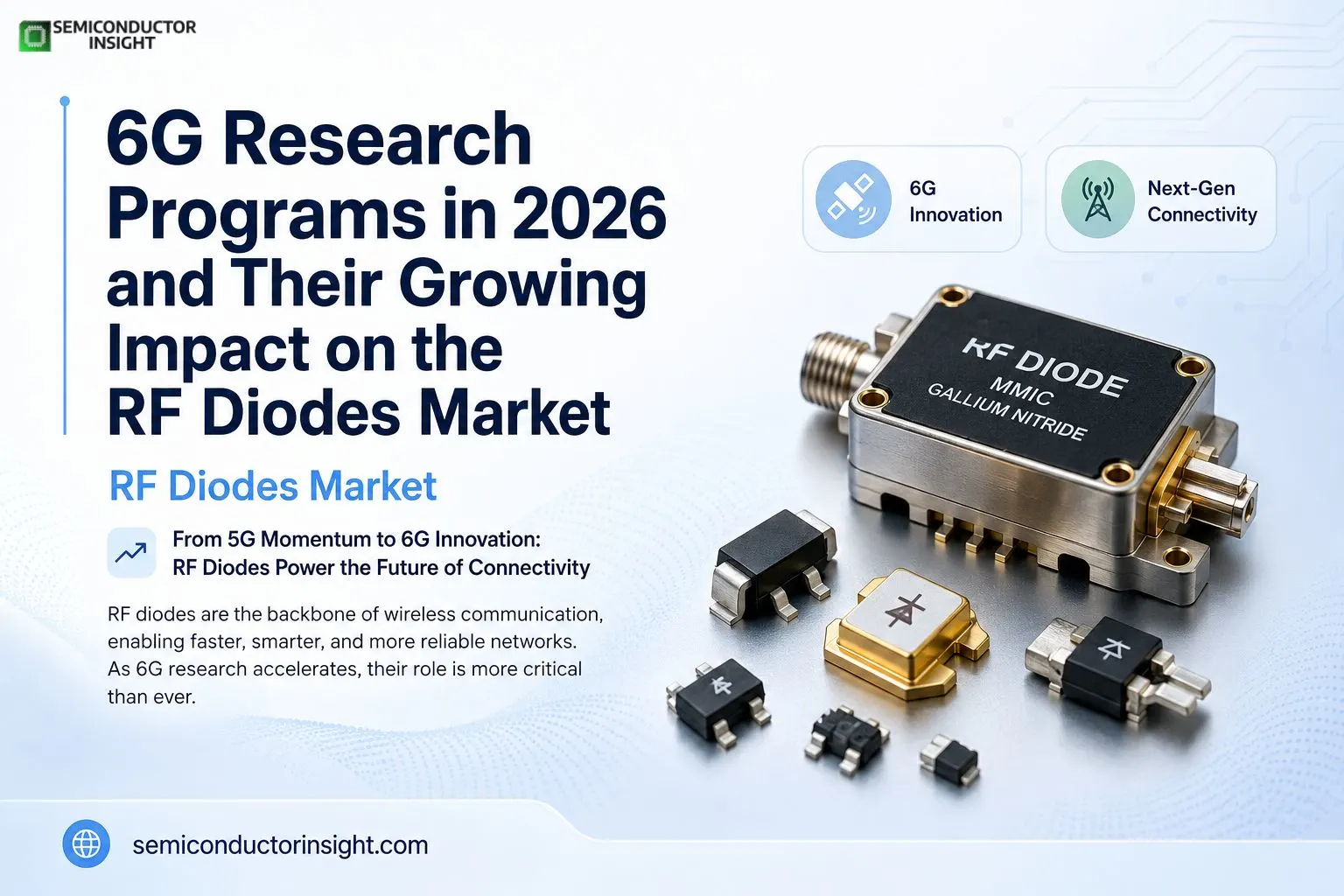
6G Research Programs in 2026 and Their Growing Impact on the RF Diodes Market
Radio frequency diodes may be tiny semiconductor components, but they play an outsized role in modern communication systems. Found in smartphones, radar systems, satellites, base stations, and IoT devices, RF diodes regulate, switch, detect, and protect high-frequency signals that power today’s connected world. As wireless communication expands from 5G to early-stage 6G research, the relevance of RF diodes continues to increase across industries.
The surge in connected devices is particularly notable. According to the International Telecommunication Union (ITU), billions of people now use mobile broadband globally, while the number of IoT devices worldwide is projected to reach tens of billions in coming years. This expanding digital ecosystem is creating sustained demand for high-performance RF components.
The Invisible Components behind Everyday Connectivity
RF diodes perform critical functions in signal processing. Different diode architectures serve distinct purposes:
- Schottky diodes for fast switching and low forward voltage
- PIN diodes for RF switching and attenuation
- Varactor diodes for frequency tuning
- Tunnel diodes for high-speed oscillation
From Wi-Fi routers to aerospace radar systems, these devices ensure efficient signal transmission with minimal losses.
Signal Journey Flow Map
Data Generation
↓
RF Signal Processing
↓
Diode Switching and Protection
↓
Antenna Transmission
↓
Wireless Reception
↓
Digital Processing
Numbers Defining the Wireless Era
The global connectivity landscape continues to expand rapidly, supported by more than 8 billion mobile subscriptions and over 5.5 billion internet users worldwide. In parallel, the number of operational satellites in orbit has crossed 11,000, while 5G network deployments now span more than 100 countries. The 5G ecosystem is also built on key RF spectrum bands, including sub-6 GHz and mmWave, which together support broader coverage and higher-speed connectivity.
As wireless infrastructure expands, semiconductor manufacturers continue improving diode performance for increasingly demanding environments.
Why Satellites Are Becoming a Growth Engine?
The rapid rise of low Earth orbit satellite constellations has created fresh demand for RF components. Satellite communication systems require highly reliable RF diodes capable of operating under extreme temperatures and radiation exposure.
Recent deployments of satellite broadband networks have accelerated investments in space-grade semiconductor technologies. Earth observation systems, navigation satellites, and global connectivity projects all depend on advanced RF architectures.
A single communication satellite may contain thousands of semiconductor devices supporting transmission, switching, and power management functions.
Semiconductor Packaging Enters a New Phase
Advanced packaging is becoming just as important as semiconductor design itself. As electronic devices become smaller and more powerful, RF diode packaging technologies are evolving to minimize signal loss and thermal stress.
Emerging packaging trends include:
✓ Wafer-level packaging
✓ Flip-chip integration
✓ System-in-package architectures
✓ Advanced thermal materials
These approaches enable compact and efficient modules for smartphones, automotive systems, and wearable electronics.
Miniaturization Flow Chart
Material engineering initiates the process by developing and preparing semiconductor substrates, which then proceed to wafer fabrication where circuits are patterned and layered. Diode integration follows, embedding crucial diode components into the fabricated wafers.
Advanced packaging then protects and interconnects the finished dies, enabling reliable performance. Finally, device deployment brings these components into end products. Continued miniaturization throughout these stages expands possibilities for both consumer and industrial electronics.
The Road from 5G Toward 6G Networks
- While 5G deployment continues globally, governments, universities, and research institutions have already begun investigating 6G technologies. Programs in Asia, Europe, and North America are exploring terahertz frequencies, intelligent networks, and ultra-low latency communication.
- These future systems will require RF devices capable of handling higher frequencies and more complex signal environments. Semiconductor researchers are increasingly studying compound materials such as gallium arsenide and gallium nitride to support next-generation performance requirements.
- Recent demonstrations of AI-enabled radio systems further illustrate how wireless networks are becoming smarter and more adaptive.
For additional report info, feel free to view our most recent edition: https://semiconductorinsight.com/report/rf-diodes-market/
Beyond Telecom Exploring New Application Frontiers
RF diodes are finding applications well beyond telecommunications. In automotive systems, they support radar sensors used in advanced driver assistance systems. Healthcare devices use RF technologies for imaging and monitoring, while industrial automation relies on wireless sensors for smart manufacturing.
As digital transformation accelerates across sectors, RF diodes are quietly enabling the seamless flow of information that powers modern economies. Their role may remain largely invisible to consumers, but these components continue to shape the future of global connectivity.

Comments (0)