RF Diodes Market Insights
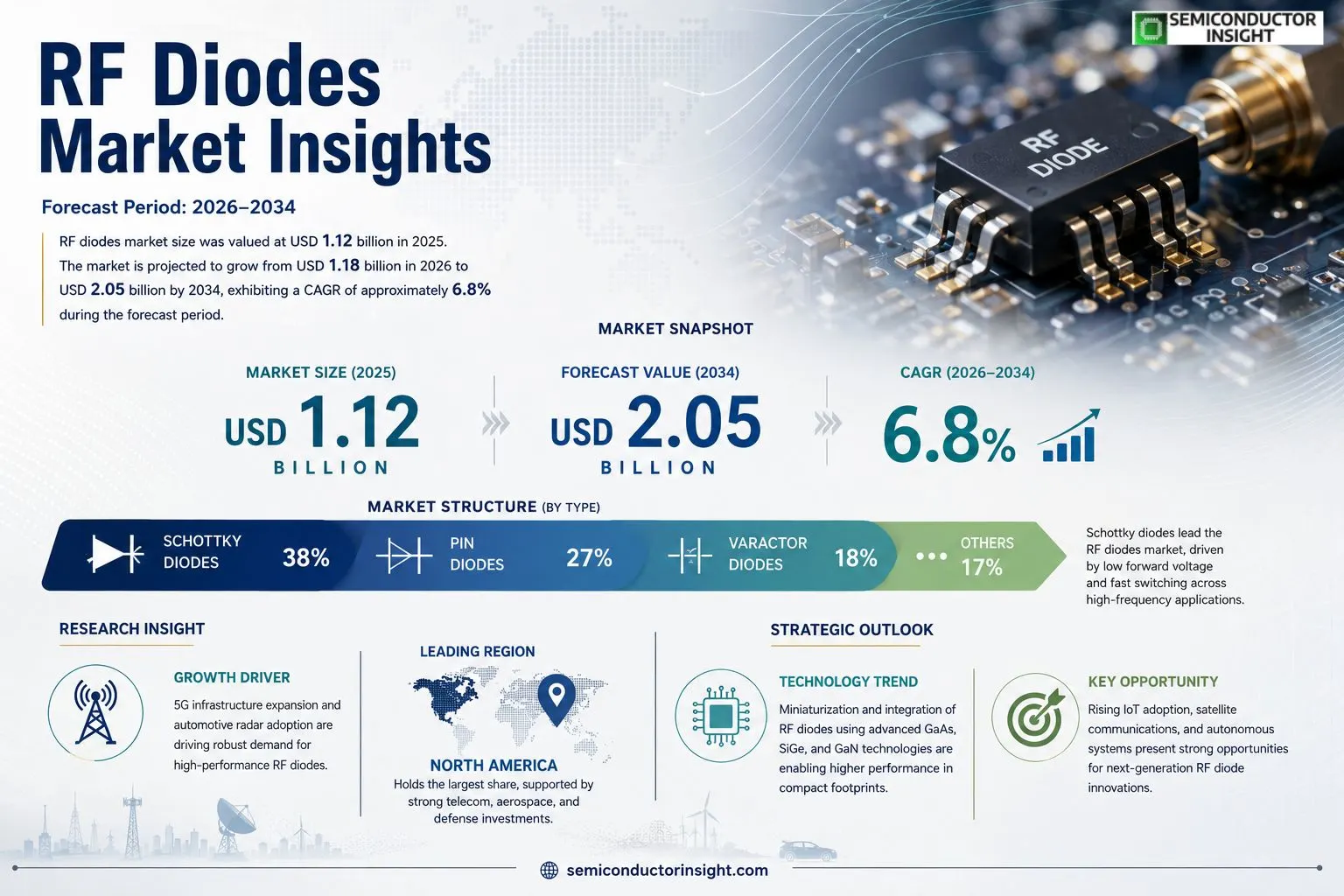
RF diodes market size was valued at USD 1.12 billion in 2025. The market is projected to grow from USD 1.18 billion in 2026 to USD 2.05 billion by 2034, exhibiting a CAGR of approximately 6.8% during the forecast period.
RF diodes are semiconductor components designed to control high‑frequency signals by allowing current flow in one direction while blocking reverse polarity. They are essential for applications such as signal detection, mixing, protection, and frequency conversion in wireless communications, radar systems, satellite transceivers, and emerging IoT devices.The market is experiencing rapid growth because demand for advanced wireless infrastructure,particularly 5G rollout and upcoming 6G research,is accelerating component adoption. Furthermore, increasing deployment of autonomous vehicles and aerospace telemetry drives higher volume requirements for robust high‑frequency protection solutions. Key players such as Skyworks Solutions, Qorvo Inc., MACOM Technology Solutions, and NXP Semiconductors are expanding their product portfolios and investing in miniaturization technologies, which further fuels expansion across both consumer‑grade and defense‑grade segments.
MARKET DRIVERS
Rising Demand for 5G Infrastructure
RF Diodes Market is being propelled by the accelerated rollout of 5G networks worldwide. Mobile operators are upgrading base stations with high‑frequency front‑end modules that rely on advanced RF diodes to achieve low insertion loss and high power handling. This shift creates a consistent pipeline of orders for component manufacturers.
Growth in Automotive Radar Systems
Automotive manufacturers are embedding radar‑based driver‑assistance systems in new models, increasing the volume of RF diode consumption. The need for reliable, high‑frequency switching devices in millimeter‑wave radar drives manufacturers to seek components with tighter tolerances and improved temperature stability.
➤ Industry consensus highlights a steady upward trajectory for RF Diodes Market, underscoring its strategic importance across telecom and automotive sectors.
Additionally, the expansion of satellite communications and microwave backhaul links reinforces demand, as service providers require robust RF diode solutions to maintain signal integrity across long distances.
MARKET CHALLENGES
Cost Sensitivity and Supply Chain Constraints
Manufacturers face pressure to reduce component cost while preserving performance, a balance that is difficult amid volatile raw‑material prices and limited semiconductor fab capacity. Any disruption can elongate lead times, affecting OEM production schedules.
Other Challenges
Regulatory Pressures
Stringent electromagnetic compatibility (EMC) regulations in key regions require additional testing and certification, increasing time‑to‑market and raising overall project budgets.
MARKET RESTRAINTS
Stringent Performance Standards
Achieving the high linearity and low noise figures demanded by modern wireless systems often necessitates advanced material technologies that are costly to develop. Companies lacking deep R&D resources may find it challenging to meet these benchmarks, limiting their market participation.
MARKET OPPORTUNITIES
Emerging Applications in IoT
The proliferation of Internet‑of‑Things devices, especially in smart‑city and industrial‑automation projects, opens new avenues for RF diode integration. Low‑power, highly integrated RF solutions are sought after to extend battery life and reduce device footprints, presenting a growth niche for innovative suppliers.
RF Diodes Market Trends
Growth Driven by 5G Rollout and Early 6G Research
The ongoing deployment of advanced wireless infrastructure is reshaping component demand across the RF spectrum. As 5G networks expand and research into 6G accelerates, manufacturers are prioritizing high‑frequency diodes that can sustain elevated data rates and tighter spectral efficiency. This shift encourages the adoption of RF diodes with enhanced linearity and lower insertion loss, enabling more reliable signal detection and mixing in dense urban cells. Simultaneously, the surge in Internet of Things (IoT) devices demands compact, robust diodes that can operate reliably under varied power conditions. These systemic changes collectively elevate the strategic importance of RF Diodes Market within the broader semiconductor ecosystem.
Other Trends
Miniaturization and Integrated Packaging
Product developers are increasingly focusing on reducing form factor while improving performance metrics. Advances in semiconductor lithography and heterojunction technologies allow designers to embed RF diodes directly into system‑in‑package (SiP) modules, decreasing parasitic effects and improving thermal management. This integration supports the trend toward smaller antenna arrays in both consumer smartphones and aerospace telemetry units. Moreover, newer ceramic and low‑loss substrate materials contribute to higher power handling capabilities without enlarging the device footprint. As manufacturers pursue these packaging innovations, supply chains are adapting to tighter tolerances and more rigorous quality benchmarks, reinforcing the market’s shift toward highly integrated solutions.
Strategic Expansion by Key Industry Players
Leading semiconductor firms are leveraging their R&D resources to broaden product portfolios that cater to diverse end‑use segments. Companies such as Skyworks Solutions, Qorvo, MACOM, and NXP Semiconductors are investing in next‑generation diode architectures that address the dual demands of consumer‑grade throughput and defense‑grade robustness. Collaborative agreements with telecom equipment manufacturers further accelerate time‑to‑market for specialized RF diode families designed for high‑power radar and autonomous vehicle communication stacks. This coordinated effort not only strengthens the competitive landscape but also ensures that RF Diodes Market remains responsive to emerging technology standards and evolving regulatory requirements.
COMPETITIVE LANDSCAPEKey Industry Players
RF Diodes Market Competitive Landscape Overview
The RF diodes sector is dominated by a few semiconductor giants that command the majority of high‑frequency protection and mixing solutions for 5G, aerospace, and emerging IoT platforms. Skyworks Solutions, Qorvo Inc., MACOM Technology Solutions, and NXP Semiconductors together account for a substantial share of the USD 1.12 billion market recorded in 2025, leveraging extensive R&D pipelines to shrink form factors while improving power handling. Their product portfolios span GaAs, SiGe, and GaN technologies, enabling integrated modules that meet stringent defense‑grade reliability and consumer‑grade cost targets. This concentration creates a tiered structure: Tier‑1 leaders provide end‑to‑end design services, while Tier‑2 and Tier‑3 firms specialize in niche frequency bands or customized packaging.Beyond the Tier‑1 leaders, a vibrant ecosystem of specialized manufacturers contributes to market depth and innovation. Infineon Technologies, STMicroelectronics, Analog Devices, Texas Instruments, and Broadcom deliver complementary RF front‑end components that often integrate diode functions within broader signal‑chain modules. Murata Manufacturing, ON Semiconductor, Microchip Technology, Renesas Electronics, and TDK Corporation focus on compact, surface‑mount diode arrays for automotive radar and satellite transceivers, addressing volume‑driven segments with aggressive pricing. These companies collectively broaden the competitive landscape, fostering technology diffusion and driving the projected CAGR of 6.8 % through 2034.
List of Key RF Diodes Companies Profiled
- Skyworks Solutions
- Qorvo Inc.
- MACOM Technology Solutions
- NXP Semiconductors
- Infineon Technologies
- STMicroelectronics
- Analog Devices
- Texas Instruments
- Broadcom Inc.
- Murata Manufacturing
- ON Semiconductor
- Microchip Technology
- Renesas Electronics
- TDK Corporation
Segment Analysis:
| Segment Category | Sub-Segments | Key Insights |
| By Type |
|
Schottky Diodes
|
| By Application |
|
Protection
|
| By End User |
|
Telecommunications
|
| By Frequency Range |
|
Millimeter‑Wave
|
| By Industry Trend |
|
5G Infrastructure
|
Regional Analysis: North America
The telecommunications sector is a primary driver for RF diodes in the United States, with ongoing network upgrades and the proliferation of wireless devices fueling demand for high-performance components.
The stringent requirements of the aerospace and defense industries necessitate the use of reliable and high-frequency RF diodes, contributing significantly to market growth.
The increasing integration of advanced electronic systems in vehicles, including radar, lidar, and wireless communication, is creating substantial demand for RF diodes in the automotive sector.
RF diodes find applications in various industrial and scientific equipment, including test and measurement instruments and wireless sensors, contributing to a steady market presence.
Europe
Europe represents a significant market for RF Diodes, with a focus on advanced technologies and a strong presence in the automotive and telecommunications sectors. The region is witnessing growing investments in 5G infrastructure, which is expected to drive increased demand for high-performance RF diodes. Stringent environmental regulations and a push towards energy efficiency are also impacting the development and adoption of RF diode technologies in Europe. The automotive industry’s transition towards electric vehicles and autonomous driving is further stimulating the demand for RF diodes used in various electronic systems.
Asia-Pacific
The Asia-Pacific region is poised for substantial growth in RF Diodes Market, driven by rapid industrialization, increasing disposable incomes, and burgeoning telecommunications infrastructure. Countries like China, India, and Japan are witnessing significant investments in 5G deployment and the development of advanced electronic devices. The automotive sector in Asia-Pacific is also experiencing rapid expansion, contributing to increased demand for RF diodes in connected and autonomous vehicles. The region’s cost-competitive manufacturing base further supports the growth of RF Diodes Market.
South America
South America presents a moderate growth opportunity for RF Diodes Market. The expansion of telecommunications networks and increasing adoption of wireless technologies are the primary drivers of demand. The growing automotive industry in countries like Brazil and Argentina is also contributing to market growth. However, economic uncertainties and infrastructure limitations pose challenges to the overall growth of RF Diodes Market in the region.
Middle East & Africa
The Middle East & Africa region offers a promising growth potential for RF Diodes Market, driven by increasing investments in telecommunications infrastructure, particularly in countries like Saudi Arabia and the UAE. The growth of the automotive and industrial sectors is also contributing to market demand. Government initiatives focused on technological advancement and digitalization are further fostering the growth of RF Diodes Market in the region.
Report Scope
This market research report provides a comprehensive analysis of the RF Diodes Market , covering the forecast period 2026–2034. It offers detailed insights into market dynamics, technological advancements, competitive landscape, and key trends shaping the industry.
Key focus areas of the report include:
- Market Overview: The report begins with an overview outlining its current market scenario, key growth indicators, and industry transformation drivers. It discusses macroeconomic factors, demand–supply balance, regulatory landscape, and the strategic role of semiconductors in powering advancements across industries such as automotive, telecommunications, consumer electronics, and industrial automation.
- Market Size & Forecast: Historical data and future projections for revenue, unit shipments, and market value across major regions and segments.
- Segmentation Analysis: Detailed breakdown by product type, technology, application, and end-user industry to identify high-growth segments and investment opportunities.
- Regional Insights: Insights into market performance across North America, Europe, Asia-Pacific, Latin America, and the Middle East & Africa, including country-level analysis where relevant.
- Competitive Landscape: Profiles of leading market participants, including their product offerings, R&D focus, manufacturing capacity, pricing strategies, and recent developments such as mergers, acquisitions, and partnerships.
- Technology Trends & Innovation: Assessment of emerging technologies, integration of AI/IoT, semiconductor design trends, fabrication techniques, and evolving industry standards.
- Market Drivers & Restraints: Evaluation of factors driving market growth along with challenges, supply chain constraints, regulatory issues, and market-entry barriers.
- Stakeholder Insights: Insights for component suppliers, OEMs, system integrators, investors, and policymakers regarding the evolving ecosystem and strategic opportunities.
Primary and secondary research methods are employed, including interviews with industry experts, data from verified sources, and real-time market intelligence to ensure the accuracy and reliability of the insights presented.
FREQUENTLY ASKED QUESTIONS:
What is the current market size of RF Diodes Market?
-> RF Diodes Market was valued at USD 1.12 billion in 2025 and is expected to reach USD 2.05 billion by 2034 with a CAGR of approximately 6.8%.
Which key companies operate in RF Diodes Market?
-> Key players include Skyworks Solutions, Qorvo Inc., MACOM Technology Solutions, and NXP Semiconductors.
What are the key growth drivers?
-> Key growth drivers include 5G rollout, emerging 6G research, autonomous vehicle deployment, and aerospace telemetry demand.
Which region dominates the market?
-> The reference does not specify a dominant region for RF Diodes Market.
What are the emerging trends?
-> Emerging trends include advancements in high‑frequency protection for 5G/6G infrastructure, miniaturization of RF components, and integration of RF diodes in IoT and autonomous systems.

Get Sample Report PDF for Exclusive Insights
Report Sample Includes
- Table of Contents
- List of Tables & Figures
- Charts, Research Methodology, and more...
 Download Sample Report PDF