
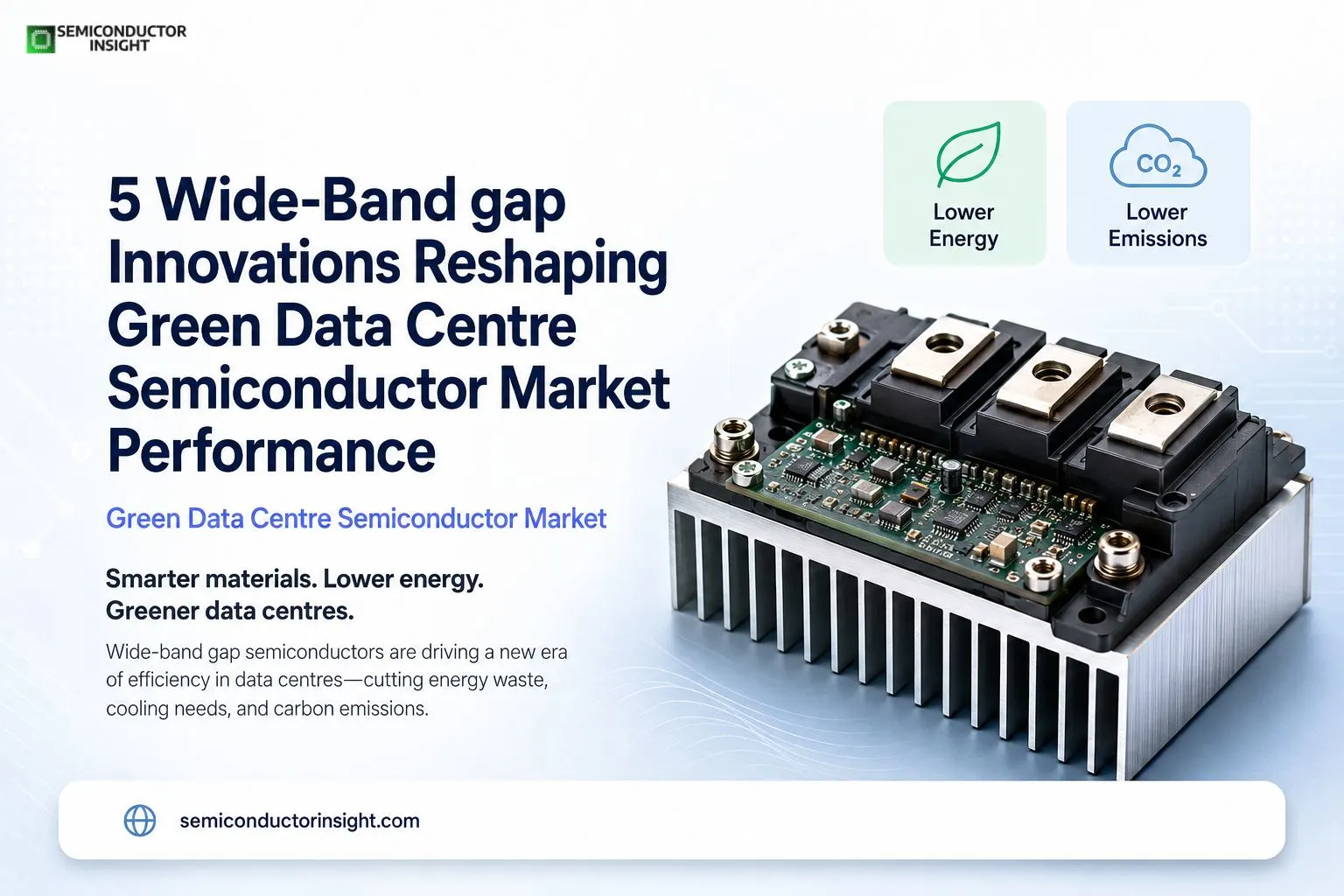
5 Wide-Band gap Innovations Reshaping Green Data Centre Semiconductor Market Performance
Data centres have become the backbone of modern digital life, yet their appetite for electricity keeps growing with every new AI workload and cloud expansion.
Semiconductors designed specifically for lower energy use now sit at the center of efforts to make these facilities more sustainable without sacrificing performance.
Where Wide-Band gap Materials Make Their Mark
- Gallium nitride and silicon carbide devices handle higher voltages and temperatures than traditional silicon, cutting switching losses in power supplies and converters.
- One analysis highlighted how shifting data centre power systems to these materials could avoid more than 100 terawatt-hours in annual energy waste globally while preventing around 125 million tons of carbon dioxide emissions by 2030.
- These numbers come from engineering projections rather than simple guesses, reflecting real differences in conversion efficiency that reach above 98% in some GaN implementations compared with 90 to 95% for older silicon approaches.
Energy-Efficient Semiconductor Innovation Gains Institutional Support
The development of AI-driven semiconductor design automation systems with an emphasis on energy efficiency is being accelerated by national technology initiatives and real-world experimentation. By employing saltwater as a natural thermal management system, Microsoft’s undersea data centre trials showed how sophisticated server architectures might function with incredibly low cooling overhead. These initiatives are motivating semiconductor engineers to create devices that can continue to function reliably in unusual, low-power computing settings.
At the same time, research into sophisticated packaging, intelligent power management technologies, and power-efficient microelectronics is being supported by government-backed programs like the U.S. CHIPS and Science Act. Global efforts to develop highly effective AI-focused computing infrastructure are being strengthened by similar semiconductor and clean-energy initiatives in Europe and Asia.
Strategic Adoption Journeys in Massive Computing Environments
Major operators now integrate silicon carbide MOSFETs into server power stages, achieving measurable drops in heat generation. These changes allow racks to run denser workloads while keeping overall facility power usage effectiveness closer to 1.1 or even lower in optimized cases. Liquid cooling systems paired with these semiconductors further reduce water consumption, sometimes by half, according to lifecycle assessments from technology developers.
Design Flows Adapting to Efficiency First
Engineers increasingly optimize entire power delivery networks from the chip level up to the rack. Tools that model thermal behavior and dynamic load changes help balance performance with energy draw. In practice, this means processors and memory modules that throttle intelligently or distribute tasks to avoid peak power spikes that strain cooling infrastructure.
- Packaging and Interconnects Playing Their Part
Advanced packaging techniques, including glass substrates and denser interconnects, cut energy lost in data movement between chips. For AI accelerators that dominate many green-focused data centres, these improvements matter because communication between processors can consume nearly as much power as the computation itself in some architectures.
- Workforce and Collaboration Shifts
Teams building these systems now include specialists who understand both semiconductor physics and facility operations. Universities and industry groups train engineers on wide-band gap device characteristics alongside data centre architecture, creating professionals who see the full picture from electrons to exhaust heat.
Don’t Forget to Surf Our Updated Report for More Detailed Analysis: https://semiconductorinsight.com/report/green-data-center-semiconductor-market/
Renewable Ties and System-Level Thinking
Semiconductors that enable smoother integration with solar, wind, and battery storage help data centres operate more flexibly. Bidirectional power converters based on modern materials allow facilities to feed excess energy back or store it efficiently, turning what was once a constant draw into a more balanced participant in the local grid.
Green Data centre Semiconductor Market continues to evolve through these layered improvements. Each new node, material choice, and integration method adds up to facilities that deliver massive computing capability while treading more lightly on resources. The journey involves countless small decisions made by designers, operators, and policymakers working in tandem, steadily reshaping how the world stores and processes its growing digital footprint.

Comments (0)