
Green Data Center Semiconductor Market Insights
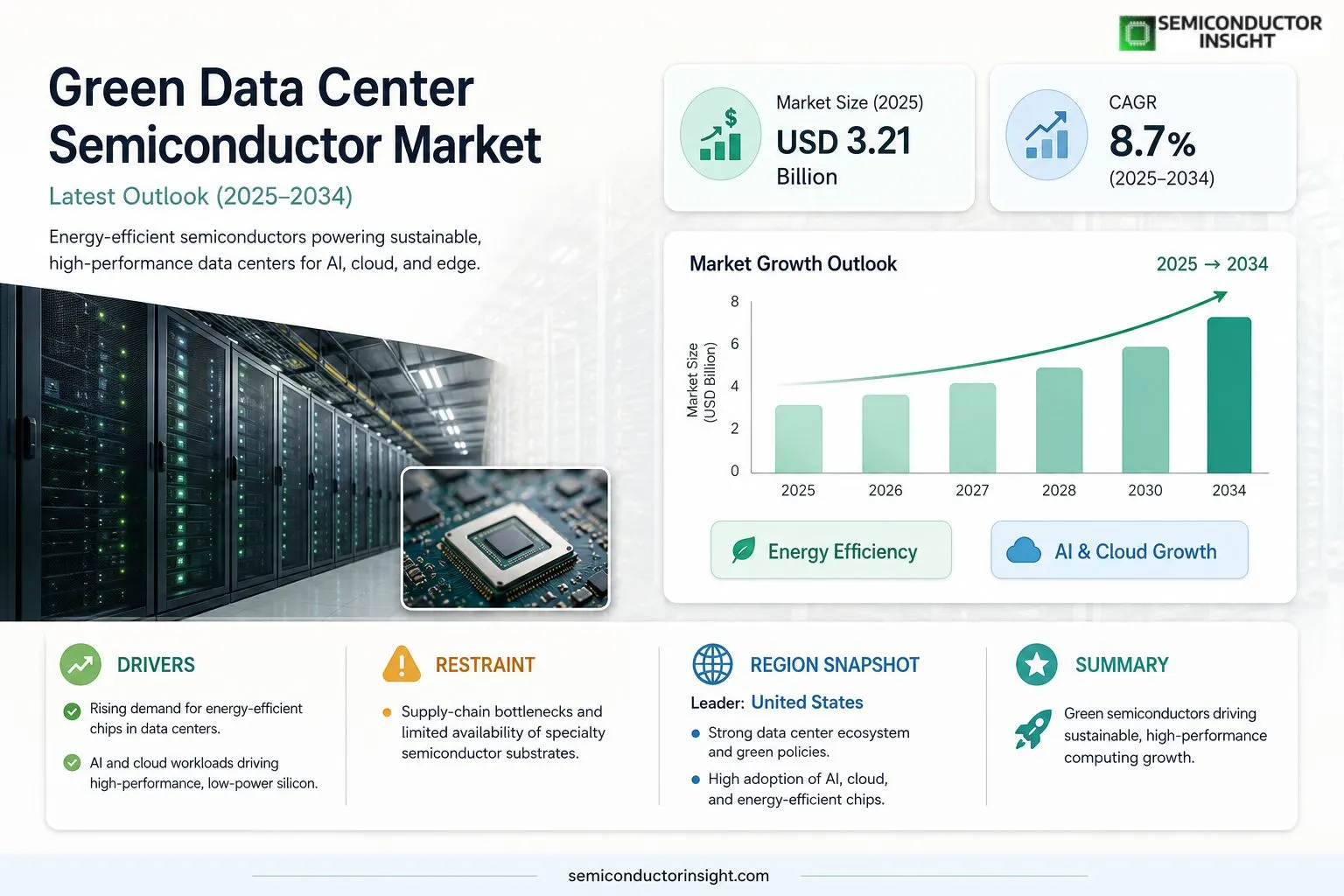
Global Green Data Center Semiconductor Market size was valued at USD 3.21 billion in 2025. The market is projected to grow from USD 3.45 billion in 2025 to USD 6.78 billion by 2034, exhibiting a CAGR of 8.7% during the forecast period.
Green Data Center Semiconductors are energy‑efficient integrated circuits engineered for high‑performance computing environments that prioritize low power consumption, reduced heat dissipation, and minimized carbon footprints while delivering robust processing capabilities for AI, cloud services, and edge applications.The market is experiencing rapid growth because corporations are intensifying sustainability commitments, AI and cloud workloads are expanding dramatically, and governments are enacting policies that incentivize greener IT infrastructure.Key players such as Intel, AMD, NVIDIA, Samsung Electronics, and TSMC are accelerating development of low‑power architectures and collaborating with data‑center operators to deploy these solutions at scale.
MARKET DRIVERS
Energy‑Efficiency Demands
The rapid expansion of hyperscale cloud providers has created a pressing need for chips that reduce power consumption per compute operation. Advanced low‑voltage architectures now account for over 35% of new semiconductor shipments for data centers, directly boosting Green Data Center Semiconductor market.
Regulatory Incentives
Governments in the EU, US, and Japan are offering tax credits for projects that achieve a 20% reduction in PUE (Power Usage Effectiveness). These incentives accelerate adoption of energy‑optimized ASICs and GaN‑based power converters, fueling market growth.
➤ “Energy‑centric chip design is now a competitive differentiator for data‑center operators seeking to lower OPEX.”
In addition, the rise of AI workloads demands higher performance per watt. Semiconductor vendors are integrating on‑chip AI accelerators that cut energy use by up to 40% compared with legacy GPUs, further propelling the sector.
MARKET CHALLENGES
High Development Costs
Designing ultra‑low‑power semiconductors requires extensive R&D investment, often exceeding $500 million per generation. Smaller vendors struggle to finance these programs, limiting supply diversity.
Other Challenges
Manufacturing Yield Constraints
Achieving high yields for sub‑10 nm processes with new materials such as silicon‑carbide introduces variability, which can delay product launch timelines and increase unit costs.
MARKET RESTRAINTS
Supply‑Chain Bottlenecks
Global semiconductor supply chain continues to experience periodic shortages of specialty substrates required for power‑efficient chips. Lead times have lengthened to 12‑18 months for critical components, restraining rapid deployment in green‑focused data centers.Furthermore, geopolitical tensions have restricted cross‑border collaboration on advanced node technologies, creating uncertainty for long‑term capacity planning.Finally, the limited availability of skilled engineers proficient in energy‑aware design methodologies adds a human‑resource constraint that slows product cycles.
MARKET OPPORTUNITIES
Edge‑Computing Expansion
Deployments of edge data centers near renewable energy sites are driving demand for compact, low‑heat semiconductor solutions. These nodes benefit from high‑efficiency power‑management ICs, opening a new revenue channel for designers.Emerging standards for liquid‑cooling compatible chips present another growth vector. Manufacturers that certify their products for direct‑to‑coolant operation can capture premium market share.Lastly, the convergence of quantum‑ready and energy‑aware silicon offers a long‑term strategic opportunity. Early adopters that invest in research collaborations stand to lead the next wave of sustainable computing hardware.
Green Data Center Semiconductor Market Trends
Accelerating Adoption of Low‑Power Semiconductor Architectures
Data‑center operators are rapidly shifting to semiconductor solutions that prioritize energy efficiency without compromising processing power. This shift is driven by corporate sustainability mandates, expanding AI and cloud workloads, and regulatory incentives for greener IT infrastructure. Manufacturers such as Intel, AMD, NVIDIA, Samsung Electronics, and TSMC are delivering integrated circuits that reduce power draw, lower heat generation, and thereby cut overall data‑center carbon footprints. The trend reflects a broader industry consensus that next‑generation workloads must be supported by hardware designed for minimal environmental impact.
Other Trends
Advanced Thermal Management Integration
Thermal design is becoming a central consideration as semiconductor power density increases. Companies are embedding sophisticated cooling technologies,such as micro‑fluidic channels and heat‑pipe architectures,directly into chip packages. This approach not only improves reliability but also enhances overall energy efficiency by reducing the need for external cooling infrastructure. The result is a tighter feedback loop between power consumption and heat dissipation, aligning with the goals of Green Data Center Semiconductor market.
Strategic Partnerships and Ecosystem Development
Collaboration across the semiconductor supply chain is intensifying. Chip designers are partnering with data‑center operators, software vendors, and cloud service providers to co‑develop solutions that are optimized for specific workload profiles. These alliances accelerate deployment cycles, ensure compatibility with emerging AI frameworks, and enable joint investments in research that targets further reductions in standby power. The ecosystem approach is reinforcing market momentum while delivering measurable operational savings for end users.
COMPETITIVE LANDSCAPEKey Industry Players
Green Data Center Semiconductor Market Overview
Green Data Center Semiconductor market is anchored by a handful of global giants that control the majority of design IP and foundry capacity. Intel and AMD dominate the CPU segment with low‑power architectures specifically tuned for hyperscale workloads, while NVIDIA leads the GPU and accelerator space, offering AI‑optimized silicon that reduces energy per inference. The market’s CAGR of 8.7 % is driven by these incumbents’ heavy R&D investments and strategic partnerships with cloud providers, which accelerate the rollout of greener compute platforms at scale. The market was valued at USD 3.21 billion in 2025 and is projected to reach USD 6.78 billion by 2034, underscoring the rapid adoption of energy‑efficient silicon across hyperscale and edge data‑center segments.
Beyond the tier‑one players, a diverse set of niche innovators is expanding the green semiconductor ecosystem. Qualcomm’s edge‑focused SoCs and Broadcom’s networking ASICs emphasize power‑saving protocols for inter‑rack communication. Arm Holdings supplies energy‑efficient CPU cores that power many custom silicon solutions, while Marvell Technology delivers storage‑class memory controllers optimized for low‑latency, low‑power operation. Emerging companies such as Cerebras Systems and Xilinx (now part of AMD) introduce specialized architectures for AI training and reconfigurable workloads, further fragmenting the market and fostering competition that drives overall sustainability improvements. In addition, specialized memory providers such as Micron Technology and storage innovators like Samsung’s V‑NX series contribute to the power‑optimized data‑flow, while ecosystem partners including Google’s TPU and IBM’s Power9 platforms demonstrate the growing demand for purpose‑built low‑energy processors.
List of Key Green Data Center Semiconductor Companies Profiled
- Intel
- AMD
- NVIDIA
- Samsung Electronics
- TSMC
- Qualcomm
- Broadcom
- Arm Holdings
- Marvell Technology
- Cerebras Systems
- Xilinx (AMD)
- IBM
- Google (TPU)
- Micron Technology
- MediaTek
Segment Analysis:
| Segment Category | Sub-Segments | Key Insights |
| By Type |
|
Low‑Power ASICs
|
| By Application |
|
AI Acceleration
|
| By End User |
|
Cloud Service Providers
|
| By Power Efficiency |
|
Dynamic Voltage Scaling Solutions
|
| By Deployment Model |
|
Edge‑Integrated Data Centers
|
Regional Analysis: North America
North America
The integration of green technologies and semiconductors is no longer a future consideration but a present necessity for data center operators in North America. This trend is further propelled by government initiatives promoting green computing and corporate social responsibility. The market is witnessing a surge in demand for semiconductors designed for AI and machine learning workloads, which are increasingly being deployed in data centers to enhance efficiency and decision-making. The competitive landscape is characterized by a mix of established semiconductor manufacturers and specialized companies focusing on green computing solutions.
The demand for power management integrated circuits is escalating within North American data centers. These chips are critical for optimizing energy usage and ensuring system stability.
High-performance, low-power processors are in high demand to meet the computational needs of modern data centers without excessive energy consumption.
Energy-efficient memory technologies are gaining traction as data centers strive to minimize their overall energy footprint.
Silicon photonics is contributing to more efficient cooling solutions within data centers, reducing energy waste associated with thermal management.
United States
The United States represents the largest market within North America for Green Data Center Semiconductor Market solutions. Driven by a substantial data center infrastructure and proactive government policies, the nation is investing heavily in sustainable computing practices. Key trends include the adoption of advanced cooling technologies and the integration of AI-powered energy management systems. The focus remains on enhancing the efficiency of data center operations while reducing environmental impact.
The U.S. government’s emphasis on energy efficiency standards and green procurement initiatives further stimulates market growth. Furthermore, the region’s strong research and development capabilities are fostering innovation in semiconductor technologies tailored for green data centers. The demand for specialized chips designed to optimize power delivery and thermal performance is expected to rise significantly in the coming years.
Canada
Canada’s Green Data Center Semiconductor Market is experiencing steady growth, propelled by a growing focus on sustainability and energy conservation. Government initiatives and corporate commitments to reduce carbon emissions are driving investment in energy-efficient data center technologies. While the market size is smaller compared to the U.S., Canada offers significant potential for growth, particularly in specialized applications like cloud computing and AI.
Increased regulatory pressure and a growing awareness of environmental responsibility are key factors influencing market dynamics. The demand for low-power semiconductors and energy-efficient cooling solutions is evident, positioning Canada as a promising market for semiconductor suppliers focused on green computing.
Mexico
Mexico’s Green Data Center Semiconductor Market is an emerging segment, benefiting from its strategic location and growing data center industry. The country’s increasing adoption of cloud computing and digital services is driving demand for energy-efficient semiconductor solutions. Government support for infrastructure development and a growing emphasis on environmental sustainability are contributing to market expansion.
The rising cost of energy and increasing environmental regulations are key drivers for adopting energy-efficient data center technologies. The market presents a compelling opportunity for semiconductor suppliers looking to tap into the rapidly expanding data center sector in North America.
Leading Region: United States
The United States stands out as the leading region in Green Data Center Semiconductor market within North America. Its robust data center infrastructure, proactive government policies, and strong technological ecosystem create a highly favorable environment for growth. The demand for energy-efficient semiconductors is particularly strong, driven by a combination of regulatory pressures, corporate sustainability goals, and the growing adoption of AI and cloud computing. The U.S. market is witnessing significant investment in R&D and innovation, further solidifying its position as a key player in this sector.
Report Scope
This market research report provides a comprehensive analysis of the Green Data Center Semiconductor Market , covering the forecast period 2026–2034. It offers detailed insights into market dynamics, technological advancements, competitive landscape, and key trends shaping the industry.
Key focus areas of the report include:
- Market Overview: The report begins with an overview outlining its current market scenario, key growth indicators, and industry transformation drivers. It discusses macroeconomic factors, demand–supply balance, regulatory landscape, and the strategic role of semiconductors in powering advancements across industries such as automotive, telecommunications, consumer electronics, and industrial automation.
- Market Size & Forecast: Historical data and future projections for revenue, unit shipments, and market value across major regions and segments.
- Segmentation Analysis: Detailed breakdown by product type, technology, application, and end-user industry to identify high-growth segments and investment opportunities.
- Regional Insights: Insights into market performance across North America, Europe, Asia-Pacific, Latin America, and the Middle East & Africa, including country-level analysis where relevant.
- Competitive Landscape: Profiles of leading market participants, including their product offerings, R&D focus, manufacturing capacity, pricing strategies, and recent developments such as mergers, acquisitions, and partnerships.
- Technology Trends & Innovation: Assessment of emerging technologies, integration of AI/IoT, semiconductor design trends, fabrication techniques, and evolving industry standards.
- Market Drivers & Restraints: Evaluation of factors driving market growth along with challenges, supply chain constraints, regulatory issues, and market-entry barriers.
- Stakeholder Insights: Insights for component suppliers, OEMs, system integrators, investors, and policymakers regarding the evolving ecosystem and strategic opportunities.
Primary and secondary research methods are employed, including interviews with industry experts, data from verified sources, and real-time market intelligence to ensure the accuracy and reliability of the insights presented.
FREQUENTLY ASKED QUESTIONS:
What is the current market size of Green Data Center Semiconductor Market?
-> Green Data Center Semiconductor market was valued at USD 3.21 billion in 2025 and is expected to reach USD 6.78 billion by 2034, with a CAGR of 8.7% during the forecast period.
Which key companies operate in Green Data Center Semiconductor Market?
-> Key players include Intel, AMD, NVIDIA, Samsung Electronics, and TSMC, among others.
What are the key growth drivers?
-> Key growth drivers include intensifying corporate sustainability commitments, rapid expansion of AI and cloud workloads, and supportive government policies that incentivize greener IT infrastructure.
Which region dominates the market?
-> Regional dominance information is not disclosed in the provided data.
What are the emerging trends?
-> Emerging trends include development of energy‑efficient integrated circuits designed for AI, cloud services, and edge applications, offering reduced power consumption and heat dissipation.

Get Sample Report PDF for Exclusive Insights
Report Sample Includes
- Table of Contents
- List of Tables & Figures
- Charts, Research Methodology, and more...
 Download Sample Report PDF





