
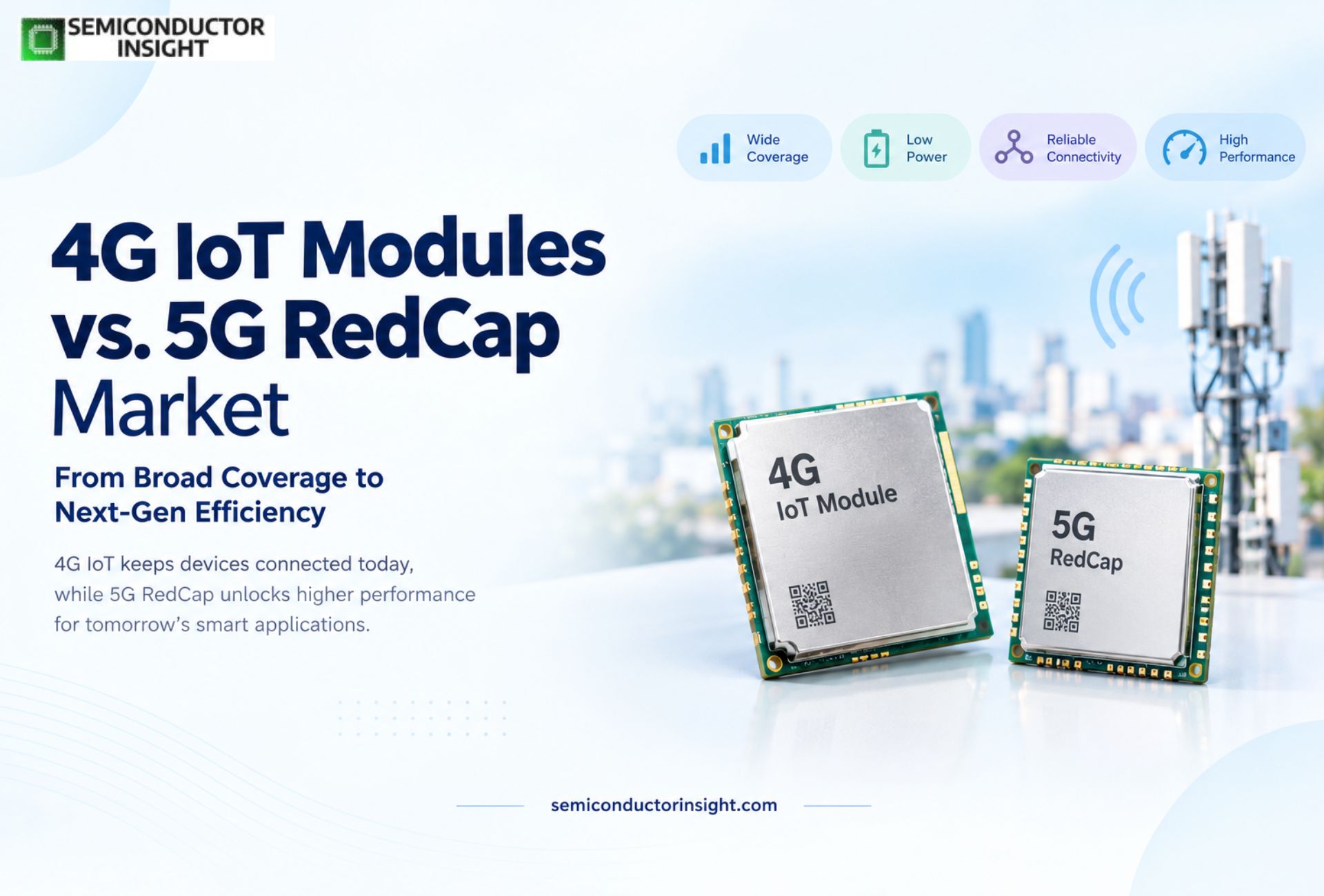
4G IoT Modules vs. 5G RedCap in 2026: Where LTE Still Has the Practical Advantage
The 4G IoT module is no longer simply a connectivity component sitting inside a tracker or industrial gateway. It has become a practical bridge between the enormous installed base of LTE networks and a new generation of connected equipment. While 5G is moving into higher-performance applications, LTE continues to provide the combination of coverage, mobility, power efficiency, hardware maturity and deployment economics that many IoT products actually need.
You Can Freely Surf Our Latest Updated Report Here: https://semiconductorinsight.com/report/4g-iot-modules-market/
The number that changes the conversation
Ericsson estimates that cellular IoT connections reached around 4.5 billion at the end of 2025, with broadband and critical IoT accounting for approximately 2.6 billion connections. The company expects total cellular IoT connections to approach 7.8 billion by 2031.
That installed connectivity base matters for module manufacturers. A product designed today may need to operate for five, eight or even ten years, making network longevity and regional compatibility just as important as peak download speed.
LTE is finding its sweet spot in the middle
The 4G IoT module market occupies an interesting position between ultra-low-data LPWAN technologies and higher-performance 5G hardware.
LTE Cat 1 and Cat 1 bis are particularly relevant because Cat 1 supports theoretical speeds of approximately 10 Mbps downlink and 5 Mbps uplink, according to Ericsson.
That is sufficient for a surprisingly broad range of connected products, including:
- Vehicle telematics and fleet equipment
- Payment terminals and kiosks
- Asset and cargo tracking
- Smart meters
- Remote monitoring systems
- Security equipment
- Portable medical devices
The attraction is not maximum bandwidth. It is getting enough bandwidth in a compact, mature and widely deployable cellular platform.
Cat 1 bis is changing the hardware equation
One of the most important developments is the growing use of LTE Cat 1 bis, which uses a single receive/transmit antenna architecture rather than the two antennas traditionally associated with Cat 1. That can simplify RF design and help manufacturers build smaller devices.
– Recent module introductions illustrate this shift. In March 2025, Telit Cinterion introduced its LE310 Cat 1 bis series in a 15 × 18 mm form factor, targeting asset tracking, telematics, wearables and portable medical equipment.
– Quectel’s EG916Q family similarly supports up to 10 Mbps downlink and 5 Mbps uplink and is positioned for applications ranging from payment and telematics to smart metering and remote monitoring.
Network sunsets are creating a hardware replacement cycle
The 4G opportunity is also being shaped by what is disappearing.
By the end of 2025, Ericsson reported that 80 service providers had completely shut down 3G networks, while 46 had fully switched off 2G services. The continued retirement of legacy networks is encouraging operators and enterprises to replace older connected equipment with modern LTE or 5G-compatible hardware.
This creates a very different type of demand. Some module deployments are not new IoT installations at all; they are migration projects replacing hardware that can no longer rely on its original cellular network.
A module increasingly has to do more than connect
Modern IoT modules are becoming miniature connectivity platforms. GNSS, security functions, multiple protocol stacks, remote management capabilities and regional cellular bands are increasingly packaged around the modem.
Telit Cinterion’s LE910Q1, for example, combines Cat 1 bis connectivity with Wi-Fi, cellular and GNSS-based positioning and supports IPv4/IPv6 as well as protocols including TCP, UDP, HTTP and HTTPS.
This reduces the amount of additional hardware that product designers need to integrate.
The 4G-to-5G transition will not happen in one jump
5G RedCap is emerging as a lower-complexity 5G option, but it does not immediately eliminate the role of LTE. Ericsson reports that 14 service providers had commercially launched 5G RedCap by 2026, while 42 providers across 27 countries were investing in the technology.
For many applications, the decision therefore looks less like 4G versus 5G and more like selecting the appropriate connectivity layer.
Low data → NB-IoT / LTE-M
Moderate data + mobility → LTE Cat 1 / Cat 1 bis
Higher performance → 5G / RedCap
That positioning is likely to keep 4G IoT modules relevant well into the next phase of cellular IoT deployment, particularly where reliability, compact hardware, established network coverage and long product lifecycles matter more than headline data rates.

Comments (0)