Key Statistics
Key Takeaways
- Alumina ceramics remain the principal material platform because established multilayer and hermetic package processes combine predictable dielectric behavior, mechanical strength and broad supplier familiarity across industrial and high-reliability electronics.
- Aluminum nitride ceramics are the higher-value growth path where thermal conductivity becomes a purchase driver, particularly in high-power electronics, laser/optical modules and demanding automotive applications.
- Automotive electronics and communication devices create the strongest incremental demand because power density, RF performance and reliability increasingly outweigh the cost advantage of plastic packages.
- Asia Pacific is the leading regional manufacturing and consumption base, while North America and Europe retain disproportionate value in aerospace, defense, medical and other qualification-heavy applications.
- Cost and manufacturability remain the core restraints, because ceramic processing involves high-temperature firing, precision metallization and tighter dimensional control than commodity polymer packaging.
- Miniaturization, EV power electronics and optical communications are shifting competition toward suppliers with advanced material engineering, fine-feature processing, hermetic sealing and customer co-development capability.
Ceramic Packages Market Overview
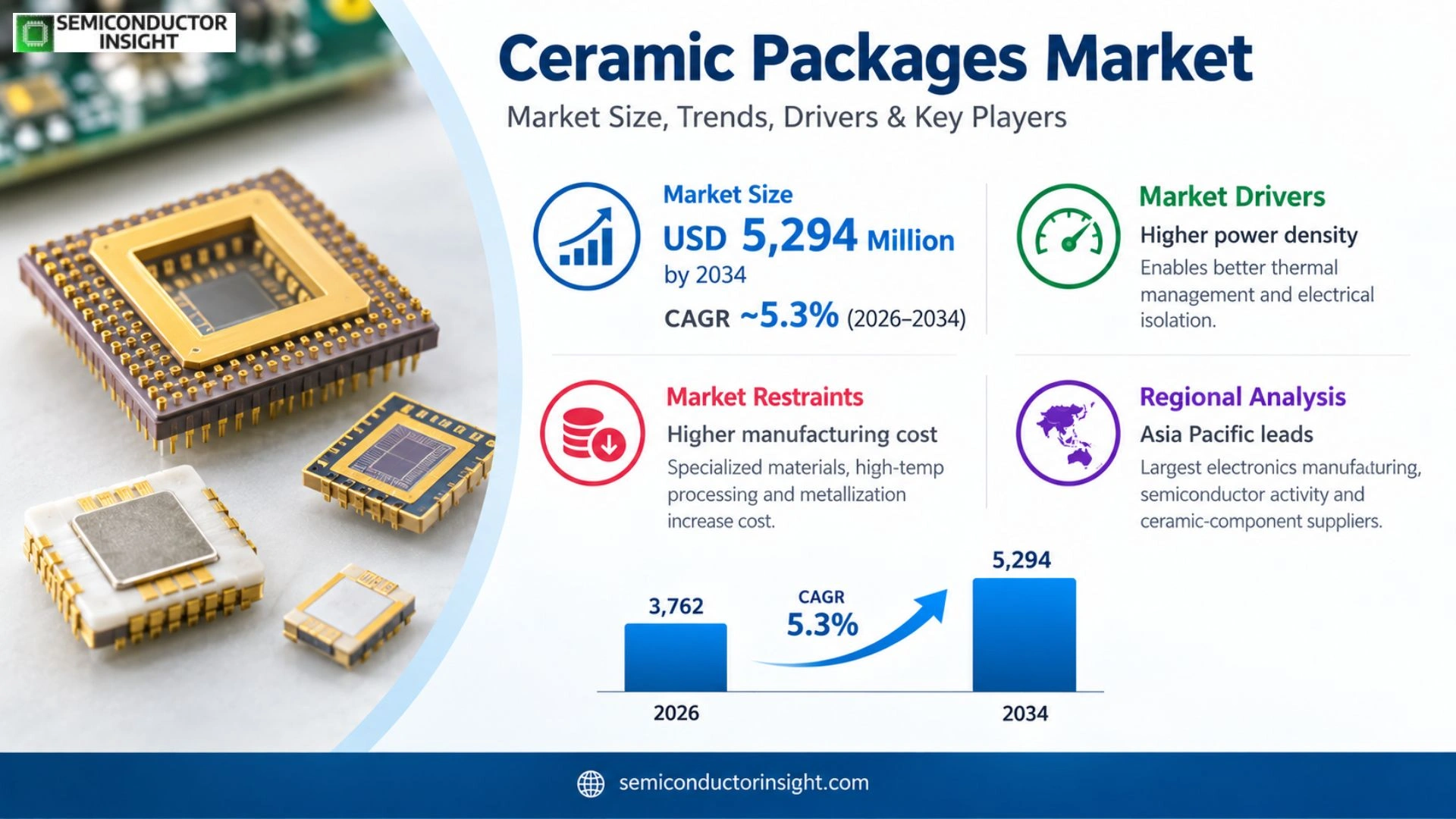
Ceramic packages market is projected from USD 3,321 million in 2025 to USD 5,294 million by 2034, representing a 5.3% CAGR during 2026–2034. Asia Pacific is the largest regional market because the region combines high-volume electronics manufacturing with established ceramic component supply chains and expanding semiconductor packaging activity.
Ceramic packages are protective and interconnect structures that surround semiconductor devices, sensors and other electronic components while controlling heat flow, electrical isolation and environmental exposure. Their value is highest where moisture resistance, dimensional stability, hermeticity, radiation tolerance or thermal management matters more than the lowest possible package cost. The market therefore spans high-reliability integrated circuits, RF modules, optoelectronics, power components, sensor assemblies and specialized industrial electronics.
The package architecture typically combines a ceramic body, conductive metallization, terminals or pads and a lid or sealing interface. Alumina remains widely used because it is established, comparatively economical and compatible with mature multilayer manufacturing routes, while aluminum nitride is selected when higher thermal conductivity is worth the material premium. Selection is consequently driven by heat load, electrical design, environmental exposure, package geometry, assembly method and customer qualification requirements rather than material price alone.
Demand is changing because modern devices place greater functional density inside smaller thermal envelopes. Automotive power electronics, RF front ends, optical communications, aerospace systems and high-power LED assemblies all create situations in which polymer packages can face limits on heat, dimensional stability or long-term environmental performance. Suppliers are responding with thinner walls, finer conductor patterns, multilayer structures, improved seals and more integrated package-and-assembly offerings, which shifts competitive value toward process capability rather than raw ceramic volume.
Segment Analysis: By Type
The client report defines the material-type segmentation as Alumina Ceramics, Aluminum Nitride Ceramics, and Others. Alumina is the established volume base because of its broad manufacturing ecosystem, while aluminum nitride is the more performance-driven segment where heat spreading and power density create a stronger willingness to pay.
| Type | Core characteristics | Market position |
|---|---|---|
| Alumina Ceramics | Mature ceramic platform with established sintering, metallization and multilayer processing routes. It balances mechanical strength, electrical insulation, chemical stability and cost across many package designs. | Largest base. Widely specified where reliability is essential but thermal conductivity requirements do not justify an aluminum-nitride premium. Strong in general semiconductor, sensor, industrial and defense packaging. |
| Aluminum Nitride Ceramics | High-thermal-conductivity ceramic selected for heat-intensive electronic designs and applications where coefficient-of-thermal-expansion matching and electrical isolation are both important. | Fastest value opportunity. Particularly relevant to high-power devices, RF, optical modules, laser assemblies and advanced automotive electronics where thermal bottlenecks directly affect system reliability. |
| Others (Zirconia, Silicon Carbide, etc.) | Specialized ceramic families used selectively for mechanical toughness, wear resistance, thermal performance or niche environmental requirements. | Smaller, specification-led segment. Growth is tied to specialized applications rather than broad substitution, and qualification cycles can be longer because customers demand application-specific reliability evidence. |
Segment Analysis: By Application
The application segmentation is Automotive Electronics, Communication Devices, Aeronautics and Astronautics, High Power LED, Consumer Electronics, and Others. Communication devices and automotive electronics provide the strongest structural demand drivers because RF density, thermal loads and reliability requirements are rising simultaneously.
| Application | Demand characteristics |
|---|---|
| Automotive Electronics | Purchasing is triggered by reliability, thermal cycling, vibration exposure and the increasing concentration of power and control functions in EVs and ADAS systems. Suppliers are rewarded when package designs can survive demanding qualification while supporting compact electronics. |
| Communication Devices | Demand centers on RF modules, optical communications and high-frequency electronics where dielectric behavior, dimensional control, thermal stability and package integration affect signal integrity and system size. |
| Aeronautics and Astronautics | Qualification, long service life and resistance to vibration, temperature and radiation dominate purchasing. Customers value traceability, hermeticity, stable processes and the ability to support legacy designs for many years. |
| High Power LED | Thermal extraction is the purchase trigger. Ceramic packages support higher junction-temperature management and long operating life, making them relevant to automotive lighting, industrial lighting and other high-brightness applications. |
| Consumer Electronics | Cost, compactness and supply responsiveness govern adoption. Ceramic solutions are concentrated in applications where their reliability or thermal benefits justify a premium over polymer alternatives. |
| Others | This category includes specialized medical, industrial, sensor and mixed high-reliability electronics where product specifications vary substantially and package choices are typically design-led rather than standardized. |
Regional Analysis
Asia Pacific leads the ceramic packages market because it combines the largest concentration of electronics manufacturing, semiconductor activity and mature ceramic-component suppliers. North America retains strong value in aerospace, defense and advanced electronics, while Europe is anchored by automotive and industrial applications; South America and the Middle East & Africa remain smaller, project- and import-led markets.
How does regional demand differ across ceramic packages?
Regional demand is separated by industrial structure rather than geography alone. Asia Pacific benefits from manufacturing scale and dense supplier ecosystems, North America from high-reliability and aerospace programs, Europe from automotive and industrial engineering, South America from selective imported equipment demand, and Middle East & Africa from energy, infrastructure and defense projects. Supplier strategy therefore changes by region: volume availability matters most in Asia, qualification and lifecycle support in the West, and channel reliability in emerging markets.
| Region | Position | Growth outlook | Demand profile | What decides supplier selection |
|---|---|---|---|---|
| Asia Pacific | Largest | Highest structural expansion | Electronics manufacturing and semiconductor ecosystem led | Cost, capacity, localized engineering and ability to support qualification with major OEM and packaging customers |
| North America | Second | Steady to strong | Aerospace, defense, medical and advanced electronics | Qualification pedigree, traceability, hermetic reliability and domestic technical support |
| Europe | Third | Moderate | Automotive, industrial and communications | Automotive-grade reliability, engineering collaboration and compliance documentation |
| South America | Fourth | Selective | Import dependent and project oriented | Landed cost, distribution reach and application support |
| Middle East & Africa | Smallest | Project driven | Energy, infrastructure, defense and specialized electronics | Supply continuity, project qualification and regional channel capability |
Competitive Landscape
Competition in ceramic packages is structured around material capability, hermetic and metallization quality, package miniaturization, customer qualification and the ability to support long production lifecycles. The leading suppliers combine ceramic processing with package design and assembly, while specialized companies defend niches in photonics, RF, aerospace and high-reliability electronics.
Key Industry Players
- KYOCERA Corporation
- NGK/NTK
- ChaoZhou Three-circle (Group)
- Morgan Advanced Materials
- Murata Manufacturing Co., Ltd
- Amkor Technology
- Corning Incorporated
- SCHOTT AG
- Remtec Inc.
- CoorsTek, Inc
- MARUWA
- AMETEK
- Hebei Sinopack Electronic Tecnology Co.Ltd
- NCI
- Yixing Electronic
- LEATEC Fine Ceramics
- Shengda Technology
Large suppliers compete through integrated ceramic materials, package engineering and global customer support. Kyocera, NGK/NTK and MARUWA, for example, combine deep ceramic-processing experience with specialized electronics applications, allowing them to participate earlier in customer design cycles. That matters because package geometry, metallization and sealing are often constrained by the device architecture, so early engineering involvement can create a durable supplier position.
Specialized competitors differentiate through hermeticity, RF and optical package capability, unusual package geometries and high-reliability qualification. Companies serving aerospace, defense, photonics and medical applications can command stronger margins because qualification and process documentation are difficult to replace. The competitive test is therefore not only manufacturing cost but the supplier’s ability to maintain a validated process while responding to design changes over long product lifecycles.
Asian manufacturers compete aggressively on production scale and localization, while North American and European suppliers often emphasize qualification, customer engineering and specialized assembly. This regional pattern creates a two-speed market: high-volume ceramic demand rewards productivity and capacity utilization, whereas premium programs reward reliability pedigree and technical service. The companies with the broadest competitiveness can move between both models by using standardized platforms alongside custom engineering services.
Partnerships are becoming more important as ceramic packaging intersects with photonics, AI electronics, automotive sensing and chiplet architectures. Suppliers that can combine ceramics with lids, optical interfaces, assembly or testing increase the share of the customer’s qualification workload they control. That raises switching costs and can protect pricing even when standard ceramic materials remain exposed to raw-material and energy cost pressure.
Production Capacity Analysis
Ceramic package production is constrained less by raw ceramic availability alone than by the combination of powder or tape quality, forming precision, co-firing yield, metallization, sealing, dimensional inspection and application-specific qualification. Capacity therefore expands in stages, with suppliers adding furnaces, machining and metallization capability only when customer programs justify the investment and stable utilization.
| Capacity stage | Primary constraint | Commercial implication |
|---|---|---|
| Material preparation and tape/powder processing | Purity, particle control and reproducibility | Quality drift at this stage propagates through the package, so stable material supply is a prerequisite for higher downstream yields. |
| Forming, lamination and sintering | Furnace capacity, shrinkage control and process windows | Expansion requires capital and process engineering; yield improvement can add effective capacity without adding all-new lines. |
| Metallization and package finishing | Fine-feature printing, plating, brazing and dimensional control | Higher-value packages depend on precise interconnect and sealing processes that can become the real bottleneck at advanced geometries. |
| Qualification and assembly | Customer-specific testing and controlled change management | A production line may have physical capacity available but remain commercially constrained until additional designs complete qualification. |
Capacity decisions are increasingly linked to semiconductor, automotive and optical-program visibility. Kyocera’s 2025 integrated report explicitly highlighted production-capacity expansion and ceramic-package growth initiatives, including expansion in Vietnam and work toward ceramic chiplet packaging. This illustrates a broader industry logic: suppliers invest when they can see durable customer programs, because advanced ceramic capacity is specialized and cannot be redeployed as easily as commodity polymer molding equipment. The commercial advantage of new capacity therefore depends on qualification wins and utilization, not installed square meters alone.
Market Dynamics
The market is being shaped by a balance between rising thermal and reliability requirements and the persistent cost advantage of alternative packages. On the positive side, electrification, communications, optics and high-power electronics are increasing the number of designs where ceramics solve a real system problem. On the negative side, simpler consumer products can often meet their requirements with lower-cost plastic packages.
Market Drivers
Higher power density
As power density increases, package materials become an active part of thermal design rather than passive protection. Ceramic packages help engineers manage electrical isolation and heat simultaneously, especially in high-power electronics and LED applications. The commercial response is greater use of aluminum nitride and advanced ceramic geometries where the thermal benefit can reduce system-level cooling demands. This widens the addressable opportunity beyond traditional high-reliability niches and toward power-dense electronics.
Growth of high-frequency communications
RF and optical communications place tight constraints on dielectric behavior, dimensional stability and package integration. Ceramic structures support these requirements because they can maintain stable mechanical and electrical properties while incorporating conductors, cavities, interfaces and protective lids. Suppliers with fine-feature processing and optical or RF assembly capabilities can therefore capture more value than vendors limited to basic package bodies, particularly as communications systems move toward higher frequencies and tighter physical integration.
Electrification and automotive electronics
Vehicle electrification increases the amount of power electronics, sensing and control content that must operate reliably under thermal cycling and vibration. Ceramic packaging can become attractive when the cost of failure exceeds the incremental package cost and when thermal management is a major design variable. Automotive qualification also creates a strong barrier to supplier switching, making the segment commercially attractive to vendors that can establish early design-in relationships and maintain stable manufacturing over long production programs.
Long-life aerospace and defense electronics
Aerospace and defense programs value lifecycle reliability, traceability and resistance to environmental stress. Ceramic packages are often suited to these environments because hermetic sealing, mechanical stability and thermal behavior can be engineered into the package architecture. The resulting demand is lower volume but higher value, with purchasing driven by qualification and mission risk rather than unit price. Suppliers that support legacy products and controlled process changes can retain business for many years.
Market Restraints
Higher manufacturing cost
Ceramic packages require specialized materials, high-temperature processing, dimensional control and metallization steps that generally cost more than commodity plastic encapsulation. In cost-sensitive consumer applications, the package economics may therefore outweigh the benefits of thermal or environmental robustness. Suppliers can address this by simplifying designs, improving yield and targeting applications where ceramic performance produces a measurable system-level benefit, but the structural cost premium remains a barrier to broad substitution.
Brittleness and handling requirements
Ceramic materials offer high strength in many operating conditions but can still be vulnerable to brittle fracture during manufacturing, assembly or mechanical shock. Fine package geometries increase this sensitivity because thin walls and precise features narrow process tolerances. Manufacturers respond with tighter handling, inspection and process controls, but those measures add cost. The restraint is most significant in high-volume applications where small improvements in package reliability may not offset incremental manufacturing complexity.
Alternative packages remain strong
Plastic, metal and organic package technologies continue to improve, narrowing the situations where ceramic is the only practical solution. Advanced polymers can deliver smaller, lighter and cheaper packages for many applications, while metal packages can remain competitive in specific thermal and mechanical architectures. Ceramic suppliers therefore need to target the failure modes and system constraints that alternatives cannot address efficiently, rather than assuming that higher reliability automatically creates demand.
Long qualification cycles
Qualification can take months or years in aerospace, automotive and medical programs, slowing revenue conversion even after technical performance has been demonstrated. New suppliers must support customer testing, documentation, process audits and controlled design changes before volume orders begin. While this barrier protects incumbents after qualification, it also makes market expansion slower and increases the working-capital burden for suppliers investing ahead of the final production award.
Market Opportunities
EV power electronics
Electric vehicles create opportunities where ceramic packaging can improve thermal paths and reliability in inverters, sensors, lighting and power-management assemblies. The beneficiaries are ceramic producers with aluminum-nitride capability, metallization expertise and automotive qualification systems. As power density increases, packaging and cooling cannot be optimized independently. Commercially, this means suppliers can win on a system-level thermal and reliability proposition rather than a narrow package-cost comparison.
Optical communications and photonics
Optical modules increasingly combine sensitive devices, high-speed electrical interfaces and thermal-management requirements inside compact packages. Ceramic platforms are attractive where hermetic sealing, dimensional stability and optical integration matter. Suppliers with experience in ceramic optical packages, lids, carriers and assembly can capture more value because they address both protection and integration. The opportunity is strongest in premium communications, sensing and photonics systems where signal and reliability performance outweighs package price.
Miniaturized medical and sensor packages
Medical sensors and miniaturized instrumentation require stable electrical interfaces and protection against moisture, chemicals and long-term environmental exposure. Ceramic packages can offer these properties in compact formats, creating opportunities for suppliers with fine-feature processing and hermetic assembly. The commercial benefit comes from enabling a smaller or more durable device while meeting qualification requirements. Design wins can be sticky because changing a qualified package architecture in a medical system is costly and time consuming.
Ceramic chiplet and advanced packaging
As semiconductor architectures become more heterogeneous, ceramic packages and ceramic interposers can become relevant to specialized chiplet and optical-electrical integration schemes. The beneficiaries are suppliers able to combine high-density interconnect, low-loss materials, thermal management and precision assembly. The opportunity is still application-specific, but the design direction increases the strategic value of ceramic expertise because advanced packaging pushes materials and geometry closer to the system-performance boundary.
Supply Chain Analysis
Raw-material suppliers capture value through purity, particle-size control and composition stability. Ceramic package manufacturers cannot easily compensate for upstream inconsistency because firing shrinkage, electrical properties and dimensional behavior are highly sensitive to material inputs. The commercial bottleneck is therefore not simply access to alumina or aluminum nitride but repeatable semiconductor-grade quality, with suppliers often preferring qualified material sources even when spot-market alternatives are cheaper.
Ceramic forming and co-firing create the central manufacturing conversion step. Yield depends on tooling, lamination, furnace profile and dimensional control, so effective capacity can vary substantially even when installed equipment remains constant. Suppliers that continuously improve yield can increase output without proportional capital expenditure, making process engineering a major competitive asset. Customers benefit through shorter lead times and lower defect rates, while manufacturers protect margins without relying only on price increases.
Package finishing includes metallization, plating, brazing, sealing and inspection, and these steps often determine whether a ceramic body can become a qualified electronic package. Fine-feature metallization and reliable hermetic sealing create higher technical barriers than basic ceramic shaping. Companies that integrate these processes can retain more value and reduce coordination risk for customers, especially in RF, optical and aerospace applications where interfaces and sealing performance are part of the qualification package.
Device assembly and qualification represent the downstream commercial bottleneck because the package becomes linked to a specific chip, sensor or module design. Once a ceramic package is qualified, the supplier can benefit from long programs, recurring orders and high switching costs, but winning that position requires engineering support and disciplined change control. This is why the most resilient suppliers increasingly market complete packaging and assembly capabilities rather than a standalone ceramic component.
Recent Developments
January 21, 2025
Development: Kyocera announced its participation in SPIE Photonics West 2025 with ceramic packages, AlN and alumina carriers, optical lids and semiconductor microelectronic assembly services. Why it matters: The development showed how ceramic packaging is being positioned at the intersection of photonics, sensing and advanced semiconductor assembly, expanding the addressable opportunity beyond legacy IC packaging.
March 2025
Development: Kyocera’s 2025 integrated reporting emphasized growth plans for ceramic packages, including expansion of production capacity in Vietnam and migration toward ceramic chiplet packages. Why it matters: The move is commercially significant because it ties regional capacity expansion to emerging advanced-packaging demand and strengthens the role of ceramics in heterogeneous integration.
2025
Development: Texas Instruments continued to offer ceramic hermetically sealed options within its space-grade product portfolio. Why it matters: This reinforces the ongoing role of ceramic packages in mission-critical electronics, where reliability qualification and environmental protection remain stronger purchase criteria than package cost alone.
Report Scope & Segmentation
| Attribute | Report scope |
|---|---|
| Market | Ceramic Packages |
| Base year | 2025 |
| Forecast period | 2026–2034 |
| Anchor years on source page | 2024–2031 |
| 2025 market size | USD 3,321 million |
| 2034 projected size | USD 5,294 million |
| CAGR | 5.3% (2026–2034) |
| By Material Type | Alumina Ceramics; Aluminum Nitride Ceramics; Others (Zirconia, Silicon Carbide, etc.) |
| By Type | Leaded Ceramic Packages; Chip Carriers; Multichip Modules |
| By Application | Automotive Electronics; Communication Devices; Aeronautics and Astronautics; High Power LED; Consumer Electronics; Others |
| Regions | North America; Europe; Asia Pacific; South America; Middle East & Africa |
| Profiled companies | KYOCERA Corporation; NGK/NTK; ChaoZhou Three-circle (Group); Morgan Advanced Materials; Murata Manufacturing Co., Ltd; Amkor Technology; Corning Incorporated; SCHOTT AG; Remtec Inc.; CoorsTek, Inc; MARUWA; AMETEK; Hebei Sinopack Electronic Tecnology Co.Ltd; NCI; Yixing Electronic; LEATEC Fine Ceramics; Shengda Technology |
Frequently Asked Questions
What is the 2025 ceramic packages market size?
The 2025 ceramic packages market size used in this overview is USD 3,321 million. The figure is derived from the published 2024 and 2031 market anchors using the fixed constant-growth rebasing framework, while the article’s forward outlook extends the same growth path to 2034.
What is the projected ceramic packages market size by 2034?
The market is projected to reach approximately USD 5,294 million by 2034 under the same constant-growth series. The forecast reflects continued demand from automotive electronics, communications, high-power devices, aerospace and other high-reliability applications where ceramic performance can justify a premium.
What is the expected CAGR from 2026 to 2034?
The implied growth rate is 5.3% from 2026 to 2034. This rate is tied to the two published market-size anchors and is used consistently across the overview so that the base-year value, forecast-end value and growth rate remain internally aligned.
Which material segment leads the market?
Alumina ceramics form the established material base because of mature manufacturing routes, broad availability and balanced electrical, mechanical and cost characteristics. Aluminum nitride is a higher-value growth opportunity where thermal conductivity becomes a key design requirement.
Which applications create the strongest demand?
Automotive electronics and communication devices create strong structural demand because electrification, higher power density, RF performance and compact integration increase the importance of package thermal and electrical behavior. Aerospace, defense and high-power LED applications add premium demand where reliability is critical.
Why are ceramic packages used in aerospace and defense?
Ceramic packages can provide hermetic protection, dimensional stability, electrical insulation and durable performance in demanding environments. These characteristics align with aerospace and defense requirements for long service life, environmental resistance, qualification traceability and stable operation under temperature, vibration and radiation stress.
Why does Asia Pacific lead the market?
Asia Pacific combines large electronics manufacturing volumes with mature ceramic component supply chains and growing semiconductor activity. The proximity of package suppliers to device makers, assemblers and OEMs shortens engineering feedback cycles and makes regional capacity economically attractive for new electronics programs.
What restrains ceramic package adoption?
The principal restraints are higher manufacturing cost, process complexity, brittleness during handling, competition from plastic and metal alternatives, and long qualification cycles. These factors limit the technology’s penetration into applications where thermal or environmental performance does not justify a package premium.
What opportunities are emerging?
EV power electronics, optical communications, miniaturized medical and sensor devices, and selected chiplet or advanced-packaging architectures offer the strongest opportunity areas. Each requires higher integration, reliability or thermal performance, allowing ceramic suppliers to compete on system value rather than commodity package cost.
Who are the key ceramic package companies?
The profiled company universe includes KYOCERA Corporation, NGK/NTK, ChaoZhou Three-circle, Morgan Advanced Materials, Murata Manufacturing, Amkor Technology, Corning, SCHOTT, Remtec, CoorsTek, MARUWA, AMETEK, Hebei Sinopack, NCI, Yixing Electronic, LEATEC Fine Ceramics and Shengda Technology.
Get Sample Report PDF for Exclusive Insights
Report Sample Includes
- Table of Contents
- List of Tables & Figures
- Charts, Research Methodology, and more...
 Download Sample Report PDF