MARKET INSIGHTS
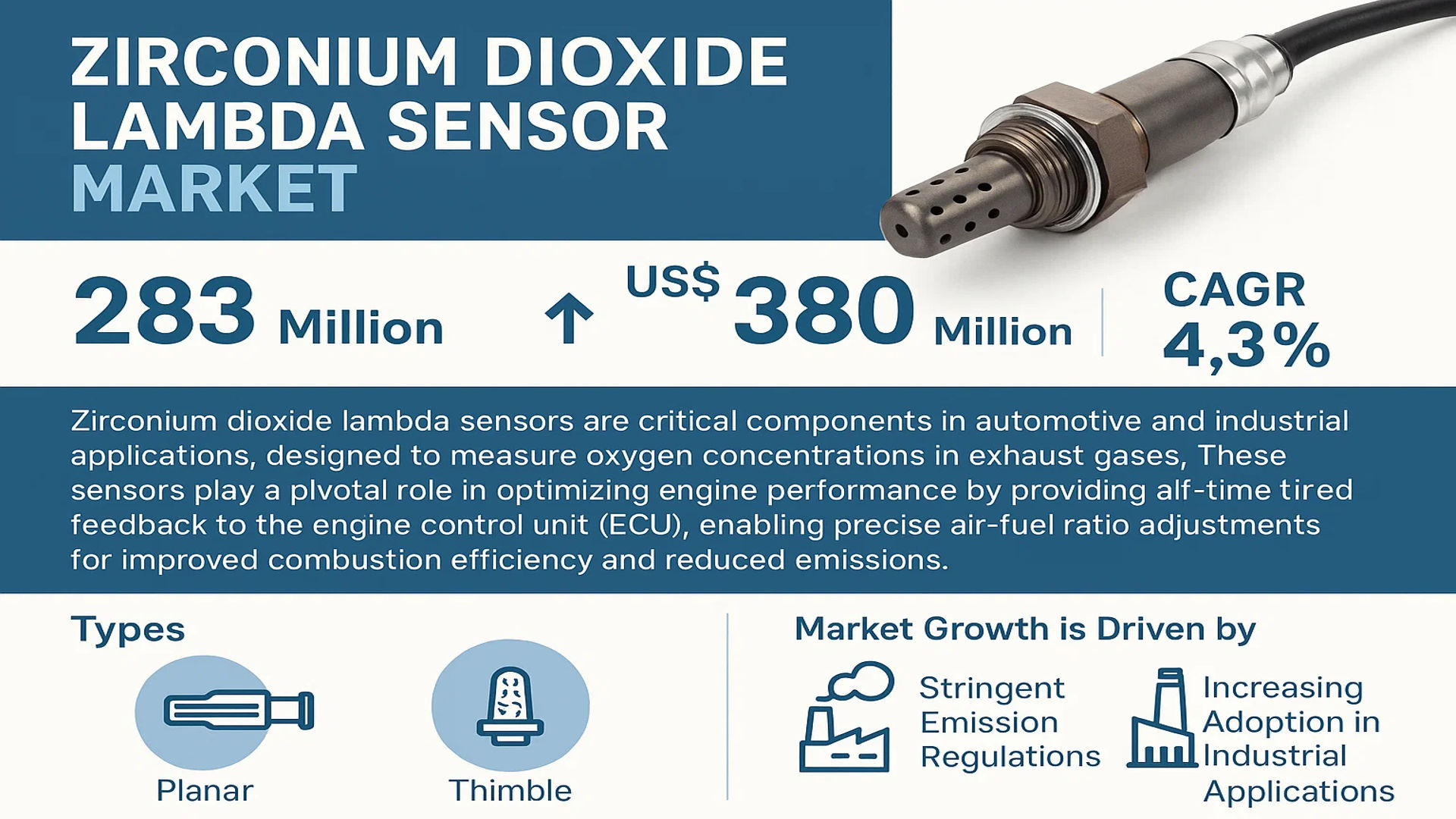
The global Zirconium Dioxide Lambda Sensor Market was valued at 283 million in 2024 and is projected to reach US$ 380 million by 2032, at a CAGR of 4.3% during the forecast period.
Zirconium dioxide lambda sensors are critical components in automotive and industrial applications, designed to measure oxygen concentrations in exhaust gases. These sensors play a pivotal role in optimizing engine performance by providing real-time feedback to the engine control unit (ECU), enabling precise air-fuel ratio adjustments for improved combustion efficiency and reduced emissions. The two primary types of these sensors include planar and thimble configurations, each catering to specific operational requirements.
The market growth is driven by stringent emission regulations worldwide, particularly in the automotive sector, alongside increasing adoption in industrial applications. While North America and Europe remain key markets due to their advanced automotive industries, Asia-Pacific is witnessing rapid growth due to expanding vehicle production and stricter environmental policies. Key players such as Niterra, Robert Bosch, Denso, and PST dominate the market, leveraging technological advancements and strategic partnerships to maintain competitive edges.
MARKET DYNAMICS
MARKET DRIVERS
Stringent Emission Norms Worldwide Accelerate Zirconium Dioxide Lambda Sensor Adoption
The global automotive industry is undergoing a radical transformation driven by increasingly strict emission regulations. With countries implementing Euro 6, China 6, and Bharat Stage VI standards, vehicle manufacturers are under immense pressure to reduce harmful pollutants like NOx and CO. Zirconium dioxide lambda sensors play a pivotal role in this transition by providing real-time oxygen level measurements that enable precise air-fuel ratio control. This critical function has become indispensable as emission limits tighten globally, with some regions implementing real-driving emission testing protocols that demand even higher sensor accuracy.
Automotive Production Expansion in Emerging Economies Fuels Market Growth
While developed markets show steady vehicle production, emerging economies are experiencing rapid automotive sector expansion. Countries like India, Brazil, and Indonesia have seen passenger vehicle production grow considerably, with annual increases in the range of 6-8% over recent years. This manufacturing boom directly correlates with higher demand for emission control components, including zirconium dioxide oxygen sensors. Furthermore, localization of automotive production in these regions is driving sensor manufacturers to establish local supply chains and production facilities, creating additional market momentum.
➤ Manufacturers are responding to this demand shift – one major player recently announced a $50 million investment to double sensor production capacity in Southeast Asia by 2026.
The gradual electrification of vehicles presents another growth avenue. While electric vehicles don’t require traditional oxygen sensors, hybrid vehicles – which are expected to dominate the transitional phase towards full electrification – continue to rely heavily on zirconia sensors for optimal combustion engine operation during range extension.
MARKET RESTRAINTS
EV Transition Creates Medium-Term Uncertainty for Conventional Sensor Demand
The automotive industry’s gradual shift toward battery electric vehicles (BEVs) introduces significant uncertainty for traditional combustion engine components. While the transition is expected to take decades, with internal projections suggesting combustion engines will still power nearly 60% of new vehicles in 2030, the long-term outlook has prompted some manufacturers to cautiously approach capacity expansion. This hesitation could temporarily restrain investment in next-generation sensor technologies until the market trajectory becomes clearer.
Raw Material Price Volatility Impacts Manufacturing Stability
Zirconium dioxide sensors rely on specialized ceramic materials whose prices have shown considerable fluctuation in global markets. The platinum electrodes and yttria-stabilized zirconia used in these sensors are particularly sensitive to supply chain disruptions and geopolitical factors. Recent trade tensions and logistical challenges have led to price swings exceeding 15-20% quarter-over-quarter for some critical materials, forcing manufacturers to either absorb cost increases or implement price adjustments that may affect market accessibility in price-sensitive regions.
MARKET OPPORTUNITIES
Industrial Applications Present Untapped Potential Beyond Automotive
While automotive applications currently dominate the zirconium dioxide lambda sensor market, industrial uses represent a significant growth frontier. Combustion optimization in industrial boilers, furnaces, and power generation equipment is gaining attention as sustainability initiatives intensify across manufacturing sectors. These applications often require more robust sensor designs capable of withstanding extreme temperatures and corrosive environments, presenting opportunities for premium product offerings with higher margins.
Smart Sensor Integration Opens New Application Possibilities
The integration of IoT capabilities and advanced diagnostics in lambda sensors is creating innovative use cases. Modern sensors with onboard diagnostic functions and digital communication protocols can now provide detailed combustion analytics beyond basic oxygen measurement. This evolution enables predictive maintenance systems and real-time process optimization – capabilities particularly valuable in heavy equipment and fleet management scenarios where fuel efficiency improvements of just 1-2% can translate to substantial cost savings.
MARKET CHALLENGES
Technical Limitations in Extreme Operating Conditions
Despite their widespread use, zirconium dioxide sensors face inherent limitations in certain operating environments. High sulfur fuel applications, for instance, can lead to sensor poisoning and performance degradation. Similarly, extreme temperature variations in specific industrial settings or cold climate vehicle operation can affect measurement accuracy. These technical constraints require ongoing R&D investment to develop more robust sensor materials and compensation algorithms.
Intense Price Competition from Alternative Technologies
The market faces growing pressure from alternative oxygen sensing technologies, particularly titania-based sensors and emerging wideband solutions. While zirconia sensors maintain advantages in longevity and measurement precision, cost-focused applications increasingly explore these alternatives. This competitive landscape forces continuous innovation in manufacturing processes to maintain cost competitiveness while preserving performance advantages.
ZIRCONIUM DIOXIDE LAMBDA SENSOR MARKET TRENDS
Emission Regulations Driving Demand for Advanced Lambda Sensors
Stringent global emission standards are fueling the adoption of zirconium dioxide lambda sensors in automotive and industrial applications. With regions like the European Union and China implementing Euro 7 and China 6 standards, manufacturers are increasingly incorporating high-precision oxygen sensors to optimize combustion efficiency. The automotive sector accounts for over 65% of total demand, as these sensors help maintain the ideal air-fuel ratio, reducing harmful emissions by up to 30% compared to conventional systems. Investments in sensor technology are expected to grow at 4.3% annually through 2032, as automakers seek compliance with evolving environmental regulations.
Other Trends
Transition to Planar Sensor Technology
The market is witnessing a significant shift from traditional thimble-type sensors to planar zirconia sensors, which offer faster response times and greater durability. Planar sensors now constitute 42% of new installations in passenger vehicles, with adoption rates projected to increase due to their compact design and improved performance in low-temperature conditions. This transition is particularly notable in hybrid electric vehicles, where precise emissions control remains critical despite electrification trends.
Industrial Applications Expanding Beyond Automotive
While automotive dominates the market, industrial applications are emerging as a growth sector. Zirconium dioxide sensors are increasingly deployed in chemical processing plants and power generation facilities to monitor combustion efficiency and emissions. The industrial segment is projected to grow at 5.1% CAGR through 2032, driven by sustainability initiatives in manufacturing. Recent advancements in sensor coatings have extended operational lifespans in high-temperature environments, making them viable for heavy industrial use where traditional sensors previously failed.
COMPETITIVE LANDSCAPE
Key Industry Players
Automotive & Industrial Sensor Giants Drive Innovation in Zirconium Dioxide Lambda Sensor Market
The global Zirconium Dioxide Lambda Sensor market presents a semi-consolidated competitive landscape, with established automotive component manufacturers dominating the space while specialized sensor developers carve out niche positions. Niterra (formerly NGK Spark Plug) has emerged as the market leader, leveraging its deep expertise in ceramic technologies and longstanding relationships with automotive OEMs. The company’s vertically integrated production capabilities give it significant cost advantages in sensor manufacturing.
Robert Bosch and Denso maintain strong positions through their integrated automotive solutions approach, where lambda sensors are bundled with engine management systems. This strategy creates high switching costs for automakers and contributes to these companies’ stable market shares. Bosch particularly dominates the European market, with estimated penetration in over 60% of locally manufactured vehicles.
Recent years have seen increased competition from specialized players like PST and SST Sensing, who focus on technological differentiation. These companies are making strides in planar-type sensor development, which offers faster response times and improved durability compared to traditional thimble designs. Their R&D investments in miniaturization and wide-band sensor technology present growing competition to established players.
The market is witnessing several strategic movements, with Ametek expanding its industrial sensor portfolio through acquisitions and PHC Holdings strengthening its medical-grade sensor applications. Meanwhile, Asian manufacturers are gaining ground through cost-competitive offerings, particularly in the motorcycle and aftermarket segments where price sensitivity is higher.
List of Key Zirconium Dioxide Lambda Sensor Companies Profiled
- Niterra (Japan)
- Robert Bosch GmbH (Germany)
- Denso Corporation (Japan)
- PST (UK)
- SST Sensing (UK)
- STG (Germany)
- Pico Technology (UK)
- Ametek, Inc. (U.S.)
- PHC Holdings Corporation (Japan)
- TiePie engineering (Netherlands)
Segment Analysis:
By Type
Planar Segment Leads the Market Due to Enhanced Durability and Accuracy
The market is segmented based on type into:
- Planar
- Thimble
By Application
Automobile Segment Dominates the Market Owing to High Demand for Emission Control Solutions
The market is segmented based on application into:
- Automobile
- Motorcycle
- Industrial
- Others
By End User
OEMs Hold Significant Market Share Due to Integrated Vehicle Manufacturing Requirements
The market is segmented based on end user into:
- OEMs (Original Equipment Manufacturers)
- Aftermarket
By Vehicle Type
Passenger Vehicles Lead Market Adoption Thanks to Stringent Emission Norms
The market is segmented based on vehicle type into:
- Passenger Vehicles
- Commercial Vehicles
Regional Analysis: Zirconium Dioxide Lambda Sensor Market
Asia-Pacific
As the global leader in Zirconium Dioxide Lambda Sensor adoption, Asia-Pacific dominates the market with over 45% share of total demand, primarily driven by China’s massive automotive production and tightening emission regulations. The region benefits from concentrated manufacturing hubs producing 70 million vehicles annually, creating consistent demand for oxygen sensors. Japan remains the technology innovator, with companies like Denso and Niterra developing advanced planar-type sensors. While cost-sensitive markets like India still prefer thimble sensors, the transition toward Euro 6-equivalent Bharat Stage VI norms is accelerating premium sensor adoption. The maturing Chinese aftermarket presents significant growth potential as vehicle fleets age.
Europe
Europe mandates the strictest emissions standards globally through Euro 6 regulations, making it the quality benchmark for zirconia sensors. German engineering firms like Robert Bosch and Continental lead in developing wide-band lambda sensors for premium vehicles. The region’s focus on electrification presents both challenges and opportunities – while BEV adoption reduces combustion engine sensor demand, hybrid vehicles still require sophisticated oxygen monitoring systems. Eastern European countries are emerging as competitive manufacturing bases, with Poland and Hungary attracting sensor component production. The aftermarket segment remains robust due to Europe’s aging passenger vehicle fleet averaging over 11 years.
North America
North America’s market prioritizes durability and precision, with planar sensors gaining traction in premium trucks and SUVs. The U.S. EPA’s Tier 3 standards and California’s CARB regulations drive continuous sensor innovation. Unlike other regions, North America exhibits strong OEM consolidation, with the top three suppliers controlling nearly 60% of the market. Recent investments in Mexican auto manufacturing create new sensor demand, while Canada’s cold climate operations spur development of ruggedized sensor designs. The region shows growing interest in smart sensors with integrated diagnostics, particularly for commercial vehicle fleets.
South America
Market growth in South America remains constrained by economic volatility, though Brazil and Argentina maintain steady sensor demand for flex-fuel vehicles. Local content requirements have prompted some sensor assembly localization, but technical limitations keep core ceramic element production concentrated in Asia. The region’s aftermarket suffers from counterfeit parts, creating quality challenges. However, increasing adoption of OBD-II compatible vehicles and rising environmental awareness suggest long-term potential, especially as Mercosur countries harmonize emissions standards with global benchmarks.
Middle East & Africa
This developing market shows divergent trends – Gulf Cooperation Council countries demand high-performance sensors for luxury vehicles and adhere to Euro 5/6 standards, while North and Sub-Saharan Africa markets remain price-driven with prevalent use of generic sensors. South Africa serves as the regional manufacturing hub, supplying both OEM and replacement markets. The lack of consistent emissions enforcement outside major cities limits market growth, though increasing urbanization and rising disposable incomes in countries like Nigeria and Kenya indicate future opportunities. Regional players are focusing on developing heat-resistant sensor variants suitable for extreme desert climates.
Report Scope
This market research report provides a comprehensive analysis of the global and regional Zirconium Dioxide Lambda Sensor markets, covering the forecast period 2024–2032. It offers detailed insights into market dynamics, technological advancements, competitive landscape, and key trends shaping the industry.
Key focus areas of the report include:
- Market Size & Forecast: Historical data and future projections for revenue, unit shipments, and market value across major regions and segments. The Global Zirconium Dioxide Lambda Sensor market was valued at USD 283 million in 2024 and is projected to reach USD 380 million by 2032, growing at a CAGR of 4.3%.
- Segmentation Analysis: Detailed breakdown by product type (Planar, Thimble), application (Automobile, Motorcycle, Industrial, Others), and end-user industry to identify high-growth segments and investment opportunities.
- Regional Outlook: Insights into market performance across North America, Europe, Asia-Pacific, Latin America, and the Middle East & Africa. The U.S. and China are key markets, with Asia-Pacific showing the fastest growth.
- Competitive Landscape: Profiles of leading market participants including Niterra, Robert Bosch, Denso, Ametek, and PST, covering their product portfolios, market share, and recent developments.
- Technology Trends & Innovation: Assessment of emerging sensor technologies, integration with automotive control systems, and advancements in emission control solutions.
- Market Drivers & Restraints: Evaluation of factors such as stringent emission regulations, automotive production growth, and challenges like supply chain constraints and material costs.
- Stakeholder Analysis: Insights for automotive manufacturers, sensor suppliers, aftermarket service providers, and investors regarding market opportunities and strategic positioning.
Primary and secondary research methods are employed, including interviews with industry experts, manufacturer surveys, and analysis of verified market data to ensure the accuracy and reliability of the insights presented.
FREQUENTLY ASKED QUESTIONS:
What is the current market size of Global Zirconium Dioxide Lambda Sensor Market?
-> Zirconium Dioxide Lambda Sensor Market was valued at 283 million in 2024 and is projected to reach US$ 380 million by 2032, at a CAGR of 4.3% during the forecast period.
Which key companies operate in Global Zirconium Dioxide Lambda Sensor Market?
-> Key players include Niterra, Robert Bosch, Denso, Ametek, PST, SST Sensing, and STG, among others. The top five players held approximately 45% market share in 2024.
What are the key growth drivers?
-> Key growth drivers include stringent emission regulations, increasing automotive production, and the shift towards fuel-efficient vehicles.
Which region dominates the market?
-> Asia-Pacific is the largest and fastest-growing market, driven by China’s automotive industry expansion, while Europe maintains strong demand due to emission standards.
What are the emerging trends?
-> Emerging trends include development of smart sensors, integration with vehicle telematics, and miniaturization of sensor components for hybrid/electric vehicles.

Get Sample Report PDF for Exclusive Insights
Report Sample Includes
- Table of Contents
- List of Tables & Figures
- Charts, Research Methodology, and more...
 Download Sample Report PDF