
Zirconia Oxygen Probe Market Insights
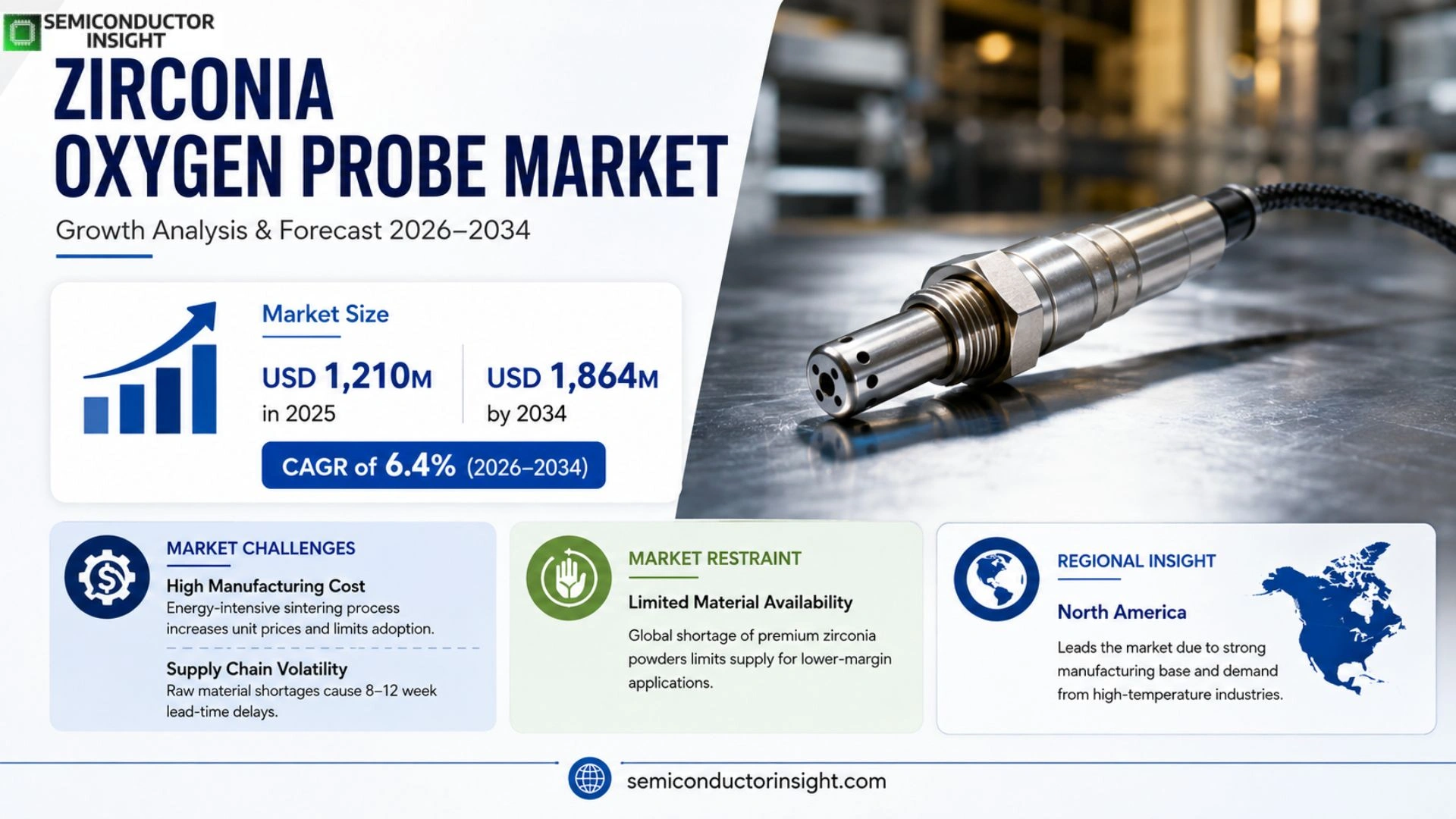
Zirconia Oxygen Probe market size was valued at USD 1,210 million in 2025. The market will likely reach USD 1,864 million by 2034, exhibiting a CAGR of 6.4 % during the forecast period.
In 2025, worldwide production of Zirconia Oxygen Probes amounted to roughly 395.5 K units, with an average selling price of about USD 3,350 per unit. The probe operates on the oxygen‑ion conductivity of a zirconia solid electrolyte and determines oxygen concentration in flue gas, industrial atmospheres or breathing gases by measuring the Nernst potential difference; it delivers fast response times, high stability and a broad measurement range suitable for both industrial and medical monitoring.
Demand for Zirconia Oxygen Probes originates from stringent industrial emission‑monitoring regulations, the need for tighter combustion‑efficiency control and expanding medical respiratory‑monitoring applications. Opportunities arise from developing high‑temperature‑resistant miniaturized probes with digital outputs, extending usage into automotive exhaust systems, industrial boilers and ventilators, and partnering with equipment manufacturers to supply cost‑effective certified products for emerging markets.
MARKET DRIVERS
Automotive Emissions Regulation
Stringent exhaust‑gas legislation across Europe, North America and Asia has forced OEMs to embed more reliable oxygen sensing solutions. Zirconia oxygen probes meet the temperature‑resilience required for lean‑burn engines, allowing manufacturers to fine‑tune fuel‑air ratios and stay within legal limits while preserving fuel efficiency.
Industrial Process Optimization
Precision metal‑casting, glass‑melting and petrochemical operations depend on accurate oxygen control to prevent oxidation defects. The superior stability of zirconia‑based probes under high‑temperature conditions translates into tighter process windows and lower scrap rates, prompting plant managers to replace legacy sensors.
➤ Real‑time monitoring can trim furnace downtime by as much as 15 % when a zirconia probe is deployed.
These regulatory and operational pressures are converging, creating a clear incentive for end‑users to upgrade to Zirconia Oxygen Probe market’s next‑generation offerings, thereby expanding the overall addressable base.
MARKET CHALLENGES
High Manufacturing Cost
The sintering process required to achieve dense, defect‑free zirconia ceramics remains energy‑intensive, pushing unit prices above those of conventional electrochemical sensors. Smaller enterprises often find it difficult to justify the capital outlay, slowing broader adoption.
Other Challenges
Supply Chain Volatility
Raw‑material shortages, particularly in high‑purity yttria‑stabilized zirconia, can cause lead‑time extensions of 8–12 weeks, disrupting scheduled equipment upgrades.
MARKET RESTRAINTS
Limited Material Availability
Global production capacity for premium zirconia powders lags behind rising demand, especially in regions investing heavily in clean‑energy infrastructure. The scarcity forces manufacturers to allocate material to higher‑margin segments, leaving lower‑margin applications under‑served.
Competing sensor technologies, such as broadband infrared and MEMS‑based oxygen detectors, are gaining acceptance in niche markets where cost sensitivity outweighs the need for extreme temperature tolerance, thereby capping the growth ceiling for zirconia solutions.
MARKET OPPORTUNITIES
Renewable Energy Integration
Hydrogen production via steam methane reforming and electrolysis routinely monitors oxygen levels to ensure safety and efficiency. The durability of zirconia probes under severe thermal cycling makes them a preferred choice for emerging green‑hydrogen facilities, opening a new revenue stream.
Medical ventilation equipment is beginning to incorporate high‑temperature tolerant oxygen sensors for advanced respiratory support systems. Early pilots suggest that zirconia‑based designs could deliver faster response times, presenting a lucrative avenue for manufacturers willing to certify devices for clinical use.
Strategic partnerships between probe manufacturers and equipment integrators can accelerate market penetration, allowing Zirconia Oxygen Probe market to capture value from both legacy industrial upgrades and next‑generation clean‑technology deployments.
Zirconia Oxygen Probe Market Trends
Regulatory Pressure Elevates Demand for Precise Sensing Solutions
Zirconia Oxygen Probe market is feeling the impact of increasingly stringent emissions legislation across major industrial jurisdictions. Manufacturers of power plants, steel mills, and large‑scale boilers are compelled to install sensors that can sustain continuous operation at high temperatures while delivering repeatable oxygen readings. Because zirconia‑based probes combine rapid response with a broad measurement window, they have become the preferred choice for compliance monitoring. This regulatory push is not merely a compliance cost; it creates a barrier to entry for low‑performance alternatives, thereby sharpening the competitive advantage of firms that can guarantee long‑life, low‑drift devices. Consequently, original equipment manufacturers are revising their procurement strategies to favor suppliers that can demonstrate certified performance under demanding conditions.
Other Trends
Technological Innovation Toward Digital Integration
Digital connectivity is reshaping Zirconia Oxygen Probe market as end users demand real‑time data streams for process optimization. Vendors that embed micro‑controllers and communication protocols such as Modbus or wireless IoT modules enable seamless integration with supervisory control systems. The shift away from purely analog outputs reduces wiring complexity and improves diagnostic capabilities, allowing maintenance teams to anticipate probe degradation before a failure occurs. Companies investing in miniaturized electronics are also tapping niche segments,particularly medical ventilators,where space constraints and hygiene requirements favor compact, self‑calibrating probes.
Emerging Applications in Automotive Exhaust Management
Automakers are increasingly targeting nitrogen‑oxide reduction and fuel‑efficiency standards that rely on precise oxygen feedback from the exhaust stream. Zirconia Oxygen Probe market is responding with probes engineered for the high‑vibration, high‑temperature environment of modern engines. By delivering stable output over extended service intervals, these sensors support closed‑loop fuel‑control strategies that lower emissions while preserving performance. As the automotive sector adopts electrified powertrains, the remaining internal‑combustion portfolio still requires robust oxygen monitoring, suggesting a sustained niche demand that manufacturers can exploit through specialized design and certification pathways.
COMPETITIVE LANDSCAPE
Key Industry Players
Zirconia Oxygen Probe Market: Competitive Overview
The market’s concentration is anchored by a handful of multinationals that combine deep sensor‑technology expertise with global distribution networks. ABB, for instance, leverages its broad industrial automation portfolio to embed zirconia probes in power‑generation and steel‑making plants, offering integrated monitoring solutions that reduce downtime and support compliance regimes. Emerson’s Rosemount division has similarly entrenched itself by providing high‑temperature, Nernst‑cell probes that cater to demanding boiler‑and‑turbine environments; its focus on digital output interfaces aligns with the industry’s shift toward remote condition‑monitoring platforms. Fuji Electric adds a medical‑grade dimension, supplying long‑life probes for ventilators where precision and sterility are paramount. Together, these leaders shape pricing dynamics, drive standardisation of performance metrics, and set the benchmark for reliability that downstream manufacturers must meet.
Beyond the global giants, a diverse cohort of specialist firms sustains niche demand and fuels incremental innovation. Huamin and SST Sensing, both rooted in the Asian market, have carved out strong positions by offering cost‑effective, region‑specific certifications that appeal to emerging‑economy manufacturers. Niterra, historically known for automotive components, is extending its sensor line into exhaust‑gas monitoring, while Inert focuses on extraction‑cell designs for laboratory and petrochemical settings. MOTOYAMA’s emphasis on miniaturised probes meets the growing need for compact medical devices, and Endress+Hauser’s strong service network in Europe underpins its success in process‑control applications. Super Systems rounds out the landscape with a portfolio of custom‑engineered probes that address high‑precision trace‑oxygen monitoring in semiconductor fabrication. This layered ecosystem creates competitive pressure that encourages product differentiation, faster time‑to‑market for digital‑output models, and strategic partnerships with OEMs across energy, automotive, and healthcare sectors.
List of Key Zirconia Oxygen Probe Companies Profiled
- ABB
- Emerson
- Fuji Electric
- Huamin
- SST Sensing
- Niterra
- Inert
- MOTOYAMA
- Endress+Hauser
- Super Systems
- Honeywell
- WIKA
- Ametek
- Kimball Process
- Yokogawa Electric
Segment Analysis:
| Segment Category | Sub-Segments | Key Insights |
| By Type |
|
Nernst Cell Zirconia remains the dominant technology because it delivers reliable long‑term stability and rapid response in harsh environments.
|
| By Application |
|
Power Generation drives the market owing to stringent emission standards and the need for precise combustion control.
|
| By End User |
|
Utilities are the primary end‑users because they require continuous, reliable oxygen data to optimize fuel efficiency and meet compliance.
|
| By Installation Form |
|
In‑Situ Insertion Probe leads due to its direct exposure to the process stream, offering immediate measurement feedback.
|
| By Measurement Range |
|
Percent‑Level Oxygen Monitoring dominates because most industrial combustion and emissions applications require measurement in the 0‑21% range.
|
Regional Analysis: Zirconia Oxygen Probe Market
North America
Major zirconia probe producers cluster in the Midwest, leveraging established ceramic foundries and skilled labor pools. This geographic concentration lowers material handling costs and accelerates prototype iteration, giving local suppliers a speed advantage over overseas rivals.
Tightened emissions standards in the U.S. and Canada obligate continuous oxygen monitoring, prompting operators to replace legacy sensors with zirconia‑based alternatives that meet higher accuracy thresholds and longer service intervals.
End‑users across petrochemical, aerospace, and renewable‑energy sectors value the probe’s thermal stability, driving early‑adopter programs that integrate the sensor into predictive‑maintenance workflows and reduce unplanned downtime.
Recent disruptions have motivated manufacturers to localize key raw‑material sourcing, creating a buffer that safeguards production schedules and reinforces confidence among OEM customers.
Europe
European firms benefit from a strong tradition of precision engineering, which translates into sophisticated probe designs tailored for specialty steel and glass‑melting furnaces. The region’s emphasis on circular‑economy initiatives encourages manufacturers to select sensors that can be refurbished, extending asset life and aligning with sustainability targets. Regulatory pressure from the EU’s Industrial Emissions Directive nudges operators toward more reliable oxygen detection, while a fragmented market of mid‑size suppliers fosters competitive pricing and rapid customization. Cross‑border collaborations, especially between Germany and the Nordics, are accelerating the integration of real‑time analytics with probe data, offering a differentiated value proposition for process‑intensive users.
Asia‑Pacific
The Asia‑Pacific arena is defined by rapid industrialization and expanding high‑temperature applications in petrochemicals, metal processing, and emerging hydrogen‑production facilities. Countries such as China and India are scaling up plant capacities, creating a cascade effect that raises demand for durable oxygen sensing solutions capable of withstanding aggressive operating conditions. Local manufacturers are investing in proprietary zirconia sintering techniques to reduce reliance on imported raw materials, a move that improves cost structures and shortens lead times. At the same time, regional trade agreements facilitate smoother market entry for established OEMs, prompting joint‑venture arrangements that blend global technology with localized service networks.
South America
In South America, growth is anchored by Brazil’s expanding oil‑and‑gas frontier and Argentina’s burgeoning agro‑industrial sector, both of which require precise oxygen control for process optimization. Market participants are differentiating themselves through after‑sales support packages that include on‑site calibration services, a critical factor given the region’s dispersed industrial geography. Environmental regulations are tightening, especially around emissions from petrochemical complexes, motivating a shift from legacy thermocouple sensors to more resilient zirconia probes. Indigenous research institutions are also contributing to material‑science advances, offering a pipeline of incremental performance improvements that local producers can commercialize.
Middle East & Africa
The Middle East & Africa region exhibits a dual narrative: flourishing investment in large‑scale petrochemical complexes alongside nascent renewable‑energy projects in desert solar‑thermal farms. Operators in the Gulf Cooperation Council prioritize probes that can sustain extreme heat while delivering consistent oxygen measurements for catalyst management. Meanwhile, South Africa’s growing steel‑production capacity is creating niche demand for sensors that can operate in corrosive atmospheres. Supply‑chain diversification efforts, driven by geopolitical considerations, are encouraging firms to establish regional stocking points, thereby reducing lead‑time exposure and reinforcing client confidence in Zirconia Oxygen Probe market’s reliability.
Report Scope
This market research report provides a comprehensive analysis of the Zirconia Oxygen Probe Market , covering the forecast period 2026–2034. It offers detailed insights into market dynamics, technological advancements, competitive landscape, and key trends shaping the industry.
Key focus areas of the report include:
- Market Overview: The report begins with an overview outlining its current market scenario, key growth indicators, and industry transformation drivers. It discusses macroeconomic factors, demand–supply balance, regulatory landscape, and the strategic role of semiconductors in powering advancements across industries such as automotive, telecommunications, consumer electronics, and industrial automation.
- Market Size & Forecast: Historical data and future projections for revenue, unit shipments, and market value across major regions and segments.
- Segmentation Analysis: Detailed breakdown by product type, technology, application, and end-user industry to identify high-growth segments and investment opportunities.
- Regional Insights: Insights into market performance across North America, Europe, Asia-Pacific, Latin America, and the Middle East & Africa, including country-level analysis where relevant.
- Competitive Landscape: Profiles of leading market participants, including their product offerings, R&D focus, manufacturing capacity, pricing strategies, and recent developments such as mergers, acquisitions, and partnerships.
- Technology Trends & Innovation: Assessment of emerging technologies, integration of AI/IoT, semiconductor design trends, fabrication techniques, and evolving industry standards.
- Market Drivers & Restraints: Evaluation of factors driving market growth along with challenges, supply chain constraints, regulatory issues, and market-entry barriers.
- Stakeholder Insights: Insights for component suppliers, OEMs, system integrators, investors, and policymakers regarding the evolving ecosystem and strategic opportunities.
Primary and secondary research methods are employed, including interviews with industry experts, data from verified sources, and real-time market intelligence to ensure the accuracy and reliability of the insights presented.
FREQUENTLY ASKED QUESTIONS:
What is the current market size of Zirconia Oxygen Probe Market?
-> Zirconia Oxygen Probe market will likely reach USD 1,864 million by 2034, exhibiting a CAGR of 6.4 % during the forecast period.
Which key companies operate in Zirconia Oxygen Probe Market?
-> Key players include Huamin, SST Sensing, Niterra, Inert, MOTOYAMA, ABB, Emerson, Fuji Electric, Endress+Hauser, Super Systems, among others.
What are the key growth drivers?
-> Key growth drivers include strict industrial emission monitoring regulations, increased combustion efficiency control, and expanding medical respiratory monitoring applications, all driving demand for high‑precision, long‑life gas‑sensing components.
Which region dominates the market?
-> Asia holds the largest share of production and consumption, supported by extensive industrial, automotive, and healthcare sectors, while Europe remains a significant market.
What are the emerging trends?
-> Emerging trends include the development of high‑temperature‑resistant, miniaturized, digital‑output probes, expanded use in automotive exhaust, industrial boilers and medical ventilators, and cost‑effective certified products for emerging markets.
Get Sample Report PDF for Exclusive Insights
Report Sample Includes
- Table of Contents
- List of Tables & Figures
- Charts, Research Methodology, and more...
 Download Sample Report PDF


