
MARKET INSIGHTS
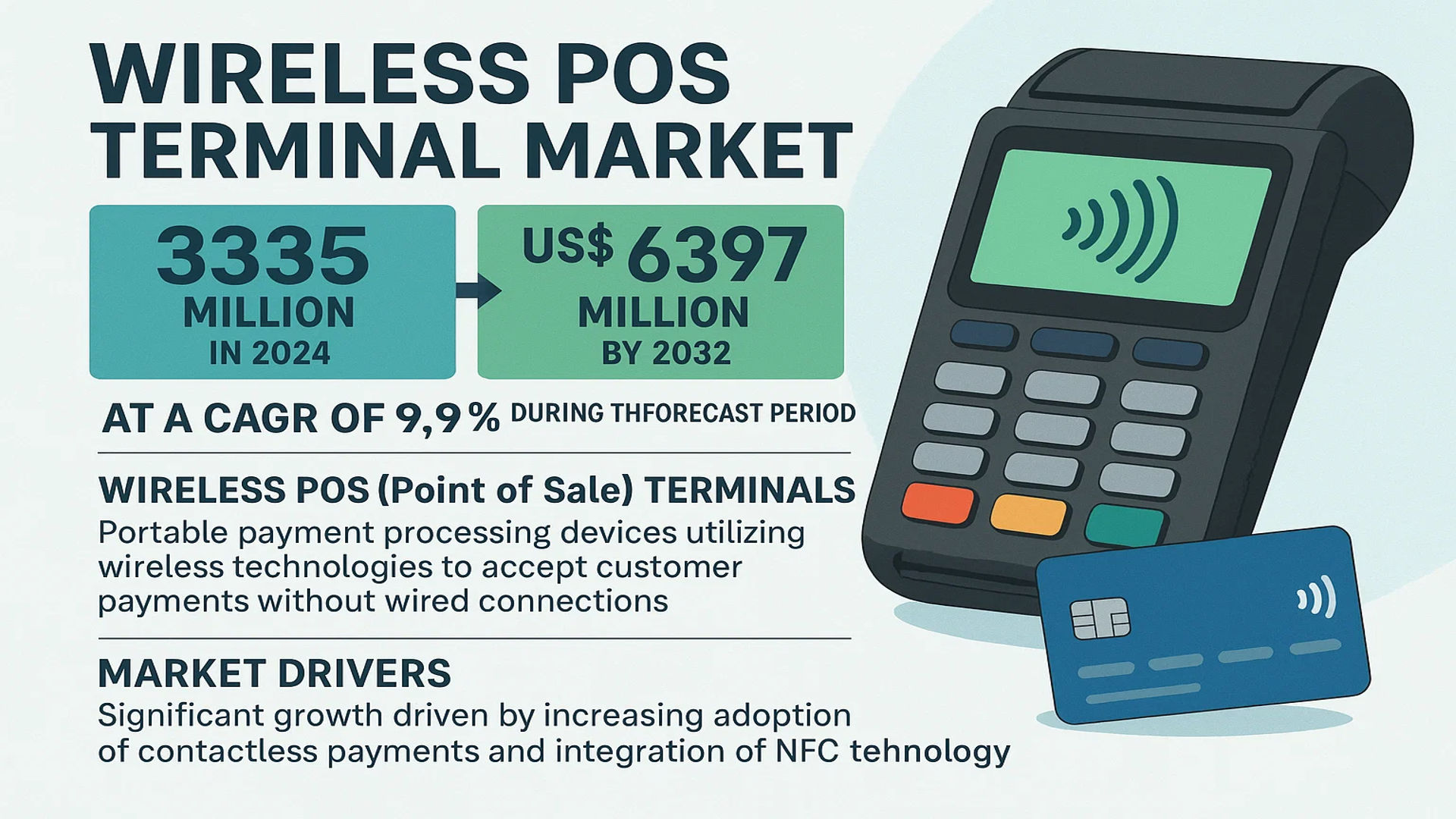
The global Wireless POS Terminal Market was valued at 3335 million in 2024 and is projected to reach US$ 6397 million by 2032, at a CAGR of 9.9% during the forecast period.
Wireless POS (Point of Sale) Terminals are portable payment processing devices that enable businesses to accept customer payments without wired connections. These devices utilize wireless technologies such as Wi-Fi, Bluetooth, or cellular networks (3G/4G/5G) to connect to payment processors, allowing transactions anywhere within the wireless range.
The market is witnessing significant growth driven by increasing adoption of contactless payments, particularly post-pandemic, due to their speed and hygiene benefits. The integration of NFC technology for tap-and-go payments via smartphones, wearables, and contactless cards has further accelerated demand. Cloud-based POS solutions are gaining traction among SMEs due to their cost-effectiveness and scalability, while advanced security features such as EMV encryption and biometric authentication are addressing growing cybersecurity concerns. Key players like PAX Technology, Verifone, and Ingenico (Worldline) continue to expand their product portfolios to cater to evolving industry needs.
MARKET DYNAMICS
MARKET DRIVERS
Accelerated Adoption of Contactless Payments Fuels Wireless POS Terminal Market
The global shift toward contactless payments has become a primary growth driver for wireless POS terminals. The convenience, speed, and enhanced hygiene of tap-to-pay transactions have made NFC-enabled wireless POS systems indispensable across retail, hospitality, and food service sectors. The pandemic accelerated this transition as businesses sought to minimize physical contact. Recent data indicates that contactless transactions accounted for over 60% of face-to-face payments in multiple developed markets, with consumers increasingly preferring mobile wallets and wearable payment methods. This fundamental change in payment behavior creates sustained demand for flexible wireless POS solutions that can process both traditional card payments and mobile transactions.
Digital Transformation in SMEs Creates Broad Market Opportunities
Small and medium enterprises are embracing wireless POS systems as part of broader digital transformation initiatives. The lower upfront costs and operational flexibility of mPOS solutions compared to traditional fixed terminals has removed barriers for smaller merchants. Cloud-based wireless POS solutions have proven particularly transformative, enabling real-time inventory management, sales analytics and customer relationship management from any location – capabilities previously only available to large retailers. Many SMBs report productivity gains exceeding 30% after adopting integrated wireless POS systems. This democratization of retail technology continues to expand the addressable market.
Mobile Commerce Expansion Drives Demand for Flexible Payment Solutions
The rapid growth of mobile commerce and omnichannel retail strategies is fueling adoption of wireless POS terminals across new use cases. Retailers increasingly require payment acceptance capabilities that work seamlessly across physical stores, pop-up locations, and curbside pickup scenarios. The ability of modern wireless POS systems to integrate with e-commerce platforms creates a unified commerce experience that consumers now expect. This trend is particularly evident in sectors like apparel and consumer electronics, where mobile checkout solutions have reduced queue times by over 40% in pilot implementations while increasing sales conversion rates.
MARKET CHALLENGES
Security Risks Pose Persistent Challenge to Market Confidence
While wireless POS terminals offer numerous advantages, security concerns remain a significant adoption barrier. The mobile nature of these devices increases vulnerability to data breaches and fraud attempts. Cybercriminals have developed sophisticated methods to intercept wireless payment data, requiring continuous security upgrades by manufacturers. Many merchants remain hesitant to adopt wireless solutions due to liability concerns and the potential reputational damage from payment data breaches. The industry continues to face challenges in balancing convenience with security, particularly when supporting older payment technologies that lack advanced encryption.
Other Challenges
Interoperability Issues
The lack of standardization across wireless POS platforms creates integration challenges for merchants operating multiple locations or using various software solutions. Compatibility problems between hardware, payment processors and business management systems frequently lead to operational disruptions that erode merchant confidence in wireless solutions.
Battery Life Limitations
Mobile POS devices face practical constraints from battery performance, particularly in high-volume retail environments. The need for frequent charging creates operational bottlenecks, with many merchants reporting dissatisfaction when battery life fails to meet advertised specifications under real-world conditions.
MARKET RESTRAINTS
Legacy Infrastructure Slows Transition to Wireless Technologies
Many established retailers remain hesitant to replace traditional wired POS systems due to the significant investments in existing infrastructure. The perceived reliability of wired connections and extensive employee training on legacy systems creates inertia in adopting wireless alternatives. Larger retailers in particular face complex migration challenges when transitioning to wireless POS, including the need to maintain operations during system changes and retrain staff on new workflows. These barriers significantly slow adoption in certain market segments despite the clear advantages of wireless solutions.
Connectivity Limitations Hinder Deployment in Certain Environments
The dependence of wireless POS terminals on stable network connectivity creates deployment challenges in areas with unreliable cellular or WiFi coverage. Many merchants report frustration with transaction delays or failures when operating in locations with weak signals. This issue is particularly acute in rural areas and developing markets where network infrastructure lags behind urban centers. The additional costs of implementing backup connectivity solutions further erodes the cost advantage of wireless POS in these challenging environments.
MARKET OPPORTUNITIES
Emerging Markets Present Significant Growth Potential
The relatively low penetration of traditional POS infrastructure in developing economies creates vast opportunities for wireless alternatives. Countries experiencing rapid growth in formal retail sectors but lacking legacy payment systems are adopting wireless POS as their primary payment acceptance method. Recent data shows wireless POS adoption growing nearly twice as fast in emerging markets compared to developed economies, with particular strength in Southeast Asia and Latin America. This trend is expected to accelerate as mobile internet coverage expands and local payment networks modernize their infrastructure.
AI-Powered Analytics Create New Value Propositions
Advanced analytics capabilities powered by artificial intelligence are transforming wireless POS terminals from simple payment devices into comprehensive business intelligence tools. The integration of AI-driven inventory optimization, dynamic pricing suggestions and customer behavior analysis directly into POS interfaces provides merchants with actionable insights that improve operational efficiency and sales performance. Forward-looking POS providers are leveraging these capabilities to create premium service tiers and recurring revenue models beyond basic transaction processing.
Vertical-Specific Solutions Open New Market Segments
The development of industry-specific wireless POS solutions tailored to unique sector requirements is creating growth opportunities beyond traditional retail. Specialized configurations for healthcare providers, field service technicians, transportation operators and other non-retail applications demonstrate the versatility of wireless POS technology. These vertical solutions typically command higher margins while addressing previously underserved market segments with specialized compliance requirements and workflow needs.
WIRELESS POS TERMINAL MARKET TRENDS
Contactless Payment Revolution Driving Wireless POS Adoption
The global wireless POS terminal market is experiencing exponential growth fueled by the rapid adoption of contactless payment technologies. NFC-enabled transactions have become the preferred payment method for both businesses and consumers, with over 50% of in-person transactions projected to be contactless by 2025. This shift accelerated dramatically during the COVID-19 pandemic, as hygiene concerns made tap-and-pay solutions essential for safe transactions. Modern wireless POS systems now support not just contactless cards but also mobile wallets like Apple Pay and Google Pay, along with wearable payment devices, creating seamless checkout experiences that reduce queue times by up to 30% compared to traditional methods.
Other Trends
Cloud-Based POS Systems Transforming Business Operations
Businesses are increasingly adopting cloud-based wireless POS solutions that offer real-time data access and remote management capabilities. These systems provide small and medium enterprises with enterprise-grade functionality at a fraction of traditional POS costs, with subscription models reducing upfront investment barriers. The integration of inventory management, CRM tools, and advanced analytics allows businesses to track sales patterns, customer preferences, and stock levels simultaneously, creating opportunities for data-driven decision making across multiple locations.
Security Innovations in Mobile Payment Processing
As wireless POS transactions grow, security remains a paramount concern. Modern systems now incorporate EMV chip technology, end-to-end encryption, and tokenization to protect sensitive payment data. Biometric authentication methods like fingerprint and facial recognition are being increasingly deployed to prevent fraud, with some systems achieving transaction authentication accuracy rates exceeding 99%. These advancements are particularly crucial as mobile POS usage expands into high-risk environments like outdoor events and pop-up retail locations where traditional security measures may be difficult to implement.
COMPETITIVE LANDSCAPE
Key Industry Players
Innovation and Strategic Partnerships Drive Competition in Wireless POS Terminal Market
The global wireless POS terminal market features a dynamic competitive landscape with a mix of established payment solution providers and emerging technology innovators. PAX Technology and Ingenico (Worldline) currently dominate the market, collectively accounting for over 30% of global mPOS terminal sales in 2024. Their leadership stems from comprehensive product portfolios that integrate advanced security features and multi-channel payment capabilities.
Verifone maintains strong market positioning through its continuous investment in cloud-based POS solutions and strategic alliances with major financial institutions. Meanwhile, Newland NPT has emerged as a key competitor in the Asian market, driven by its cost-effective solutions tailored for small merchants.
Technology adoption remains central to competitive differentiation. Market leaders are actively incorporating NFC capabilities, biometric authentication, and AI-driven analytics into their wireless POS offerings. BBPOS recently gained traction by introducing modular mPOS devices that support both traditional card payments and QR code transactions, addressing diverse merchant needs.
The competitive intensity continues to escalate as fintech companies like Square disrupt traditional POS models with integrated payment ecosystems. Their vertically integrated solutions, combining hardware, software, and financial services, are reshaping merchant expectations and forcing incumbents to accelerate innovation cycles.
List of Key Wireless POS Terminal Companies Profiled
- PAX Technology (China)
- Ingenico (Worldline) (France)
- Verifone (U.S.)
- Newland NPT (China)
- BBPOS (Hong Kong)
- Square (U.S.)
- NCR Voyix (U.S.)
- Shenzhen Xinguodu Technology (China)
- Posiflex Technology (Taiwan)
- Wuhan Tianyu Information (China)
Segment Analysis:
By Type
Smart POS Dominates the Market Due to Advanced Features and Integration Capabilities
The market is segmented based on type into:
- Smart POS
- Subtypes: Android-based, iOS-based, and others
- Non-smart POS
- Subtypes: Basic wireless terminals and hybrid models
By Application
Retail Segment Leads Due to Increasing Adoption of Contactless Payments
The market is segmented based on application into:
- Retail
- Restaurant
- Hospitality
- Entertainment
- Others
By Technology
NFC-enabled Terminals Gain Traction for Secure Contactless Transactions
The market is segmented based on technology into:
- Bluetooth
- Wi-Fi
- NFC
- Cellular (3G/4G/5G)
By End User
SMEs Show Rapid Adoption Due to Cost-effectiveness and Mobility
The market is segmented based on end user into:
- Large Enterprises
- Small and Medium Enterprises (SMEs)
- Individual Merchants
Regional Analysis: Wireless POS Terminal Market
Asia-Pacific
The Asia-Pacific region dominates the global wireless POS terminal market, driven by rapid digital payment adoption, SME expansion, and government-led financial inclusion initiatives. China leads in manufacturing and adoption, with its mobile payment ecosystem processing over $60 trillion annually. India’s market is surging due to Unified Payments Interface (UPI) integration in mPOS devices—November 2023 recorded 12 billion UPI transactions. The region benefits from low-cost manufacturing hubs in China and Taiwan, supplying wireless POS devices globally. However, cybersecurity concerns and fragmented regulations across countries pose challenges for standardization. Cloud-based POS solutions are gaining traction among SMEs due to operational flexibility.
North America
North America, particularly the U.S., is a key innovator in wireless POS technology, with contactless payments adopted by 58% of consumers as of 2024. The market thrives on advanced 5G infrastructure, enabling faster transaction processing. Retail and restaurant sectors account for 65% of mPOS deployments, with companies like Square and Toast driving vertical-specific solutions. Regulatory emphasis on PCI-DSS compliance and EMV chip standards ensures robust security, though high device costs limit small business adoption. The region is transitioning toward integrated platforms combining payment processing with AI-driven analytics.
Europe
Europe’s wireless POS market is shaped by PSD2 regulations, mandating strong customer authentication for payments. NFC-enabled terminals now represent 72% of new deployments in the EU, with the UK and Germany leading in contactless penetration. Cross-border compatibility remains a priority—vendors like Ingenico (Worldline) provide multi-currency devices for tourism-heavy economies. Sustainability initiatives push manufacturers toward energy-efficient hardware designs, though supply chain disruptions from geopolitical tensions have slowed production. The hospitality sector shows the highest growth potential, with cloud-based mPOS systems replacing legacy terminals.
Middle East & Africa
This emerging market is propelled by mobile wallet partnerships between banks and telecom providers—Saudi Arabia’s Mada Click and UAE’s Apple Pay rollouts doubled wireless POS installations in 2023. Infrastructure limitations in Africa drive demand for offline-capable mPOS devices in remote areas. While oil-rich GCC countries invest heavily in smart retail solutions, Sub-Saharan Africa relies on low-cost Android POS terminals for informal sectors. Political instability and currency volatility in parts of the region deter foreign investors, though fintech startups are bridging gaps in underbanked markets.
South America
Brazil and Argentina account for 80% of regional mPOS adoption, fueled by Pix instant payments and tax incentives for digital transactions. However, economic fluctuations and import restrictions in Argentina suppress hardware availability. Brazilian fintech firms like StoneCo dominate with all-in-one wireless terminals combining QR code and contactless payments. The market is bifurcated—urban areas adopt sophisticated Smart POS systems, while rural merchants prefer basic Bluetooth card readers. Banking correspondent models are expanding financial access, though cybersecurity investment lags behind other regions.
Report Scope
This market research report provides a comprehensive analysis of the Global Wireless POS Terminal Market, covering the forecast period 2024–2032. It offers detailed insights into market dynamics, technological advancements, competitive landscape, and key trends shaping the industry.
Key focus areas of the report include:
- Market Size & Forecast: Historical data and future projections for revenue, unit shipments, and market value across major regions and segments. The global market was valued at USD 3,335 million in 2024 and is projected to reach USD 6,397 million by 2032, growing at a CAGR of 9.9%.
- Segmentation Analysis: Detailed breakdown by product type (Smart POS vs. Non-smart POS), application (Retail, Restaurant, Hospitality, Entertainment, Others), and end-user industry to identify high-growth segments and investment opportunities.
- Regional Outlook: Insights into market performance across North America, Europe, Asia-Pacific, Latin America, and the Middle East & Africa, including country-level analysis of key markets such as the US, China, Germany, and India.
- Competitive Landscape: Profiles of leading market participants including Verifone, Ingenico (Worldline), PAX Technology, and Square, covering their product offerings, market share, pricing strategies, and recent developments such as mergers and acquisitions.
- Technology Trends & Innovation: Assessment of emerging technologies including NFC-based contactless payments, cloud-based POS systems, integration with business management tools, and advanced security features like biometric authentication.
- Market Drivers & Restraints: Evaluation of factors driving market growth such as increasing adoption of contactless payments, SME digital transformation, and mobile payment penetration in emerging economies, along with challenges like cybersecurity risks and regulatory compliance.
- Stakeholder Analysis: Strategic insights for payment solution providers, POS terminal manufacturers, system integrators, investors, and policymakers regarding the evolving payment ecosystem and business opportunities.
The research employs both primary and secondary methodologies, including interviews with industry experts, analysis of company financial reports, and data from verified market intelligence sources to ensure accuracy and reliability.
FREQUENTLY ASKED QUESTIONS:
What is the current market size of Global Wireless POS Terminal Market?
-> Wireless POS Terminal Market was valued at 3335 million in 2024 and is projected to reach US$ 6397 million by 2032, at a CAGR of 9.9% during the forecast period.
Which key companies operate in Global Wireless POS Terminal Market?
-> Key players include Verifone, Ingenico (Worldline), PAX Technology, Square, Newland NPT, and BBPOS, among others.
What are the key growth drivers?
-> Key growth drivers include rising adoption of contactless payments, SME digital transformation, and increasing mobile payment penetration in emerging economies.
Which region dominates the market?
-> Asia-Pacific is the fastest-growing region, while North America currently holds the largest market share.
What are the emerging trends?
-> Emerging trends include integration of AI-powered analytics, biometric authentication, and omnichannel payment solutions in Wireless POS systems.

Get Sample Report PDF for Exclusive Insights
Report Sample Includes
- Table of Contents
- List of Tables & Figures
- Charts, Research Methodology, and more...



