
MARKET INSIGHTS
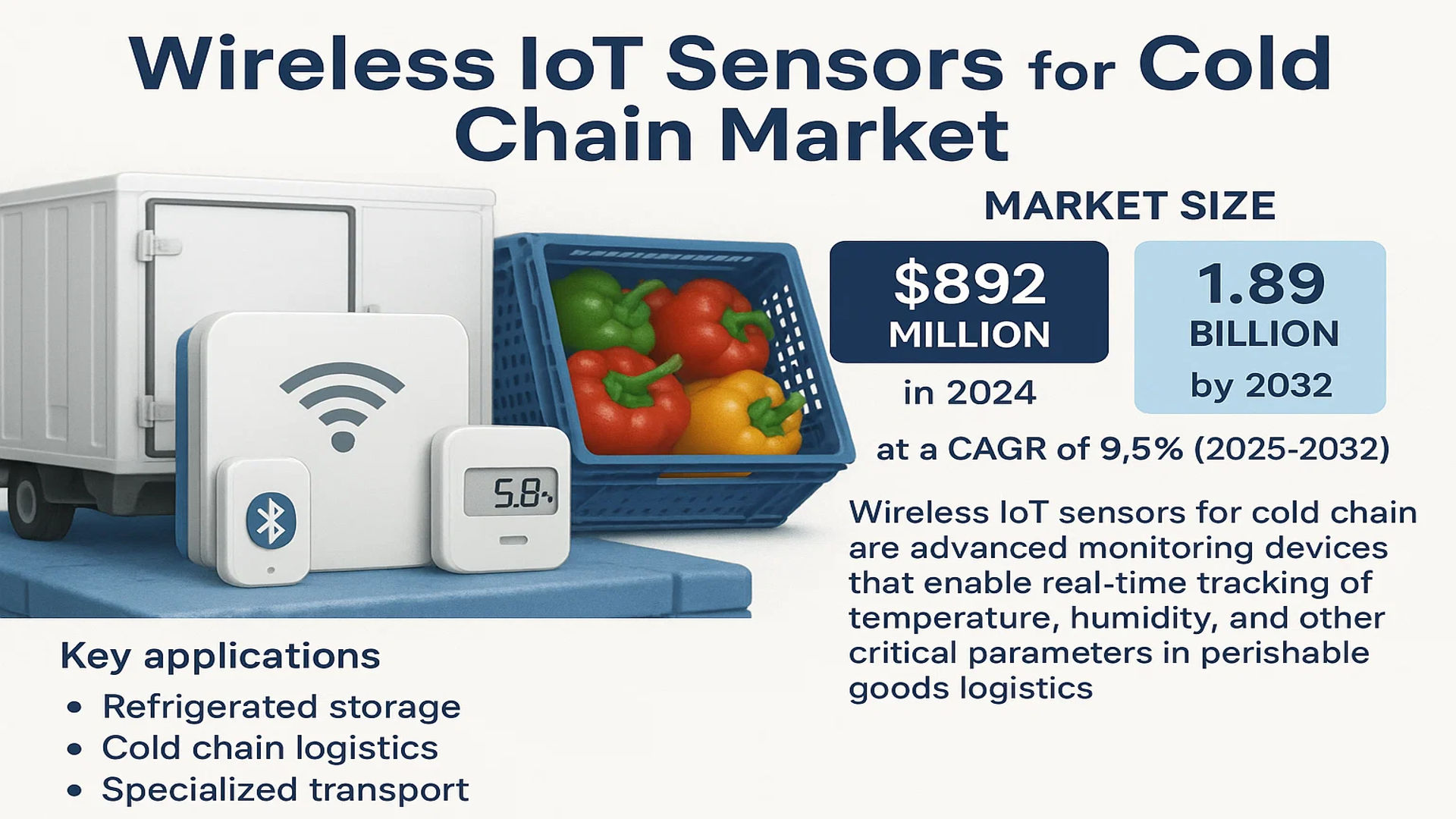
The global Wireless IoT Sensors for Cold Chain market size was valued at US$ 892 million in 2024 and is projected to reach US$ 1.89 billion by 2032, at a CAGR of 9.5% during the forecast period 2025-2032.
Wireless IoT sensors for cold chain are advanced monitoring devices that enable real-time tracking of temperature, humidity, and other critical parameters in perishable goods logistics. These sensors utilize traditional wireless technologies (like Bluetooth and Wi-Fi) or LPWANs (Low-Power Wide-Area Networks) to transmit data, ensuring food safety, pharmaceutical integrity, and reduced spoilage across the supply chain. Key applications include refrigerated storage, cold chain logistics, and specialized transport solutions.
The market growth is primarily driven by stringent regulatory requirements for perishable goods, increasing adoption of IoT in logistics, and rising demand for end-to-end visibility in supply chains. The rapid expansion of 5G networks and cloud-based monitoring platforms further accelerates adoption. For instance, China’s deployment of 2.3 million 5G base stations by 2022 has significantly enhanced IoT connectivity. Key players like Honeywell, Bosch, and Texas Instruments dominate the market with innovative sensor solutions, while sectors like pharmaceuticals and food & beverages remain major adopters.
MARKET DYNAMICS
MARKET DRIVERS
Stringent Regulatory Requirements for Food and Pharmaceutical Safety Driving Adoption
The global cold chain market is experiencing significant growth due to increasingly strict regulations governing food and pharmaceutical safety. Regulatory bodies worldwide are mandating real-time temperature monitoring throughout supply chains, with temperature deviations potentially leading to product recalls worth billions annually. Wireless IoT sensors provide continuous monitoring capabilities that help companies comply with these requirements while reducing losses from spoiled goods. The pharmaceutical cold chain alone accounts for over 20% of biopharmaceutical products requiring stringent temperature control, creating substantial demand for reliable monitoring solutions.
Expansion of Global Cold Chain Logistics Infrastructure Fueling Demand
With international trade in perishable goods growing steadily, the global cold chain logistics market is projected to expand at over 15% CAGR through 2030. Major economies are investing heavily in cold storage facilities and refrigerated transportation networks, particularly in emerging markets where infrastructure development is accelerating. Wireless IoT sensors play a critical role in these expansions by enabling end-to-end visibility across complex supply chains. Recent investments in Asia-Pacific cold chain infrastructure, estimated at $15 billion annually, demonstrate the scale of opportunity for sensor providers.
Advancements in LPWAN and 5G Technologies Enabling Scalable Deployments
The proliferation of low-power wide-area networks (LPWAN) and 5G connectivity is removing traditional barriers to large-scale IoT deployments in cold chain operations. Technologies like NB-IoT and LoRaWAN provide reliable connectivity even in remote locations while maximizing battery life – critical for sensors monitoring shipments across international borders. With 5G networks now covering over 30% of global population centers, the infrastructure exists to support high-density sensor networks with real-time data transmission capabilities that were previously unattainable.
MARKET RESTRAINTS
High Initial Deployment Costs Creating Barriers for Small Operators
While wireless IoT sensors deliver long-term value, their upfront costs remain prohibitive for many small and medium-sized cold chain operators. A complete sensor-based monitoring system can require significant capital expenditure for hardware, software platforms, and integration with existing systems. This financial barrier is particularly challenging in developing regions where cold chain participants often operate on thin margins. The payback period for such investments, typically 18-24 months, discourages adoption among cost-sensitive businesses despite proven operational benefits.
Data Security and Privacy Concerns Limiting Adoption Rates
As cold chain operations generate increasing volumes of sensitive shipment data, concerns about cybersecurity and data privacy are emerging as significant adoption barriers. High-profile breaches in logistics networks have made operators cautious about deploying IoT solutions that could expose proprietary shipping routes, customer information, or product details. The pharmaceutical industry in particular faces strict data governance requirements that complicate sensor deployments, with compliance costs for secure implementations sometimes exceeding the technology costs themselves.
MARKET CHALLENGES
Interoperability Issues Between Diverse IoT Ecosystems
The wireless IoT sensor market faces significant challenges from fragmented technology standards and incompatible platforms. Cold chain operators often struggle to integrate sensor data from multiple vendors into unified monitoring systems, creating operational inefficiencies. With over 20 competing IoT protocols and platforms in the market, establishing seamless interoperability remains elusive. This challenge is compounded by the long lifecycle of cold chain assets like refrigerated containers that may need to work with evolving sensor technologies over decades.
Battery Life Limitations in Extreme Temperature Environments
While wireless IoT sensors have made significant advances in energy efficiency, maintaining reliable operation in extreme cold chain environments continues to present technical challenges. Lithium-ion batteries commonly used in these devices can experience reduced performance in sub-zero temperatures common to frozen food and pharmaceutical transports. Sensor manufacturers must balance power requirements with the need for frequent data transmission, often resulting in compromises that limit functionality or require more frequent maintenance interventions.
MARKET OPPORTUNITIES
Emerging AI-Powered Predictive Analytics Creating Value-Added Services
The integration of artificial intelligence with wireless IoT sensor networks is opening new revenue streams for cold chain solution providers. Advanced analytics platforms can now predict equipment failures before they occur, optimize routing based on real-time conditions, and automatically adjust storage parameters for maximum product preservation. These capabilities are transforming basic monitoring systems into intelligent platforms that deliver measurable operational improvements, with early adopters reporting 15-20% reductions in spoilage rates through predictive maintenance alone.
Expansion of Ultra-Low Temperature Pharmaceutical Logistics
The rapid growth of cell and gene therapies requiring ultra-low temperature storage (-70°C to -196°C) is creating specialized opportunities for wireless sensor providers. These high-value biologics demand monitoring solutions capable of withstanding extreme conditions while maintaining precision measurements. With the global market for advanced therapy medicinal products projected to exceed $20 billion by 2026, sensor manufacturers are developing ruggedized solutions specifically for this lucrative niche, incorporating redundant sensing and enhanced connectivity features.
WIRELESS IOT SENSORS FOR COLD CHAIN MARKET TRENDS
Adoption of LPWAN Technologies Drives Cold Chain Monitoring Efficiency
The growing adoption of Low-Power Wide-Area Network (LPWAN) technologies such as NB-IoT and LoRaWAN is revolutionizing the cold chain market by enabling cost-effective, long-range wireless connectivity for temperature and humidity monitoring. These solutions offer battery lifetimes exceeding 10 years while maintaining reliable data transmission at distances up to 15km in rural areas. Recent deployments show LPWAN-based cold chain monitoring systems achieving 99.9% data transmission reliability even in challenging environments like deep-freeze storage facilities. The integration of edge computing capabilities with these sensors further enhances real-time decision-making by processing data locally before cloud transmission.
Other Trends
Artificial Intelligence in Predictive Analytics
AI-powered predictive analytics are transforming cold chain management through advanced pattern recognition of temperature fluctuations and equipment performance. Modern systems can now forecast potential refrigeration failures 24-48 hours in advance with 92% accuracy, dramatically reducing spoilage risks. The pharmaceutical sector has particularly benefited from this technology, where stringent temperature requirements for vaccines and biologics demand precise monitoring. Machine learning algorithms analyze historical sensor data to optimize storage conditions, reducing energy consumption by up to 30% in large cold storage facilities while maintaining product integrity.
Regulatory Compliance Accelerates Smart Monitoring Adoption
Stringent food safety and pharmaceutical regulations are accelerating wireless IoT sensor deployment across global supply chains. Recent updates to Good Distribution Practice (GDP) guidelines now mandate continuous temperature monitoring for certain medical products throughout transit. In the food sector, FSMA regulations in the U.S. and similar frameworks internationally require detailed temperature logs with audit capabilities. Wireless solutions have emerged as the preferred compliance tool, with cold chain operators reporting 40-60% faster audit processes compared to manual recording methods. The ability to generate automated compliance reports with digital signatures and blockchain-verified timestamps provides additional assurance for regulated industries.
COMPETITIVE LANDSCAPE
Key Industry Players
Market Leaders Invest in IoT-Enabled Cold Chain Solutions to Address Growing Demand
The global Wireless IoT Sensors for Cold Chain market features a dynamic competitive environment with established multinational corporations competing alongside specialized sensor manufacturers. Robert Bosch GmbH and Honeywell currently dominate the market, collectively accounting for over 25% of global revenue share in 2024. Their leadership stems from comprehensive sensor portfolios and robust IoT integration capabilities across temperature-controlled logistics applications.
Notably, semiconductor giants NXP Semiconductors and Texas Instruments have emerged as critical enablers in this space, providing low-power wireless chipsets specifically designed for cold chain monitoring. These companies benefit from established relationships with sensor manufacturers and logistics providers, allowing for seamless integration of their technology into existing cold chain infrastructure.
The market has witnessed increased competition from specialized IoT players like Sensirion AG and Sensata Technologies, who are introducing advanced sensor nodes with multi-parameter monitoring capabilities. These companies are gaining traction by offering customized solutions for pharmaceutical and food cold chain applications where precise environmental control is critical.
Strategic acquisitions have marked recent market developments, with TE Connectivity acquiring two IoT sensor startups in 2023 to strengthen its cold chain offerings. Meanwhile, STMicroelectronics has expanded its production capacity for wireless sensor components, anticipating continued growth in cold chain applications across emerging markets.
List of Key Wireless IoT Sensor Companies in Cold Chain
- Robert Bosch GmbH (Germany)
- Honeywell International Inc. (U.S.)
- Analog Devices, Inc. (U.S.)
- NXP Semiconductors N.V. (Netherlands)
- Infineon Technologies AG (Germany)
- Silicon Laboratories, Inc. (U.S.)
- ABB Ltd. (Switzerland)
- InvenSense (TDK Corporation) (Japan)
- Panasonic Corporation (Japan)
- Texas Instruments Incorporated (U.S.)
- STMicroelectronics N.V. (Switzerland)
- TE Connectivity Ltd. (Switzerland)
- Omron Corporation (Japan)
- Semtech Corporation (U.S.)
- Sensata Technologies, Inc. (U.S.)
- Vishay Intertechnology, Inc. (U.S.)
- Sensirion AG (Switzerland)
Segment Analysis:
By Type
LPWANs Technology Segment Leads Due to Energy Efficiency and Long-Range Connectivity
The market is segmented based on type into:
- Traditional Wireless Technology
- Subtypes: Bluetooth, Wi-Fi, Zigbee, and others
- LPWANs Technology
- Subtypes: LoRaWAN, NB-IoT, Sigfox, and others
By Application
Cold Chain Logistics Segment Dominates Owing to Growing Demand for Real-Time Monitoring
The market is segmented based on application into:
- Refrigerated Storage
- Cold Chain Logistics
- Pharmaceutical Transportation
- Food & Beverage Distribution
- Others
By End-User
Pharmaceutical Industry Drives Adoption for Temperature-Sensitive Product Monitoring
The market is segmented based on end-user into:
- Pharmaceutical Companies
- Food & Beverage Manufacturers
- Logistics Providers
- Retail Chains
- Others
Regional Analysis: Wireless IoT Sensors for Cold Chain Market
North America
North America leads the global Wireless IoT Sensors for Cold Chain market due to strict regulatory requirements for food and pharmaceutical safety, particularly in the U.S. and Canada. The FDA’s Food Safety Modernization Act (FSMA) mandates stringent temperature monitoring during transportation and storage, pushing logistics providers to adopt IoT-enabled solutions. Additionally, advanced 5G infrastructure and LPWAN deployments accelerate market growth. Major players like Honeywell and Texas Instruments are investing in R&D to enhance battery life and connectivity for cold chain monitoring, especially in perishable food and vaccine distribution networks. However, high implementation costs remain a challenge for small and medium enterprises.
Europe
Europe’s cold chain IoT sensor market thrives on stringent EU regulations, such as GDP (Good Distribution Practice) guidelines for pharmaceuticals and perishables. Countries like Germany and France are early adopters, leveraging LoRaWAN and NB-IoT technologies for real-time monitoring. The region’s focus on reducing food waste—a priority under the EU Farm to Fork Strategy—further drives demand. Key suppliers, including STMicroelectronics and ABB, are developing energy-efficient sensors to comply with sustainability goals. Nonetheless, fragmented logistics networks across Eastern Europe slow widespread adoption.
Asia-Pacific
Asia-Pacific is the fastest-growing region, propelled by China’s massive cold chain expansion and India’s booming pharmaceutical sector. China’s 5G infrastructure, with over 2.3 million base stations, supports seamless IoT connectivity for temperature-controlled logistics. Japan and South Korea lead in technological innovation, integrating AI with IoT sensors for predictive analytics. However, cost sensitivity in emerging markets like Southeast Asia limits the penetration of high-end solutions, favoring traditional wireless technologies over LPWANs in smaller enterprises. Government initiatives, such as India’s National Cold Chain Development Plan, aim to bridge this gap.
South America
South America shows gradual adoption of wireless IoT sensors, driven by Brazil’s agricultural exports and Argentina’s biopharma industry. The lack of standardized cold chain infrastructure and inconsistent regulatory enforcement pose hurdles, though investments in smart agriculture and vaccine distribution are creating niche opportunities. Local players prioritize affordable, rugged sensors for harsh transport conditions, but reliance on imports for advanced technology stifles scalability.
Middle East & Africa
The Middle East’s focus on pharmaceutical hubs (e.g., UAE’s Dubai Science Park) and Africa’s expanding vaccine programs underpin demand for IoT cold chain solutions. While Gulf nations leverage high-tech logistics parks, sub-Saharan Africa struggles with unreliable power and connectivity. Partnerships with global firms like Sensitech and Panasonic aim to address these gaps through solar-powered sensors and satellite-based monitoring, though progress is uneven.
Report Scope
This market research report provides a comprehensive analysis of the Global Wireless IoT Sensors for Cold Chain market, covering the forecast period 2025–2032. It offers detailed insights into market dynamics, technological advancements, competitive landscape, and key trends shaping the industry.
Key focus areas of the report include:
- Market Size & Forecast: Historical data and future projections for revenue, unit shipments, and market value across major regions and segments. The market was valued at US$ 892 million in 2024 and is projected to reach US$ 1.89 billion by 2032 at a significant CAGR of 9.5%.
- Segmentation Analysis: Detailed breakdown by product type (Traditional Wireless Technology, LPWANs Technology), application (Refrigerated Storage, Cold Chain Logistics, Others), and end-user industry to identify high-growth segments.
- Regional Outlook: Insights into market performance across North America, Europe, Asia-Pacific, Latin America, and the Middle East & Africa, including country-level analysis. Asia-Pacific leads with the highest growth rate due to expanding cold chain infrastructure.
- Competitive Landscape: Profiles of leading market participants such as Robert Bosch GmbH, Honeywell, Analog Devices, NXP Semiconductors, and Infineon Technologies, including their product portfolios, R&D investments, and strategic initiatives.
- Technology Trends & Innovation: Assessment of LPWAN advancements, 5G integration, and AI-driven analytics in cold chain monitoring, with China having deployed 2.3 million 5G base stations by 2022.
- Market Drivers & Restraints: Evaluation of factors such as rising demand for perishable goods, regulatory compliance, and IoT adoption, alongside challenges like high deployment costs.
- Stakeholder Analysis: Strategic insights for sensor manufacturers, logistics providers, and investors to capitalize on the 14 billion global IoT-connected devices ecosystem.
Primary and secondary research methods are employed, including interviews with industry experts, verified market data, and real-time intelligence to ensure accuracy.
FREQUENTLY ASKED QUESTIONS:
What is the current market size of the Global Wireless IoT Sensors for Cold Chain Market?
->Wireless IoT Sensors for Cold Chain market size was valued at US$ 892 million in 2024 and is projected to reach US$ 1.89 billion by 2032, at a CAGR of 9.5% during the forecast period 2025-2032.
Which key companies operate in this market?
-> Key players include Robert Bosch GmbH, Honeywell, NXP Semiconductors, Texas Instruments, and STMicroelectronics, among others.
What are the key growth drivers?
-> Growth is driven by rising cold chain logistics demand, IoT adoption, and stringent food safety regulations.
Which region dominates the market?
-> Asia-Pacific dominates due to rapid industrialization, while North America leads in technological adoption.
What are the emerging trends?
-> Trends include LPWAN integration, AI-powered predictive analytics, and blockchain for supply chain transparency.

Get Sample Report PDF for Exclusive Insights
Report Sample Includes
- Table of Contents
- List of Tables & Figures
- Charts, Research Methodology, and more...
 Download Sample Report PDF





