
MARKET INSIGHTS
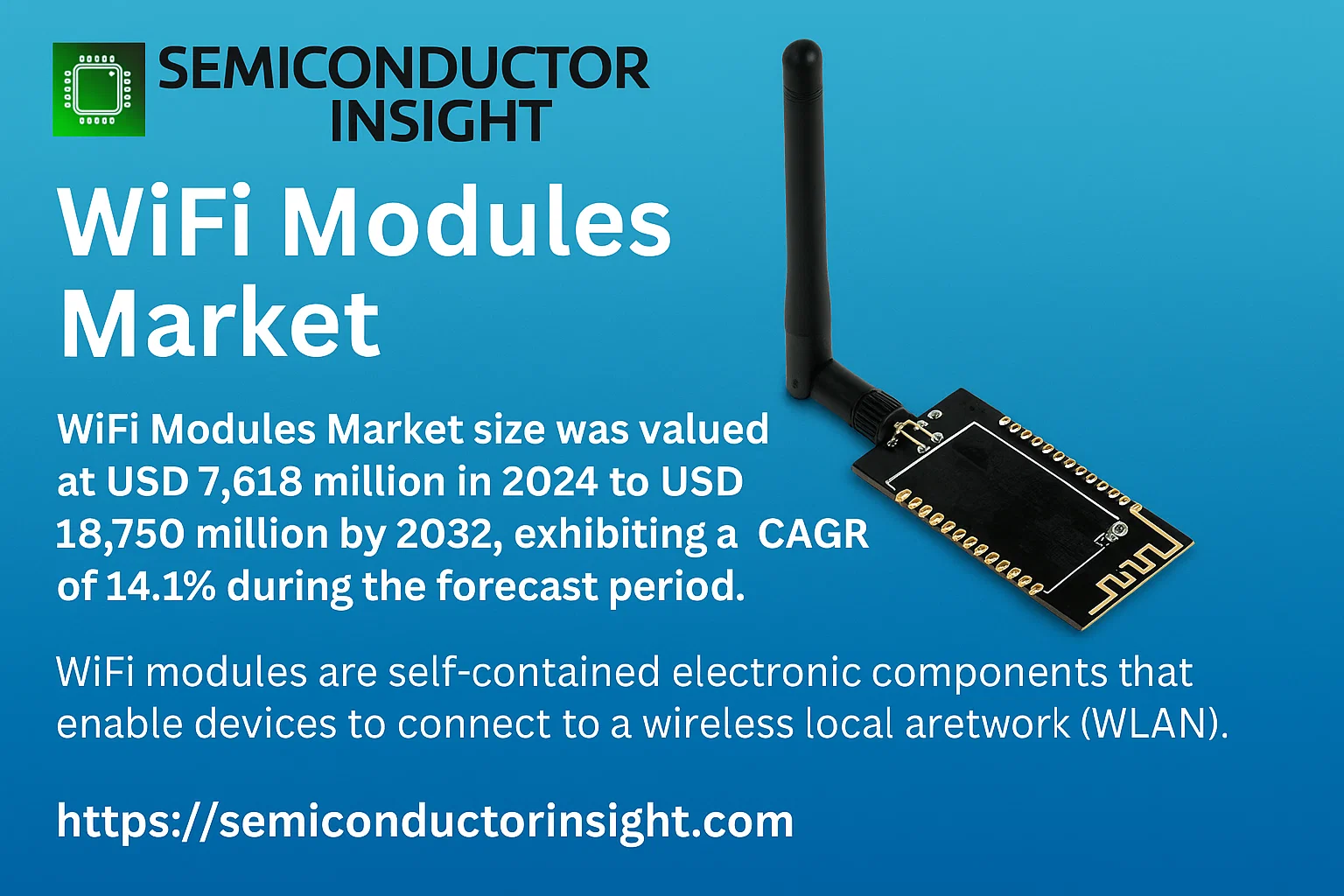
Global WiFi Modules Market size was valued at USD 7,618 million in 2024 to USD 18,750 million by 2032, exhibiting a CAGR of 14.1% during the forecast period.
WiFi modules are self-contained electronic components that enable devices to connect to a wireless local area network (WLAN). These integrated circuits contain a WiFi radio, processor, and necessary software stack, providing a ready-to-use solution for embedding wireless connectivity into a wide range of products. The primary types of modules include universal Wi-Fi modules, router scheme Wi-Fi modules, and embedded Wi-Fi modules.
The market is experiencing rapid growth due to several factors, including the exponential expansion of the Internet of Things (IoT), rising demand for smart home appliances, and increasing industrial automation. Furthermore, the rollout of advanced WiFi standards like Wi-Fi 6 and Wi-Fi 6E is contributing to market expansion by offering higher speeds and better performance in congested environments. Initiatives by key players in the market are also expected to fuel growth; for instance, companies are continuously launching compact, low-power modules designed for battery-operated IoT devices. China dominates as the largest regional market with a share of approximately 50%, followed by North America at around 15%. Murata Electronics, USI, Taiyo Yuden, AzureWave, and TI are some of the key players that operate in the market with a wide range of portfolios.
MARKET DRIVERS
Proliferation of IoT and Smart Devices
The exponential growth of the Internet of Things (IoT) ecosystem is a primary driver for the WiFi Modules Market. Modules are essential components in smart home devices, industrial sensors, and connected appliances, enabling seamless wireless connectivity. Demand is further accelerated by the increasing consumer and industrial adoption of automation and remote monitoring solutions.
Advancements in WiFi Standards
The continuous evolution of WiFi standards, particularly the widespread deployment of WiFi 6 and the emerging WiFi 6E/7, is propelling market growth. These newer standards offer significant improvements in speed, capacity, latency, and power efficiency, making WiFi modules more attractive for bandwidth-intensive applications like 4K/8K video streaming and augmented reality.
The push for smart city infrastructure and the increasing integration of WiFi in automotive infotainment systems are also **significant contributors** to the expanding market footprint of WiFi modules.
MARKET CHALLENGES
Intense Price Competition and Margin Pressure
The WiFi Modules Market is highly competitive, with numerous manufacturers vying for market share. This leads to significant price pressure, squeezing profit margins, particularly for standard, low-differentiation modules. Companies must continually innovate to add value beyond basic connectivity to maintain profitability.
Other Challenges
Security Vulnerabilities
As WiFi modules become ubiquitous in critical applications, they represent a growing attack surface for cyber threats. Ensuring robust, updated security protocols to protect against breaches is a persistent and costly challenge for manufacturers and integrators.
Supply Chain and Component Shortages
The industry has faced volatility from global chip shortages, impacting the production and lead times for WiFi modules. Dependence on a concentrated semiconductor supply chain creates vulnerability to geopolitical and logistical disruptions.
MARKET RESTRAINTS
Competition from Alternative Connectivity Technologies
While dominant, WiFi faces strong competition from other wireless protocols like Bluetooth Low Energy, Zigbee, LoRaWAN, and cellular technologies (NB-IoT, LTE-M). For specific use cases, particularly those requiring long-range, low-power, or mesh networking, these alternatives can be more suitable, restraining the addressable market for WiFi modules.
Complexity in Network Management
The deployment of large-scale WiFi networks, such as in enterprise or industrial settings, introduces challenges related to network congestion, interference management, and complex infrastructure requirements. This complexity can be a barrier to adoption for some applications where simpler, proprietary protocols are sufficient.
MARKET OPPORTUNITIES
Expansion into Industrial IoT (IIoT) and Automotive
The transition to Industry 4.0 is creating substantial opportunities for robust, high-performance WiFi modules in factory automation, predictive maintenance, and asset tracking. Similarly, the automotive sector’s shift towards connected and autonomous vehicles presents a growing market for advanced in-vehicle WiFi solutions.
Integration of AI and Edge Computing
The convergence of WiFi with Artificial Intelligence (AI) and edge computing is a key growth frontier. AI-enhanced WiFi modules can optimize network performance, enable predictive analytics, and improve power management, opening up new value-added applications in smart infrastructure and personalized user experiences.
WiFi Modules Market Trends
Explosive Growth Fueled by IoT and Smart Devices
Global WiFi Modules market is undergoing a period of significant expansion, with its valuation projected to surge from USD 7,618 million in 2024 to USD 18,750 million by 2032, representing a compound annual growth rate (CAGR) of 14.1%. This robust growth trajectory is primarily driven by the pervasive integration of Internet of Things (IoT) technologies and the escalating demand for connected smart appliances and handheld mobile devices. The market’s momentum is underpinned by the essential role WiFi modules play in providing wireless connectivity across a diverse range of applications, making seamless communication and data exchange possible.
Other Trends
Regional Market Concentration and Competitive Landscape
The geographical distribution of the WiFi Modules market is highly concentrated, with China accounting for approximately 50% of the global market share, solidifying its position as the dominant regional player. North America follows as the second-largest market, holding a 15% share. The competitive environment is characterized by the presence of key manufacturers such as Murata Electronics, USI, Taiyo Yuden, AzureWave, and Texas Instruments (TI). These top five players collectively command nearly 45% of the total market, indicating a moderately concentrated competitive landscape where technological innovation and strategic partnerships are critical for maintaining market position.
Segmentation by Type and Application
The market is segmented into key product types, including Universal Wi-Fi Modules, Router Scheme Wi-Fi Modules, and Embedded Wi-Fi Modules, each catering to specific technical requirements and use cases. On the application front, major segments driving demand are Smart Appliances, Handheld Mobile Devices, Medical and Industrial Testing Instruments, Smart Grid applications, and Routers. The expansion of smart home ecosystems and industrial automation is creating substantial growth opportunities within these application segments.
Future Outlook and Strategic Imperatives
Looking ahead, the WiFi Modules market is poised for continuous evolution, supported by advancements in WiFi standards like Wi-Fi 6 and Wi-Fi 6E, which offer higher speeds and improved efficiency for dense IoT environments. The focus for manufacturers will be on developing low-power, high-performance modules to meet the demands of battery-operated devices. Understanding the dynamics of regional markets, particularly the growth potential in emerging economies within Asia and South America, alongside navigating supply chain considerations and technological standardization, will be crucial for stakeholders aiming to capitalize on the market’s promising future.
COMPETITIVE LANDSCAPE
Key Industry Players
A Market Dominated by Specialized Electronics Manufacturers
Global WiFi Modules Market is characterized by a high level of consolidation among a few key players, with the top five manufacturers accounting for approximately 45% of the market share. Murata Electronics stands as the undisputed leader, leveraging its extensive expertise in ceramic substrates and component miniaturization to produce highly reliable modules for demanding applications. The market structure is heavily influenced by the dominance of the Asia-Pacific region, particularly China, which alone constitutes about 50% of the global market. This concentration is driven by a robust electronics manufacturing ecosystem and high demand from consumer electronics and industrial sectors. The competitive dynamics are shaped by continuous innovation in module size, power efficiency, and protocol support (like Wi-Fi 6/6E), with leading players investing heavily in R&D to maintain their positions.
Beyond the top-tier manufacturers, a number of other significant players compete effectively by focusing on niche applications and specific technological expertise. Companies like Silicon Labs and Microchip Technology are prominent for their strengths in providing integrated solutions for the Internet of Things (IoT), combining microcontrollers with connectivity. Other firms, such as Silex Technology and Advantech B+B SmartWorx, have carved out strong positions in industrial and enterprise-grade applications, offering specialized modules with enhanced security, reliability, and long-term availability. The market also includes agile players like MXCHIP and Particle, which cater to developers and startups with easy-to-integrate modules and development platforms, fostering innovation in smart home devices and other emerging IoT segments.
List of Key WiFi Modules Companies Profiled
- Murata Electronics
- USI
- Taiyo Yuden
- AzureWave
- Texas Instruments (TI)
- Silicon Labs
- LSR
- RF-LINK
- Broadlink
- Advantech B+B SmartWorx
- Mi
- MXCHIP
- Silex Technology
- Microchip Technology
- Longsys
- Particle
Segment Analysis:
| Segment Category | Sub-Segments | Key Insights |
| By Type |
|
Embedded Wi-Fi Module is experiencing the most significant growth trajectory, largely driven by the proliferation of the Internet of Things. This segment’s integration directly into device motherboards offers superior space efficiency and reliability, making it the preferred choice for smart home appliances, wearables, and industrial automation. The demand for seamless, compact connectivity solutions in consumer electronics and automotive applications continues to fuel innovation and adoption in this category, positioning it as a critical enabler for next-generation connected devices. |
| By Application |
|
Smart Appliances represent the most dynamic application segment, driven by the accelerating trend of home automation and consumer demand for interconnected living environments. The integration of Wi-Fi modules into refrigerators, washing machines, and climate control systems enables remote monitoring and energy management, creating a strong value proposition. This segment’s growth is further amplified by advancements in smart home ecosystems and voice assistant compatibility, which are becoming standard features in modern households and driving sustained market expansion. |
| By End User |
|
Consumer Electronics remains the dominant end-user segment, with relentless innovation in smartphones, tablets, and smart home devices creating continuous demand for advanced connectivity. The segment’s leadership is reinforced by rapid product lifecycles and the integration of Wi-Fi into an ever-expanding array of personal and entertainment gadgets. Furthermore, the increasing consumer expectation for always-on connectivity and high-speed data transfer capabilities in personal devices ensures this segment maintains a pivotal role in driving overall market development and technological standards. |
| By Connectivity Standard |
|
Wi-Fi 6 (802.11ax) is the most influential and rapidly adopted connectivity standard, characterized by its superior efficiency in high-density environments and support for a greater number of connected devices. Its advanced capabilities in managing network congestion and providing higher data throughput are critical for modern smart homes and enterprise applications. The ongoing transition to this standard is a major market driver, as manufacturers across consumer electronics and networking equipment prioritize future-proofing their products to meet the demands of increasingly data-intensive applications and IoT ecosystems. |
| By Integration Level |
|
Combo Modules (Wi-Fi + Bluetooth) are emerging as the leading integration level, driven by the synergistic benefits of combining two ubiquitous wireless technologies in a single component. This approach is particularly advantageous for space-constrained devices like wearables and compact IoT sensors, simplifying design and reducing the bill of materials. The ability to leverage both connectivity options for different tasks—such as using Bluetooth for device pairing and Wi-Fi for high-speed data transfer—provides manufacturers with greater design flexibility and enhances the overall user experience, making it a highly sought-after solution. |
Regional Analysis: WiFi Modules Market
The region’s extensive electronics supply chain, from component suppliers to end-product assembly lines, ensures seamless integration and availability of WiFi modules. This ecosystem allows for rapid prototyping, cost-efficient mass production, and quick time-to-market for new connected devices, giving manufacturers in the region a significant competitive advantage.
There is a massive push towards Industry 4.0 and smart manufacturing across the region, requiring reliable wireless communication for machine-to-machine connectivity. WiFi modules are critical for sensors, controllers, and automated systems, with growing adoption in smart homes, agriculture, and logistics, creating a vast and expanding addressable market.
National strategies, such as China’s “Made in China 2025” and India’s “Digital India,” actively promote the integration of digital technologies into all economic sectors. These policies drive demand for connectivity hardware, including WiFi modules, by funding smart city projects, digital infrastructure, and the broader adoption of IoT solutions.
The region is a hotbed for research and development in wireless technologies. Leading semiconductor and telecommunications companies are headquartered here, driving advancements in module performance, power efficiency, and miniaturization. This continuous innovation cycle ensures that the latest WiFi standards are quickly incorporated into modules, meeting evolving global demands.
North America
North America is a highly mature and technologically advanced market for WiFi modules, characterized by early adoption of new standards and high demand from both consumer and enterprise sectors. The region’s strong economy supports significant investment in smart home devices, high-end computing, and enterprise networking equipment. A robust ecosystem of technology giants and innovative startups constantly pushes the boundaries for connected devices, requiring high-performance, reliable modules. The enterprise sector, including offices, healthcare, and retail, is a major driver, implementing WiFi for everything from point-of-sale systems to complex asset tracking solutions. While manufacturing is less prominent than in Asia-Pacific, the region excels in high-value, specialized module design and development for cutting-edge applications.
Europe
The European market for WiFi modules is driven by stringent regulatory standards, a strong focus on industrial IoT, and widespread adoption in the automotive and smart home sectors. The region has a well-established industrial base that is increasingly integrating wireless connectivity for automation and predictive maintenance. Europe’s automotive industry, a global leader, is incorporating WiFi modules for in-vehicle infotainment, telematics, and emerging V2X communication systems. Consumer demand for smart appliances and home automation systems is also significant. General Data Protection Regulation (GDPR) and other privacy laws influence module design, emphasizing security features. The market is characterized by a demand for high-quality, secure, and energy-efficient modules tailored to specific industrial and consumer applications.
South America
The WiFi Modules Market in South America is growing steadily, albeit from a smaller base, driven primarily by increasing internet penetration and the gradual expansion of smart city initiatives in major urban centers. The consumer electronics segment is the largest driver, with growing sales of smartphones and smart TVs fueling demand. Industrial adoption is still in early stages but shows promise in sectors like agriculture and resource management. Market growth is somewhat tempered by economic volatility and infrastructure challenges in some countries. However, efforts to improve broadband infrastructure and the rising middle class’s adoption of connected devices present significant growth opportunities for module suppliers willing to navigate the regional complexities.
Middle East & Africa
This region presents a diverse and emerging market for WiFi modules, with growth concentrated in the Gulf Cooperation Council (GCC) countries and major African urban hubs. The market is propelled by massive government investments in smart city projects, such as NEOM in Saudi Arabia and smart city initiatives in Dubai and Abu Dhabi, which require extensive deployment of connected sensors and devices. There is also growing demand from the telecommunications sector for network infrastructure equipment. While the market is smaller compared to other regions, it offers high growth potential. Challenges include varying levels of infrastructure development across the continent, but the ongoing digital transformation agendas in many countries are expected to drive increased adoption of WiFi modules in the coming years.
Report Scope
This market research report provides a comprehensive analysis of the WiFi Modules Market, covering the forecast period 2025–2032. It offers detailed insights into market dynamics, technological advancements, competitive landscape, and key trends shaping the industry.
Key focus areas of the report include:
- Market Overview: The report begins with an overview outlining its current market scenario, key growth indicators, and industry transformation drivers. It discusses macroeconomic factors, demand–supply balance, regulatory landscape, and the strategic role of semiconductors in powering advancements across industries such as automotive, telecommunications, consumer electronics, and industrial automation.
- Market Size & Forecast: Historical data and future projections for revenue, unit shipments, and market value across major regions and segments.
- Segmentation Analysis: Detailed breakdown by product type, technology, application, and end-user industry to identify high-growth segments and investment opportunities.
- Regional Insights: Insights into market performance across North America, Europe, Asia-Pacific, Latin America, and the Middle East & Africa, including country-level analysis where relevant.
- Competitive Landscape: Profiles of leading market participants, including their product offerings, R&D focus, manufacturing capacity, pricing strategies, and recent developments such as mergers, acquisitions, and partnerships.
- Technology Trends & Innovation: Assessment of emerging technologies, integration of AI/IoT, semiconductor design trends, fabrication techniques, and evolving industry standards.
- Market Drivers & Restraints: Evaluation of factors driving market growth along with challenges, supply chain constraints, regulatory issues, and market-entry barriers.
- Stakeholder Insights: Insights for component suppliers, OEMs, system integrators, investors, and policymakers regarding the evolving ecosystem and strategic opportunities.
Primary and secondary research methods are employed, including interviews with industry experts, data from verified sources, and real-time market intelligence to ensure the accuracy and reliability of the insights presented.
FREQUENTLY ASKED QUESTIONS:
What is the current market size of WiFi Modules Market?
-> WiFi Modules Market size was valued at USD 7,618 million in 2024 to USD 18,750 million by 2032, exhibiting a CAGR of 14.1% during the forecast period.
Which key companies operate in WiFi Modules Market?
-> Key players include Murata Electronics, USI, Taiyo Yuden, AzureWave, and TI, among others. The top 5 manufacturers held a combined market share of about 45% in 2024.
What are the key growth drivers?
-> Key growth drivers include the proliferation of IoT devices, increasing demand for wireless connectivity in smart appliances and handheld mobile devices, and advancements in industrial automation.
Which region dominates the market?
-> China is the largest region, with a market share of about 50% in 2024. It was followed by North America with approximately 15%.
What are the emerging trends?
-> Emerging trends include the adoption of embedded Wi-Fi modules, integration in smart grid applications, and the development of universal and router scheme modules for diverse connectivity solutions.

Get Sample Report PDF for Exclusive Insights
Report Sample Includes
- Table of Contents
- List of Tables & Figures
- Charts, Research Methodology, and more...
 Download Sample Report PDF



