Key Statistics
Key Takeaways
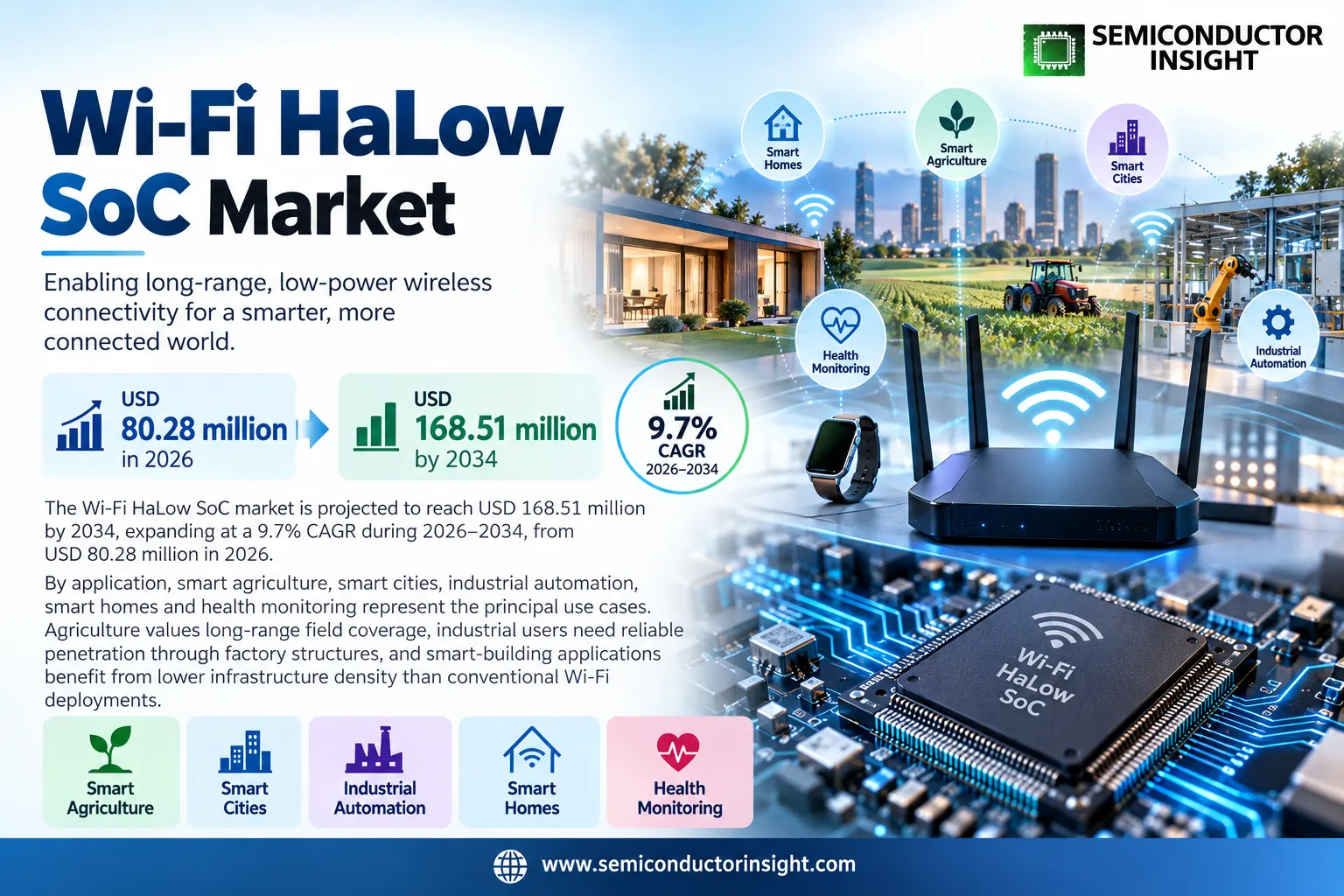
- Market size: The market is valued at USD 73.18 million in 2025 and is projected to reach USD 168.51 million by 2034, representing a 9.7% CAGR during 2026–2034.
- North America leads current technology adoption, supported by early Wi-Fi HaLow commercialization in industrial, utility and smart-building applications.
- Asia Pacific is the fastest-growing region, driven by IoT manufacturing, smart-city deployment and strong electronics supply chains.
- 2 MHz and 4 MHz channels form the mainstream operating profile, balancing range, throughput and power consumption across sub-GHz deployments.
- Commercial acceleration is shifting from chip availability to ecosystem readiness, with modules, USB adapters, RTOS support and design partners reducing time to market.
Wi-Fi HaLow SoC Market Overview
Wi-Fi HaLow SoC market is valued at USD 73.18 million in 2025 and is projected to reach USD 168.51 million by 2034, expanding at a 9.7% CAGR during 2026–2034. The 2026 market level is USD 80.28 million. North America leads current adoption, while Asia Pacific grows fastest through IoT manufacturing, utilities and smart-infrastructure programs. The market is transitioning from early evaluation kits toward production modules, certified devices and embedded software support.
Wi-Fi HaLow SoCs implement IEEE 802.11ah connectivity in the sub-1 GHz band, combining long range, low power consumption and native IP networking. Compared with conventional 2.4 GHz or 5 GHz Wi-Fi, HaLow can cover larger areas and penetrate obstacles more effectively, making it suitable for industrial sensors, smart agriculture, utilities, surveillance, smart buildings and battery-operated IoT devices.
Commercial differentiation depends on link budget, sleep current, data rate, channel flexibility, security, host interface and software maturity. Morse Micro’s second-generation MM8108 platform supports 1, 2, 4 and 8 MHz channel bandwidths and is being deployed through modules and reference designs, showing how the market is moving toward production-ready connectivity stacks rather than stand-alone silicon evaluation.
System designers compare HaLow against LoRaWAN, cellular LPWAN, Zigbee and conventional Wi-Fi. HaLow’s advantage is standards-based IP connectivity with higher throughput than many LPWAN alternatives while retaining long range. The strongest opportunities occur where customers need camera data, firmware updates or richer sensor payloads without the recurring cost of cellular connectivity.
Segment Analysis: By Type
By type, the market is segmented by maximum bandwidth, with 2 MHz and 4 MHz channels forming the core volume categories. Narrower bandwidths prioritize range and power efficiency, while wider channels support higher throughput at shorter practical range. Other modes include 1 MHz and 8 MHz channels used for specialized coverage or bandwidth requirements.
| Type | Commercial role |
|---|---|
| Maximum Bandwidth: 2 MHz | Balanced range and throughput for industrial, utility and smart-building IoT. |
| Maximum Bandwidth: 4 MHz | Higher throughput for richer data streams and edge devices. |
| Others | 1 MHz, 8 MHz and region-specific operating configurations. |
Additional Segmentation: By Deployment Model
Deployment models include module-integrated SoCs, standalone chips and complete reference platforms. Modules simplify certification and RF design for OEMs, standalone SoCs suit high-volume customers optimizing bill of materials, and reference platforms reduce engineering effort for companies entering the HaLow ecosystem for the first time. Commercial decisions in the Wi-Fi HaLow SoC market also depend on qualification history, integration effort, operating reliability, lifecycle support and measurable system-level value.
| Deployment Model | Demand characteristics |
|---|---|
| Module-Integrated SoC | Pre-certified or integrated modules that accelerate commercial product design. |
| Standalone SoC | Chip-level integration for high-volume OEMs controlling RF and antenna design. |
| Reference Platform | Development kits and turnkey designs for rapid prototyping and evaluation. |
Segment Analysis: By Application
By application, smart agriculture, smart cities, industrial automation, smart homes and health monitoring represent the principal use cases. Agriculture values long-range field coverage, industrial users need reliable penetration through factory structures, and smart-building applications benefit from lower infrastructure density than conventional Wi-Fi deployments. Commercial decisions in the Wi-Fi HaLow SoC market also depend on qualification history, integration effort, operating reliability, lifecycle support and measurable system-level value.
| Application | Demand characteristics |
|---|---|
| Smart Agriculture | Long-range sensor, camera and equipment connectivity across farms. |
| Smart City | Lighting, surveillance, parking and environmental monitoring. |
| Industrial Automation | Factory sensors, machine monitoring and remote diagnostics. |
| Smart Home and Health Monitoring | Low-power connected devices requiring better range through walls. |
| Others | Utilities, logistics, campuses and specialized IoT deployments. |
Additional Segmentation: By End User
End-user demand spans utilities, industrial enterprises, consumer IoT, agriculture and healthcare. Utilities value long range and low power, industrial customers prioritize reliability and security, and consumer applications require low cost and easy installation. Healthcare use is more selective but benefits from indoor coverage and low-energy operation. Commercial decisions in the Wi-Fi HaLow SoC market also depend on qualification history, integration effort, operating reliability, lifecycle support and measurable system-level value.
| End User | Commercial relevance |
|---|---|
| Utilities | Smart metering, grid monitoring and remote infrastructure. |
| Industrial | Machine monitoring, asset tracking and facility connectivity. |
| Consumer IoT | Smart home, security and connected appliance use cases. |
| Agriculture | Field sensing, cameras and equipment monitoring. |
| Healthcare | Facility monitoring and low-power connected devices. |
Regional Analysis
North America leads current adoption, while Asia Pacific is the fastest-growth region. Europe is expanding through industrial and smart-building use cases, while other regions adopt HaLow where wide-area coverage and low infrastructure density create clear operating advantages. Commercial decisions in the Wi-Fi HaLow SoC market also depend on qualification history, integration effort, operating reliability, lifecycle support and measurable system-level value.
Why does regional demand differ across the Wi-Fi HaLow SoC market?
Regional adoption depends on available sub-GHz spectrum, module certification, IoT investment and local design ecosystems. North America benefits from early vendor commercialization, Asia Pacific from manufacturing scale, and Europe from industrial and building automation. Emerging regions can benefit where lower access-point density improves deployment economics. Commercial decisions in the Wi-Fi HaLow SoC market also depend on qualification history, integration effort, operating reliability, lifecycle support and measurable system-level value.
| Region | Position | Demand profile | Supplier-selection factor |
|---|---|---|---|
| North America | Largest | Industrial IoT, smart buildings, utilities | Early commercialization |
| Asia Pacific | Fastest growth | Manufacturing, agriculture, smart cities | IoT scale |
| Europe | Strategic | Industrial, buildings, utilities | Standards and energy efficiency |
| South America | Emerging | Agriculture, utilities | Coverage economics |
| Middle East & Africa | Emerging | Smart infrastructure, agriculture | Greenfield IoT deployment |
Competitive Landscape
Morse Micro, Newracom, Newratek, Broadcom, Qualcomm, MediaTek and Taixin Semiconductor participate in the Wi-Fi HaLow ecosystem. The market remains concentrated among specialist vendors because 802.11ah radio, baseband, power management and software integration require significant protocol and RF expertise. Commercial decisions in the Wi-Fi HaLow SoC market also depend on qualification history, integration effort, operating reliability, lifecycle support and measurable system-level value.
Morse Micro has accelerated ecosystem development through modules, USB adapters, developer programs and Zephyr support in 2026, indicating that commercial differentiation increasingly depends on software and design support as much as radio performance. Commercial decisions in the Wi-Fi HaLow SoC market also depend on qualification history, integration effort, operating reliability, lifecycle support and measurable system-level value.
Newracom remains a major early supplier with broad reference-design experience, while larger connectivity vendors have the resources to integrate HaLow into broader Wi-Fi and IoT portfolios. Customer choice depends on certification, software maturity, range and power performance. Commercial decisions in the Wi-Fi HaLow SoC market also depend on qualification history, integration effort, operating reliability, lifecycle support and measurable system-level value.
| Competitive tier | Representative companies | Primary differentiation |
|---|---|---|
| HaLow specialists | Morse Micro, Newracom, Newratek | Focused 802.11ah silicon, modules and developer ecosystems. |
| Large connectivity suppliers | Qualcomm, Broadcom, MediaTek | Potential integration with broader Wi-Fi and IoT platforms. |
| Regional suppliers | Taixin Semiconductor and Asian vendors | Cost-focused devices and local design support. |
Key companies profiled
Morse Micro, Newracom, Newratek, Broadcom, Qualcomm, MediaTek and Taixin Semiconductor are included in the competitive scope. Their positions vary by chip architecture, module support, certification status, software stack and geographic channel coverage. Commercial decisions in the Wi-Fi HaLow SoC market also depend on qualification history, integration effort, operating reliability, lifecycle support and measurable system-level value.
Production Capacity Analysis
Capacity depends on RF CMOS fabrication, packaging, module assembly, certification and software readiness. Unlike simple MCU markets, a commercially usable HaLow product also requires protocol stacks, drivers, reference antennas and region-specific RF validation. Commercial decisions in the Wi-Fi HaLow SoC market also depend on qualification history, integration effort, operating reliability, lifecycle support and measurable system-level value.
Module-based adoption can scale faster than chip-only deployment because OEMs avoid part of the RF and certification burden. Morse Micro’s 2026 production modules and USB reference designs illustrate this shift toward easier integration and broader developer access. Commercial decisions in the Wi-Fi HaLow SoC market also depend on qualification history, integration effort, operating reliability, lifecycle support and measurable system-level value.
Market Dynamics
The market is driven by IoT growth, smart infrastructure, industrial automation and demand for low-power long-range IP networking. Growth is restrained by ecosystem maturity, regional spectrum rules and competition from LPWAN alternatives. Certified modules, RTOS support and edge-AI connectivity create the strongest opportunities. Commercial decisions in the Wi-Fi HaLow SoC market also depend on qualification history, integration effort, operating reliability, lifecycle support and measurable system-level value.
Market Drivers
| Driver | Impact | Commercial mechanism |
|---|---|---|
| IoT expansion | High | More battery-operated devices require low-power connectivity with usable bandwidth. |
| Smart agriculture | High | Large outdoor sites benefit from fewer access points. |
| Industrial automation | Medium-High | Factories need reliable wireless coverage through walls and equipment. |
| Smart cities | Medium | Outdoor infrastructure needs range, low power and IP connectivity. |
IoT expansion
HaLow combines long range with native Wi-Fi/IP behavior, allowing sensors and cameras to connect directly to existing network architectures. Commercial decisions in the Wi-Fi HaLow SoC market also depend on qualification history, integration effort, operating reliability, lifecycle support and measurable system-level value. Buyers therefore evaluate technical performance together with manufacturability, supply continuity and the cost of maintaining the solution across its intended service life.
Smart agriculture
Sub-GHz propagation can cover wide farms and penetrate vegetation or structures better than higher-frequency Wi-Fi. Commercial decisions in the Wi-Fi HaLow SoC market also depend on qualification history, integration effort, operating reliability, lifecycle support and measurable system-level value. Buyers therefore evaluate technical performance together with manufacturability, supply continuity and the cost of maintaining the solution across its intended service life.
Industrial automation
HaLow can connect sensors, cameras and mobile assets without relying on cellular subscriptions or dense access-point layouts. Commercial decisions in the Wi-Fi HaLow SoC market also depend on qualification history, integration effort, operating reliability, lifecycle support and measurable system-level value. Buyers therefore evaluate technical performance together with manufacturability, supply continuity and the cost of maintaining the solution across its intended service life.
Smart cities
Lighting, parking, surveillance and environmental monitoring can use one HaLow network across larger areas. Commercial decisions in the Wi-Fi HaLow SoC market also depend on qualification history, integration effort, operating reliability, lifecycle support and measurable system-level value. Buyers therefore evaluate technical performance together with manufacturability, supply continuity and the cost of maintaining the solution across its intended service life.
Market Restraints
| Restraint | Impact | Commercial consequence |
|---|---|---|
| Ecosystem maturity | High | HaLow has fewer devices and tools than mainstream Wi-Fi. |
| Spectrum variation | Medium-High | Sub-GHz rules differ by country. |
| Alternative LPWAN technologies | Medium | LoRaWAN and cellular IoT address overlapping use cases. |
| Design complexity | Medium | RF performance depends on antenna and enclosure design. |
Ecosystem maturity
OEMs may hesitate if modules, software and certified products are not broadly available. Ecosystem expansion during 2026 reduces this barrier. Commercial decisions in the Wi-Fi HaLow SoC market also depend on qualification history, integration effort, operating reliability, lifecycle support and measurable system-level value. Buyers therefore evaluate technical performance together with manufacturability, supply continuity and the cost of maintaining the solution across its intended service life.
Spectrum variation
Channel plans, transmit power and certification requirements vary regionally, increasing product-development complexity. Commercial decisions in the Wi-Fi HaLow SoC market also depend on qualification history, integration effort, operating reliability, lifecycle support and measurable system-level value. Buyers therefore evaluate technical performance together with manufacturability, supply continuity and the cost of maintaining the solution across its intended service life.
Alternative LPWAN technologies
Customers compare range, throughput, infrastructure and recurring cost before selecting connectivity. Commercial decisions in the Wi-Fi HaLow SoC market also depend on qualification history, integration effort, operating reliability, lifecycle support and measurable system-level value. Buyers therefore evaluate technical performance together with manufacturability, supply continuity and the cost of maintaining the solution across its intended service life.
Design complexity
Poor antenna integration can reduce range or power efficiency, making module and reference-design support commercially important. Commercial decisions in the Wi-Fi HaLow SoC market also depend on qualification history, integration effort, operating reliability, lifecycle support and measurable system-level value. Buyers therefore evaluate technical performance together with manufacturability, supply continuity and the cost of maintaining the solution across its intended service life.
Market Opportunities
RTOS integration
Native support in Zephyr and other embedded platforms can shorten software integration for industrial and consumer developers. Commercial decisions in the Wi-Fi HaLow SoC market also depend on qualification history, integration effort, operating reliability, lifecycle support and measurable system-level value. Buyers therefore evaluate technical performance together with manufacturability, supply continuity and the cost of maintaining the solution across its intended service life.
USB and gateway adapters
Simple adapters can add HaLow to existing edge computers, cameras and gateways without redesigning the host device. Commercial decisions in the Wi-Fi HaLow SoC market also depend on qualification history, integration effort, operating reliability, lifecycle support and measurable system-level value. Buyers therefore evaluate technical performance together with manufacturability, supply continuity and the cost of maintaining the solution across its intended service life.
Edge-AI cameras
Long-range wireless links can connect remote smart cameras where conventional Wi-Fi requires multiple access points. Commercial decisions in the Wi-Fi HaLow SoC market also depend on qualification history, integration effort, operating reliability, lifecycle support and measurable system-level value. Buyers therefore evaluate technical performance together with manufacturability, supply continuity and the cost of maintaining the solution across its intended service life.
Utility networks
Private IP-based HaLow networks can connect meters and infrastructure without cellular recurring fees. Commercial decisions in the Wi-Fi HaLow SoC market also depend on qualification history, integration effort, operating reliability, lifecycle support and measurable system-level value. Buyers therefore evaluate technical performance together with manufacturability, supply continuity and the cost of maintaining the solution across its intended service life.
Supply Chain Analysis
Silicon. RF transceivers, baseband processing, MCU functions and power management are integrated into HaLow SoCs using RF-capable CMOS processes. Commercial decisions in the Wi-Fi HaLow SoC market also depend on qualification history, integration effort, operating reliability, lifecycle support and measurable system-level value. Buyers therefore evaluate technical performance together with manufacturability, supply continuity and the cost of maintaining the solution across its intended service life.
Modules. SoCs are combined with RF front ends, clocks, memory and antennas or antenna connectors. Pre-certified modules reduce customer RF engineering effort. Commercial decisions in the Wi-Fi HaLow SoC market also depend on qualification history, integration effort, operating reliability, lifecycle support and measurable system-level value. Buyers therefore evaluate technical performance together with manufacturability, supply continuity and the cost of maintaining the solution across its intended service life.
Software. Drivers, security, network stacks and RTOS support determine integration speed. Certification and regional channel plans must be maintained across products. Commercial decisions in the Wi-Fi HaLow SoC market also depend on qualification history, integration effort, operating reliability, lifecycle support and measurable system-level value. Buyers therefore evaluate technical performance together with manufacturability, supply continuity and the cost of maintaining the solution across its intended service life.
Deployment. OEMs integrate HaLow into gateways, sensors, cameras and industrial devices. Field performance depends on antenna placement, range, interference and power profile. Commercial decisions in the Wi-Fi HaLow SoC market also depend on qualification history, integration effort, operating reliability, lifecycle support and measurable system-level value. Buyers therefore evaluate technical performance together with manufacturability, supply continuity and the cost of maintaining the solution across its intended service life.
Recent Developments in the Wi-Fi HaLow SoC Market
Developments tracked through September 2026 and limited to events that materially affect technology, capacity, adoption or competition.
- 17 September 2026
Morse Micro joined the Zephyr Project and announced that its Wi-Fi HaLow software would be made available to Zephyr developers, reducing embedded integration effort. Source - 1 June 2026
Morse Micro launched the MM8108-M20 high-power Wi-Fi HaLow module for the U.S. and Canada, supporting 1, 2, 4 and 8 MHz channel bandwidths. Source - 10 March 2026
Morse Micro launched a global Design Partner Program at Embedded World 2026 to accelerate production-ready Wi-Fi HaLow products. Source
Report Scope & Segmentation
| Attribute | Scope |
|---|---|
| Base year | 2025 |
| Estimated year | 2026 |
| Forecast period | 2026–2034 |
| 2025 market size | USD 73.18 million |
| 2026 estimated size | USD 80.28 million |
| 2034 projected size | USD 168.51 million |
| CAGR (2026–2034) | 9.7% |
| Largest market in 2025 | North America |
| By Type | Maximum Bandwidth: 2 MHz; Maximum Bandwidth: 4 MHz; Others |
| By Application | Smart Agriculture; Smart City; Industrial Automation; Smart Home and Health Monitoring; Others |
| By Deployment Model | Module-Integrated SoC; Standalone SoC; Reference Platform |
| By End User | Utilities; Industrial; Consumer IoT; Agriculture; Healthcare |
| Companies profiled | Morse Micro; Newracom; Newratek; Broadcom; Qualcomm; MediaTek; Taixin Semiconductor |
Frequently Asked Questions
What is the Wi-Fi HaLow SoC market size in 2025?
The global market is valued at USD 73.18 million in 2025.
What is the market forecast for 2034?
The market is projected to reach USD 168.51 million by 2034, representing a 9.7% CAGR during 2026–2034. The 2026 market level is USD 80.28 million.
Which region leads the market?
North America leads current technology adoption, while Asia Pacific has the fastest growth profile.
What bandwidths are most common?
2 MHz and 4 MHz channels are mainstream, with 1 MHz and 8 MHz used for specialized range and throughput needs.
Which applications drive demand?
Smart agriculture, industrial automation, smart cities, utilities and smart-building applications are the main demand areas.
Who are the major suppliers?
Morse Micro, Newracom, Newratek and larger connectivity vendors are important participants.
Why is Wi-Fi HaLow attractive?
It combines long range, low power and native IP networking in sub-GHz spectrum.
What limits adoption?
Ecosystem maturity, regional spectrum rules, RF integration and competition from LPWAN alternatives are the main restraints.
How are modules helping adoption?
Pre-certified modules reduce RF design and certification effort and shorten OEM time to market.
What will drive growth through 2034?
Production modules, RTOS support, edge-AI devices and large-scale industrial IoT deployments will support growth.
Research Sources & Evidence Base
View research sources used in this market overview
- Morse Micro — MM8108-M20 Module. 2026 module, channel and commercialization evidence.
- Morse Micro — Zephyr Project Integration. 2026 embedded software ecosystem evidence.
Get Sample Report PDF for Exclusive Insights
Report Sample Includes
- Table of Contents
- List of Tables & Figures
- Charts, Research Methodology, and more...