Key Statistics
Key Takeaways
- Processor IP is the largest type because CPU and compute architectures sit at the center of SoCs used in mobile, automotive, edge and data-center systems.
- IDMs and fabless chip developers are the largest application users because reusable IP reduces design time, lowers verification risk and allows engineering teams to focus on differentiated silicon.
- Asia Pacific is the leading regional market through the concentration of semiconductor design and manufacturing in China, Taiwan, South Korea, Japan and India.
- AI and chiplets are increasing IP value per design. Modern SoCs need processor, memory, interface, security, interconnect and foundation IP across advanced nodes and multi-die systems.
- 2026 activity confirms continued strategic investment in IP. Arm expanded from licensable IP into compute subsystems and production silicon, Cadence broadened 2nm memory/interface IP with Samsung, and Synopsys continues to expand RISC-V and high-speed interface portfolios.
Intellectual Property (IP) in Semiconductor Market Overview
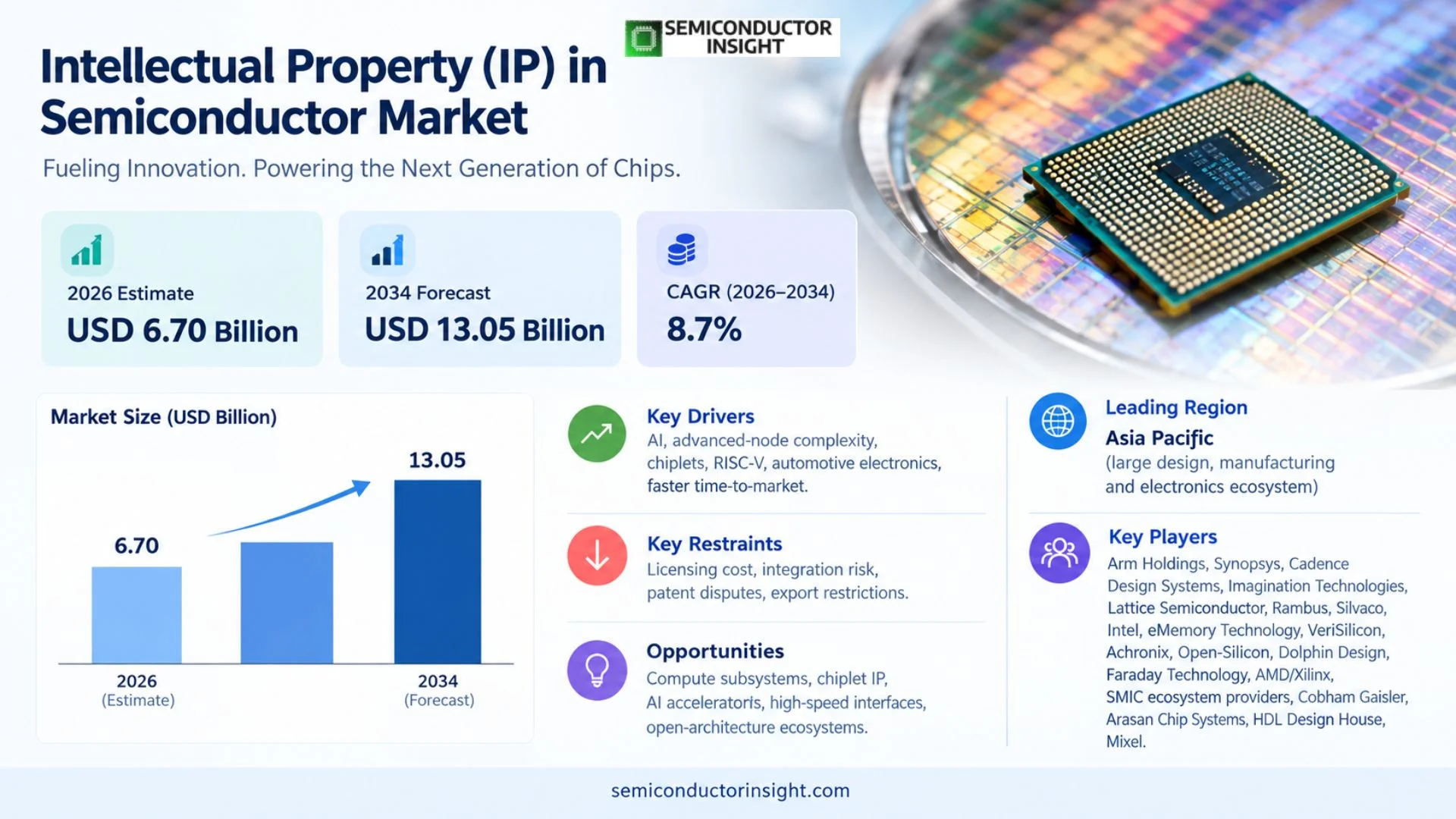
Intellectual Property (IP) in Semiconductor market is valued at USD 6.16 billion in 2025 and is projected to reach USD 13.05 billion by 2034, representing an 8.7% CAGR during 2026–2034. The 2026 estimated market size is USD 6.70 billion. Asia Pacific is the leading regional market through its large semiconductor design, manufacturing and electronics ecosystem.
Semiconductor IP consists of reusable processor, interface, memory, analog, security and foundation design blocks licensed for integration into SoCs, ASICs, FPGAs and multi-die systems. Instead of designing every subsystem from scratch, chip developers adopt qualified IP to reduce engineering effort, shorten verification and improve time-to-market.
The economic model includes upfront licensing, royalties tied to chip shipments, maintenance and support, customization and broader architecture agreements. Value grows with silicon complexity because advanced chips require more interfaces, memory subsystems, safety mechanisms and software-compatible processing blocks.
IP is becoming more system-level. Customers increasingly license processor clusters, compute subsystems, chiplet interconnect, memory PHYs and complete interface stacks rather than isolated cores. This increases integration value while raising expectations for process-node readiness, silicon validation and interoperability.
Segment Analysis: By Type
By type, the market is segmented into Processor IP, Interface IP, Memory IP and Other IP. Processor IP leads because compute architectures underpin SoCs across smartphones, automotive, edge AI, networking and data centers.
| IP type | Typical content | Market position |
|---|---|---|
| Processor IP | CPU, GPU, DSP, NPU and configurable processor architectures licensed as synthesizable cores, hard macros or compute subsystems. | Largest type. Arm, RISC-V ecosystem vendors, Tensilica-class DSPs and other processor technologies drive broad licensing and royalty revenue. |
| Interface IP | PCIe, CXL, UCIe, Ethernet, USB, MIPI, HDMI, SerDes, DDR, HBM and chiplet links delivered as controller, PHY and verification solutions. | High-growth segment as AI systems require more memory bandwidth, die-to-die connectivity and high-speed I/O. |
| Memory IP | Embedded SRAM, ROM, NVM, memory controllers and PHYs optimized for process nodes and power/performance targets. | Strategic foundation segment because every SoC needs qualified on-chip or external-memory connectivity. |
| Other IP | Analog, data-converter, security, clocking, foundation libraries and application-specific accelerators. | Fragmented but important value pool that expands as SoCs integrate more mixed-signal and security functions. |
Business-model and integration-level segmentation
The market also segments by business model and integration level. Per-use licenses and royalties remain standard, while broader architecture agreements and compute-subsystem contracts capture more value. IP can be supplied as soft RTL, hardened macros or pre-integrated subsystems depending on timing, process node and customer differentiation goals.
| Axis | Segments | Commercial implication |
|---|---|---|
| By Business Model | License Fee · Royalty · Architecture / Platform Agreement · Support / Customization | Royalty models scale with customer shipments; architecture agreements increase flexibility; customization and support add recurring engineering revenue. |
| By Integration Level | Soft IP · Hard IP · Subsystem / CSS · Chiplet-Ready IP | Soft IP maximizes portability; hard IP improves predictability; subsystems reduce integration risk; chiplet-ready IP adds die-to-die and packaging requirements. |
Segment Analysis: By Application
By application, the market includes IDMs, Foundries, OSATs and Other Semiconductor Companies. IDMs and fabless design organizations represent the largest practical usage because they integrate licensed IP directly into products.
| Application | Key market insight |
|---|---|
| IDMs / Fabless Chip Companies | CPU, memory, connectivity and security IP shorten SoC development and allow teams to concentrate engineering resources on product differentiation. |
| Foundries | Foundries qualify foundation, interface and memory IP on each process node and distribute design enablement through ecosystem programs. |
| OSATs / Chiplet Integrators | Advanced packaging and multi-die systems increasingly require die-to-die, test, PHY and security IP alongside substrate and packaging design. |
| Automotive / Edge AI Designers | Functional safety, real-time compute, image processing and AI acceleration increase demand for validated processor and interface IP. |
| Cloud / Data Center Silicon | Custom CPUs, DPUs, accelerators and networking ASICs use high-value processor, HBM, PCIe, CXL and UCIe IP. |
Regional Analysis
Asia Pacific is the leading Semiconductor IP market, supported by semiconductor design ecosystems in China, Taiwan, South Korea, Japan and India. North America remains the largest center for many major IP vendors and advanced chip designers, while Europe is strong in processor architecture, automotive and embedded systems.
Why does semiconductor IP growth track design complexity rather than fab output alone?
IP revenue is created when chip developers license or integrate reusable designs, so the market follows R&D intensity, SoC complexity and design starts. Regions with large fabless ecosystems, foundry enablement programs and automotive/AI design activity can generate substantial IP demand even when wafer manufacturing occurs elsewhere.
| Region | Market position | Growth outlook | Core demand | Commercial priority |
|---|---|---|---|---|
| Asia Pacific | Leading | Very high | Mobile, consumer, auto & foundry ecosystems | Node readiness and integration support |
| North America | Vendor / design hub | Very high | AI, cloud, networking & automotive | High-value architecture and interface IP |
| Europe | Processor / embedded hub | High | Automotive, industrial & edge | Safety and long lifecycle |
| South America | Emerging | Moderate | Design services & embedded | Access to affordable IP |
| Middle East & Africa | Emerging | Moderate | Israel fabless & new tech hubs | Local design talent and ecosystem |
Competitive Landscape
Key participants include Arm Holdings, Synopsys, Cadence Design Systems, Imagination Technologies, Lattice Semiconductor, Rambus, Silvaco, Intel, eMemory Technology, VeriSilicon, Achronix, Open-Silicon, Dolphin Design, Faraday Technology, AMD/Xilinx, SMIC ecosystem providers, Cobham Gaisler, Arasan Chip Systems, HDL Design House and Mixel.
Arm remains the most influential processor-IP company through architecture licensing, CPU/GPU IP and increasingly Compute Subsystems. Its 2026 expansion into production silicon does not remove the IP model; it broadens customer choices from licensable cores through CSS and complete CPUs.
Synopsys and Cadence compete across high-speed interface, memory, foundation and security IP integrated with EDA flows. Synopsys’ current portfolio includes PCIe, CXL, UCIe, Ethernet, USB, DDR and HBM, while Cadence continues to expand node-specific IP with TSMC, Samsung and Intel Foundry.
Specialists such as Rambus, Imagination, eMemory, VeriSilicon, Faraday, Arasan and Mixel compete in narrower domains including memory interfaces, GPUs, embedded NVM, analog and connectivity. Competitive advantage depends on silicon proof, standards compliance, process-node availability and technical support.
Competitive tier structure
| Competitive tier | Representative companies | Competitive strengths |
|---|---|---|
| Global architecture / processor leaders | Arm; Imagination; RISC-V ecosystem vendors | CPU/GPU architecture, compute subsystems, software ecosystem and royalties |
| Broad IP platform leaders | Synopsys; Cadence; Rambus | Interface, memory, foundation, security and silicon-proven node coverage |
| Specialist / regional IP suppliers | eMemory; VeriSilicon; Faraday; Arasan; Mixel; Dolphin; Achronix | Specialized NVM, analog, interface, SoC and configurable IP |
Key companies profiled
Semiconductor IP Development Capacity & Design Enablement Analysis
IP capacity is measured through engineering talent, validation infrastructure, foundry-node coverage, standards expertise and support bandwidth rather than physical factory output. Building one high-speed interface PHY can require years of analog design, characterization and silicon validation across several process technologies.
Process portability is a major capacity challenge. A soft digital core may move between nodes relatively easily, while a hard PHY, SRAM or analog block needs transistor-level re-optimization and silicon characterization on each foundry process.
Support capacity also matters after licensing. Customers require integration help, verification models, software, bring-up support and ongoing standards updates. Large vendors can amortize these resources across many customers and nodes.
Market Dynamics
Growth is driven by AI, advanced-node complexity, chiplets, RISC-V, automotive electronics and faster time-to-market. Restraints include licensing cost, integration risk, patent disputes and export restrictions. Opportunities center on compute subsystems, chiplet IP, AI accelerators, high-speed interfaces and open-architecture ecosystems.
MARKET DRIVERS
Chip design is too complex to build entirely from scratch
Reusable IP shortens schedules and reduces verification risk.
AI increases interface and memory requirements
Accelerators need HBM, PCIe, CXL, Ethernet and die-to-die connectivity in addition to compute cores.
Chiplets create a new IP integration layer
Multi-die systems require UCIe, coherent interconnect, security and package-aware validation.
Automotive and edge products need trusted platforms
Safety, security and software ecosystems increase the value of validated processor and subsystem IP.
Drivers Impact Analysis
| Driver | Impact | Primary markets | Time horizon |
|---|---|---|---|
| AI / custom silicon | High | Global | Short to long term |
| Design complexity | High | Advanced nodes | Persistent |
| Chiplet adoption | High | Data center & HPC | Medium to long term |
| Automotive / edge AI | High | Global vehicle / embedded | Persistent |
MARKET RESTRAINTS
Advanced IP can be expensive
High-value processor and interface licenses can strain startup budgets.
Integration still requires significant engineering
Pre-verified blocks can conflict in clocking, power, verification or physical implementation.
Patent disputes create uncertainty
Architecture and interface IP are legally valuable and sometimes subject to litigation.
Technology controls can limit market access
Cross-border restrictions may affect access to advanced IP or foundry enablement.
Restraints Impact Analysis
| Restraint | Impact | Exposure | Time horizon |
|---|---|---|---|
| Licensing cost | High | Startups / smaller design teams | Persistent |
| Integration complexity | High | Large SoCs / chiplets | Persistent |
| IP / patent disputes | Medium to high | Global vendors | Recurring |
| Export / geopolitical controls | Medium to high | Cross-border licensing | Persistent |
MARKET OPPORTUNITIES
Expand compute-subsystem licensing
Pre-integrated CPU, interconnect and system IP can reduce customer integration time.
Build chiplet-ready IP portfolios
UCIe, HBM, CXL and die-to-die security create high-value multi-die design opportunities.
Grow RISC-V commercial ecosystems
Open ISA adoption creates demand for verified cores, tools, security and interface IP.
License AI-specific accelerators
Edge and data-center SoCs increasingly need NPU, DSP and tensor-processing blocks.
Semiconductor IP Value Chain Analysis
Architecture / standards development
IP design & silicon validation
Foundry / EDA enablement
SoC / chiplet development
Standards create reusable markets
PCIe, UCIe and DDR allow one IP vendor to serve many chip companies.
Silicon proof reduces customer risk
Measured test-chip performance is more valuable than simulation-only claims.
Foundry certification accelerates adoption
Qualified PDK integration shortens customer implementation and signoff.
Customer shipments create royalty leverage
Successful IP can generate recurring revenue across millions of chips.
Recent Developments in the Intellectual Property (IP) in Semiconductor Market
Arm introduces next-generation CSS platforms for mobile and cloud AI
Arm expanded pre-integrated compute platforms across mobile and infrastructure, reinforcing the shift from individual cores toward system-level IP.
Arm reports record first-quarter licensing and royalty revenue
Arm reported 22% year-over-year growth and continued adoption of higher-value Armv9 and Compute Subsystems.
Cadence expands design IP collaboration with Intel Foundry
The multi-year Intel 14A agreement includes design IP readiness, DTCO and advanced-node enablement for HPC and mobile.
Cadence and Samsung expand 2nm memory and interface IP
The collaboration covers Memory, NVLink-C2C, PCIe, UCIe and other high-speed interface IP on Samsung’s second-generation 2nm technology.
Cadence launches chiplet partner ecosystem
The initiative integrates partner IP including Arm, Arteris, eMemory and others into pre-validated chiplet solutions.
REPORT SCOPE & SEGMENTATION
| Attribute | Details |
|---|---|
| Study Period | 2019–2034 |
| Base Year | 2025 |
| Estimated Year | 2026 |
| Forecast Period | 2026–2034 |
| Historical Period | 2019–2025 |
| Market Size 2025 | USD 6.16 billion |
| Market Size 2034 | USD 13.05 billion |
| Growth Rate | 8.7% during 2026–2034 |
| Unit | Value (USD Million/Billion) and IP licensing / royalty revenue |
| By Type | Processor IP · Interface IP · Memory IP · Other IP (D/A and A/D Converter, Security, Foundation) |
| By Application | IDMs · Foundries · OSATs · Others |
| By Business Model | License Fee · Royalty · Architecture / Platform Agreement · Support / Customization |
| By Integration Level | Soft IP · Hard IP · Subsystem / CSS · Chiplet-Ready IP |
| By Region | Each region analysed by IP type, application, business model, integration level and country semiconductor-design ecosystem North AmericaUnited States, Canada, Mexico EuropeUnited Kingdom, Germany, France, Italy and other European markets Asia PacificChina, Taiwan, South Korea, Japan, India and Southeast Asia South AmericaBrazil, Argentina and other South American markets Middle East & AfricaIsrael, UAE, Saudi Arabia and other MEA markets |
| Key Companies Profiled | Arm Holdings · Synopsys · Cadence Design Systems · Imagination Technologies · Lattice Semiconductor · Rambus · Silvaco · Intel · eMemory Technology · VeriSilicon · Achronix Semiconductor · Open-Silicon · Dolphin Design · Faraday Technology · AMD / Xilinx · Cobham Gaisler · Arasan Chip Systems · HDL Design House · Mixel |
| Customization Scope | Free report customization equivalent to up to four analyst working days with purchase. Addition or alteration to country, regional and segment scope. |
Frequently Asked Questions
What is the 2025 size of the Semiconductor IP market?
The market is valued at USD 6.16 billion in 2025 and is projected to reach USD 13.05 billion by 2034. The 2026 estimate is USD 6.70 billion and the 2026–2034 CAGR is 8.7%.
Which IP type leads the market?
Processor IP is the largest type because CPU and compute architectures sit at the center of SoCs used in mobile, automotive, edge and cloud systems.
Who uses semiconductor IP?
IDMs, fabless chip companies, foundries, OSATs and system companies use licensed IP to reduce design time and integration risk.
Which region leads the market?
Asia Pacific leads through the concentration of semiconductor design, foundry and electronics ecosystems in China, Taiwan, South Korea, Japan and India.
What is the estimated market size in 2026?
The 2026 estimated market size is USD 6.70 billion within the consistent long-term market series.
Why is IP becoming more valuable?
AI, chiplets and advanced nodes require more processor, memory, interface, security and foundation blocks per design.
What are the main market restraints?
Licensing cost, integration complexity, patent disputes and cross-border technology controls are the main constraints.
How are chiplets changing IP demand?
Multi-die systems create demand for UCIe, high-speed memory, coherent interconnect, security and package-aware verification IP.
Which companies are active in the market?
Major participants include Arm, Synopsys, Cadence, Imagination, Rambus, Silvaco, eMemory, VeriSilicon, Faraday, Arasan and other specialist providers.
What does the report cover?
The report covers processor, interface, memory and other IP; applications; business models; integration levels; five global regions; competition; development capacity; dynamics; developments and value chain.
Research Sources & Evidence Base
View primary and authoritative evidence used in this overview
- Arm. 2026 Compute Platform Expansion – Official evidence on Arm IP, CSS and system-level compute platforms.
- Arm. Q1 FYE27 Results – Primary evidence on 2026 licensing, royalty and CSS adoption momentum.
- Synopsys. Semiconductor IP Portfolio – Official evidence on interface, memory, foundation and security IP portfolios.
- Synopsys. RISC-V Solutions – Official evidence on commercial RISC-V design, verification and IP solutions.
- Cadence. TSMC AI Silicon Collaboration – April 2026 evidence on advanced-node memory/interface/foundation IP.
- Cadence. Chiplet Partner Ecosystem – January 2026 evidence on pre-validated multi-vendor chiplet IP.
Get Sample Report PDF for Exclusive Insights
Report Sample Includes
- Table of Contents
- List of Tables & Figures
- Charts, Research Methodology, and more...
 Download Sample Report PDF