MARKET INSIGHTS
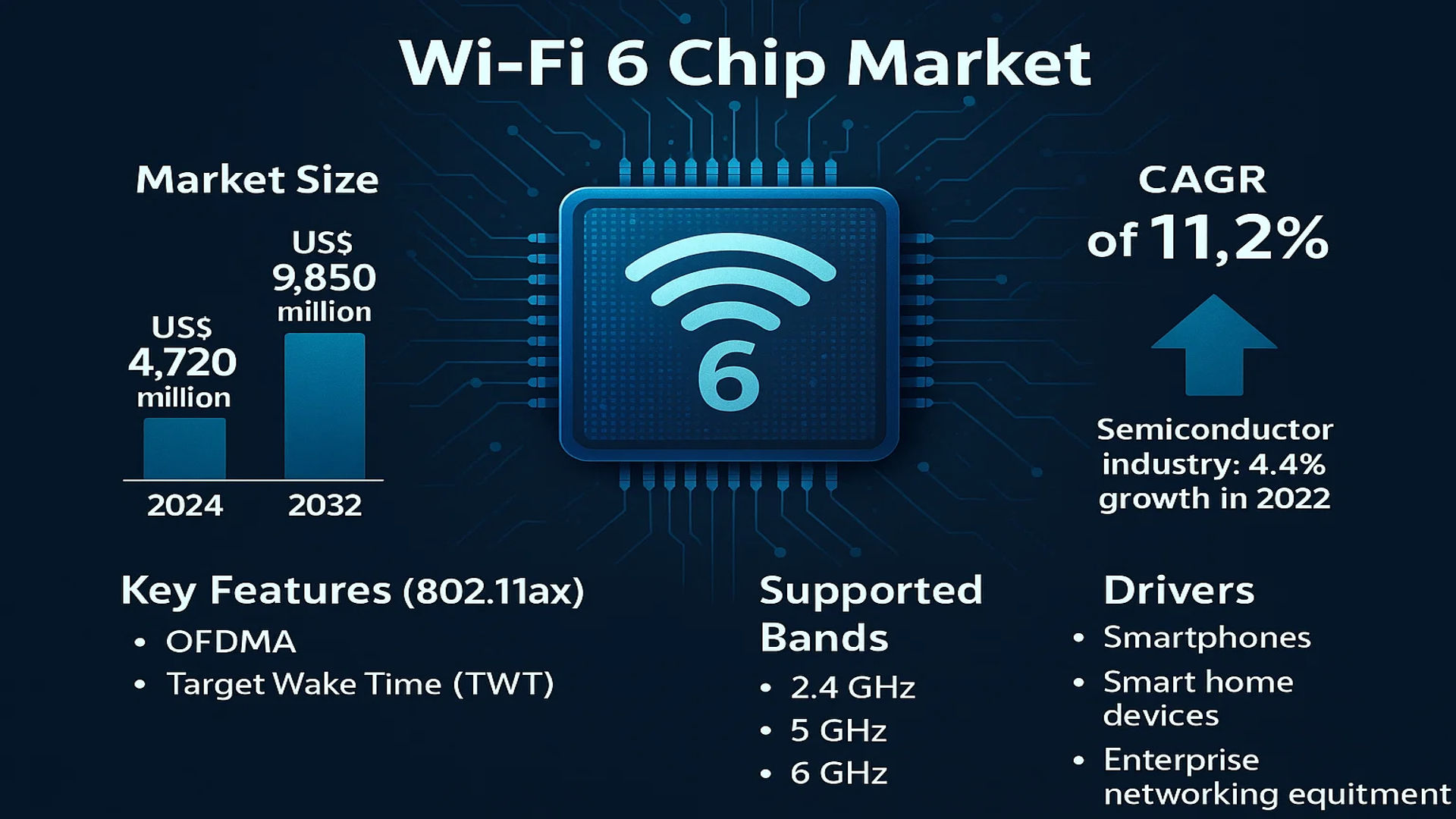
The global Wi-Fi 6 Chip Market size was valued at US$ 4,720 million in 2024 and is projected to reach US$ 9,850 million by 2032, at a CAGR of 11.2% during the forecast period 2025-2032. While the semiconductor industry faced moderate growth in 2022 (4.4% year-over-year), Wi-Fi 6 adoption continues expanding rapidly due to increasing demand for high-speed connectivity in both consumer and enterprise applications.
Wi-Fi 6 chips (also known as 802.11ax) represent the sixth generation of wireless networking technology, offering significant improvements over previous standards through features like OFDMA (Orthogonal Frequency Division Multiple Access) and Target Wake Time (TWT). These chips enable higher data rates (up to 9.6 Gbps), improved network efficiency in dense environments, and better power management for connected devices. Major frequency bands supported include 2.4 GHz, 5 GHz, and the emerging 6 GHz spectrum.
The market growth is primarily driven by increasing adoption in smartphones, smart home devices, and enterprise networking equipment. Additionally, the rollout of Wi-Fi 6E (extending into the 6 GHz band) by chipmakers like Qualcomm and Intel is creating new opportunities. However, supply chain constraints and macroeconomic factors temporarily slowed growth in 2022-2023. Key players such as Broadcom, Qualcomm, and Intel dominate the market, collectively holding over 65% share through their comprehensive chipset portfolios for various applications.
MARKET DYNAMICS
MARKET DRIVERS
Exponential Growth in Connected Devices Fueling Wi-Fi 6 Adoption
The proliferation of Internet of Things (IoT) devices and smart appliances is creating unprecedented demand for high-performance wireless connectivity. With over 30 billion IoT devices projected to be in use by 2025, the need for efficient bandwidth management provided by Wi-Fi 6 chips has become critical. Unlike previous generations, Wi-Fi 6 (802.11ax) delivers 4 times greater capacity, reduces latency by 75%, and improves energy efficiency – features essential for handling dense device environments. This technological leap is driving rapid adoption across smart homes, industrial automation, and public infrastructure.
Enterprise Digital Transformation Accelerating Market Growth
The global shift toward cloud computing and hybrid work models has compelled enterprises to upgrade their network infrastructure. Wi-Fi 6 chips enable faster data transfer speeds up to 9.6 Gbps while supporting more concurrent connections in office environments. Recent surveys indicate that 78% of enterprises plan to upgrade to Wi-Fi 6 within the next two years to accommodate video conferencing, AR/VR applications, and cloud-based collaboration tools. The education and healthcare sectors are particularly active adopters, with universities deploying Wi-Fi 6 to support digital classrooms and hospitals implementing the technology for connected medical devices.
5G Network Convergence Creating New Possibilities
The synergy between 5G and Wi-Fi 6 technologies is opening new frontiers in wireless connectivity. Both technologies complement each other – while 5G excels in wide-area mobility, Wi-Fi 6 dominates in localized, high-density environments. This convergence is particularly valuable for smart city applications, industrial automation, and edge computing implementations. Network operators are increasingly deploying dual-mode solutions that leverage both technologies, with the market for converged 5G-Wi-Fi 6 solutions expected to grow at a compounded annual rate exceeding 40% through 2028.
MARKET RESTRAINTS
Semiconductor Supply Chain Disruptions Impacting Production
The global chip shortage continues to pose significant challenges for Wi-Fi 6 manufacturers. While demand has surged across multiple industries, production capacity remains constrained due to raw material shortages and geopolitical factors affecting semiconductor fabrication. Lead times for certain Wi-Fi 6 components have extended to 52 weeks in some cases, forcing manufacturers to reevaluate their inventory strategies. These supply chain challenges are particularly acute for smaller vendors who lack the purchasing power of industry leaders.
Legacy Infrastructure Limiting Immediate Adoption
Despite the clear advantages of Wi-Fi 6, many organizations face difficulties in justifying the complete overhaul of existing network infrastructure. The need to replace both access points and client devices to fully realize Wi-Fi 6 benefits creates substantial upfront costs. In price-sensitive markets, this has led to slower adoption rates as businesses opt for incremental upgrades rather than comprehensive network transformations. This restraint is most pronounced in developing regions where IT budgets remain constrained.
MARKET CHALLENGES
Technical Complexity in Wi-Fi 6 Implementation
While Wi-Fi 6 offers superior performance, its implementation presents several technical challenges. The technology introduces complex features like OFDMA (Orthogonal Frequency Division Multiple Access) and BSS Coloring that require specialized knowledge to configure properly. Many IT departments struggle with staff expertise gaps, particularly in smaller organizations where network administration may be handled by generalists rather than wireless specialists. This knowledge barrier could potentially slow enterprise adoption until adequate training programs and certification tracks become widely available.
Other Challenges
Interoperability Issues
The rapid evolution of Wi-Fi standards has created compatibility concerns between different hardware generations. While backward compatibility is maintained, achieving optimal performance across mixed device environments requires careful network planning that many users lack the expertise to implement effectively.
Regulatory Hurdles
Various countries have implemented different spectrum allocation policies for Wi-Fi 6, particularly regarding the use of 6GHz bands. This fragmentation creates challenges for manufacturers developing products for global markets, potentially increasing compliance costs and time-to-market for new solutions.
MARKET OPPORTUNITIES
Emerging Applications in Automotive and Industrial Sectors
The automotive industry presents significant growth potential as connected vehicle technologies evolve. Wi-Fi 6 is becoming essential for vehicle-to-everything (V2X) communication, in-cabin infotainment systems, and over-the-air software updates. Similarly, the industrial sector is adopting Wi-Fi 6 for industrial IoT applications, where its ability to support high device density and deterministic latency meets critical operational requirements. These vertical markets are expected to account for nearly 30% of Wi-Fi 6 chip demand by 2026.
Advancements in AI-powered Network Optimization
The integration of artificial intelligence with Wi-Fi 6 network management creates new opportunities for product differentiation. AI-driven solutions can automatically optimize channel selection, power levels, and client steering to maximize network performance. This capability is particularly valuable in dense deployment scenarios like stadiums, airports, and smart buildings. As AI algorithms become more sophisticated, they will enable predictive maintenance and self-healing networks that reduce operational costs while improving user experience.
Expansion of Wi-Fi 6E Creating New Revenue Streams
The introduction of Wi-Fi 6E, which extends operation into the 6GHz band, provides manufacturers with opportunities to develop premium products for bandwidth-intensive applications. The additional spectrum alleviates congestion in dense environments and enables higher throughput applications like 8K video streaming and AR/VR. While regulatory approval varies by country, markets that have opened the 6GHz band for unlicensed use are seeing rapid adoption of Wi-Fi 6E solutions, particularly in the consumer electronics and enterprise networking segments.
WI-FI 6 CHIP MARKET TRENDS
Increased Demand for High-Speed Connectivity Fuels Market Expansion
The global Wi-Fi 6 chip market is experiencing accelerated growth due to the rising demand for high-speed, low-latency wireless connectivity across multiple industries. Wi-Fi 6, also known as 802.11ax, delivers up to 40% faster speeds than its predecessor, Wi-Fi 5 (802.11ac), with improved efficiency in dense environments. By 2022, approximately 40% of all Wi-Fi chip shipments were Wi-Fi 6 capable, reflecting the rapid adoption of this technology. The proliferation of smart devices, Internet of Things (IoT) applications, and high-bandwidth content consumption are key factors propelling market demand. Enterprises, telecom operators, and data center providers are increasingly integrating Wi-Fi 6 chips to support 4K streaming, virtual reality (VR), and cloud computing applications.
Other Trends
Adoption in Smart Infrastructure and IoT
Wi-Fi 6 chips are becoming integral to smart infrastructure projects, including smart cities, industrial automation, and connected transportation systems. The technology’s ability to handle multiple device connections simultaneously without compromising performance is crucial for Industrial IoT (IIoT) deployments, where low latency and high reliability are non-negotiable. Global investments in 5G and smart city initiatives are further boosting demand—by 2024, Wi-Fi 6-enabled routers accounted for over 50% of the enterprise router market, showcasing the shift toward next-generation wireless solutions.
Expansion in Consumer Electronics and Automotive Sectors
The consumer electronics sector continues to be a major driver for Wi-Fi 6 chips, with flagship smartphones, laptops, and gaming consoles increasingly embedding the technology for superior performance. Over 70% of premium smartphones launched in 2023 featured Wi-Fi 6 compatibility, indicating strong adoption in this segment. Additionally, the automotive industry is embracing Wi-Fi 6 for in-vehicle infotainment systems, autonomous driving data transfer, and V2X (Vehicle-to-Everything) communications. With electrification and autonomous vehicle development accelerating, automakers require stable, high-speed wireless connectivity, positioning Wi-Fi 6 as a critical component for future mobility solutions.
COMPETITIVE LANDSCAPE
Key Industry Players
Semiconductor Giants Accelerate Innovation in Wi-Fi 6 to Capture Emerging Opportunities
The global Wi-Fi 6 chip market exhibits a moderately concentrated competitive environment dominated by established semiconductor companies and specialized wireless solution providers. Qualcomm Technologies, Inc. leads the market with an estimated 30-35% revenue share in 2024, owing to its comprehensive portfolio of networking chips and early mover advantage in the 802.11ax standard implementation.
Broadcom Inc. follows closely with approximately 25-30% market share, benefiting from strong adoption in enterprise networking equipment and flagship smartphone designs. The company’s latest BCM4375/4389 chipsets have gained significant traction among premium device manufacturers seeking multi-gigabit wireless performance.
Meanwhile, Intel Corporation maintains a strong position in the laptop and IoT segments through its integrated Wi-Fi 6 solutions. While the company faced initial challenges in standalone chip development, recent partnerships with major OEMs have reinforced its market presence. Intel’s Tiger Lake and Alder Lake platforms with built-in Wi-Fi 6/6E capabilities continue to drive volume adoption.
The competitive intensity is further heightened by emerging players like MediaTek and Zunpai, who are aggressively targeting cost-sensitive applications. These companies are capitalizing on the growing Wi-Fi demand in smart home devices and entry-level smartphones, leveraging their competitive pricing strategies and regional distribution networks.
Looking ahead, the competitive dynamics are expected to evolve with technological advancements. The transition to Wi-Fi 6E (6 GHz) capability is prompting market participants to accelerate R&D investments, with over $2 billion estimated to be collectively invested in next-generation chip development through 2026.
List of Key Wi-Fi 6 Chip Manufacturers
- Qualcomm Technologies, Inc. (U.S.)
- Broadcom Inc. (U.S.)
- Intel Corporation (U.S.)
- NXP Semiconductors N.V. (Netherlands)
- Nordic Semiconductor (Norway)
- MediaTek Inc. (Taiwan)
- Zunpai Communications (China)
- Texas Instruments Incorporated (U.S.)
- STMicroelectronics N.V. (Switzerland)
Segment Analysis:
By Type
5 GHz Segment Dominates the Market Due to Enhanced Speed and Wider Bandwidth Capabilities
The market is segmented based on type into:
- 2.4 GHz
- 5 GHz
- 6 GHz
By Application
Consumer Electronics Segment Leads Due to High Adoption in Smartphones and IoT Devices
The market is segmented based on application into:
- Industrial Internet of Things Applications
- Automotive
- Consumer Electronics Products
- Household Appliances
- Others
By End User
Telecom Operators Segment Dominates Due to Rising Demand for High-Speed Connectivity
The market is segmented based on end user into:
- Telecom Operators
- Enterprises
- Government Institutions
- Others
Regional Analysis: Wi-Fi 6 Chip Market
Asia-Pacific
The Asia-Pacific region dominates the global Wi-Fi 6 chip market, driven by rapid technological adoption, urbanization, and the high concentration of semiconductor manufacturers. China leads the region, accounting for over 40% of global Wi-Fi chip production, supported by government initiatives such as “Made in China 2025.” India and South Korea are also key contributors, with expanding 5G infrastructure accelerating demand for Wi-Fi 6-enabled devices. However, supply chain disruptions and trade tensions between the U.S. and China have introduced volatility. Despite this, strong demand for consumer electronics (smartphones, IoT devices) and enterprise networking solutions keeps the region at the forefront of Wi-Fi 6 adoption.
North America
North America is a critical market for Wi-Fi 6 chips, fueled by high R&D investments and early adoption of advanced networking technologies. The U.S., home to key players like Qualcomm and Broadcom, drives innovation in high-performance Wi-Fi 6 solutions for enterprise and residential applications. The Federal Communications Commission’s (FCC) 6 GHz spectrum allocation has further accelerated deployments. While consumer electronics remain a major application, industrial IoT and smart cities are emerging as growth areas. However, semiconductor shortages and inflationary pressures have temporarily constrained market expansion.
Europe
Europe’s Wi-Fi 6 chip market is growing steadily, supported by strict data privacy regulations and demand for secure, high-speed connectivity. The European Union’s focus on digital sovereignty and initiatives like the “Digital Decade” program are fostering investments in next-generation wireless infrastructure. Germany and the U.K. lead in industrial and automotive applications, while Nordic countries prioritize energy-efficient IoT solutions. Despite slower consumer adoption than Asia-Pacific, Europe’s emphasis on cybersecurity and Industry 4.0 presents long-term opportunities for specialized Wi-Fi 6 deployments.
South America
South America shows nascent but promising growth for Wi-Fi 6 chips, primarily driven by Brazil and Argentina. Urbanization and increasing smartphone penetration are key demand drivers, though economic instability and limited local manufacturing capacity hinder faster adoption. Telecom operators are gradually upgrading networks to support Wi-Fi 6, but cost sensitivity favors older standards in price-conscious markets. Government-led digital inclusion programs could unlock future potential, particularly in smart city projects.
Middle East & Africa
The Middle East & Africa region is in the early stages of Wi-Fi 6 adoption, with growth concentrated in GCC countries like the UAE and Saudi Arabia. Large-scale infrastructure projects, including NEOM and Dubai’s Smart City initiatives, are driving demand for high-speed connectivity solutions. However, limited local semiconductor ecosystems and reliance on imports create supply chain challenges. In Africa, mobile-first markets are leapfrogging to Wi-Fi 6 in select urban hubs, though widespread adoption remains constrained by infrastructure gaps.
Report Scope
This market research report provides a comprehensive analysis of the Global Wi-Fi 6 Chip Market, covering the forecast period 2025–2032. It offers detailed insights into market dynamics, technological advancements, competitive landscape, and key trends shaping the industry.
Key focus areas of the report include:
- Market Size & Forecast: Historical data and future projections for revenue, unit shipments, and market value across major regions and segments. The Global Wi-Fi 6 Chip market was valued at US$ 4,720 million in 2024 and is projected to reach US$ 9,850 million by 2032, growing at a CAGR of 11.2% during the forecast period.
- Segmentation Analysis: Detailed breakdown by product type (2.4 GHz, 5 GHz, 6 GHz), application (Industrial IoT, Automotive, Consumer Electronics, Household Appliances), and end-user industry to identify high-growth segments.
- Regional Outlook: Insights into market performance across North America, Europe, Asia-Pacific, Latin America, and Middle East & Africa. Asia-Pacific dominated with 42% market share in 2024.
- Competitive Landscape: Profiles of leading market participants including Intel, Qualcomm, Broadcom, NXP, and MediaTek, covering their product portfolios, R&D investments, and strategic partnerships.
- Technology Trends & Innovation: Assessment of Wi-Fi 6E adoption, integration with 5G networks, AI-powered optimization, and energy-efficient chip designs.
- Market Drivers & Restraints: Evaluation of factors including increasing IoT adoption, smart home proliferation, and supply chain challenges in semiconductor manufacturing.
- Stakeholder Analysis: Strategic insights for chip manufacturers, OEMs, network equipment providers, and investors regarding emerging opportunities.
The research employs both primary and secondary methodologies, including interviews with industry leaders and analysis of verified market data from semiconductor industry reports.
FREQUENTLY ASKED QUESTIONS:
What is the current market size of Global Wi-Fi 6 Chip Market?
-> Wi-Fi 6 Chip Market size was valued at US$ 4,720 million in 2024 and is projected to reach US$ 9,850 million by 2032, at a CAGR of 11.2% during the forecast period 2025-2032.
Which key companies operate in Global Wi-Fi 6 Chip Market?
-> Key players include Intel, Qualcomm, Broadcom, NXP, MediaTek, and Texas Instruments, collectively holding 68% market share in 2024.
What are the key growth drivers?
-> Key growth drivers include 5G network deployments, increasing smart device penetration, enterprise digital transformation, and government initiatives for smart city infrastructure.
Which region dominates the market?
-> Asia-Pacific accounted for 42% market share in 2024, driven by China’s semiconductor ecosystem and India’s digital growth, while North America leads in technology adoption.
What are the emerging trends?
-> Emerging trends include Wi-Fi 6E adoption, integration with 5G small cells, AI-powered network optimization, and ultra-low-power designs for IoT devices.

Get Sample Report PDF for Exclusive Insights
Report Sample Includes
- Table of Contents
- List of Tables & Figures
- Charts, Research Methodology, and more...