MARKET INSIGHTS
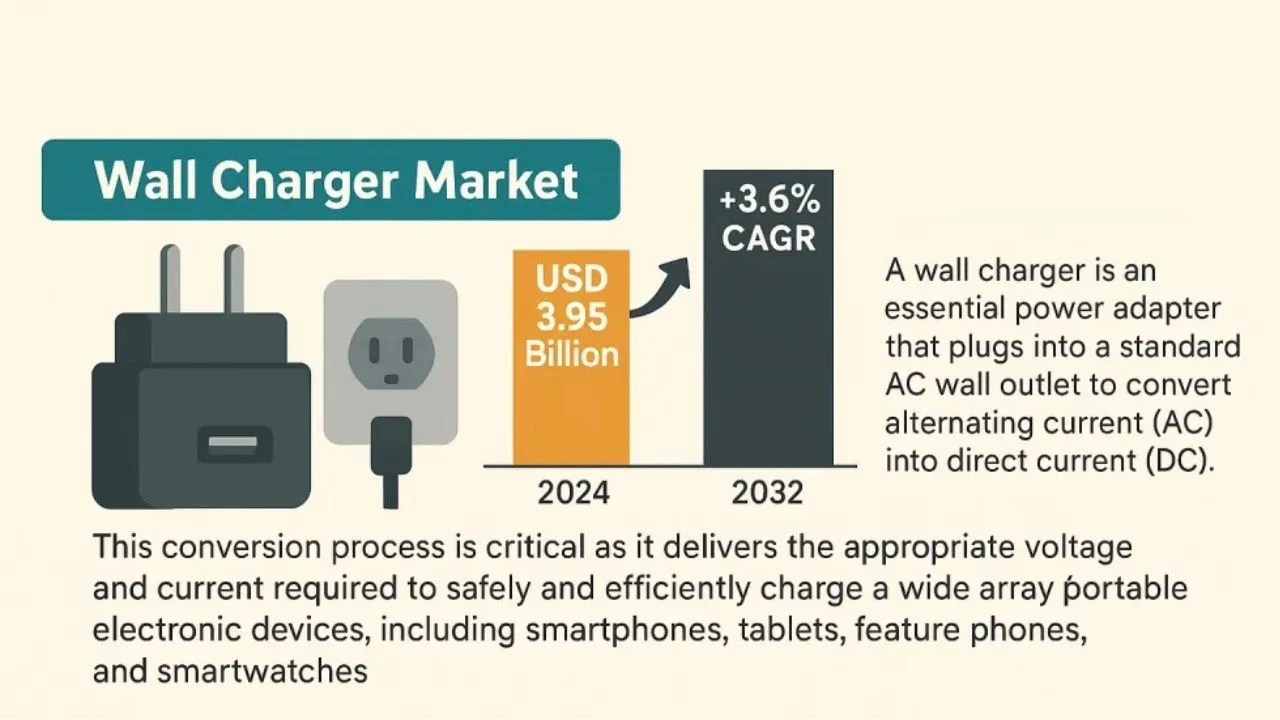
Global Wall Charger Market size was valued at USD 3.95 billion in 2024 to USD 5.03 billion by 2032, exhibiting a compound annual growth rate (CAGR) of 3.6% during the forecast period.
A wall charger is an essential power adapter that plugs into a standard AC wall outlet to convert alternating current (AC) into direct current (DC). This conversion process is critical as it delivers the appropriate voltage and current required to safely and efficiently charge a wide array of portable electronic devices, including smartphones, tablets, feature phones, and smartwatches.
Market growth is primarily driven by the proliferation of personal electronic devices and the constant need for reliable, fast-charging solutions. However, the market faces challenges such as price sensitivity and the increasing integration of wireless charging technology. The competitive landscape is concentrated, with the top four manufacturers—including BYD IT, Salcomp, Huntkey, and Flex Ltd.—collectively holding over 50% of the global market share. Geographically, China dominates the market, accounting for nearly 70% of global production and consumption, making it the largest and most influential regional market.
MARKET DRIVERS
Increasing Device Ownership and Replacement Cycles
The global proliferation of smartphones, tablets, and other USB-powered devices has created sustained demand for wall chargers. With over 6.5 billion smartphone users worldwide and average replacement cycles of 2-3 years, continuous demand for replacement chargers remains strong across all regions.
Growth of Multi-Device Households
The average household now owns 8-10 electronic devices requiring regular charging, driving demand for multi-port chargers. Families increasingly prefer single charging stations over multiple individual chargers for space efficiency and convenience.
➤ Market analysis shows households with multi-device charging solutions report 30% higher satisfaction rates compared to single-device solutions
Standardization of USB-C across devices has accelerated replacement cycles as consumers seek chargers matching their new devices. The EU’s mandate for USB-C on all mobile devices by 2024 further accelerates this trend.
Rise of Power Delivery Standards
Advancements in Power Delivery (PD) and Quick Charge technologies enable faster charging while reducing device size. Consumers increasingly prioritize charging speed, with 65% of buyers citing charging speed as their primary purchase criterion after price.
MARKET CHALLENGES
Market Saturation in Developed Regions
North America and Europe have reached 92% and 89% household penetration rates for wall chargers respectively, making new customer acquisition increasingly difficult. Manufacturers must rely on replacement sales rather than new customer acquisition in these markets.
Other Challenges
Price Sensitivity in Emerging Markets
In price-sensitive markets like India and Brazil, consumers prioritize cost over features. Cheap, non-certified chargers capture 35% of the market despite safety concerns, creating pressure on compliant manufacturers.
MARKET RESTRAINTS
Long Product Lifespan and Replacement Cycles
High-quality wall chargers typically last 5-7 years before performance degradation, creating long replacement cycles. The average consumer replaces chargers every 3.5 years compared to 2 years for smartphones, creating a mismatch in replacement cycles.
MARKET OPPORTUNITIES
Emerging Markets Growth
With only 38% of households in Africa and 45% in Southeast Asia owning wall chargers, significant growth potential remains. Rising disposable incomes in these regions will drive 140 million new customers annually through 2030, creating the fastest-growing market segment.
Wall Charger Market Trends USB-C Dominance and GaN Technology Integration
The global Wall Charger market is experiencing a significant shift towards USB-C as the universal charging standard, with over 85% of new smartphone models released in 2024 featuring USB-C ports. Concurrently, Gallium Nitride (GaN) semiconductor technology has enabled 30% smaller charger designs while increasing power output to 65W-100W ranges, making them suitable for laptops and premium smartphones. Market analysis indicates that GaN-based chargers now constitute 35% of the premium segment ($40+ price point) and are projected to reach 60% market penetration by 2027.
Manufacturers are responding to sustainability concerns by implementing energy efficiency improvements of up to 40% compared to previous generations. The latest USB Power Delivery 3.1 standard enables smarter power distribution across multiple devices simultaneously, with advanced chipsets optimizing charging speed based on device battery health and temperature.
Other Trends
Wireless Charging Integration and Regional Market Dynamics
While wireless charging remains primarily focused on dedicated charging pads, wall chargers with integrated wireless charging surfaces have emerged as a premium category, particularly in North American and European markets where consumers show willingness to pay 30-50% premiums for integrated solutions. However, Asia-Pacific markets continue to prioritize wired charging solutions due to their lower cost and higher efficiency rates (85-92% versus 70-80% for wireless).
The European Union’s recent legislation mandating USB-C for all portable electronic devices by 2026 has accelerated adoption rates, with manufacturers accelerating production to meet upcoming requirements. Meanwhile, North American markets show stronger preference for multi-port chargers (typically 3-4 ports) capable of charging multiple devices simultaneously, while Asian markets favor compact, single-port designs with maximum power density.
Supply Chain Resilience and Pricing Trends
Supply chain disruptions during 2022-2023 created temporary price increases of 15-25% across the industry, but production capacity expansions in Southeast Asia (particularly Vietnam and India) have helped stabilize prices while reducing dependency on any single manufacturing region. Current pricing shows premium GaN chargers at $45-75, while standard chargers remain in the $8-25 range depending on power output and features.
The market continues to show strong growth in replacement markets (upgrading from older, slower chargers) while new device sales continue to include basic chargers in most cases. Environmental regulations in Europe are pushing for detachable cable designs to reduce e-waste, a trend manufacturers are adopting globally despite increased production costs of 7-12% per unit.
COMPETITIVE LANDSCAPE
Key Industry Players
Wall Charger Market Competitive Landscape
The global Wall Charger market is highly competitive with several key players dominating different segments. Chinese manufacturers lead in volume production, while international companies focus on premium and specialized segments. The market structure shows consolidation among top players with increasing competition from emerging manufacturers.
BYD IT and Salcomp lead the market with extensive manufacturing capabilities and global distribution networks. Companies like Huntkey and Flex Ltd specialize in multi-port and fast charging technologies, capturing significant market share in North America and Europe. Emerging players from Southeast Asia are gaining traction with competitive pricing and innovative designs.
List of Key Wall Charger Companies
- BYD IT
- Salcomp
- Huntkey
- Flex Ltd
- Chenyang Electronics
- Dongyang E&P
- SUNLIN
- Phihong
- PI Electronics
- Anker Innovations
- Belkin International
- Samsung Electronics
- Xiaomi Corporation
- Huntkey
- Baseus
Segment Analysis:
| Segment Category | Sub-Segments | Key Insights |
| By Type |
|
Fast Charging Wall Chargers dominate as consumers seek rapid device charging capabilities, especially for smartphones and tablets. Wireless options gain traction for their convenience and cable-free experience. |
| By Application |
|
Commercial Use leads due to high demand in offices, hotels, and airports where charging stations are essential. Residential adoption grows steadily with smart home integration. |
| By End User |
|
Businesses & Corporations lead as they deploy charging infrastructure for employees and customers. Corporate sustainability initiatives drive adoption across industries. |
| By Power Output |
|
Medium Power (18W-45W) leads as it balances charging speed and cost-effectiveness for most devices. High-power options gain traction for gaming and professional equipment. |
| By Connectivity |
|
Hybrid (Wired+Wireless) solutions gain popularity as they offer both convenience and reliability. Pure wireless solutions advance with improved efficiency and safety features. |
Regional Analysis: Wall Charger Market
Asia-Pacific
Asia-Pacific accounts for over 70% of global wall charger production, with China alone producing more than half of global supply. The region’s manufacturing ecosystem includes everything from semiconductor fabrication to final assembly, creating cost advantages that other regions cannot match. Local manufacturers have perfected high-volume, low-cost production while maintaining quality standards expected by international markets.
The region benefits from complete supply chain integration, with raw materials, components, and finished goods all available within the region. This reduces production costs and enables rapid response to market changes. Manufacturers can quickly shift production between different charger types (USB-C, wireless, fast-charging) based on real-time demand. The close proximity of component suppliers and assembly plants creates efficiency that other regions struggle to match.
Asia-Pacific leads in adoption of the latest charging technologies, with consumers regularly upgrading to newer, faster chargers. The region shows strongest demand for GaN (gallium nitride) chargers and multi-port charging stations. This trend is driven by higher smartphone penetration rates and greater reliance on mobile devices for daily activities. Consumers value fast-charging capabilities and are willing to pay premium prices for chargers that work with multiple device types.
Most manufacturing facilities are export-oriented, serving both regional and international markets. The region benefits from well-established export channels and logistics networks that efficiently move products to North America and Europe. Manufacturers have adapted to different regional standards (UL, CE, CCC certifications) and power system requirements (110V vs 220V). The export focus keeps competition intense and drives innovation in product design and manufacturing efficiency.
North America
North America represents the second largest market for wall chargers, characterized by high purchasing power and demand for premium products. Consumers show strong preference for safety-certified (UL listed) and durable chargers, willing to pay more for reputable brands. The market shows increasing demand for multi-device charging stations as households accumulate more electronic devices. Sustainability concerns drive interest in energy-efficient chargers, though price sensitivity remains lower than in other regions. The market shows strong growth in wireless charging adoption, particularly for mobile devices and emerging smart home applications.
Europe
Europe maintains strong demand for high-quality, safe chargers with emphasis on environmental sustainability. The region shows preference for universal chargers that work across multiple device types. Consumers display willingness to pay premium prices for products with environmental certifications and responsible manufacturing practices. The market shows particular strength in Western and Northern Europe, where consumers prioritize durability over price. Recent trends include increased demand for travel adapters with integrated surge protection and compact chargers for mobile professionals. Strict regulatory requirements ensure high safety standards but also increase compliance costs for manufacturers.
Latin America
Latin America represents an emerging market with growth potential outpacing mature markets. The region shows increasing demand for affordable yet reliable charging solutions. Price sensitivity remains higher than in North America or Europe, but consumers show growing awareness of safety standards and willingness to invest in quality chargers. The market shows particular strength in Brazil and Mexico, where economic growth drives electronics adoption. The region shows preference for multi-port chargers that can serve entire families or small businesses with limited resources.
Middle East & Africa
The Middle East and Africa show diverse market characteristics with wealthy Gulf states demanding premium products and other regions focusing on affordability. The market shows rapid growth in smartphone penetration, driving demand for compatible chargers. The region shows particular interest in fast-charging technologies to compensate for unreliable grid power in some areas. Market growth remains strong but uneven, with greatest potential in urban centers. The region shows increasing demand for multi-device chargers as household electronics ownership increases.
Report Scope
This market research report provides a comprehensive analysis of the Wall Charger Market , covering the forecast period 2025–2032. It offers detailed insights into market dynamics, technological advancements, competitive landscape, and key trends shaping the industry.
Key focus areas of the report include:
- Market Overview: The report begins with an overview outlining its current market scenario, key growth indicators, and industry transformation drivers. It discusses macroeconomic factors, demand–supply balance, regulatory landscape, and the strategic role of semiconductors in powering advancements across industries such as automotive, telecommunications, consumer electronics, and industrial automation.
- Market Size & Forecast: Historical data and future projections for revenue, unit shipments, and market value across major regions and segments.
- Segmentation Analysis: Detailed breakdown by product type, technology, application, and end-user industry to identify high-growth segments and investment opportunities.
- Regional Insights: Insights into market performance across North America, Europe, Asia-Pacific, Latin America, and the Middle East & Africa, including country-level analysis where relevant.
- Competitive Landscape: Profiles of leading market participants, including their product offerings, R&D focus, manufacturing capacity, pricing strategies, and recent developments such as mergers, acquisitions, and partnerships.
- Technology Trends & Innovation: Assessment of emerging technologies, integration of AI/IoT, semiconductor design trends, fabrication techniques, and evolving industry standards.
- Market Drivers & Restraints: Evaluation of factors driving market growth along with challenges, supply chain constraints, regulatory issues, and market-entry barriers.
- Stakeholder Insights: Insights for component suppliers, OEMs, system integrators, investors, and policymakers regarding the evolving ecosystem and strategic opportunities.
Primary and secondary research methods are employed, including interviews with industry experts, data from verified sources, and real-time market intelligence to ensure the accuracy and reliability of the insights presented.
FREQUENTLY ASKED QUESTIONS:
What is the current market size of the Wall Charger Market?
->Wall Charger Market size was valued at USD 3.95 billion in 2024 to USD 5.03 billion by 2032, exhibiting a compound annual growth rate (CAGR) of 3.6% during the forecast period.
What is the growth rate of the Wall Charger Market?
-> The market is projected to grow at a CAGR of 3.6% during the forecast period 2025-2032.
Who are the key players in the Wall Charger Market?
-> Key players include BYD IT, Salcomp, Huntkey, Flex Ltd, Chenyang Electronics, Dongyang E&P, SUNLIN, Phihong, and PI Electronics, among others.
Which region has the largest market share?
-> China is the largest market, with a share of nearly 70%.
What are the key product types in the Wall Charger Market?
-> The market is segmented into 1 Port, Multi Ports, and Wireless Chargers based on product type.

Get Sample Report PDF for Exclusive Insights
Report Sample Includes
- Table of Contents
- List of Tables & Figures
- Charts, Research Methodology, and more...
 Download Sample Report PDF