Wafer SMIF Pod Market Insights
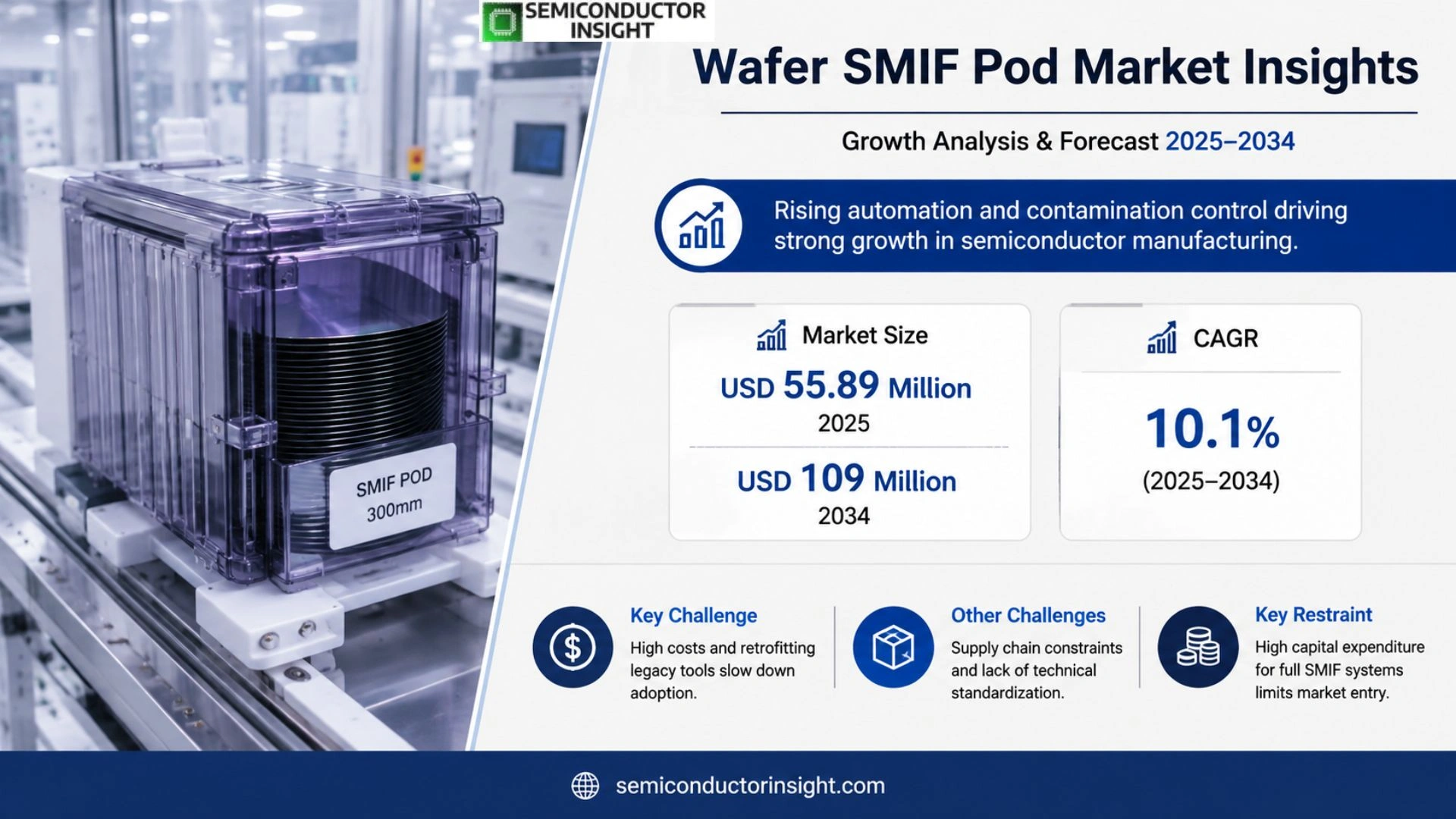
Global Wafer SMIF Pod market size was valued at USD 55.89 million in 2025 and is forecasted to reach USD 109 million by 2034, reflecting a CAGR of 10.1 % during the forecast period.
Wafer SMIF Pods are standardized mini‑environment carriers designed for 150 mm and 200 mm wafer manufacturing lines. They seal cassettes loaded with wafers in a low‑particle, low‑outgassing, ESD‑controlled environment, thereby limiting contamination, gaseous emissions and handling‑related damage while interfacing with standard mechanical and automation equipment.
The growth momentum stems from expanding mature‑node fab capacity,SEMI projects over 7.7 million 200 mm wafers per month by 2026,and increasing demand for power‑semiconductor and MEMS production. Moreover, policies such as the U.S. CHIPS Act and EU Chips Act stimulate new fab construction, which indirectly boosts carrier demand. Suppliers differentiate through SEMI‑standard compatibility, airtight seals, purge capability, RFID/barcode traceability and OHT readiness; these features are becoming decisive purchase criteria as fabs seek higher yield and tighter process control.
MARKET DRIVERS
Increasing Demand for High‑Yield Semiconductor Fabrication
The surge in advanced logic and memory devices has forced fabs to tighten yield margins. Operators are turning to Wafer SMIF Pod Market solutions that minimize particle contamination, thereby safeguarding costly 300‑mm wafers during storage and transport. The correlation between lower defect density and higher profitability makes these pods a strategic necessity.
Stringent Cleanroom Requirements
Regulatory guidelines for class‑1 and class‑10 environments compel manufacturers to adopt sealed handling systems. SMIF pods, with their hermetic lids and controlled atmosphere, directly address this mandate, reducing the risk of ambient particles entering the wafer train. Consequently, fabs are allocating a larger share of CAPEX to upgrade their wafer‑handling line.
➤ Operators that integrated SMIF technology in 2022 reported a 12% reduction in wafer‑related re‑work costs within the first twelve months.
Beyond defect control, the ability of SMIF pods to streamline automated material handling translates into shorter cycle times. With fab utilization rates hovering near 80%, any incremental throughput gain strengthens a plant’s competitive position, reinforcing the upward momentum of Wafer SMIF Pod market.
Environmental Sustainability Pressures
Corporate sustainability agendas are prompting fabs to reduce waste generated by disposable wafer carriers. Re‑usable SMIF pods, built from robust polymer composites, align with these goals while delivering long‑term cost efficiencies. The convergence of environmental and economic incentives is a palpable catalyst for market expansion.
MARKET CHALLENGES
Cost Pressures and Process Compatibility
While SMIF pods deliver clear contamination benefits, their upfront price remains a barrier for mid‑size foundries operating on razor‑thin margins. Moreover, retrofitting legacy equipment to accommodate pod interfaces can trigger extensive engineering effort, delaying ROI realization.
Other Challenges
Supply Chain Constraints
The global shortage of high‑purity polymers and precision‑machined components has sporadically throttled pod production. Lead times of 8‑12 weeks are now common, compelling buyers to maintain larger safety stocks and increasing overall inventory costs.
Technical Standardization
Fragmented specifications across equipment vendors create integration hurdles. Companies that lack a unified handling protocol may experience mismatched pod dimensions, leading to handling errors and decreased throughput.
MARKET RESTRAINTS
High Capital Expenditure Requirements
The initial outlay for a fully automated SMIF system,including robots, storage cabinets, and software,can exceed $5 million for a 200‑mm line. This capital intensity deters new entrants and slows adoption among fabs seeking to preserve liquidity amid volatile demand cycles.
In addition, the depreciation schedule for SMIF assets is lengthy, often spanning a decade. Financial planners must balance the long‑term amortization against short‑term earnings targets, which can defer investment decisions.
MARKET OPPORTUNITIES
Emerging 450‑mm Wafer Platforms
The industry’s tentative move toward 450‑mm wafers opens a niche for next‑generation SMIF pods designed to handle larger diameters while preserving the same contamination control standards. Early adopters stand to benefit from a first‑mover advantage in a market segment that is still in its infancy.
Parallel to diameter scaling, the rise of AI‑driven fab automation creates demand for pods equipped with sensors and real‑time data links. Vendors that embed IoT capabilities into their pod designs can offer predictive maintenance insights, unlocking new revenue streams and reinforcing the strategic value of Wafer SMIF Pod market.
Wafer SMIF Pod Market Trends
Growth of Clean Transfer Solutions in Mature‑Node Fab Expansion
Wafer SMIF Pod market, valued at roughly US$ 55.9 million in 2025, is moving toward a double‑digit increase that reflects deeper integration of contamination‑controlled logistics in 150 mm and 200 mm lines. Capacity forecasts for 200 mm fabs now exceed 7.7 million wafers per month, driven largely by automotive power devices and MEMS production. Each additional transfer node creates a direct requirement for sealed carriers that can preserve particle and electrostatic integrity, because even marginal contamination translates into measurable yield loss on high‑value silicon‑carbide and power‑semiconductor wafers. Consequently, wafer fabs are allocating budget not only for basic containers but also for carriers that embed purge gas capability, RFID traceability and OHT compatibility, turning the SMIF pod from a consumable into a strategic yield‑preservation asset.
Other Trends
Customization and Traceability as Differentiators
Suppliers are expanding portfolio options beyond the standard SEMI‑compatible shell. Options now include conductive coatings for ESD dissipation, interchangeable back‑plates for color‑coding, and modular filter assemblies that adapt to specific gas‑charging protocols. The inclusion of barcode and RFID modules permits real‑time wafer‑track analytics, allowing fab managers to correlate carrier history with defect density. This shift forces customers to evaluate total‑cost‑of‑ownership rather than upfront price, since maintenance contracts, cleaning services and validation checks become part of the procurement decision. Firms that can bundle these capabilities into a single, upgradeable platform gain leverage in long‑term service agreements, reinforcing the “stickiness” of the product in the fab’s equipment ecosystem.
Regional Concentration and Supply‑Chain Resilience
Manufacturing capability remains clustered in the United States, Japan and Taiwan. U.S. players tend to embed the pod within broader clean‑handling system suites, Japanese firms emphasize long‑term reliability and strict adherence to Class‑1 cleanliness, while Taiwanese manufacturers focus on rapid OHT‑ready variants and localized aftermarket support. This geographic pattern creates a natural barrier to entry for generic plastics producers, who must acquire expertise in low‑outgassing polymers, precision molding tolerances and fab‑specific interface standards. Policy initiatives such as the U.S. CHIPS Act and the EU Chips Act stimulate new fab construction, indirectly amplifying demand for SMIF pods across these regions. Companies that can align their supply networks with these policy‑driven expansions are positioned to capture replacement cycles and retrofit projects, ensuring a stable revenue base even as the overall wafer portfolio evolves.
COMPETITIVE LANDSCAPE
Key Industry Players
Wafer SMIF Pod Market: Competitive Overview
Entegris dominates the upper tier of the SMIF pod segment by offering a portfolio that couples low‑particle polymer shells with integrated RFID and purge‑gas modules. The company’s global support infrastructure enables fabs in North America, Europe, and Asia to source replacement pods and maintenance services through a single contract, reinforcing customer lock‑in. Entegris’ emphasis on durability under repetitive OHT handling, combined with a strong aftermarket service business, creates a revenue stream that cushions cyclical wafer‑capacity swings. This blend of product breadth and long‑term support positions Entegris as the reference supplier for high‑volume 200 mm lines and for specialty SiC processes that demand tighter contamination control.
Beyond the market leader, a cohort of midsize manufacturers supplies differentiated options that address specific fab requirements. Dainichi (Japan) leverages its expertise in precision molding to deliver Class‑1 pods with customizable back‑plate materials, appealing to fabs that retrofit legacy equipment. Taiwanese players such as E‑SUN, Chung King Enterprise, and Gudeng Precision focus on rapid OHT‑ready configurations and localized color‑coding, which shortens lead times for regional fabs. Chinese‑origin firms YAOLIEN TECHNOLOGY and ePAK International inject value‑added features like conductive shells and silicon‑carbide‑compatible seals, targeting the emerging power‑device niche. Smaller specialists, including MITSUBISHI‑CHEMICAL (Japan) and Advanced Materials (USA), complement the ecosystem by offering cleaning‑service contracts and validation programs that extend pod lifecycles. Collectively, these niche actors sustain a competitive environment where differentiation rests on material science, traceability options, and the ability to adapt to fab‑specific automation interfaces.
List of Key Wafer SMIF Pod Companies Profiled
- Entegris, Inc.
- Dainichi Shoji Co., Ltd.
- E‑SUN Technology Co., Ltd.
- Chung King Enterprise Co., Ltd.
- Gudeng Precision Industrial Co., Ltd.
- YAOLIEN TECHNOLOGY CO., LTD.
- ePAK International, Inc.
- Mitsubishi‑Chemical Corp.
- Advanced Materials Corp.
- Hoya Corp.
- DuPont Electronics & Industrial Polymers.
- Shinkawa Precision Ltd.
- Fujitsu Semiconductor Solutions.
- Nanomaker Ltd.
- TechnoPolymers International.
Segment Analysis:
| Segment Category | Sub-Segments | Key Insights |
| By Type |
|
Standard 200 mm Pods dominate because they meet the broadest fab footprint and interface requirements. – Provide robust airtight seals that minimise particle and outgassing risks. – Integrate seamlessly with legacy mechanical interfaces while supporting OHT retrofits. – Offer a familiar form factor that reduces operator learning curve and maintenance overhead. |
| By Application |
|
Power Semiconductor Lines are the most demanding application segment. – Require ultra‑low particle generation to protect high‑voltage devices. – Benefit from ESD‑controlled shells that safeguard wafer integrity during rapid transfers. – Often pair SMIF pods with gas‑purge capability to maintain a pristine environment for SiC epitaxy. |
| By End User |
|
Wafer Fab Operators drive selection through day‑to‑day handling experience. – Prioritise ease of loading/unloading to minimise cycle time. – Seek transparent shells for visual inspection without breaking the mini‑environment. – Value long‑life wear‑resistant positioning structures that reduce replacement frequency. |
| By Cleanliness Level |
|
Class 1 Clean Pods are the premium choice for contamination‑sensitive processes. – Incorporate low‑outgassing materials that preserve wafer surface chemistry. – Often feature integrated purge ports to maintain a nitrogen‑rich environment. – Align with stringent semiconductor fab standards, ensuring process yield stability. |
| By Automation Interface |
|
OHT‑Compatible Pods are gaining traction as fabs automate wafer logistics. – Offer plug‑and‑play compatibility with overhead transport systems, reducing manual handling. – Include barcode/RFID modules that feed real‑time traceability data to MES. – Enable predictive maintenance by reporting wear‑state and seal integrity to fab control software. |
Regional Analysis: Wafer SMIF Pod Market
Asia-Pacific
Fab density in China, Taiwan, and South Korea generates a sustained pull for SMIF pods that can operate continuously under tight cycle times. Suppliers tailor pod dimensions to match the layout of high‑mix production lines, reducing handling steps and preserving yield.
Regional logistics networks, bolstered by port‑side warehousing and redundant component suppliers, limit exposure to disruptions. This robustness encourages fab managers to source pods locally rather than relying on distant inventories.
Government programmes that subsidise capital equipment upgrades include earmarked funds for wafer‑handling infrastructure. Such incentives lower the effective cost of adopting newer SMIF solutions, prompting early‑stage adoption among mid‑size fabs.
A steady pipeline of engineers proficient in clean‑room automation fuels continuous product improvement. Universities partnered with foundries often host pilot projects that trial next‑generation pod designs under real‑world conditions.
North America
In the United States and Canada, Wafer SMIF Pod market is shaped by a mature semiconductor base that emphasizes reliability over volume. End users prioritize long‑term service agreements and modular pod architectures that can be retrofitted into existing fab lines. Industry consortia focus on standardisation, which reduces integration risk for equipment makers. While growth is steadier than in Asia‑Pacific, the region’s emphasis on intellectual‑property protection drives vendors to offer highly customised solutions for niche applications such as advanced packaging and photonics. The strategic importance of maintaining supply‑chain sovereignty also encourages domestic procurement of pods, reinforcing a market segment that values security and traceability.
Europe
European semiconductor clusters around Germany, the Netherlands, and France exhibit a cautious investment stance, balancing cost efficiency with strict environmental regulations. Wafer SMIF Pod market here reflects a demand for pods constructed from recyclable materials and equipped with energy‑saving mechanisms. Collaborative research hubs, often funded by the EU, explore low‑contamination sealing technologies that align with regional clean‑room standards. Procurement policies favour suppliers with demonstrable sustainability credentials, prompting manufacturers to differentiate their portfolios through eco‑friendly designs. Though overall volume lags behind the Asia‑Pacific, Europe’s focus on high‑value, precision‑engineered products sustains a specialized niche within the broader market.
South America
The South American landscape is characterised by emerging fabs in Brazil and Chile that are still scaling their production capabilities. For these operators, Wafer SMIF Pod market presents an opportunity to leapfrog older handling methods and adopt internationally recognised contamination controls. Adoption is driven by partnerships with multinational equipment vendors who provide training programmes to up‑skill local staff. Cost considerations remain paramount; therefore, vendors that can offer modular pods with flexible pricing structures find receptive customers. As regional demand for automotive and IoT chips grows, the need for reliable wafer transport solutions will become a more prominent factor in fab planning.
Middle East & Africa
Investment in semiconductor assembly and testing facilities across the United Arab Emirates, Saudi Arabia, and select African nations is still nascent, yet strategic initiatives aim to diversify economies away from oil dependence. Wafer SMIF Pod market in this zone is largely influenced by government‑backed technology parks that import turnkey fab solutions. Vendors that can deliver turnkey pod systems with minimal on‑site calibration are favoured, as local technical expertise is limited. Moreover, the emphasis on rapid up‑skilling programs means that training and after‑sales support are decisive criteria when selecting a pod supplier. As these regions pursue broader participation in the global supply chain, demand for robust wafer handling infrastructure is expected to rise modestly but steadily.
Report Scope
This market research report provides a comprehensive analysis of the Wafer SMIF Pod Market , covering the forecast period 2026–2034. It offers detailed insights into market dynamics, technological advancements, competitive landscape, and key trends shaping the industry.
Key focus areas of the report include:
- Market Overview: The report begins with an overview outlining its current market scenario, key growth indicators, and industry transformation drivers. It discusses macroeconomic factors, demand–supply balance, regulatory landscape, and the strategic role of semiconductors in powering advancements across industries such as automotive, telecommunications, consumer electronics, and industrial automation.
- Market Size & Forecast: Historical data and future projections for revenue, unit shipments, and market value across major regions and segments.
- Segmentation Analysis: Detailed breakdown by product type, technology, application, and end-user industry to identify high-growth segments and investment opportunities.
- Regional Insights: Insights into market performance across North America, Europe, Asia-Pacific, Latin America, and the Middle East & Africa, including country-level analysis where relevant.
- Competitive Landscape: Profiles of leading market participants, including their product offerings, R&D focus, manufacturing capacity, pricing strategies, and recent developments such as mergers, acquisitions, and partnerships.
- Technology Trends & Innovation: Assessment of emerging technologies, integration of AI/IoT, semiconductor design trends, fabrication techniques, and evolving industry standards.
- Market Drivers & Restraints: Evaluation of factors driving market growth along with challenges, supply chain constraints, regulatory issues, and market-entry barriers.
- Stakeholder Insights: Insights for component suppliers, OEMs, system integrators, investors, and policymakers regarding the evolving ecosystem and strategic opportunities.
Primary and secondary research methods are employed, including interviews with industry experts, data from verified sources, and real-time market intelligence to ensure the accuracy and reliability of the insights presented.
FREQUENTLY ASKED QUESTIONS:
What is the current market size of Wafer SMIF Pod Market?
-> Wafer SMIF Pod market is forecasted to reach USD 109 million by 2034, reflecting a CAGR of 10.1 % during the forecast period.
Which key companies operate in Wafer SMIF Pod Market?
-> Key players include Entegris, Inc.; Dainichi Shoji Co., Ltd.; E‑SUN; Chung King Enterprise Co., Ltd.; Gudeng Precision Industrial Co., Ltd.; YAOLIEN TECHNOLOGY CO., LTD.; ePAK International, Inc..
What are the primary growth drivers for Wafer SMIF Pod market?
-> Growth is driven by expanding 200 mm fab capacity, increasing demand from automotive and power‑semiconductor applications, the rise of wide‑bandgap (SiC) production, and supportive policies such as the U.S. CHIPS Act and the EU Chips Act.
Which region dominates Wafer SMIF Pod market?
-> Asia-Pacific holds the largest share owing to a high concentration of mature‑node fabs in China, Japan, South Korea and Taiwan, while North America shows strong demand from legacy‑line retrofits.
What emerging trends are shaping Wafer SMIF Pod market?
-> Emerging trends include OHT‑compatible pod designs, silicon‑carbide‑specific SMIF solutions, advanced RFID/barcode traceability, higher‑cleanliness Class 1 specifications, and integrated purge/gas‑charging capabilities.
Get Sample Report PDF for Exclusive Insights
Report Sample Includes
- Table of Contents
- List of Tables & Figures
- Charts, Research Methodology, and more...