Visible Light Communication Chip Market Insights
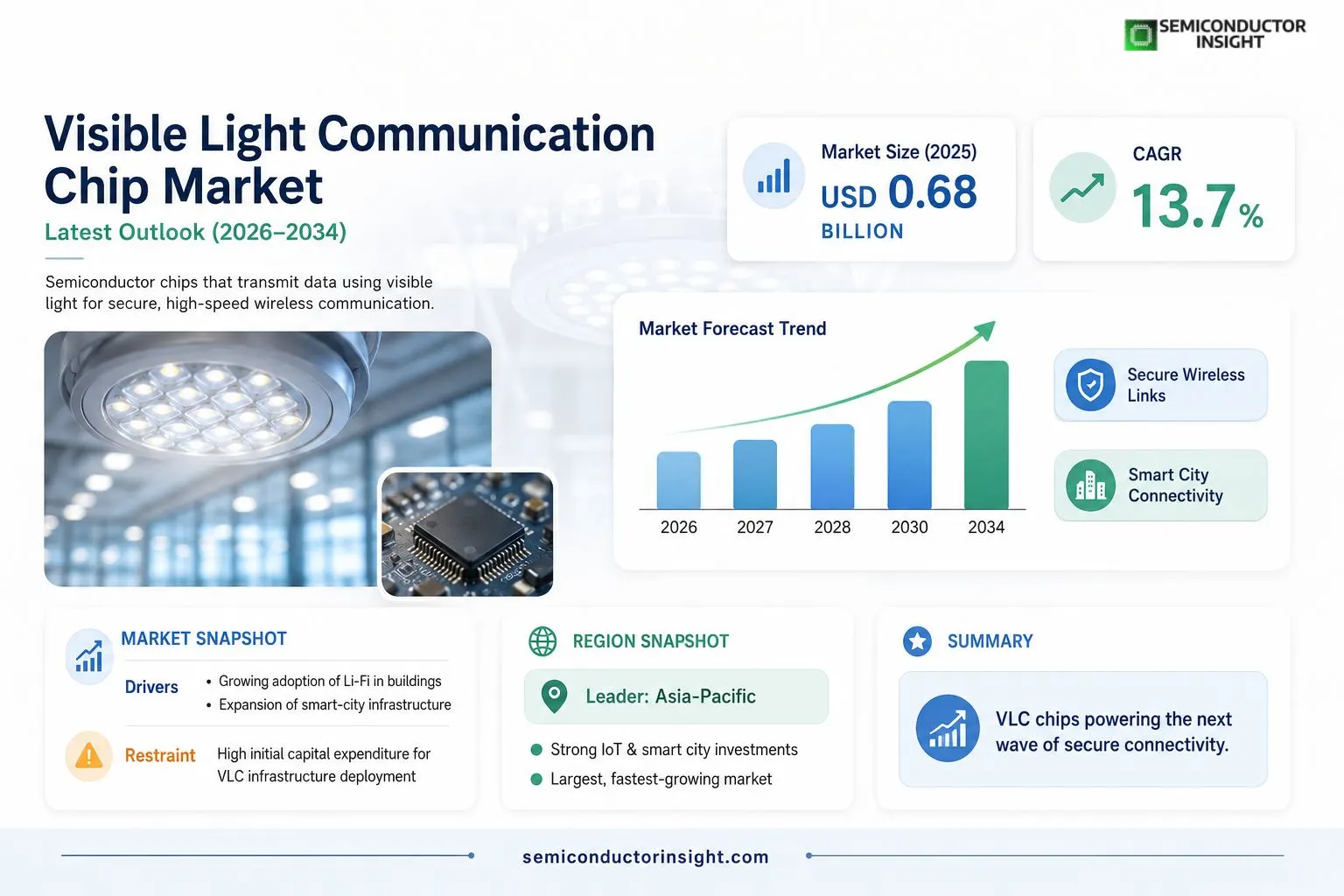
Global visible light communication chip market is projected to grow from USD 0.68 billion in 2025 to USD 2.15 billion by 2034, exhibiting a CAGR of 13.7% during the forecast period.
Visible light communication (VLC) chips are semiconductor components that enable data transmission using the visible spectrum (400–800 nm). These chips modulate light‑emitting diodes (LEDs) or laser diodes at high frequencies, converting optical signals into electrical data streams for applications such as indoor positioning, high‑speed wireless networking, automotive LiDAR, and IoT connectivity.The market is experiencing rapid growth because demand for bandwidth‑intensive services and secure wireless links is rising across consumer electronics and smart‑city infrastructures. However, challenges remain in standardization and integration costs; nevertheless, advancements in silicon photonics and decreasing LED prices are driving wider adoption. Key players,including Signify, Osram Opto Semiconductors, Broadcom and Vishay,are expanding their portfolios through strategic partnerships and R&D investments aimed at enhancing data rates beyond gigabit per second thresholds.
MARKET DRIVERS
Growing Adoption of Li‑Fi in Commercial Buildings
Visible Light Communication Chip Market is being propelled by the rapid integration of Li‑Fi technology into office complexes, hospitals, and retail spaces. Companies are replacing traditional Wi‑Fi with light‑based data links to achieve higher security and reduced electromagnetic interference, leading to a projected CAGR of approximately 12% through 2028.
Expansion of Smart‑City Infrastructure
Municipal initiatives worldwide are embedding VLC chips into street lighting and traffic signals to enable real‑time data transmission for IoT sensors. This smart‑city push is expected to add $850 million in revenue to Visible Light Communication Chip Market by 2027.
➤ Industry analysts forecast that the convergence of 5G and VLC will unlock new hybrid networking models, further accelerating chip demand.
Additionally, the rise of AR/VR headsets that rely on high‑bandwidth, low‑latency communication is driving chip manufacturers to develop miniaturized, power‑efficient VLC solutions, strengthening the market’s growth trajectory.
MARKET CHALLENGES
Limited Line‑of‑Sight Range in Dense Environments
VLC technology requires a clear optical path, and obstacles such as partitions or furniture can degrade signal quality. This physical limitation hampers widespread deployment in crowded office layouts, creating a barrier for rapid market expansion.
Other Challenges
Standardization Gaps
The absence of universally accepted communication protocols leads to compatibility issues between vendors, slowing adoption rates and increasing integration costs for end users.
MARKET RESTRAINTS
High Initial Capital Expenditure
Deploying VLC infrastructure often involves retrofitting existing lighting fixtures with specialized chips, which can entail significant upfront investment. Small‑and‑medium enterprises may postpone adoption until cost reductions become evident, limiting short‑term market velocity.
MARKET OPPORTUNITIES
Integration with Automotive Lighting Systems
The automotive sector presents a lucrative avenue as manufacturers embed VLC chips into vehicle headlights and interior lighting for vehicle‑to‑infrastructure (V2I) communication. Forecasts suggest this niche could contribute over $300 million to Visible Light Communication Chip Market by 2030, driven by safety‑enhancing data exchange and OTA updates.
Visible Light Communication Chip Market Trends
Integration of VLC Chips into Smart‑City Infrastructure
Visible Light Communication Chip Market is witnessing a decisive shift as municipalities adopt LED‑based street lighting that doubles as high‑speed data transmitters. By embedding VLC chips directly into the luminaires, cities achieve two‑fold benefits: energy‑efficient illumination and a secure, license‑free wireless backbone for public Wi‑Fi, traffic management, and environmental sensing. This convergence reduces the need for separate radio‑frequency hardware, streamlining deployment costs and enabling real‑time analytics for urban planners. The trend is reinforced by policy incentives that favor low‑emission technologies, making VLC‑enabled lighting a cornerstone of next‑generation smart‑city networks.
Other Trends
Automotive LiDAR and Safety Applications
Automakers are increasingly integrating Visible Light Communication Chip Market solutions into LiDAR and vehicle‑to‑everything (V2X) systems. VLC chips modulate laser diodes to create precise distance maps while simultaneously transmitting diagnostic data to onboard processors. This dual‑function approach shortens signal latency and improves obstacle detection under varied lighting conditions. As autonomous driving prototypes move toward mass production, manufacturers prioritize chips that combine high bandwidth with robust automotive‑grade reliability, driving competitive R&D investments across the sector.
Advances in Silicon Photonics for Higher Data Rates
Recent breakthroughs in silicon photonics are unlocking gigabit‑per‑second transmission capabilities for Visible Light Communication Chip Market. By leveraging CMOS‑compatible processes, chip designers can integrate optical modulators and drivers on a single die, dramatically reducing form factor and power consumption. These advances support emerging use cases such as ultra‑dense indoor positioning, high‑definition video streaming in conference rooms, and secure data links for industrial IoT nodes. As production yields improve, cost per unit falls, encouraging broader adoption across consumer electronics and enterprise environments.
COMPETITIVE LANDSCAPEKey Industry Players
Visible Light Communication Chip Market Competitive Overview
Visible Light Communication (VLC) chip market is currently led by a handful of large semiconductor and lighting specialists that have leveraged their existing LED or silicon‑photonic platforms to deliver high‑speed optical transceivers. Signify, leveraging its Philips Lighting heritage, dominates the indoor‑positioning and smart‑building segments through integrated VLC modules that couple directly with its LED product lines. Osram Opto Semiconductors, with deep expertise in automotive lighting, is expanding its VLC portfolio to support vehicle‑to‑vehicle LiDAR and infotainment applications. Broadcom’s acquisition of a photonics startup has accelerated its entry into gigabit‑per‑second VLC chipsets, positioning it as a cross‑industry supplier for consumer electronics, data‑center interconnects, and IoT gateways. Vishay’s broad analog and power‑semiconductor base provides cost‑effective VLC drivers that are widely adopted in low‑cost consumer devices, reinforcing a tiered market structure where a few tier‑1 firms supply high‑performance chips while a broader base of niche vendors address price‑sensitive segments.Beyond the tier‑1 players, several specialized companies are shaping niche markets and driving innovation. IQE (formerly Ilika) focuses on silicon‑photonic VLC chips for high‑density data‑center links, while LiteOn supplies compact VLC transceivers for automotive head‑up displays. Panasonic and Samsung Electronics have introduced VLC‑enabled smartphones and wearables, demonstrating convergence with consumer electronics. Texas Instruments and NXP Semiconductors offer mixed‑signal VLC solutions that integrate LED drivers and demodulators for smart‑city lighting grids. ON Semiconductor, Melexis, and Luminus Devices provide custom‑engineered VLC components for industrial automation and medical imaging. These companies, though smaller in revenue share, contribute critical differentiated technologies that broaden the overall ecosystem.
List of Key Visible Light Communication Chip Companies Profiled
- Signify
- Osram Opto Semiconductors
- Broadcom
- Vishay
- IQE
- LiteOn
- Panasonic
- Samsung Electronics
- Texas Instruments
- NXP Semiconductors
- ON Semiconductor
- Melexis
- Luminus Devices
- Acacia Communications
- Finisar
Segment Analysis:
| Segment Category | Sub-Segments | Key Insights |
| By Type |
|
LED‑based VLC chips
Laser‑based VLC chips
|
| By Application |
|
Indoor positioning
High‑speed wireless networking
Automotive LiDAR
IoT connectivity
|
| By End User |
|
Consumer electronics
Smart‑city infrastructure
Automotive systems
|
| By Integration Mode |
|
Standalone chips
System‑on‑Chip solutions
Hybrid modular designs
|
| By Standardization |
|
Proprietary protocols
Open standards (IEEE 802.15.7)
Emerging AI‑driven adaptive protocols
|
Regional Analysis: North America
United States
The robust ecosystem of semiconductor companies and the presence of numerous startups dedicated to VLC technology further solidify the United States’ position as a leading hub for Visible Light Communication Chip Market. Government initiatives promoting smart city development and the expansion of 5G infrastructure are also expected to indirectly benefit the uptake of VLC chips as complementary technologies.
The smart home sector is a primary driver for VLC chip adoption, facilitating seamless data transfer between devices and enhancing the overall user experience.
VLC’s low power consumption aligns well with the demands of IoT devices, extending battery life and reducing energy costs.
Retail environments are increasingly leveraging VLC for in-store navigation, digital signage, and personalized advertising.
The ability to transmit data directly to consumers’ devices without relying on cellular networks enhances customer engagement.
VLC technology is finding applications in industrial settings for wireless control, monitoring, and data acquisition.
Its immunity to electromagnetic interference makes it suitable for harsh industrial environments.
Within healthcare, VLC offers secure and reliable data transmission for medical devices and patient monitoring systems.
The inherent security features of VLC are particularly valuable in this sensitive sector.
Europe
Europe is witnessing a steady growth in Visible Light Communication Chip Market, driven by stringent data privacy regulations and a focus on energy-efficient technologies. The region’s strong emphasis on research and development, particularly in areas like automotive and telecommunications, is fostering innovation in VLC chip technology. The European Union’s commitment to sustainable development further supports the adoption of energy-saving solutions like VLC, especially for IoT deployments. However, fragmented regulatory landscapes across different European countries can pose challenges to market standardization and widespread adoption. Businesses are responding by focusing on developing interoperable solutions and collaborating with regional stakeholders to navigate these complexities. The automotive sector is a key area, with VLC being explored for in-vehicle communication and sensor applications, aligning with the industry’s push towards connected and autonomous vehicles.
Asia-Pacific
The Asia-Pacific region represents the largest and fastest-growing market for Visible Light Communication Chip Market globally. Countries like China, Japan, and South Korea are investing heavily in 5G infrastructure and IoT initiatives, creating significant demand for VLC technology. The proliferation of smart cities and the increasing adoption of smart home devices are further propelling market growth. China, in particular, is emerging as a major manufacturing hub for VLC chips, contributing to lower production costs and increased market accessibility. The region’s dynamic consumer electronics market also fuels demand for VLC applications in displays, wearables, and other consumer devices. While competition is intense, the sheer size of the market and the rapid pace of technological advancements present substantial opportunities for players in the VLC chip market.
South America
South America is an emerging market for Visible Light Communication Chip Market, with growth potential linked to increasing internet penetration and the expansion of IoT applications. The region’s growing focus on smart city initiatives, particularly in major urban centers like São Paulo and Rio de Janeiro, is creating opportunities for VLC deployments in areas such as public transportation, street lighting, and smart infrastructure. The adoption of VLC in retail and commercial spaces is also gaining traction, driven by demand for enhanced customer experiences and improved operational efficiency. However, infrastructure limitations and economic uncertainties present challenges to market development. Businesses are focusing on partnerships and localized solutions to adapt to the specific needs of the South American market.
Middle East & Africa
The Middle East & Africa region presents a nascent but promising market for Visible Light Communication Chip Market. The region’s rapid urbanization and investment in smart city projects are creating opportunities for VLC applications in areas like smart lighting, traffic management, and security systems. Several countries are actively pursuing initiatives to enhance digital infrastructure and promote technological innovation, which is expected to drive adoption of VLC. The focus on energy efficiency and sustainable development also aligns with the benefits of VLC technology. However, economic volatility and infrastructural challenges remain key obstacles to market growth. Strategic partnerships and tailored solutions will be crucial for success in this region.
Report Scope
This market research report provides a comprehensive analysis of the Visible Light Communication Chip Market , covering the forecast period 2026–2034. It offers detailed insights into market dynamics, technological advancements, competitive landscape, and key trends shaping the industry.
Key focus areas of the report include:
- Market Overview: The report begins with an overview outlining its current market scenario, key growth indicators, and industry transformation drivers. It discusses macroeconomic factors, demand–supply balance, regulatory landscape, and the strategic role of semiconductors in powering advancements across industries such as automotive, telecommunications, consumer electronics, and industrial automation.
- Market Size & Forecast: Historical data and future projections for revenue, unit shipments, and market value across major regions and segments.
- Segmentation Analysis: Detailed breakdown by product type, technology, application, and end-user industry to identify high-growth segments and investment opportunities.
- Regional Insights: Insights into market performance across North America, Europe, Asia-Pacific, Latin America, and the Middle East & Africa, including country-level analysis where relevant.
- Competitive Landscape: Profiles of leading market participants, including their product offerings, R&D focus, manufacturing capacity, pricing strategies, and recent developments such as mergers, acquisitions, and partnerships.
- Technology Trends & Innovation: Assessment of emerging technologies, integration of AI/IoT, semiconductor design trends, fabrication techniques, and evolving industry standards.
- Market Drivers & Restraints: Evaluation of factors driving market growth along with challenges, supply chain constraints, regulatory issues, and market-entry barriers.
- Stakeholder Insights: Insights for component suppliers, OEMs, system integrators, investors, and policymakers regarding the evolving ecosystem and strategic opportunities.
Primary and secondary research methods are employed, including interviews with industry experts, data from verified sources, and real-time market intelligence to ensure the accuracy and reliability of the insights presented.
FREQUENTLY ASKED QUESTIONS:
What is the current market size of Visible Light Communication Chip Market?
-> Visible Light Communication Chip Market was valued at USD 0.68 billion in 2025 and is expected to reach USD 2.15 billion by 2034, with a CAGR of 13.7% during the forecast period.
Which key companies operate in Visible Light Communication Chip Market?
-> Key players include Signify, Osram Opto Semiconductors, Broadcom, and Vishay, among others.
What are the key growth drivers?
-> Key growth drivers include rising demand for bandwidth‑intensive services, secure wireless links in consumer electronics and smart‑city infrastructures, advancements in silicon photonics, and decreasing LED prices.
Which region dominates the market?
-> The reference does not specify a single dominant region; growth is observed across major regions globally.
What are the emerging trends?
-> Emerging trends include standardization efforts, integration of VLC chips with AI/IoT platforms, and continued cost reductions through silicon photonics innovations.

Get Sample Report PDF for Exclusive Insights
Report Sample Includes
- Table of Contents
- List of Tables & Figures
- Charts, Research Methodology, and more...
 Download Sample Report PDF