
Vietnam AI Chip Assembly and Test Equipment Market Insights
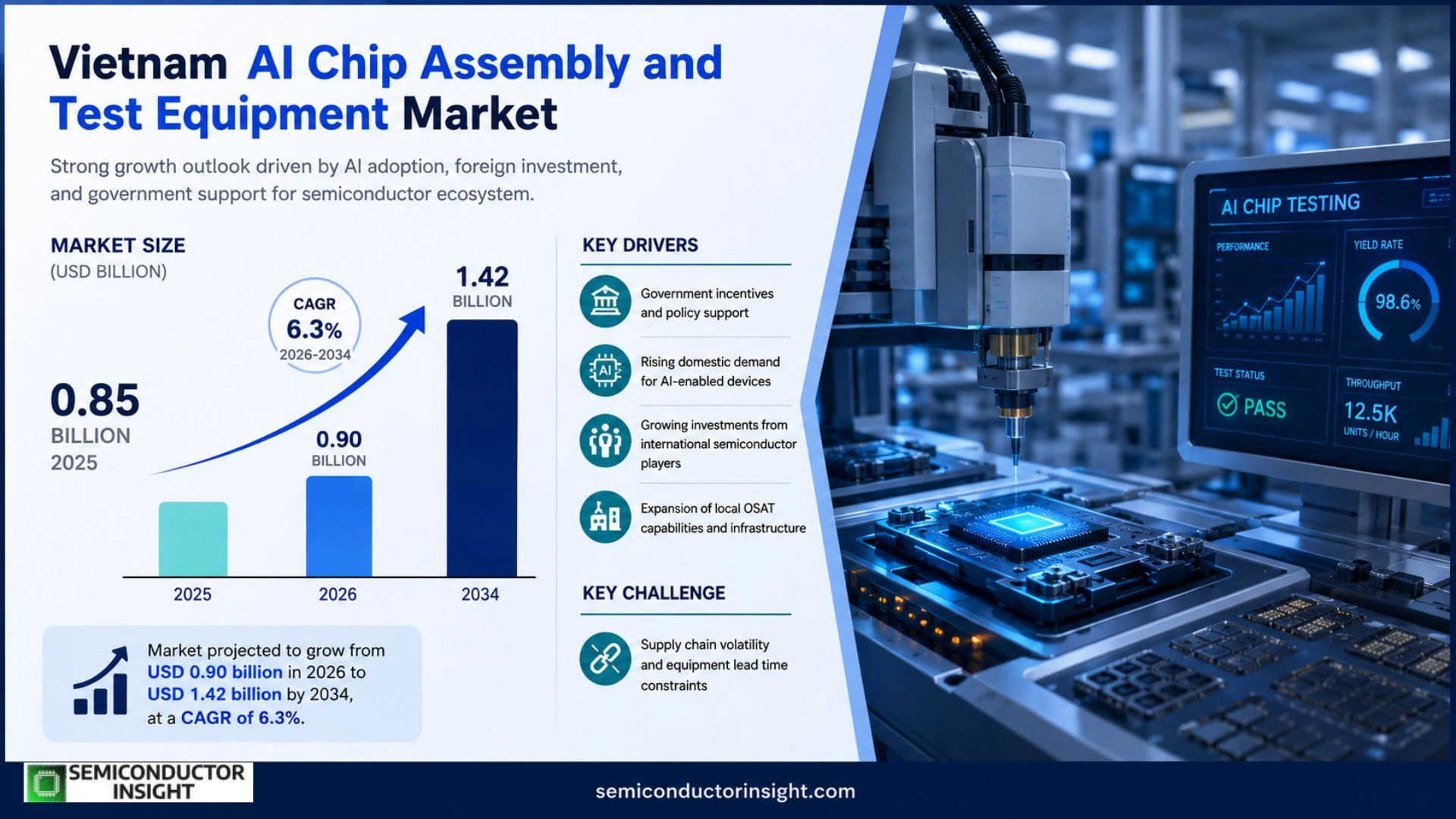
Global Vietnam AI Chip Assembly and Test Equipment market size was valued at USD 0.85 billion in 2025. The market will expand from USD 0.85 billion in 2025 to USD 1.42 billion by 2034, reflecting a CAGR of 6.3% during the forecast period.
This segment comprises precision machinery used for die‑level placement, wafer‑level packaging, automated optical inspection (AOI), electrical testing and burn‑in processes that enable high‑performance artificial‑intelligence (AI) chips to reach volume production. The upward trajectory stems from Vietnam’s aggressive semiconductor roadmap, sizable foreign direct investment from firms such as Samsung Electronics and Intel, and rising regional demand for edge‑AI solutions.
Furthermore, government incentives,including tax holidays and infrastructure grants,lower entry barriers for equipment suppliers.
MARKET DRIVERS
Government incentives and policy support
Vietnamese Ministry of Science and Technology has rolled out tax holidays and land‑lease subsidies aimed at high‑value semiconductor activities. These fiscal levers reduce upfront capital outlays, allowing equipment vendors to price their AI chip assembly and test solutions more competitively.
Rising domestic demand for AI‑enabled devices
Local manufacturers of smartphones, smart cameras, and edge‑computing modules are integrating AI accelerators at an accelerating pace. This creates a reliable pipeline of orders for assembly lines and test stations, underpinning short‑term revenue growth for the equipment market.
➤ “Vietnam’s push toward a semiconductor ecosystem is no longer a long‑term vision; it is shaping operational realities for equipment suppliers today.”
Foreign fab operators, attracted by the country’s growing talent pool, are establishing pilot lines for AI chips. Their entry amplifies the need for sophisticated testing platforms that can validate performance at scale, further stimulating market activity.
MARKET CHALLENGES
Supply chain volatility
Global shortages of high‑precision lithography tools and specialty chemicals have strained procurement cycles. Vietnamese assemblers face longer lead times, which can erode the cost advantage of localized production and delay time‑to‑market for AI chip customers.
Other Challenges
Talent retention
While engineering graduates are abundant, retaining specialists with deep expertise in AI‑specific test methodologies remains difficult. Companies must invest in continuous training programs, which adds to operational overhead.
MARKET RESTRAINTS
Capital intensity of advanced test equipment
State‑of‑the‑art AI chip testers command prices that can exceed $10 million per unit. For many midsize Vietnamese firms, financing such assets without robust loan structures is challenging, limiting adoption to a handful of large players.
MARKET OPPORTUNITIES
Emerging niche for low‑power AI chip verification
The proliferation of IoT sensors and wearable AI modules calls for cost‑effective, low‑throughput testers that can validate power‑consumption metrics. Equipment makers that tailor solutions for this segment can capture a growing slice of Vietnam AI Chip Assembly and Test Equipment Market without competing directly with high‑end suppliers.
Partnerships with multinational fabs
International semiconductor firms are seeking local partners to streamline their pilot productions. Joint‑venture arrangements offer Vietnamese firms access to proprietary test algorithms, accelerating technology transfer and creating a differentiated service offering.
Vietnam AI Chip Assembly and Test Equipment Market Trends
Growing Investment and Policy Incentives Accelerate Equipment Deployment
Vietnamese government’s semiconductor roadmap has been reinforced by a suite of fiscal measures that lower entry costs for high‑precision assembly and test solutions. Tax holidays and targeted infrastructure grants have made it feasible for global equipment vendors to establish local service hubs, while the influx of capital from Samsung Electronics, Intel, and other multinational manufacturers creates a reliable order pipeline. This convergence of policy support and foreign direct investment encourages customers to transition from legacy testers to modular platforms capable of handling both mature process nodes and the emerging sub‑10 nm regime. The result is a measurable uptick in procurement activity, prompting suppliers to prioritize Vietnamese operations in their Asia‑Pacific expansion plans. Vietnam AI Chip Assembly and Test Equipment Market therefore benefits from a feedback loop where regulatory encouragement fuels equipment spend, which in turn validates the country’s strategic positioning in the regional AI‑chip value chain.
Other Trends
Shift Toward Integrated Die‑Level Placement and Automated Optical Inspection
Manufacturers are increasingly consolidating die‑level placement machinery with automated optical inspection (AOI) capabilities to streamline yield management. Recent product releases from ASE Group and Advantest feature combined placement‑vision modules that reduce cycle time and minimize human intervention. By integrating these functions, fabs can better control particle contamination and alignment accuracy,critical parameters for edge‑AI chips that demand tight power‑performance envelopes. Moreover, the adoption of AI‑enhanced defect detection algorithms within AOI systems accelerates root‑cause analysis, allowing production engineers to adjust process recipes in near real‑time. This technological shift aligns with client expectations for higher volume output without sacrificing the defect density thresholds required for AI workloads, reinforcing the strategic relevance of Vietnam AI Chip Assembly and Test Equipment Market for both domestic and export‑oriented fabs.
Supply‑Chain Localization Efforts
Local ecosystem development is gaining momentum as Vietnamese firms seek to reduce reliance on imported test fixtures and calibration tools. Partnerships between domestic engineering firms and multinational OEMs have yielded joint‑venture projects focused on producing custom probe stations and burn‑in chambers within the country. These initiatives not only shorten lead times but also create a skilled workforce attuned to the nuances of AI‑chip qualification. For equipment suppliers, the trend translates into a need for flexible manufacturing footprints and after‑sales service models that can support a growing base of home‑grown fabs. Companies that succeed in aligning their product roadmaps with Vietnam’s move toward supply‑chain self‑sufficiency are poised to capture a larger share of the equipment spend, while also positioning themselves as preferred technology partners for the next generation of AI‑focused semiconductor facilities.
COMPETITIVE LANDSCAPE
Key Industry Players
Vietnam AI Chip Assembly and Test Equipment Competitive Overview
The market is anchored by a handful of global equipment manufacturers that have already established joint ventures or dedicated service centers in Ho Chi Minh City and Hanoi. ASE Group commands the largest share of wafer‑level packaging lines, leveraging its deep legacy in advanced substrate handling to meet the volume‑and‑precision demands of AI‑focused fab customers. Advantest and Teradyne complement ASE’s footprint by supplying probe‑card testers and burn‑in systems capable of supporting sub‑10 nm nodes, which are increasingly required for edge‑AI processors. TSMC’s ancillary service arm, operating through a local subsidiary, introduces modular test platforms that can be re‑configured for both mature and emerging process technologies, thereby reducing capital outlay for Vietnamese fabs. The confluence of these players creates a tiered supply chain where high‑end test solutions cascade down to more cost‑effective platforms, ensuring that both multinational and domestic chipmakers can access equipment aligned with their production scale.
Beyond the headline makers, a cohort of specialized firms is carving out niches in precision placement, optical inspection and reliability testing. JCET Group and GlobalFoundries have entered the market through technology‑transfer agreements, offering die‑level assembly kits that cater to start‑up AI chip designers. Credence and SUSS MicroTec provide automated optical inspection stations that address the stringent defect‑density targets of AI chips. KLA’s defect‑review tools and Applied Materials’ plasma‑clean equipment are increasingly cited in fab expansion plans as complementary assets that improve yield before test. Local Vietnamese integrators, such as VietChip Solutions, are beginning to assemble turnkey lines that bundle foreign hardware with domestic engineering support, a model that could accelerate adoption among smaller players seeking to avoid the steep learning curve associated with imported systems.
List of Key AI Chip Assembly and Test Equipment Companies Profiled
- ASE Group
- Advantest Corporation
- Teradyne Inc.
- TSMC Service Arm
- JCET Group
- GlobalFoundries
- Credence Systems Corp.
- SUSS MicroTec
- KLA Corporation
- Applied Materials
- VietChip Solutions
- Lam Research
- Synopsys Inc.
- Intel Vietnam
Segment Analysis:
| Segment Category | Sub-Segments | Key Insights |
| By Type |
|
Advanced Test Platforms
|
| By Application |
|
Edge‑Focused Solutions
|
| By End User |
|
Fab Operators
|
| By Technology Adoption |
|
Hybrid Adoption Strategy
|
| By Supply Chain Role |
|
Integrated Service Ecosystem
|
Regional Analysis: Vietnam AI Chip Assembly and Test Equipment Market
New clean‑room projects in Hanoi and Da Nang are slated to add several thousand square meters of assembly floor space, allowing firms to accommodate higher wafer‑per‑day volumes without compromising yield. This capacity boost aligns with regional demand for AI‑centric processors.
Targeted tax holidays and accelerated depreciation on testing instrumentation incentivize both foreign and domestic investors, creating a fiscal environment that rewards rapid technology adoption.
University‑industry collaboration programs have introduced specialized curricula in semiconductor reliability and AI chip verification, feeding a pipeline of engineers equipped to handle next‑generation test protocols.
Proximity to component suppliers in Malaysia and Singapore shortens logistics cycles, enabling just‑in‑time delivery of critical test modules and reducing inventory overhead.
North America
The United States continues to dominate high‑performance AI chip design, yet its assembly footprint remains limited by cost constraints. Companies exporting test equipment view Vietnam as a cost‑effective surrogate for on‑shore validation, especially for prototype runs that demand rapid turnaround. Canadian firms are exploring joint ventures to tap into Vietnam’s growing talent pool, positioning themselves as niche providers of customized test solutions for AI workloads.
Europe
European chip designers, particularly those in Germany and the Netherlands, are seeking alternative validation sites to mitigate Brexit‑related uncertainties. Vietnam’s emerging ecosystem presents an attractive balance of affordability and technical competence. German equipment manufacturers have initiated pilot programs that embed their test suites into Vietnamese fabs, a move that could reshape cross‑border collaborative models in the next decade.
South America
Brazil’s nascent AI chip initiatives lack the infrastructure for end‑to‑end assembly, prompting firms to outsource test phases. Vietnam’s growing reputation as a reliable test hub offers a pragmatic solution, allowing South American players to focus on design while leveraging Asian execution capabilities. This dynamic fosters a de‑facto trilateral supply chain linking Latin American innovation with Asian manufacturing excellence.
Middle East & Africa
Investment in high‑tech manufacturing across the Gulf Cooperation Council is accelerating, yet the region still depends on external partners for sophisticated test equipment. Vietnamese providers are positioning themselves as preferred vendors for Middle Eastern firms entering the AI chip arena, capitalizing on shared interests in cost containment and technology transfer.
Report Scope
This market research report provides a comprehensive analysis of the Vietnam AI Chip Assembly and Test Equipment Market , covering the forecast period 2026–2034. It offers detailed insights into market dynamics, technological advancements, competitive landscape, and key trends shaping the industry.
Key focus areas of the report include:
- Market Overview: The report begins with an overview outlining its current market scenario, key growth indicators, and industry transformation drivers. It discusses macroeconomic factors, demand–supply balance, regulatory landscape, and the strategic role of semiconductors in powering advancements across industries such as automotive, telecommunications, consumer electronics, and industrial automation.
- Market Size & Forecast: Historical data and future projections for revenue, unit shipments, and market value across major regions and segments.
- Segmentation Analysis: Detailed breakdown by product type, technology, application, and end-user industry to identify high-growth segments and investment opportunities.
- Regional Insights: Insights into market performance across North America, Europe, Asia-Pacific, Latin America, and the Middle East & Africa, including country-level analysis where relevant.
- Competitive Landscape: Profiles of leading market participants, including their product offerings, R&D focus, manufacturing capacity, pricing strategies, and recent developments such as mergers, acquisitions, and partnerships.
- Technology Trends & Innovation: Assessment of emerging technologies, integration of AI/IoT, semiconductor design trends, fabrication techniques, and evolving industry standards.
- Market Drivers & Restraints: Evaluation of factors driving market growth along with challenges, supply chain constraints, regulatory issues, and market-entry barriers.
- Stakeholder Insights: Insights for component suppliers, OEMs, system integrators, investors, and policymakers regarding the evolving ecosystem and strategic opportunities.
Primary and secondary research methods are employed, including interviews with industry experts, data from verified sources, and real-time market intelligence to ensure the accuracy and reliability of the insights presented.
FREQUENTLY ASKED QUESTIONS:
What is the current market size of Vietnam AI Chip Assembly and Test Equipment Market?
-> Vietnam AI Chip Assembly and Test Equipment Market was valued at USD 0.85 billion in 2025 and is expected to reach USD 1.42 billion by 2034.
Which key companies operate in Vietnam AI Chip Assembly and Test Equipment Market?
-> Key players include ASE Group, Advantest Corporation, Teradyne Inc., and Taiwan Semiconductor Manufacturing Company’s allied service arms.
What are the key growth drivers?
-> Key growth drivers include Vietnam’s aggressive semiconductor roadmap, substantial foreign direct investment from Samsung Electronics and Intel, rising regional demand for edge‑AI solutions, and government incentives such as tax holidays and infrastructure grants.
Which region dominates the market?
-> Asia-Pacific is the fastest‑growing region, while Vietnam itself remains a core market within the region.
What are the emerging trends?
-> Emerging trends include next‑generation probe stations and modular test platforms that support both mature nodes and emerging sub‑10 nm processes.

Get Sample Report PDF for Exclusive Insights
Report Sample Includes
- Table of Contents
- List of Tables & Figures
- Charts, Research Methodology, and more...
 Download Sample Report PDF


