Video Processing Unit ASIC Chip Market Insights
Global Video Processing Unit ASIC Chip market was valued at USD 115 million in 2025. The market is projected to reach USD 338 million by 2032, exhibiting a CAGR of 17.0% during the forecast period.
Video Processing Unit ASIC Chips are video accelerators specially designed for AI scenarios. They integrate high-performance video encoding acceleration modules with low power consumption and low latency, enabling efficient accelerated computing for video industry applications. The VPU chip acts as the core data processing unit on the board, managing decoding, encoding, transcoding, and post-processing of video data entirely within the chip.
The market is experiencing rapid growth due to surging demand for AI-enhanced video processing, expansion of 4K and 8K resolutions, and increasing integration in edge devices. Additionally, advancements in automotive vision systems, security surveillance, and mobile computing drive further adoption. Key players like Qualcomm, Google, NETINT, Meta, AMD, and Tencent lead with robust portfolios, while ongoing innovations in low-latency solutions bolster competitive dynamics and market potential.
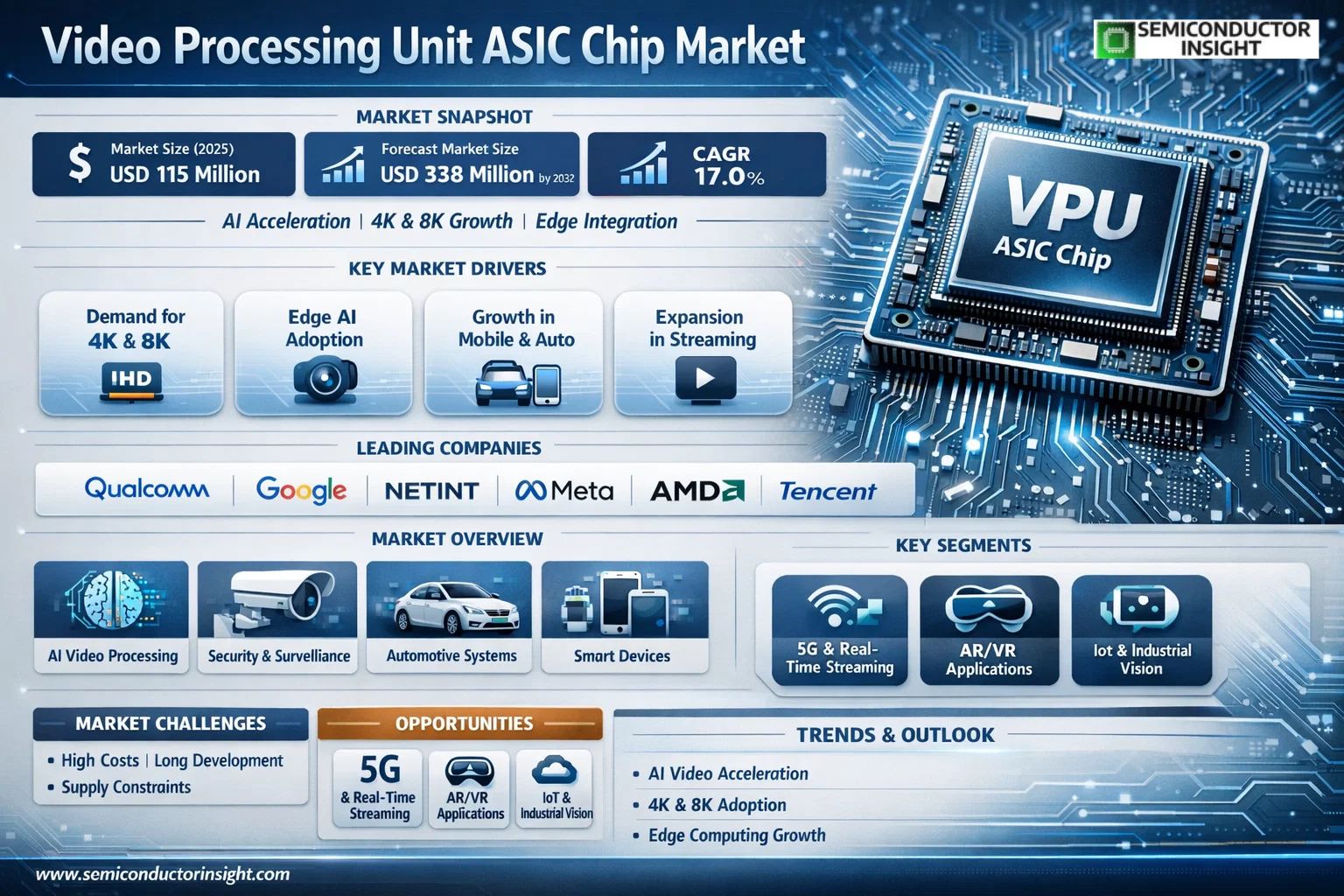
MARKET DRIVERS
Rising Demand for High-Resolution Video
Video Processing Unit ASIC Chip Market is propelled by the exponential growth in 4K and 8K video content consumption across streaming platforms and broadcasting. With global video traffic projected to exceed 80% of internet bandwidth by 2025, specialized ASICs deliver efficient real-time processing, reducing latency and enhancing quality in consumer devices.
Edge AI Integration in Surveillance and Automotive
Advancements in edge computing drive adoption of Video Processing Unit ASIC chips for on-device AI analytics in security cameras and ADAS systems. These chips handle complex tasks like object detection at low power, supporting the market’s expansion amid rising smart city initiatives and autonomous vehicle deployments.
➤ Global surveillance camera shipments reached 150 million units in 2023, boosting ASIC demand for efficient video analytics.
Additionally, consumer electronics like smartphones and smart TVs increasingly incorporate these ASICs for superior video encoding, further accelerating market growth through optimized performance and cost-effectiveness.
MARKET CHALLENGES
High Development Costs and Long Time-to-Market
Developing custom ASICs for video processing involves substantial non-recurring engineering expenses, often exceeding $50 million per design, posing barriers for smaller players in Video Processing Unit ASIC Chip Market. The lengthy design cycles, spanning 18-24 months, delay product launches amid rapidly evolving standards.
Other Challenges
Competition from Flexible Alternatives
GPUs and FPGAs offer reprogrammability, challenging ASIC dominance despite higher power consumption. Manufacturers must balance customization benefits against these versatile options in dynamic applications like broadcasting.Supply chain disruptions exacerbate prototyping delays, compelling firms to optimize designs for multi-sourcing while navigating geopolitical tensions in semiconductor fabrication.
MARKET RESTRAINTS
Semiconductor Supply Shortages
Persistent global chip shortages constrain production capacity in Video Processing Unit ASIC Chip Market, with lead times extending up to 52 weeks for advanced nodes. This hampers scalability for high-volume sectors like automotive and surveillance.Regulatory compliance with standards like GDPR and export controls adds complexity, increasing certification costs and slowing market entry for video processing applications handling sensitive data.Power efficiency demands intensify restraints, as advanced nodes struggle with thermal management in edge devices, limiting deployment in battery-constrained environments despite performance gains.
MARKET OPPORTUNITIES
Expansion in 5G and Real-Time Streaming
The rollout of 5G networks unlocks opportunities for Video Processing Unit ASIC Chip Market through ultra-low latency video applications in live streaming and cloud gaming. ASICs enabling 120fps processing at scale position the market for double-digit growth.Emerging AR/VR ecosystems demand specialized chips for immersive video rendering, with headset shipments forecasted to surpass 75 million units annually by 2027, creating niches for high-fidelity ASIC solutions.IoT proliferation in industrial vision systems offers untapped potential, where rugged ASICs provide reliable processing, driving partnerships between chipmakers and system integrators.
Video Processing Unit ASIC Chip Market Trends
Advancements in AI-Driven Video Acceleration
Video Processing Unit ASIC Chip Market is witnessing significant momentum from innovations in AI-optimized video processing. Video Processing Units serve as specialized accelerators designed for AI scenarios, incorporating high-performance video encoding modules that deliver low power consumption and minimal latency. These chips handle critical functions such as decoding, encoding, transcoding, and post-processing entirely within the unit, forming the core of video industry applications. This architecture enables efficient accelerated computing, particularly as demand grows for real-time video analytics in diverse sectors.
Other Trends
Shift Toward Higher Resolution Support
Major players including Qualcomm, Google, NETINT, Meta, AMD, and Tencent are prioritizing development of Video Processing Unit ASIC Chips compatible with 4K and 8K resolutions. This trend aligns with the escalating need for ultra-high-definition content across consumer and professional applications, where enhanced clarity and detail processing are paramount. The focus on these resolutions ensures seamless handling of complex video streams without compromising performance.
Diversification into Key Application Areas
Video Processing Unit ASIC Chip Market is expanding across applications like mobile phones, computers, automobiles, and security systems. In automobiles, these chips support advanced driver-assistance systems through efficient video data handling. Security applications benefit from robust decoding capabilities for surveillance footage, while mobile and computing devices leverage low-latency encoding for smooth streaming and AR/VR experiences. Regional dynamics show strong activity in North America, Europe, and Asia, with countries like the US, China, Japan, and Germany driving adoption through tailored ecosystem integrations. Competitive pressures among top manufacturers foster ongoing enhancements in efficiency and integration, shaping a dynamic landscape for Video Processing Unit ASIC Chip deployments.
COMPETITIVE LANDSCAPE
Key Industry Players
Video Processing Unit ASIC Chip Market Leaders and Emerging Challengers
Video Processing Unit (VPU) ASIC Chip market is dominated by a handful of technology giants, with Qualcomm and Google leading the pack due to their integrated solutions for AI-accelerated video processing. Qualcomm’s Snapdragon platforms embed high-efficiency VPU cores for low-latency encoding and decoding, capturing significant share in mobile and edge computing segments. Google complements this with its Tensor Processing Units (TPUs), optimized for video workloads in cloud and AI scenarios. The market structure remains oligopolistic, as the top five players,Qualcomm, Google, AMD, Meta, and Tencent,collectively control a majority of global revenue in 2025, bolstered by proprietary architectures amid high R&D barriers and a projected CAGR of 17% to reach US$338 million by 2032.
Beyond the frontrunners, niche players like NETINT and regional innovators such as Tencent drive competition through specialized, power-efficient ASICs targeting transcoding and post-processing. NETINT’s Codensity series excels in cloud video infrastructure with ultra-low power consumption, while AMD leverages its acquisition of Xilinx for hybrid FPGA-ASIC VPUs in data centers. Other key contributors include Intel’s Movidius and Habana lines for security and automotive applications, Ambarella’s CVflow chips for 4K/8K vision processing, and Broadcom’s custom video accelerators. These firms focus on application-specific optimizations across mobile phones, computers, automobiles, and security sectors, intensifying rivalry as demand surges for efficient video acceleration in AI-driven ecosystems.
List of Key Video Processing Unit ASIC Chip Companies Profiled
- Qualcomm
- NETINT
- Meta
- AMD
- Tencent
- Intel
- NVIDIA
- Ambarella
- HiSilicon
- MediaTek
- Broadcom
- Hailo
- Axelera AI
- Syntiant
Segment Analysis:
| Segment Category | Sub-Segments | Key Insights |
| By Type |
|
4K
|
| By Application |
|
Security
|
| By End User |
|
Automotive
|
| By Functionality |
|
Encoding
|
| By Deployment |
|
Edge Devices
|
Regional Analysis: Video Processing Unit ASIC Chip Market
North America
North America’s Video Processing Unit ASIC Chip Market thrives on pioneering R&D hubs where firms develop bespoke chips for AI video inference and multi-stream processing. This fosters breakthroughs in low-power designs for mobile and IoT devices, setting benchmarks for efficiency.
High demand stems from automotive ADAS, broadcasting, and smart city initiatives, where custom ASICs outperform general-purpose GPUs in video decoding and encoding tasks, enabling seamless integration into diverse ecosystems.
Strategic alliances with foundries provide agile manufacturing for Video Processing Unit ASIC Chips, mitigating risks and supporting customization for hyperscale video workloads in cloud environments.
Expanding into edge AI and 5G-enabled video streaming propels the market, with focus on scalable ASICs for real-time processing, positioning the region for sustained leadership.
Europe
Europe’s Video Processing Unit ASIC Chip Market grows steadily, fueled by stringent data protection regulations and emphasis on energy-efficient technologies. Key players invest in ASICs optimized for smart manufacturing and broadcast applications, integrating video processing with Industry 4.0 frameworks. Collaborative EU-funded projects drive innovation in low-latency video chips for automotive and security sectors. The region’s focus on sustainability promotes green ASIC designs that reduce power consumption in surveillance networks. Proximity to automotive OEMs accelerates adoption in advanced driver-assistance systems, where custom video units enhance object detection accuracy. Challenges like fragmented supply chains are addressed through strategic partnerships, enhancing resilience. Europe’s balanced approach to R&D and commercialization solidifies its role in specialized Video Processing Unit ASIC Chip deployments.
Asia-Pacific
Asia-Pacific emerges as a dynamic hub in Video Processing Unit ASIC Chip Market, propelled by massive consumer electronics demand and rapid 5G rollout. Manufacturing prowess supports high-volume production of cost-effective ASICs for smartphones, gaming consoles, and smart TVs. Government initiatives in key economies bolster semiconductor self-reliance, spurring local design centers for video-intensive applications. The region’s vast surveillance and streaming markets necessitate robust ASICs for multi-format video handling. Intense competition drives iterative improvements in chip efficiency and integration. Supply chain density enables quick scaling for emerging trends like live video analytics in e-commerce. Asia-Pacific’s blend of fabrication scale and application diversity positions it for accelerated expansion in Video Processing Unit ASIC Chip innovations.
South America
South America’s Video Processing Unit ASIC Chip Market develops amid rising digital infrastructure investments and urbanization. Demand surges in security systems and media broadcasting, where ASICs provide reliable video processing for resource-constrained environments. Local partnerships with global firms facilitate technology transfer, enhancing capabilities in custom chip design for broadcast and retail analytics. Economic diversification efforts support adoption in agriculture monitoring via video drones. Challenges such as infrastructure gaps are offset by cloud-hybrid solutions leveraging efficient ASICs. Growing middle-class consumption fuels consumer device integration, promising steady market maturation in Video Processing Unit ASIC Chip applications.
Middle East & Africa
The Middle East & Africa region in Video Processing Unit ASIC Chip Market gains traction through smart city projects and oil & gas digitalization. Specialized ASICs cater to high-temperature video processing in harsh environments for surveillance and remote monitoring. Investments in 4G/5G networks drive demand for edge video units in telecom infrastructure. Visionary government strategies in the Gulf foster semiconductor ecosystems, attracting R&D for defense and broadcasting. Africa’s expanding digital economy boosts affordable ASICs for mobile video services. Regional collaborations mitigate import dependencies, paving the way for tailored Video Processing Unit ASIC Chip solutions amid diverse growth opportunities.
Report Scope
This market research report provides a comprehensive analysis of Video Processing Unit ASIC Chip Market, covering the forecast period 2026–2034. It offers detailed insights into market dynamics, technological advancements, competitive landscape, and key trends shaping the industry.
Key focus areas of the report include:
- Market Overview: The report begins with an overview outlining its current market scenario, key growth indicators, and industry transformation drivers. It discusses macroeconomic factors, demand–supply balance, regulatory landscape, and the strategic role of semiconductors in powering advancements across industries such as automotive, telecommunications, consumer electronics, and industrial automation.
- Market Size & Forecast: Historical data and future projections for revenue, unit shipments, and market value across major regions and segments.
- Segmentation Analysis: Detailed breakdown by product type, technology, application, and end-user industry to identify high-growth segments and investment opportunities.
- Regional Insights: Insights into market performance across North America, Europe, Asia-Pacific, Latin America, and the Middle East & Africa, including country-level analysis where relevant.
- Competitive Landscape: Profiles of leading market participants, including their product offerings, R&D focus, manufacturing capacity, pricing strategies, and recent developments such as mergers, acquisitions, and partnerships.
- Technology Trends & Innovation: Assessment of emerging technologies, integration of AI/IoT, semiconductor design trends, fabrication techniques, and evolving industry standards.
- Market Drivers & Restraints: Evaluation of factors driving market growth along with challenges, supply chain constraints, regulatory issues, and market-entry barriers.
- Stakeholder Insights: Insights for component suppliers, OEMs, system integrators, investors, and policymakers regarding the evolving ecosystem and strategic opportunities.
Primary and secondary research methods are employed, including interviews with industry experts, data from verified sources, and real-time market intelligence to ensure the accuracy and reliability of the insights presented.
FREQUENTLY ASKED QUESTIONS:
What is the current market size of Video Processing Unit ASIC Chip Market?
-> Global Video Processing Unit ASIC Chip market was valued at USD 115 million in 2025 and is projected to reach USD 338 million by 2032, at a CAGR of 17.0% during the forecast period.
Which key companies operate in Video Processing Unit ASIC Chip Market?
-> Key players include Qualcomm, Google, NETINT, Meta, AMD, Tencent, among others.
What are the key growth drivers?
-> Key growth drivers include demand for AI-optimized video acceleration, high-performance encoding/decoding, and applications in mobile phones, automobiles, and security.
Which region dominates the market?
-> Asia is the fastest-growing region, particularly China, while North America holds a key position with the U.S. market.
What are the emerging trends?
-> Emerging trends include AI scenarios for video processing, 4K and 8K resolutions, low power consumption VPUs, and integration in edge computing.

Get Sample Report PDF for Exclusive Insights
Report Sample Includes
- Table of Contents
- List of Tables & Figures
- Charts, Research Methodology, and more...
 Download Sample Report PDF