Key Statistics
Key Takeaways
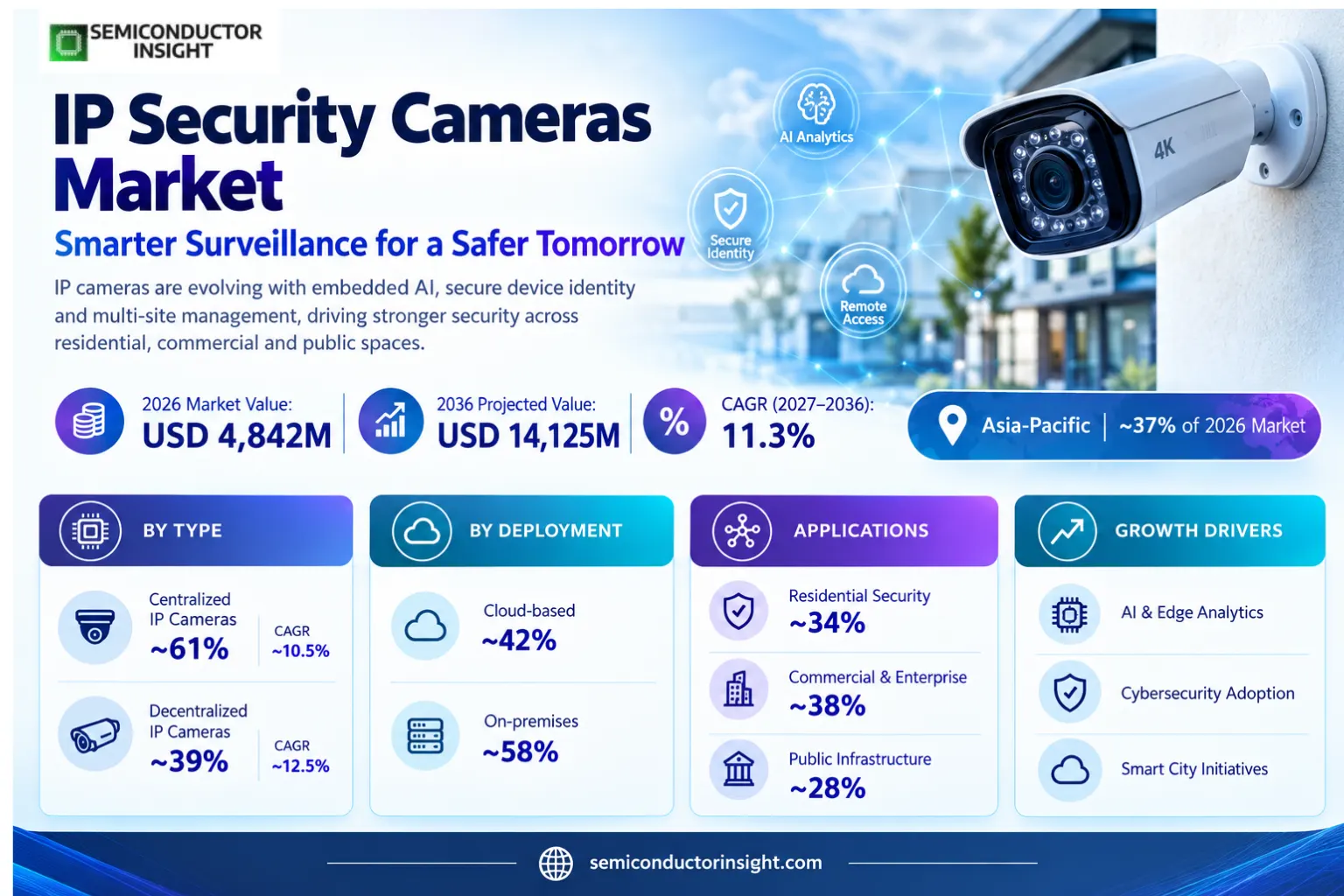
- Market size and demand: USD 4,842 million in 2026, with hardware spending tied to networked cameras rather than recurring cloud-video subscriptions or stand-alone recording software.
- Forecast trajectory: USD 14,125 million by 2036, equivalent to a 11.3% annualized increase, as upgrades in analytics, low-light imaging and device cybersecurity support replacement alongside new deployments.
- Product mix: Centralized IP cameras represent an estimated ~61% of 2026 revenue, while decentralized edge-recording architectures account for ~39% and show the stronger modeled ~12.5% growth trajectory.
- Applications: Commercial premises lead at an estimated ~34% of camera hardware revenue; public infrastructure contributes ~29%, residential installations ~24%, and manufacturing sites ~13%.
- Regional outlook: Asia-Pacific leads at an estimated ~37%, followed by North America at ~30% and Europe at ~21%; security procurement, network infrastructure and camera price points vary considerably across countries.
IP Security Cameras Market Overview
The IP security cameras market is moving from simple network video capture toward embedded inference, secure device identity and manageable multi-site fleets. Hardware demand totals USD 4,842 million in 2026 and is projected to reach USD 14,125 million by 2036, a 11.3% expansion across the decade. Asia-Pacific contributes an estimated ~37% of base-year sales, reflecting a large manufacturing ecosystem and wide deployment across residential, commercial and public sites. North America holds an estimated ~30%, supported by high-value enterprise cameras and cybersecurity-driven replacement. These estimates count camera hardware and exclude separately billed video-management subscriptions, cloud storage and unrelated access-control devices.
IP network cameras encode and transmit video over Ethernet, Wi-Fi or cellular-connected gateways rather than requiring a dedicated analogue video cable for every channel. The addressable hardware includes fixed bullet and dome cameras, panoramic systems, pan-tilt-zoom models and consumer Wi-Fi units. A 4K device can generate substantially more image data than a 1080p unit, so image compression, local storage and network management influence both the camera specification and the purchase decision. Axis now combines 8 MP video with AV1, H.264 and H.265 on the P1488-LE platform.
The market is not a single uniform replacement cycle. A retail chain may prioritize centrally administered cameras and searchable footage across 100 stores, whereas a remote industrial plant may choose decentralized recording to tolerate intermittent connectivity. Consumer buyers compare app reliability, night vision, subscription conditions and a 180-degree field of view. Public infrastructure operators assess resilience, retention periods, tender eligibility and incident response. These requirements create different average selling prices even when 2 cameras advertise the same 4K resolution.
The underlying value chain runs from CMOS image sensors, lenses and infrared emitters through system-on-chip processing, secure elements and networking hardware to enclosure design, firmware and channel distribution. Hanwha Vision markets its Wisenet 9 system-on-chip with on-device AI and FIPS 140-3 Level 3 security capabilities, while Axis combines ARTPEC-9 processing with secure key storage. Those specifications increasingly matter in government and enterprise tenders, where a device must remain supportable throughout an installation lasting 5 to 10 years.
An estimated ~61% of revenue remains in centralized network-camera architectures, where cameras connect to a recorder, security operations center or managed video platform. Decentralized designs, estimated at ~39%, combine on-device analytics, edge storage and more autonomous event handling. The distinction concerns operating architecture rather than the presence of a cloud app: an IP camera can upload selected events while continuing to record locally. Profile T interoperability, encrypted transport and signed firmware influence whether mixed-vendor fleets can be upgraded without wholesale replacement.
Product innovation is changing the economics of surveillance. A 30x optical-zoom PTZ unit can replace several fixed viewpoints for live response but may not provide continuous coverage of every direction, while a 12 MP fisheye camera captures a broad scene at the cost of per-object pixel density. Higher resolution does not automatically improve night-time evidence; sensor size, exposure, infrared illumination and compression are equally important. Suppliers therefore compete on usable image quality, cyber resilience and total installed cost rather than on megapixels alone.
Segment Analysis: By Type
Two operating architectures define the camera-type segmentation. Centralized IP cameras capture an estimated ~61% of 2026 hardware sales and show a modeled ~10.5% CAGR, because larger organizations continue to buy devices integrated with network video recorders and centralized security software. Decentralized IP cameras hold ~39% and expand at an estimated ~12.5% CAGR as local analytics, removable storage and secure remote access reduce dependence on a continuous backhaul connection. Both types can use 4K sensors, H.265 compression and ONVIF interfaces.
| Type | Function | Market position |
|---|---|---|
| Centralized IP Camera | Centralized video: Network cameras transmit 1080p, 2K or 4K streams to a network video recorder, enterprise VMS or central operations platform. Operators can apply shared retention rules and correlate events from 10, 100 or 1,000 channels. Campus and commercial tenders favor consistent firmware, ONVIF Profile T interoperability and manageable power-over-Ethernet installation. A central recorder can simplify evidence export but creates network and storage concentration risk during a site outage. Typical procurement weighs 24/7 uptime, H.264/H.265 encoding and secure authentication rather than sensor resolution alone. | Estimated leadership: Centralized architectures account for ~61% of 2026 camera-hardware revenue and expand at ~10.5% CAGR in the modeled outlook. Their installed base is particularly relevant to retail, education, transport and public facilities where multi-camera incident reconstruction remains essential. Hanwha BLAZE shows how cloud federation can coexist with on-premises recording, but software subscription income is excluded from the camera hardware denominator. An 8 MP bullet camera and a 4 MP PTZ can both be deployed in a centralized network without changing this segmentation. |
| Decentralized IP Camera | Edge autonomy: Decentralized devices combine a CMOS sensor, processor and local decision logic, with some models supporting microSD recording or direct cloud upload. They suit residences, distributed small sites and installations where transmitting 24/7 4K video is costly or unreliable. On-camera analytics can identify a person or vehicle and send an event rather than every raw frame, but secure firmware updates remain critical. Device specifications may include 2K, 4K, AV1 and encrypted credentials; connectivity requirements differ by deployment. | Growth profile: Decentralized designs represent ~39% of 2026 sales and are modeled to grow at ~12.5% CAGR as embedded AI and local storage become more capable. Residential Wi-Fi products and autonomous edge devices provide visible demand signals, but cloud subscription revenue must be stripped out before hardware comparisons. A consumer 4K camera with 180-degree viewing is not equivalent in price or lifecycle to a hardened IP67 industrial model. This segment includes stand-alone IP cameras even when they periodically synchronize with a remote security service. |
Centralized camera systems: multi-site control
Large installations typically connect tens or hundreds of cameras to a recorder or management platform. Axis P14 bullet models and Hanwha 4K AI domes illustrate the importance of local image processing even when a central server stores the recordings. An enterprise purchaser may ask for 60 fps at 8 MP, H.265 compression and authenticated access, but also needs predictable patch schedules and device inventory. A central topology simplifies retention policies across buildings while increasing the consequences of an improperly sized network uplink.
The centralized share is an estimated ~61%, not a count of recorder boxes. A 4-channel main unit such as Axis F9114-R Mk II can serve distributed sensors while still feeding a central management platform. This shows why the boundary must follow the operating architecture rather than physical camera shape. Public institutions also place greater weight on standards compliance and chain-of-custody controls, which can outweigh the appeal of a low upfront device price.
Decentralized cameras: analytics near the lens
Edge processing shifts object detection and event classification closer to the image sensor. Residential products, autonomous factory cameras and small-business installations benefit when a device can filter motion before sending video over a 10 Mbps connection. Arlo Ultra 2 illustrates consumer demand for 4K capture and a wide field of view, whereas professional decentralized models may prioritize local SD storage, secure boot and industrial operating temperatures. The commercial opportunity lies in reducing operator workload and cloud transfer rather than eliminating all centralized management.
A ~39% revenue position and modeled ~12.5% CAGR reflect growing adoption of distributed processing, but not every AI-enabled camera should be classified as decentralized. A 4K dome performing object detection locally can still rely on centralized video retention and incident management. Architecture is defined by where recording, decisions and resilience sit during network disruption. Procurement specifications should therefore describe the required offline behavior, authentication model and service contract instead of relying on the marketing label edge AI.
Segment Analysis: By Application
Commercial facilities account for an estimated ~34% of 2026 IP camera hardware revenue, public and government infrastructure ~29%, residential ~24%, and manufacturing or factory settings ~13%. The four applications total 100% and represent different procurement mechanisms. Retail and office buyers seek 24/7 monitoring across many locations; government buyers require compliance and robust evidence retention; households prioritize simple Wi-Fi onboarding; factories emphasize environmental protection and operational uptime. The manufacturing category has a modeled ~12.4% CAGR, compared with ~10.7% in commercial installations.
| Application | Demand characteristics |
|---|---|
| Commercial | Commercial demand: Shops, offices, banks, logistics depots and hospitality sites deploy cameras for loss prevention, access monitoring and post-incident review. A multi-site retailer may standardize on 4K dome cameras with edge people counting, while a loading bay needs an outdoor IP66 bullet model. The application represents an estimated ~34% of 2026 hardware revenue and grows at ~10.7% CAGR. Interoperability with existing VMS and network switches reduces migration costs; a premium analytics feature may require a separate software licence. Camera budgets must distinguish a 2 MP PTZ purchase from a 12 MP panoramic installation and from recurring recording subscriptions. |
| Public & Government Infrastructure | Public infrastructure: Transit platforms, municipal buildings, roads, campuses and utilities buy hardened IP cameras for continuous surveillance, incident response and perimeter observation. A 31x zoom traffic unit and an 8 MP fixed bullet serve different evidentiary needs. The category accounts for ~29% of modeled 2026 revenue and grows at ~11.6% CAGR, reflecting replacement and new coverage. Tender rules can require FIPS 140-3 security, ONVIF Profile T support, documented supply chains and retention controls. Privacy masking and legal access permissions are material because publicly operated systems can record bystanders over 24-hour periods. |
| Residential | Household demand: Homeowners and apartment residents choose Wi-Fi and Ethernet cameras for doorways, garages, gardens and shared corridors. Arlo markets 4K wireless cameras with 180-degree viewing, while lower-priced models offer 2K or 1080p capture. Residential installations represent ~24% of 2026 camera revenue with a modeled ~11.2% CAGR. Easy onboarding, battery life, notifications and subscription transparency shape purchase decisions more than enterprise VMS compatibility. Cloud video storage and monitoring services are excluded from the camera-hardware total even when bundled with an initial device purchase. |
| Manufacturing/Factory | Industrial monitoring: Factories use network cameras for perimeter protection, restricted areas, loading docks and visual confirmation of process alarms. A dusty or wet site may specify IP67 enclosures, vibration resistance, PoE redundancy and night imaging. Manufacturing accounts for an estimated ~13% of 2026 revenue and has the fastest modeled application growth at ~12.4% CAGR. A 5 MP PTZ with 40x zoom can inspect long corridors, while fixed 8 MP domes monitor access points without moving parts. Security traffic often traverses segmented operational networks, requiring disciplined patching and recording isolation. |
Commercial and public-sector buyers increasingly compare the operational value of edge AI with the cost of maintaining a central search platform. VIVOTEK announced Network Optix integration on 12 March 2026, allowing camera-generated metadata to support search inside a third-party VMS. This changes the purchasing conversation from raw megapixels toward investigation time, device integration and long-term support. It also reinforces the hardware-only revenue boundary: a VMS subscription may make a camera more useful without becoming part of the camera unit selling price.
Manufacturing environments create a different cost equation because replacing a camera can require production downtime or safety permits. Ruggedized devices with IP66 or IP67 sealing, IK10 impact ratings and extended temperature limits command higher hardware prices than consumer Wi-Fi models. Residential demand is more sensitive to promotions, app quality and cloud-storage fees. These contrasts explain why a ~13% industrial revenue allocation can still represent a substantial commercial opportunity despite fewer installed cameras than the ~24% residential category.
Regional Analysis
Asia-Pacific is the largest regional revenue pool at an estimated ~37% in 2026, ahead of North America at ~30% and Europe at ~21%. The remaining allocations are Middle East and Africa ~7% and South America ~5%. The model differentiates replacement-led enterprise demand from infrastructure-led new installations, rather than assuming that every geography buys the same mix of 2 MP, 4K and PTZ devices. Regional CAGRs range from ~9.7% in North America to ~13.2% in Middle East and Africa.
Which regions contribute the most IP security camera revenue?
The regional market structure reflects installed infrastructure, camera price points, regulatory requirements and manufacturing concentration. Asia-Pacific contributes an estimated ~37% of 2026 revenue, with China, Japan, South Korea, India and Southeast Asia representing different technology and pricing tiers. North America follows at ~30%, supported by established high-value enterprise deployments. Europe holds ~21%, with more emphasis on replacement, privacy controls and interoperability. The smaller ~7% Middle East and Africa and ~5% South America allocations offer different new-build opportunities.
The strongest modeled growth occurs in Middle East and Africa at ~13.2% CAGR, followed by Asia-Pacific at ~12.7%, South America at ~12.0%, Europe at ~10.0% and North America at ~9.7%. These rates describe regional hardware-revenue trajectories rather than unit shipment growth. A shift from 1080p cameras to 8 MP edge-AI units can increase revenue without a proportional increase in camera counts, while lower average selling prices can have the opposite effect. Integrator capacity and product cybersecurity will shape realized spending.
| Region | Position | Growth outlook | Demand profile | What decides supplier selection |
|---|---|---|---|---|
| Asia-Pacific | Largest (~37%) | Strong (~12.7% CAGR) | Manufacturing depth, large urban deployments and mixed 1080p/4K procurement | Price, supply continuity and cybersecurity requirements |
| North America | Second largest (~30%) | Established (~9.7% CAGR) | Enterprise refresh, commercial sites and high-value cybersecure devices | Cyber assurance, lifecycle support and integration |
| Europe | Third largest (~21%) | Compliance-led (~10.0% CAGR) | Replacement, GDPR-aligned controls and interoperable enterprise deployments | Privacy governance, product security and tender qualification |
| South America | Developing (~5%) | Infrastructure-led (~12.0% CAGR) | Retail expansion, urban safety and bandwidth-conscious installations | Landed device cost, integrator coverage and spare parts |
| Middle East & Africa | Emerging (~7%) | Fastest (~13.2% CAGR) | New infrastructure, harsh environments and integrated command centers | Temperature rating, service coverage and cyber procurement |
Competitive Landscape: Network Camera Manufacturers
Competition spans multinational enterprise-security suppliers, specialized network-camera manufacturers and consumer-oriented Wi-Fi brands. Axis, Hanwha Vision, VIVOTEK, Avigilon, MOBOTIX and Arlo each sell identifiable camera hardware, but they do not compete on the same price or deployment basis. A 4K professional dome can include certified cryptographic hardware and integration support, while a residential 4K wireless unit emphasizes mobile onboarding and convenience. Software platform revenue is excluded when comparing camera sales.
Axis competes through a broad network-camera portfolio, ARTPEC processing, AV1 compression and Edge Vault security features. Its P1488-LE delivers 8 MP footage at up to 60 fps with IP66/IP67 environmental protection, making it suitable for premium commercial and public tenders. The supplier emphasizes lifecycle manageability, not just sensor specifications. Integrators also value consistent firmware and third-party VMS support when upgrading a site with hundreds of existing cameras. These attributes can protect selling prices even when lower-cost 4K alternatives are widely available.
Hanwha Vision combines 4K and AI camera ranges with Wisenet 9 processing and BLAZE hybrid video management. The XNB-A9004 4K box camera and XNV-A9016R 8 MP dome illustrate different professional form factors, while the 2026 BLAZE announcement emphasizes camera-to-platform integration. The supplier can sell into high-security enterprises that need central search, encrypted credentials and documented support. Hardware demand should remain separate from BLAZE licences and cloud management fees to avoid double-counting platform value.
VIVOTEK and MOBOTIX address integrator-driven deployments with differentiated AI and rugged surveillance portfolios. VIVOTEK added Network Optix Deep Search integration in March 2026, enabling scene and attribute searches from camera-generated intelligence. MOBOTIX markets the MOVE SD-540 with 5 MP resolution, 40x optical zoom and long-range infrared illumination. These examples show competition shifting toward usable evidence and interoperability rather than simply advertising higher pixel counts. The relevant purchase decision often includes installer capability and replacement-parts availability.
Avigilon and Arlo operate at different ends of the market. Avigilon H6A PTZ offers 2 MP or 4 MP capture with 30x zoom and enterprise analytics, while its H6A fisheye line reaches 12 MP for panoramic coverage. Arlo Ultra 2 offers 4K wireless home monitoring with a 180-degree viewing angle. Both are IP cameras, yet their procurement cycles, channel margins, installation costs and service obligations differ. A credible competitive comparison must therefore separate professional equipment from consumer hardware before drawing conclusions about share.
Tier structure
| Tier | Companies | Basis of competition |
|---|---|---|
| Enterprise network specialists | Axis Communications; Hanwha Vision; Avigilon | Enterprise suppliers: These vendors offer 4K/8 MP fixed cameras, PTZ, secure firmware and managed fleet capabilities across commercial and public tenders. Their competitive advantage is documented integration, 5-to-10-year maintenance planning and hardware trust features rather than the lowest price. Products can require VMS licences or recorder infrastructure, but those software revenues remain outside the camera-only market boundary. Procurement compares 24/7 operation, H.265/AV1 compression, ONVIF Profile T and FIPS 140-3 claims where applicable. |
| Specialist integrator portfolios | VIVOTEK; MOBOTIX; GeoVision | Specialist suppliers: These companies address integrator projects requiring network cameras, edge analytics and differentiated housings. VIVOTEK supports AI search through third-party platforms, while MOBOTIX markets 5 MP 40x zoom models for longer-range observation. Regional channel coverage and firmware maintenance can determine project success more than a single headline specification. Buyers compare 1080p, 4K, IP66 and IR illumination features against installed system requirements. |
| Residential and connected-home vendors | Arlo Technologies; selected consumer-camera brands | Consumer suppliers: Residential vendors compete on Wi-Fi setup, app experience, cloud integrations and camera resolution tiers such as 2K and 4K. Arlo Ultra 2 offers 4K video and a 180-degree field of view, while entry-level devices trade imaging performance for affordability. Recurring subscriptions can influence purchasing decisions but are not counted as hardware revenue in the market total. A home may use 2 to 6 cameras rather than the 100-plus channels of an enterprise installation. |
Key companies profiled
- Axis Communications
- Hanwha Vision
- VIVOTEK
- Avigilon
- MOBOTIX
- Arlo Technologies
- Hikvision
- Dahua Technology
- GeoVision
- Costar Technologies
Production Footprint, Component Economics and Hardware Pricing
Network-camera manufacturing combines CMOS sensor procurement, optical modules, secure processing, printed-circuit assembly, enclosure fabrication and firmware integration. Asian electronics manufacturing supports a wide range of 2 MP to 8 MP devices, while European and North American suppliers often emphasize system design, cybersecurity and channel service. Unit shipment counts alone do not measure market value: a consumer 2K camera, a rugged IP67 dome and a 30x PTZ system occupy different price bands.
Camera bill-of-materials sensitivity begins with the sensor and processor. A 4K/8 MP design needs more imaging throughput and memory than a basic 1080p model, while advanced infrared illumination, optical zoom and a secure element add component cost. Axis ARTPEC-9 and Hanwha Wisenet 9 illustrate integrated processing strategies intended to improve image quality and embedded analytics. When semiconductor supply is constrained, manufacturers can alter product mix or delay premium releases, affecting hardware revenue even if customer demand remains stable.
Assembly and test requirements vary substantially by form factor. A 180-degree consumer Wi-Fi camera emphasizes compact plastics, radio certification and mobile onboarding; a 5 MP industrial PTZ with 40x zoom requires precision mechanics, sealing and thermal validation. Outdoor IP66 or IP67 products must tolerate rain, dust and temperature cycles, and a 60 fps 8 MP device must sustain imaging and encoding performance under load. These requirements explain why comparing shipments across product tiers without average selling price adjustments can distort the market.
Distribution includes direct enterprise accounts, security-system integrators, wholesalers, consumer electronics retailers and e-commerce channels. Large commercial projects may bundle 50 to 500 cameras with switching, storage and maintenance, while residential devices are sold individually or in small kits. Only the attributable camera hardware price belongs in this revenue definition. Integrators increasingly assess ONVIF Profile T, signed firmware and patch support before installation, because replacement and support expenses can exceed the original device discount over a multi-year service life.
Market Dynamics: Drivers, Restraints and Opportunities
The IP camera hardware market is shaped by three intersecting requirements: usable evidence, secure connectivity and affordable operations. Higher-resolution sensors and edge AI can improve detection, but they also increase power, bandwidth and maintenance demands. Network standards and secure device credentials make cameras easier to deploy across mixed-vendor sites. At the same time, price pressure in basic 1080p products and subscription fatigue in consumer applications can offset premium hardware growth. The strongest opportunities lie where device features reduce real operational cost.
MARKET DRIVERS
Drivers Impact Analysis*
| Driver | (~) % impact on CAGR forecast | Geographic relevance | Impact timeline |
|---|---|---|---|
| Edge AI and searchability | +1.6% | Asia-Pacific, North America and Europe | 2026–2036 |
| Secure 4K replacement | +1.2% | Enterprise and public facilities worldwide | 2027–2034 |
| Commercial and logistics site expansion | +0.8% | Asia-Pacific and Middle East | 2026–2032 |
AI-assisted incident review
Embedded object detection reduces the volume of footage that security teams must inspect manually. VIVOTEK announced integration of Deep Search with Network Optix on 12 March 2026, enabling scene and attribute searches in an established VMS. Axis and Hanwha also describe camera-side inference on their current product families. The hardware implication is a higher-value processor and sensor mix, particularly in 4K devices. The commercial benefit depends on accurate alerts and integration quality rather than the number of marketing features.
Cybersecure fleet renewal
ONVIF plans to end new Profile S conformance submissions on 31 March 2027 because its mandated authentication method no longer aligns with recommended cybersecurity practices. Profile T supports stronger authentication options and modern H.264/H.265 streams. Enterprises operating 100 or more cameras may refresh devices with outdated firmware or unsupported cryptographic controls before a sensor fails physically. This creates replacement demand in North America and Europe, but procurement still requires careful testing of recorder compatibility and existing camera-management software.
Better imaging in difficult environments
Low-light capability, infrared illumination and wide dynamic range can materially improve evidentiary video. Axis P1488-LE combines 8 MP imaging with OptimizedIR and Forensic WDR, while Hanwha 4K AI domes address outdoor security applications. A buyer monitoring a 50 m yard may value night-time recognition more than a nominal megapixel upgrade. Suppliers able to demonstrate consistent imaging at night can command a premium, although compression, exposure settings and lens selection must be evaluated at the installed location.
MARKET RESTRAINTS
Restraints Impact Analysis*
| Restraint | (~) % impact on CAGR forecast | Geographic relevance | Impact timeline |
|---|---|---|---|
| Network and storage cost | -0.9% | High-resolution multi-site deployments | 2026–2036 |
| Cybersecurity and privacy exposure | -0.7% | Public, healthcare and enterprise sites | 2026–2036 |
| Price compression in entry-level cameras | -0.6% | Residential and small business | 2026–2033 |
Bandwidth and retention economics
A 4K stream can consume substantially more storage than a 1080p stream when compression settings and recording hours are comparable. Although AV1 and H.265 reduce data requirements, a site with 100 cameras still needs adequate switching, recorder capacity and backup storage. Buyers may therefore use 8 MP cameras at high-risk entrances while retaining 2 MP devices in low-risk corridors. This mixed-resolution strategy can restrain premium hardware revenue despite growth in the installed camera count.
Connected-device security and privacy
A network camera is an addressable computing endpoint, so weak passwords, exposed management ports or delayed firmware updates can create risk beyond the immediate video stream. ONVIF is phasing out Profile S submissions by March 2027, and professional manufacturers increasingly promote signed firmware and protected keys. Public installations also need privacy masking, retention controls and operator audit trails. Compliance costs can delay small tenders, but poorly secured inexpensive cameras may be rejected from high-value enterprise procurement.
Commoditization of basic models
Entry-level 1080p and 2K cameras face intense retail and distributor competition. Consumers may defer replacement when an existing camera still provides adequate night-time coverage, especially if a new product requires recurring cloud fees. Small businesses also compare total installed cost, not just the device invoice. Premium 4K/8 MP and PTZ features can support revenue growth, but falling average selling prices in simpler models limit the relationship between unit shipment growth and market value.
MARKET OPPORTUNITIES
Open-platform edge search
The 2026 VIVOTEK and Network Optix integration demonstrates a path for camera manufacturers to offer AI search inside existing VMS environments. Buyers can deploy analytics-enabled 4K hardware without abandoning a familiar control room interface. This matters for large retail and logistics estates with mixed camera brands. Vendors that publish robust APIs, maintain ONVIF compatibility and support secure metadata transfer may win upgrade projects even where the end customer is unwilling to replace its entire video-management system.
Industrial and infrastructure resilience
Factories, transport terminals and remote utilities increasingly require cameras that operate through heat, dust, vibration and intermittent connectivity. A 5 MP PTZ with 40x optical zoom can inspect distant assets, while fixed 8 MP IP67 units cover access points continuously. Hardware suppliers can differentiate through redundant power, local recording and secure device management. The market opportunity is not simply more cameras; it is higher-value equipment capable of reducing truck rolls and maintenance visits across distributed sites.
Consumer video with clearer value
Residential camera vendors can expand adoption by reducing setup friction and separating device value from optional cloud storage. Arlo Ultra 2 demonstrates a 4K wireless tier with 180-degree viewing, but many households only require 2K capture at a doorway. Manufacturers that improve battery life, local detection and transparent privacy settings may reduce subscription resistance. Hardware growth remains tied to replacement frequency and the number of homes adding 2 or 3 cameras rather than to recurring software fees.
Supply Chain and Route to Market
The IP camera value chain spans optical components, imaging silicon, embedded processing, enclosure manufacturing, firmware and integrator distribution. A single camera can combine a CMOS sensor, 4K image signal processor, infrared LEDs, network interface and secure element, but revenue is recorded at the finished hardware sale. Recorder appliances, video-management licences and installation labor are adjacent purchases. Supply-chain quality therefore affects the camera selling price, while channel capability determines whether the device delivers dependable 24/7 surveillance after commissioning.
Image capture and optics. A network camera begins with a CMOS sensor and a lens selected for field of view, light sensitivity and resolution. An 8 MP fixed bullet requires a different optical tradeoff from a 4 MP 30x PTZ or a 12 MP fisheye. Infrared illumination and wide dynamic range can improve usable footage, but component selection must be matched to the mounting height and scene. Suppliers increasingly design camera families around shared processing platforms to control qualification and firmware costs.
Processing and device security. The image-processing layer encodes video and runs analytics before data leaves the camera. Axis ARTPEC-9 supports AV1, H.264 and H.265 on the P1488-LE, while Hanwha describes Wisenet 9 with advanced AI noise reduction and FIPS 140-3 Level 3 capabilities. A secure element can protect keys, but the full deployment still requires patch management and authenticated access. Buyers should evaluate processor headroom for 4K video and multiple analytics workloads rather than assuming every edge-AI label represents equal performance.
Assembly and environmental test. Finished cameras require printed-circuit assembly, sensor calibration, optical alignment, thermal design and enclosure sealing. Outdoor IP66 or IP67 models may face rain, dust and temperature extremes, while indoor consumer products emphasize compact size and simple installation. A 40x PTZ adds moving parts and a different maintenance profile from a fixed dome. Manufacturers must balance hardware reliability with a competitive bill of materials, particularly where 1080p devices face aggressive price competition in distribution channels.
Distribution and after-sales support. Enterprise camera sales often flow through integrators that design power, switching, storage and access controls for installations containing 50 or 500 devices. Consumer 2K and 4K products may sell through online retail with self-installation and optional cloud services. Firmware support, ONVIF conformance and spare-parts availability affect lifetime cost in both channels. A camera manufacturer can win a lower-price order yet lose future projects if its devices cannot be managed securely or integrated with the buyer’s existing VMS.
Recent Developments in Network Video Security
- 12 Mar 2026 OPEN AI SEARCH
VIVOTEK announced integration of its Deep Search Plugin into the Network Optix platform, enabling scene and attribute searches using AI-generated camera metadata. The release matters because customers can add smarter IP cameras without replacing an established video-management interface. It supports a shift toward higher-value camera hardware, although any separately charged platform subscription remains outside the network-camera hardware market. Source - 23 Mar 2026 WISENET 9
Hanwha Vision outlined Wisenet 9 at ISC West 2026, emphasizing secure edge processing, AI-based noise reduction and enhanced image capture in its new camera ecosystem. The announcement signals competition around the image-processing chip and protected device identity rather than sensor megapixels alone. For enterprise buyers evaluating 4K or 8 MP deployments, processing efficiency and FIPS 140-3 security can affect approved vendor lists and total installed cost. Source - 25 Mar 2026 HYBRID VIDEO
Hanwha Vision announced its BLAZE hybrid video-management platform with native support for Hanwha cameras, AI investigation tools and cloud federation across multiple sites. The significance for camera hardware is easier onboarding and a stronger upgrade proposition for existing enterprise fleets. Centralized administration can coexist with edge analytics, illustrating why a camera’s operating architecture must be distinguished from whether its management software is hosted in the cloud. Source - 2026 SECURE STANDARDS
ONVIF confirmed that new Profile S product conformance submissions will stop after 31 March 2027 because the profile requires username-token authentication. Profile T offers stronger authentication options and modern H.264/H.265 video features. The transition encourages camera manufacturers and enterprise buyers to plan firmware and device upgrades, especially where installations contain equipment from multiple vendors. Existing Profile S devices may remain interoperable, so replacement will not be universal or immediate. Source - 2026 HIGH-RES EDGE
Axis lists the P1488-LE as an 8 MP outdoor bullet camera capable of up to 60 fps, supporting AV1, H.264 and H.265 encoding, infrared illumination and secure key storage. The specification illustrates how suppliers combine image quality, bandwidth efficiency and cybersecurity in one professional device. For purchasers, the benefit depends on real-world low-light performance and compatibility with existing recorders, not simply the nominal 4K pixel count. Source
REPORT SCOPE & SEGMENTATION
| Attribute | Details |
|---|---|
| Market | Global IP Security Cameras Market — network-connected camera hardware |
| 2026 Market Size | USD 4,842 million |
| 2027 Estimated Size | USD 5,389 million |
| 2036 Forecast Size | USD 14,125 million |
| CAGR (2027–2036) | 11.3% |
| Largest Region | Asia-Pacific, estimated ~37% of 2026 camera hardware revenue |
| Historical Period | 2021–2025 |
| Study Period | 2021–2036 |
| Base Year | 2026 |
| Forecast Period | 2027–2036 |
| Market Boundary | Finished IP security camera hardware, including fixed, panoramic, PTZ and consumer Wi-Fi cameras; excluding separately priced VMS licences, recurring cloud storage, installation services, recorders and unrelated access-control products. |
| By Type | Centralized IP Camera · Decentralized IP Camera |
| By Application | Residential · Commercial · Manufacturing/Factory · Public & Government Infrastructure |
| By Camera Resolution | 2K / Full HD · 4K (8 MP) · Above 4K |
| By Region | Five-region segmentation with country coverage for security-camera hardware demand and supply. North AmericaUnited States · Canada · Mexico EuropeGermany · United Kingdom · France · Italy · Russia · Rest of Europe Asia-PacificChina · Japan · South Korea · India · Southeast Asia · Rest of Asia-Pacific South AmericaBrazil · Argentina · Colombia · Rest of South America Middle East & AfricaSaudi Arabia · UAE · Egypt · Nigeria · South Africa · Rest of MEA |
| Key Companies Profiled | Axis Communications · Hanwha Vision · VIVOTEK · Avigilon · MOBOTIX · Arlo Technologies · Hikvision · Dahua Technology · GeoVision · Costar Technologies |
| Customization Scope | Country-level hardware revenues, network-camera deployment architecture, 2 MP versus 8 MP resolution tiers, centralized and decentralized applications, manufacturer positioning, security certification and channel pricing. |
Frequently Asked Questions
How large is the global IP security cameras market in 2026?
The global market reaches USD 4,842 million in 2026 on a finished-camera hardware basis. This includes IP-connected bullet, dome, panoramic, PTZ and consumer Wi-Fi security cameras, but not separately priced VMS subscriptions, cloud recording or installation labor. Commercial sites represent an estimated ~34% of demand, public infrastructure ~29%, residential ~24% and manufacturing ~13%. Camera resolution and device security materially influence average selling price.
What is the 2036 market forecast and CAGR?
The market is projected to reach USD 14,125 million in 2036, corresponding to a 11.3% annualized increase. Growth reflects replacement of ageing 1080p installations, wider adoption of 4K and edge AI, and new commercial and infrastructure sites. The forecast covers camera hardware rather than recurring video-platform revenue. Regional growth varies, with Middle East and Africa modeled at ~13.2% and North America at ~9.7%.
Which camera type has the largest market share?
Centralized IP cameras lead with an estimated ~61% of 2026 hardware revenue, while decentralized devices contribute ~39%. Centralized systems remain common in commercial, government and campus installations because operators need unified recording and incident search. Decentralized devices rely more on local analytics or storage and can operate through connectivity interruptions. The categories describe operating architecture, not whether a camera includes a Wi-Fi radio or a cloud management app.
Which application buys the most IP camera hardware?
Commercial premises represent an estimated ~34% of 2026 camera hardware spending, ahead of public and government infrastructure at ~29%, residential installations at ~24%, and manufacturing or factory sites at ~13%. Commercial buyers include retail, offices, logistics and hospitality. Industrial demand is modeled to grow faster at ~12.4% CAGR because rugged, cybersecure cameras support operational continuity. Cloud video subscriptions are excluded even when purchased with the cameras.
Which region leads IP security camera demand?
Asia-Pacific holds an estimated ~37% of 2026 global camera hardware revenue, followed by North America at ~30%, Europe at ~21%, Middle East and Africa at ~7%, and South America at ~5%. The regional mix reflects differing levels of new construction, installed-base replacement, manufacturing concentration and average camera selling prices. North America emphasizes enterprise cybersecurity and lifecycle support, while Asia-Pacific spans both cost-sensitive and premium device tiers.
Are decentralized IP cameras growing faster than centralized systems?
Decentralized IP cameras have a modeled ~12.5% CAGR compared with ~10.5% for centralized designs. Their appeal comes from on-camera analytics, local storage and reduced need to transmit every 4K frame to a central recorder. However, many enterprise cameras process AI events locally while still using centralized recording, so the classification depends on operating architecture. Buyers should specify offline behavior and management responsibilities rather than relying solely on an edge-AI product label.
What does ONVIF Profile T mean for buyers?
ONVIF Profile T defines interoperable IP video capabilities including H.264/H.265 streaming, metadata and modern authentication options. It is increasingly relevant as new Profile S conformance submissions end after 31 March 2027. Existing Profile S cameras may remain operational, but enterprises replacing 50 or 500 devices should test secure access, event metadata and recorder compatibility. A stated ONVIF feature does not replace verification of actual product conformance and firmware support.
How do 4K and 1080p cameras affect hardware revenue?
A 4K camera typically captures 3840 by 2160 pixels, compared with 1920 by 1080 for full HD, but sensor size, exposure, optics and compression determine usable detail. Premium 8 MP cameras can command higher prices when they also include edge AI, IP67 housings and secure elements. A basic 1080p device may still be appropriate for a narrow indoor corridor. Revenue growth therefore depends on product mix and selling price, not only the number of units shipped.
Who are important IP security camera manufacturers?
Axis Communications, Hanwha Vision, VIVOTEK, Avigilon, MOBOTIX and Arlo supply identifiable IP camera product families. Professional suppliers compete on integration, security and low-light performance, while residential vendors prioritize Wi-Fi onboarding, app reliability and value. Hikvision, Dahua, GeoVision and Costar also participate in network-video hardware, although their portfolios differ. Vendor rankings require consistent camera-only revenue definitions because cloud services, recorders and other security products can distort comparisons.
What limits adoption of high-resolution network cameras?
Bandwidth, storage, cybersecurity and total installation cost can constrain 4K and 8 MP deployments. A 100-camera site may require significant recorder capacity, secure switching and ongoing firmware maintenance even when H.265 or AV1 compression is used. Privacy controls also matter in public and residential settings. Buyers can mitigate cost by combining premium cameras at critical entrances with 1080p or 2K models elsewhere, rather than selecting maximum resolution at every location.
Research Sources & Evidence Base

Get Sample Report PDF for Exclusive Insights
Report Sample Includes
- Table of Contents
- List of Tables & Figures
- Charts, Research Methodology, and more...
 Download Sample Report PDF