
Vehicle Current Sensor Market Insights
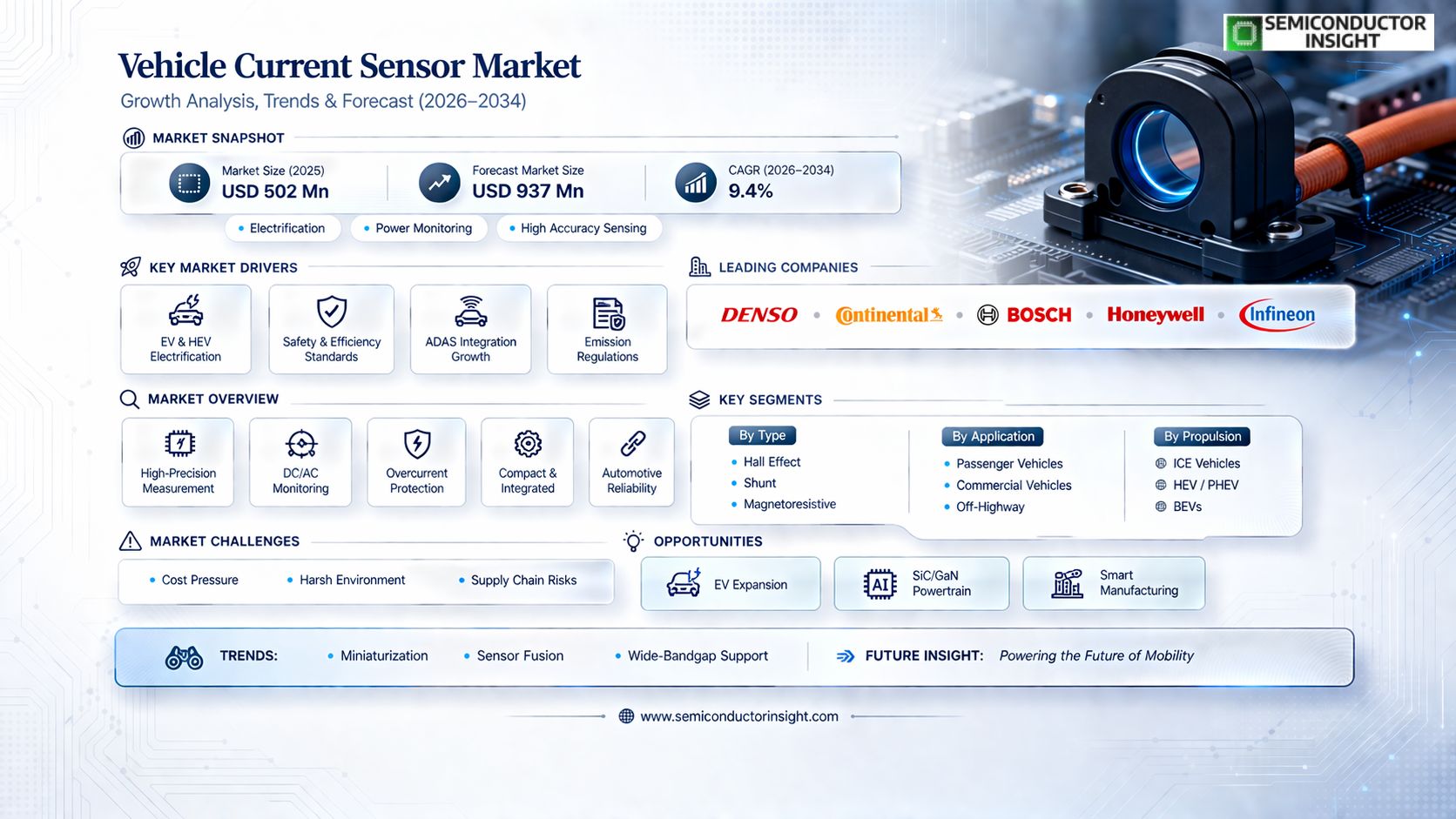
Global Vehicle Current Sensor market size was valued at USD 502 million in 2025. The market is projected to grow from USD 549 million in 2026 to USD 937 million by 2034, exhibiting a CAGR of 9.4% during the forecast period.
Vehicle current sensors are critical components used to measure the flow of electrical current within automotive systems. These sensors provide real-time monitoring and precise data on both direct current (DC) and alternating current (AC) to vital onboard control units, such as the Battery Management System (BMS) and motor controllers, ensuring operational safety and efficiency across the vehicle’s electrical architecture.
The market is experiencing robust growth driven primarily by the accelerating electrification of vehicles and increasing demand for advanced driver-assistance systems (ADAS). Furthermore, stringent government regulations mandating improved fuel efficiency and emission controls necessitate more sophisticated power monitoring solutions. Key industry players are actively fueling this expansion through strategic initiatives; for instance, in recent years, companies like Allegro Microsystems have launched new high-precision, integrated current sensor ICs specifically designed for demanding automotive applications like traction inverters and onboard chargers. Leading manufacturers operating in this space with extensive portfolios include Denso Corporation, Continental AG, Robert Bosch GmbH, Honeywell International Inc., and Infineon Technologies AG.
MARKET DRIVERS
Global Push Towards Electrification and Advanced Battery Management
The transition from internal combustion engines to electric and hybrid vehicles is the primary catalyst for the Vehicle Current Sensor Market. Precise current measurement is fundamental for battery management systems (BMS) to monitor state of charge, health, and ensure safe operating limits. This demand directly drives the adoption of high-accuracy sensors like Hall-effect and shunt-based solutions across all vehicle classes, supporting the broader evolution of the automotive powertrain.
Rising Demand for Vehicle Safety, Efficiency, and Functional Integration
Modern vehicles integrate sophisticated electronic control units (ECUs) that require real-time current data for optimal operation. Sensors are critical for functions like overcurrent protection in power steering and braking systems, load management to enhance fuel efficiency, and monitoring auxiliary systems. This integration is essential for meeting stringent safety standards and improving overall vehicle reliability, making current sensors a ubiquitous component in automotive electronics.
➤ The proliferation of Advanced Driver-Assistance Systems (ADAS) and autonomous driving features creates a significant secondary demand layer, as these high-power compute and sensor platforms require meticulous power monitoring for functional safety and thermal management.
Furthermore, government regulations worldwide mandating improved vehicle efficiency and lower emissions compel automakers to implement smarter power distribution networks. This regulatory landscape positions the Vehicle Current Sensor Market as an enabling technology for compliance and next-generation automotive design.
MARKET CHALLENGES
High-Cost Pressure and Integration Complexity in Competitive Landscape
Automotive manufacturers operate under extreme cost constraints, making the adoption of advanced, high-performance current sensors a challenging value proposition. While essential, sensor cost must be minimized without sacrificing the accuracy and reliability required for safety-critical applications. Integrating these sensors into compact, high-noise automotive environments while ensuring electromagnetic compatibility (EMC) adds significant design complexity and validation time.
Other Challenges
Performance Under Extreme Conditions
Vehicle current sensors must maintain specified accuracy across a wide temperature range (-40°C to +150°C) and in the presence of vibration, humidity, and electromagnetic interference, which pushes material and packaging technologies to their limits.
Technology Standardization and Lifecycle Management
The rapid pace of innovation in electric vehicle architectures can lead to fragmented sensor requirements, complicating supply chain and lifecycle management for sensor suppliers who must support platforms for over a decade.
MARKET RESTRAINTS
Economic Volatility and Supply Chain Disruptions Impacting Automotive Production
Macroeconomic fluctuations directly affect automotive production volumes, which in turn dictates the demand for components like current sensors. Periods of reduced vehicle manufacturing slow market growth. Additionally, the reliance on semiconductors and rare-earth materials for certain sensor types creates supply chain vulnerability, potentially restraining the Vehicle Current Sensor Market by introducing component shortages and price instability for OEMs.
Technical Limitations of Legacy Sensor Architectures
Traditional shunt resistor solutions, while cost-effective, face limitations in high-voltage applications due to isolation requirements and power loss. Similarly, some older Hall-effect sensor designs may struggle with drift or offset errors over time and temperature. This creates a restraint where the performance ceiling of existing, widely deployed sensors may not meet the future demands of ultra-high efficiency or 800V+ vehicle architectures without significant redesign.
MARKET OPPORTUNITIES
Innovation in Wide-Bandgap Semiconductor Applications and Sensor Fusion
The adoption of Silicon Carbide (SiC) and Gallium Nitride (GaN) semiconductors in EV power electronics operates at higher frequencies and efficiencies. This creates a distinct opportunity for the Vehicle Current Sensor Market to develop new, faster-response sensors optimized for these platforms. Furthermore, integrating current sensing data with other parameters (voltage, temperature) into a single “sensor fusion” module presents a value-added opportunity for system simplification and improved diagnostic capabilities.
Expansion into New Electric Vehicle Segments and Two-Wheeler Electrification
Beyond passenger cars, the electrification of commercial vehicles, buses, and notably, electric two-wheelers across Asia-Pacific, opens vast new application fields. These segments often have unique cost, size, and performance requirements, driving innovation in sensor product portfolios. Successfully catering to these diverse needs within the broader Vehicle Current Sensor Market allows for significant market expansion and revenue diversification for leading suppliers.
Vehicle Current Sensor Market Trends
Acceleration in Electrification as the Primary Market Driver
The prevailing trend shaping the Vehicle Current Sensor market is the rapid global transition to vehicle electrification. The need for precise and reliable current measurement is fundamental in battery management systems (BMS) and motor control units for electric and hybrid vehicles. These sensors ensure operational safety by preventing over-current conditions, optimize battery efficiency, and contribute to extended driving range. As automotive manufacturers expand their EV portfolios, the integration of multiple high-current sensors per vehicle is becoming standard, directly propelling demand for these critical components.
Other Trends
Dominance of Advanced Sensor Technologies
Technological advancement is a significant trend, with Hall Effect sensors maintaining a leading market share due to their contactless measurement, high accuracy, and low power loss. Magnetoresistive sensors are gaining traction for their superior sensitivity and compact form factor, enabling new design possibilities. This competitive landscape is driving innovation among key players like Allegro Microsystems, Melexis, and Infineon, who are focusing on developing integrated solutions with enhanced diagnostics and functional safety (ASIL) ratings to meet stringent automotive requirements.
Supply Chain Consolidation and Regional Manufacturing Shifts
A notable trend is the strategic alignment and regional expansion of supply chains. Leading manufacturers are establishing production facilities closer to major automotive hubs in Asia, particularly China, to serve the region’s vast EV production base. This move is coupled with increased vertical integration, where sensor suppliers collaborate directly with Tier-1 system integrators and automakers. This trend ensures supply stability, reduces logistical complexity, and shortens development cycles for next-generation vehicle platforms requiring advanced current sensing solutions.
COMPETITIVE LANDSCAPE
Key Industry Players
Market Consolidation Led by Global Tier-1 Automotive Suppliers
Global Vehicle Current Sensor market is characterized by a moderately consolidated competitive structure, with the top five players accounting for a significant revenue share as of 2025. Dominance is held by established global automotive electronics and semiconductor giants such as Robert Bosch, Continental, and Denso. These leaders leverage their extensive R&D capabilities, deep integration within vehicle electrical architectures, and long-standing relationships with major OEMs to maintain their stronghold. The technological landscape is largely segmented into Hall Effect, Shunt Type, and Magnetoresistive sensors, with the Hall Effect segment showing robust growth prospects. Competition is intensifying with the electrification of vehicles, which demands higher precision, miniaturization, and reliability for critical systems like battery management (BMS) and motor control.
Beyond the dominant players, a second tier of specialized sensor manufacturers and semiconductor firms competes effectively in niche applications and regions. Companies like Allegro Microsystems, Melexis, and Infineon Technologies are pivotal innovators in integrated circuit-based current sensing solutions. Specialists such as LEM and Kohshin Electric Corporation are key suppliers for high-accuracy industrial-grade sensors adapted for automotive use. The competitive dynamic is further enriched by growing participation from regional players, particularly in Asia-Pacific, who compete on cost and local supply chain agility, catering to the burgeoning electric vehicle markets in China and neighboring countries.
List of Key Vehicle Current Sensor Companies Profiled
- Robert Bosch GmbH
- Continental AG
- Denso Corporation
- Littelfuse, Inc.
- Honeywell International Inc.
- LEM Holding SA
- Melexis NV
- Allegro Microsystems, Inc.
- Kohshin Electric Corporation
- Infineon Technologies AG
- Nicera Co., Ltd.
- Texas Instruments Incorporated
- CTS Corporation
- Piher Sensing Systems
- TDK Micronas
Segment Analysis:
| Segment Category | Sub-Segments | Key Insights |
| By Type |
|
Hall Effect Current Sensors is the dominant and most technologically advanced segment. Its non-intrusive nature and ability to measure both AC and DC currents with high accuracy make it indispensable for modern vehicle architectures. This segment is favored for its compact size, reliability in harsh environments, and essential role in managing high-power systems found in electric and hybrid vehicles. The technology’s superior isolation characteristics and minimal power loss during measurement are critical factors driving its broad adoption across premium and mainstream automotive applications. |
| By Application |
|
Passenger Vehicles constitute the core application segment due to massive production volumes and rapid electrification. This segment’s growth is propelled by the integration of advanced driver-assistance systems (ADAS), sophisticated infotainment, and the transition to electric powertrains, all of which require precise current monitoring for safety and efficiency. The increasing complexity of in-vehicle electrical networks and the demand for longer driving ranges in electric vehicles further solidify the reliance on robust current sensing solutions in this category. |
| By End User |
|
OEMs (Original Equipment Manufacturers) are the primary and most influential end users, driving innovation and specification requirements. They integrate current sensors directly into new vehicle platforms, focusing on performance, durability, and miniaturization to meet strict design and safety standards. The competitive push among global OEMs to launch advanced electric vehicles and enhance vehicle intelligence creates a consistent, high-volume demand for integrated sensor solutions, making this the most strategic channel for technology adoption and market growth. |
| By Vehicle Propulsion |
|
Battery Electric Vehicles (BEVs) represent the most critical and fastest-evolving segment, with the highest per-vehicle demand for current sensors. Electrification fundamentally increases the complexity and criticality of current measurement for battery management, motor control, and onboard charging systems. This segment demands sensors with exceptional accuracy, wide measurement ranges, and resilience to electromagnetic interference. The strategic focus on BEV development by major automakers globally ensures sustained technological advancement and premiumization within this segment, making it the key driver for future market evolution. |
| By Integration Level |
|
Integrated Sensor Modules are gaining significant traction as the preferred integration level, balancing performance with design efficiency. These modules combine the sensing element with signal conditioning and communication interfaces, simplifying the assembly process for OEMs and enhancing system reliability. The trend towards domain and zone-based vehicle architectures favors this integrated approach, as it reduces wiring complexity and improves overall vehicle weight and space utilization. This segment’s growth is closely tied to the automotive industry’s push for more compact, reliable, and easily serviceable electronic control units. |
Regional Analysis: Global Vehicle Current Sensor Market
Asia-Pacific
Asia-Pacific’s dominance in the Vehicle Current Sensor Market is anchored by its extensive electronics manufacturing ecosystem. The concentration of semiconductor fabrication and sensor assembly plants ensures high-volume, cost-effective production, making it the primary global supplier for both domestic and international automotive OEMs.
Aggressive national mandates for EV adoption in China, South Korea, and India directly fuel demand for high-precision current sensors. These policies necessitate advanced Battery Management Systems (BMS), where Vehicle Current Sensors are critical for monitoring cell health, charge cycles, and overall powertrain safety.
Local firms are leaders in integrating current sensing technology with next-generation vehicle architectures. This includes sensor fusion for autonomous driving platforms and the development of compact, highly reliable sensors for space-constrained 48V mild-hybrid systems, pushing the boundaries of the Vehicle Current Sensor Market.
The region has developed a resilient and localized supply chain for raw materials and components essential for current sensors, such as magnetic cores and ICs. This reduces dependency and mitigates global logistics risks, ensuring stable growth for the regional Vehicle Current Sensor Market.
North America
The North American Vehicle Current Sensor Market is characterized by high-value integration in premium and performance vehicles, alongside a strong pivot toward electric trucks and SUVs. The region benefits from stringent automotive safety and emissions regulations, which mandate sophisticated power monitoring in advanced driver-assistance systems (ADAS) and electrified powertrains. Major automotive technology innovators and semiconductor companies based in the U.S. and Canada drive R&D in high-accuracy, automotive-grade current sensors. Demand is particularly strong for sensors capable of operating in harsh environments and delivering high-bandwidth data for real-time vehicle control systems. Collaboration between traditional automakers and tech giants in developing autonomous and electric platforms creates a premium-focused, innovation-driven segment within Global Vehicle Current Sensor Market.
Europe
Europe represents a mature and technologically advanced Vehicle Current Sensor Market, heavily influenced by the region’s strict CO2 emission targets and leading luxury automotive brands. The accelerated transition to full battery electric vehicles (BEVs) by European OEMs creates sustained demand for precision current sensors in inverter systems, onboard chargers, and DC-DC converters. A strong engineering culture emphasizes sensor reliability, functional safety (ISO 26262), and longevity, leading to the adoption of cutting-edge non-invasive sensing technologies. The market is further supported by significant public and private investment in a continent-wide EV charging infrastructure, which indirectly stimulates sensor development for charging station components. The European focus on performance and compliance ensures it remains a key high-value region for Vehicle Current Sensor solutions.
South America
The Vehicle Current Sensor Market in South America is in a growth phase, primarily driven by gradual modernization of vehicle fleets and increasing local assembly of hybrid and entry-level electric models, especially in Brazil and Argentina. Market dynamics are shaped by economic factors, with cost sensitivity playing a larger role than in other regions. Adoption is currently strongest in commercial vehicles and premium passenger segments, where fleet efficiency and advanced features justify the investment. Regional growth is dependent on broader economic stability, infrastructure development for electrification, and the local implementation of regional emissions standards, which would catalyze wider integration of the monitoring and safety systems that utilize Vehicle Current Sensors across more vehicle models.
Middle East & Africa
The Vehicle Current Sensor Market in the Middle East & Africa region is nascent but presents unique opportunities driven by diversification strategies. In the Gulf Cooperation Council (GCC) nations, development of smart city projects and the introduction of luxury and high-performance electric vehicles are creating initial demand for advanced sensor technologies. In parts of Africa, market growth is linked to the gradual increase in new vehicle sales and the modernization of public transportation networks. However, the overall market pace is tempered by a heavy reliance on imported vehicles and components, and a slower regulatory push for electrification compared to other regions. The market’s evolution is closely tied to infrastructure investment and the strategic adoption of new automotive technologies in key urban centers.
Report Scope
This market research report provides a comprehensive analysis of the Vehicle Current Sensor Market, covering the forecast period 2026–2034. It offers detailed insights into market dynamics, technological advancements, competitive landscape, and key trends shaping the industry.
Key focus areas of the report include:
- Market Overview: The report begins with an overview outlining its current market scenario, key growth indicators, and industry transformation drivers.
- Market Size & Forecast: Historical data and future projections for revenue, unit shipments, and market value across major regions and segments.
- Segmentation Analysis: Detailed breakdown by product type, technology, application, and end-user industry to identify high-growth segments and investment opportunities.
- Regional Insights: Insights into market performance across North America, Europe, Asia-Pacific, Latin America, and the Middle East & Africa, including country-level analysis where relevant.
- Competitive Landscape: Profiles of leading market participants, including their product offerings, R&D focus, manufacturing capacity, pricing strategies, and recent developments such as mergers, acquisitions, and partnerships.
- Technology Trends & Innovation: Assessment of emerging technologies, integration of AI/IoT, semiconductor design trends, fabrication techniques, and evolving industry standards.
- Market Drivers & Restraints: Evaluation of factors driving market growth along with challenges, supply chain constraints, regulatory issues, and market-entry barriers.
- Stakeholder Insights: Insights for component suppliers, OEMs, system integrators, investors, and policymakers regarding the evolving ecosystem and strategic opportunities.
Primary and secondary research methods are employed, including interviews with industry experts, data from verified sources, and real-time market intelligence to ensure the accuracy and reliability of the insights presented.
FREQUENTLY ASKED QUESTIONS:
What is the current market size of Vehicle Current Sensor Market?
-> Global Vehicle Current Sensor market was valued at USD 502 million in 2025 and is projected to reach USD 937 million by 2034, growing at a CAGR of 9.4% during the forecast period.
Which key companies operate in Vehicle Current Sensor Market?
-> Key players include Denso, Continental, Robert Bosch, Littelfuse, Honeywell International Inc., LEM, Melexis, Allegro Microsystems, Kohshin Electric Corporation, and Infineon Technologies, among others.
What are the key growth drivers?
-> Key growth drivers include the electrification of vehicles, demand for real-time battery and motor system monitoring, and the need for safe and efficient automotive electrical systems.
Which region dominates the market?
-> The U.S. is a major market, while China is also a key and growing regional market.
What are the emerging trends?
-> Emerging trends include advancements in Hall Effect and magnetoresistive sensor technologies, increasing integration in electric and hybrid vehicles, and the development of more accurate and compact current sensing solutions.

Get Sample Report PDF for Exclusive Insights
Report Sample Includes
- Table of Contents
- List of Tables & Figures
- Charts, Research Methodology, and more...
 Download Sample Report PDF





