Vector Network Analyzer (VNA) Frequency Extenders Market Insights
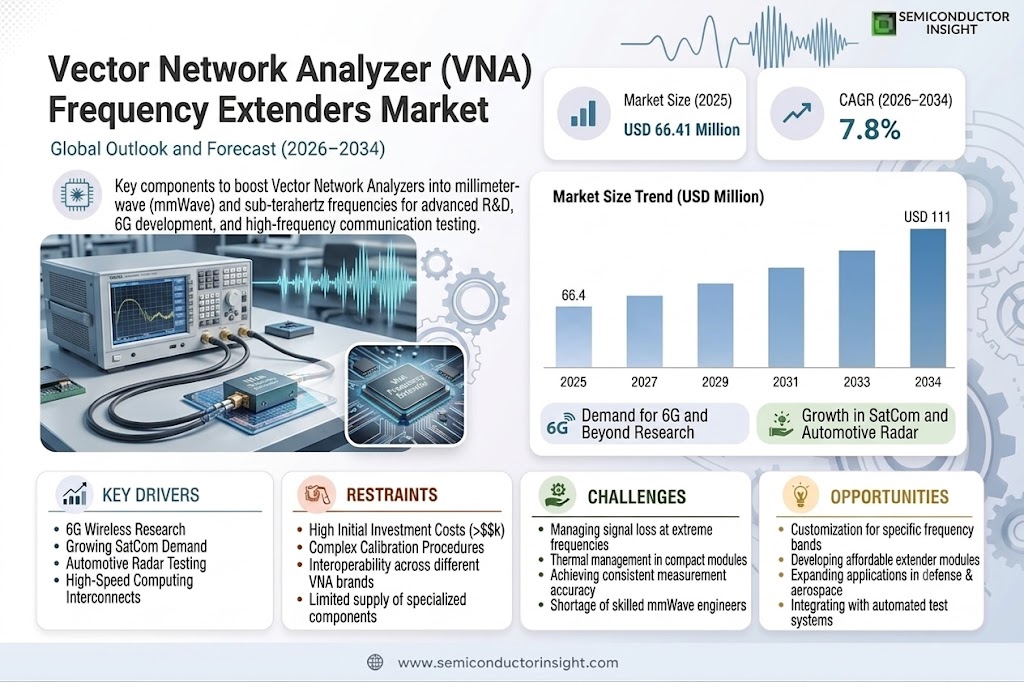
Global Vector Network Analyzer (VNA) Frequency Extenders market size was valued at USD 66.41 million in 2025. The market is projected to grow from USD 71.59 million in 2026 to USD 111.00 million by 2034, exhibiting a CAGR of 7.8% during the forecast period.
Vector Network Analyzer (VNA) Frequency Extenders are specialized millimeter-wave and sub-terahertz instruments designed to expand the operational frequency range of standard VNAs beyond their native measurement capabilities. These extenders interface directly with conventional VNAs to enable precise characterization of high-frequency components, covering extended frequency bands such as 0 to 100 GHz, 100 to 200 GHz, 200 to 300 GHz, 300 to 400 GHz, and above 400 GHz. They are widely employed across communications, automotive, aerospace and defense, and electronic manufacturing applications, where accurate S-parameter measurement at millimeter-wave frequencies is critical to device validation and system performance verification.
The market is witnessing sustained growth driven by accelerating deployment of 5G infrastructure, rising demand for advanced radar and satellite systems, and the rapid proliferation of millimeter-wave technologies across commercial and defense sectors. Furthermore, increasing R&D investment in automotive radar for advanced driver-assistance systems (ADAS) and the expansion of terahertz-band research are broadening the addressable market significantly. Key manufacturers operating in global Vector Network Analyzer (VNA) Frequency Extenders market include Eravant, Virginia Diodes, Copper Mountain Technologies, OML Inc., Farran, AT Microwave, Rohde & Schwarz, VivaTech, ACST GmbH, Radiometer Physics, and KELAG Künzli Elektronik AG, among others, each offering differentiated product portfolios spanning a broad spectrum of frequency extension solutions.
MARKET DRIVERS
Growing Demand for High-Frequency Testing Applications
The proliferation of 5G/6G networks, satellite communications, and advanced radar systems is driving substantial demand for Vector Network Analyzer Frequency Extenders. These devices enable VNAs to operate beyond their native frequency ranges, up to 110 GHz and higher, which is essential for characterizing next-generation wireless components and systems. Market analysis indicates a compound annual growth rate of approximately 8.5% over the next five years, fueled by telecommunications infrastructure upgrades and defense spending.
Advancements in Semiconductor and Materials Research
Research and development in compound semiconductors, metamaterials, and THz technologies require precise high-frequency measurement capabilities. VNA frequency extenders provide the necessary accuracy for S-parameter measurements and material characterization at millimeter-wave and sub-THz frequencies. This is particularly critical for academic institutions, national labs, and R&D departments in the electronics industry, which are major end-users of these systems.
➤ The need for accurate, calibrated measurements in the development of 6G technology and quantum computing systems is a primary market accelerator.
Additionally, the trend towards miniaturization and integration of RF components necessitates higher frequency testing, further solidifying the role of VNA extenders in the ecosystem of electronic design and validation tools.
MARKET CHALLENGES
High Cost of Ownership and Calibration Complexity
Vector Network Analyzer Frequency Extenders represent a significant capital investment, often exceeding the cost of the base VNA unit. Additionally, maintaining measurement accuracy requires frequent and precise calibration, which demands specialized expertise and reference standards. This high total cost of ownership can be a barrier for smaller companies and academic research groups, limiting market penetration in cost-sensitive segments.
Other Challenges
Technical Expertise Requirements
Operating and interpreting results from extended frequency VNA systems requires highly trained personnel. The shortage of RF engineers with experience in millimeter-wave measurements can slow adoption and increase operational costs for end-users.
Integration and Compatibility Issues
Ensuring seamless compatibility between frequency extenders and various VNA models from different manufacturers remains a challenge. This can lead to increased system complexity and potential performance inconsistencies.
MARKET RESTRAINTS
Economic Volatility and Reduced R&D Budgets
Global economic uncertainties and fluctuations in industrial and defense spending can lead to deferred capital expenditures on high-end test and measurement equipment. During periods of economic downturn, organizations often prioritize essential operational expenses over advanced R&D tools like VNA frequency extenders, temporarily restraining market growth.
Market Maturity in Certain Segments
While growth is robust in emerging high-frequency applications, some traditional sectors using lower-frequency VNAs show slower adoption rates for extender modules. The need for frequency extension is not universal across all electronic testing applications, which naturally caps the total addressable market in the near term.
MARKET OPPORTUNITIES
Expansion into Terahertz (THz) Frequency Bands
The frontier of frequency extension is moving into the terahertz range, driven by applications in medical imaging, non-destructive testing, and security scanning. Companies that develop reliable and accurate VNA frequency extenders operating above 110 GHz are positioned to capture a high-growth niche market. This represents a significant technological and commercial opportunity for innovation.
Rise of Automated and Modular Test Systems
The increasing automation of production test environments creates demand for integrated, turn-key solutions. There is a growing opportunity to develop frequency extender modules that are easier to integrate into automated test equipment (ATE) racks, reducing setup time and complexity for high-volume manufacturing testing of RF components.
Emerging Applications in Automotive Radar and Aerospace
The adoption of advanced driver-assistance systems (ADAS) and satellite broadband constellations requires rigorous testing of radar and communication systems at high frequencies. This expansion into new vertical industries presents a sustained, long-term growth vector for the VNA Frequency Extenders Market.
Vector Network Analyzer (VNA) Frequency Extenders Market Trends
Accelerated Demand in High-Frequency Testing Applications
global Vector Network Analyzer (VNA) Frequency Extenders market is experiencing significant growth driven by the escalating need for high-frequency testing across multiple industries. These devices are critical for extending the measurement range of standard VNAs into millimeter-wave and sub-terahertz frequencies, enabling precise characterization of components and systems. The proliferation of 5G/6G infrastructure, satellite communications, and advanced radar systems is a primary catalyst, as these technologies operate at frequencies that demand the enhanced capabilities provided by VNA Frequency Extenders.
Other Trends
Expansion into Extended Frequency Bands
There is a clear industry trend toward developing Vector Network Analyzer (VNA) Frequency Extenders that support progressively higher frequency bands. While the 0 to 100 GHz segment represents a substantial portion of the market, manufacturers are actively investing in R&D to produce units capable of operating effectively at 200 GHz, 300 GHz, and even above 400 GHz. This push is directly aligned with the requirements of emerging applications in terahertz imaging, advanced materials research, and next-generation wireless communication standards.
Consolidation and Strategic Partnerships Among Key Players
The competitive landscape of the Vector Network Analyzer (VNA) Frequency Extenders market is characterized by the presence of specialized technology firms. Leading manufacturers, including Eravant, Virginia Diodes, and Copper Mountain Technologies, are focusing on technological innovation and strategic collaborations to enhance their market position. This environment fosters continuous product development, leading to more compact, efficient, and user-friendly extender solutions that meet the evolving precision measurement needs of sectors like aerospace, defense, and electronic manufacturing.
COMPETITIVE LANDSCAPE
Key Industry Players
A Consolidated Market with Dominant Global Leaders
global Vector Network Analyzer (VNA) Frequency Extenders market is characterized by a concentrated competitive environment, with the top five players accounting for a significant portion of the total revenue as of 2025. These leading companies, including Eravant, Virginia Diodes, and Rohde & Schwarz, possess extensive technological expertise and hold substantial market shares. Their dominance is largely driven by strong R&D capabilities, established brand reputation, and comprehensive product portfolios that cater to high-frequency measurement needs across various bands, from 0 to above 400 GHz.
Beyond the top-tier players, several other specialized manufacturers and technology firms hold significant niches within the market. Companies like OML Inc., Farran, and ACST GmbH are recognized for their expertise in specific frequency ranges or bespoke solutions, serving specialized applications in aerospace, defense, and advanced communications. These players compete on precision, performance in extreme conditions, and application-specific support, carving out substantial roles in a market that demands high reliability and accuracy.
List of Key Vector Network Analyzer (VNA) Frequency Extenders Companies Profiled
- Eravant
- Virginia Diodes
- Copper Mountain Technologies
- OML Inc.
- Farran
- AT Microwave
- Rohde & Schwarz
- VivaTech
- ACST GmbH
- Radiometer Physics
- KELAG Künzli Elektronik AG
- Keysight Technologies
- Anritsu Corporation
- Millitech, Inc.
- MVG – Microwave Vision Group
Segment Analysis:
| Segment Category | Sub-Segments | Key Insights |
| By Type |
|
Leading Segment: Extended Frequency: 0 to 100 GHz
|
| By Application |
|
Leading Segment: Aerospace and Defense
|
| By End User |
|
Leading Segment: Government and Defense Organizations
|
| By Technology |
|
Leading Segment: Harmonic Mixing
|
| By Configuration |
|
Leading Segment: 2-Port Extenders
|
Regional Analysis: Vector Network Analyzer (VNA) Frequency Extenders Market
North America
North America’s Silicon Valley and Boston tech corridors lead in developing next-generation VNA frequency extenders, integrating AI-driven calibration for superior accuracy. This innovation edge supports diverse applications from 6G prototyping to quantum sensing.
Heavy reliance on military contracts drives demand for ruggedized extenders in radar and EW systems. Prime contractors prioritize North American suppliers for secure supply chains and compliance with stringent export controls.
Universities and national labs collaborate with industry on frequency extension breakthroughs, accelerating commercialization of extenders for high-speed data links and phased array testing.
Alliances between VNA makers and telecom giants enhance extender interoperability, focusing on modular designs for seamless integration in next-gen networks.
Europe
Europe exhibits strong growth in the Vector Network Analyzer (VNA) Frequency Extenders Market, fueled by automotive and satellite industries. Precision engineering traditions support demand for extenders in ADAS radar validation and Earth observation systems. EU-funded projects promote harmonized standards, encouraging cross-border collaborations that advance mmWave testing capabilities. Key markets like Germany and France emphasize eco-friendly manufacturing, integrating extenders into sustainable 5G rollouts and space missions. The region’s focus on regulatory compliance drives adoption of certified high-frequency solutions, with suppliers innovating in compact, portable designs for field testing. Competitive dynamics highlight a shift toward open architectures, enabling versatile applications in broadcasting and industrial IoT.
Asia-Pacific
Asia-Pacific emerges as a dynamic hub in the VNA Frequency Extenders Market, propelled by rapid 5G/6G deployments and semiconductor manufacturing. Countries like China, Japan, and South Korea invest heavily in indigenous technologies, customizing extenders for consumer electronics and base station testing. Supply chain localization reduces dependencies, fostering cost-effective solutions for high-volume production. Regional dynamics feature intense competition, spurring innovations in broadband extenders for automotive and consumer radar. Government incentives for tech self-reliance amplify R&D, positioning Asia-Pacific as a pivotal growth engine with scalable manufacturing prowess.
South America
South America shows nascent but promising expansion in the Vector Network Analyzer (VNA) Frequency Extenders Market, centered on telecommunications upgrades and agrotech applications. Brazil and Chile lead with infrastructure projects demanding reliable high-frequency testing for rural connectivity. Import reliance transitions to local assembly, supported by partnerships with global firms. Market dynamics emphasize affordability and ease-of-use, tailoring extenders for emerging 5G networks and mining sensor systems. Gradual skill development in workforce enhances adoption, unlocking potential in defense modernization.
Middle East & Africa
The Middle East & Africa region gains traction in the VNA Frequency Extenders Market through oil & gas, defense, and smart city initiatives. UAE and Saudi Arabia prioritize extenders for pipeline monitoring and radar surveillance in harsh climates. Africa’s telecom liberalization spurs demand for spectrum analyzers in mobile expansions. Strategic investments in training centers build capacity, while regional hubs facilitate technology transfer. Dynamics reflect a blend of imported expertise and localized adaptations, focusing on durable designs for extreme environments and fostering gradual market maturity.
Report Scope
This market research report provides a comprehensive analysis of the Vector Network Analyzer (VNA) Frequency Extenders Market , covering the forecast period 2026–2034. It offers detailed insights into market dynamics, technological advancements, competitive landscape, and key trends shaping the industry.
Key focus areas of the report include:
- Market Overview: The report begins with an overview outlining its current market scenario, key growth indicators, and industry transformation drivers. It discusses macroeconomic factors, demand–supply balance, regulatory landscape, and the strategic role of frequency extenders in high-frequency RF testing across industries such as communications, automotive, aerospace and defense, and electronic manufacturing.
- Market Size & Forecast: Historical data and future projections for revenue, unit shipments, and market value across major regions and segments.
- Segmentation Analysis: Detailed breakdown by product type, technology, application, and end-user industry to identify high-growth segments and investment opportunities.
- Regional Insights: Insights into market performance across North America, Europe, Asia-Pacific, Latin America, and the Middle East & Africa, including country-level analysis where relevant.
- Competitive Landscape: Profiles of leading market participants, including their product offerings, R&D focus, manufacturing capacity, pricing strategies, and recent developments such as mergers, acquisitions, and partnerships.
- Technology Trends & Innovation: Assessment of emerging technologies, integration of AI/IoT, semiconductor design trends, fabrication techniques, and evolving industry standards.
- Market Drivers & Restraints: Evaluation of factors driving market growth along with challenges, supply chain constraints, regulatory issues, and market-entry barriers.
- Stakeholder Insights: Insights for component suppliers, OEMs, system integrators, investors, and policymakers regarding the evolving ecosystem and strategic opportunities.
Primary and secondary research methods are employed, including interviews with industry experts, data from verified sources, and real-time market intelligence to ensure the accuracy and reliability of the insights presented.
FREQUENTLY ASKED QUESTIONS:
What is the current market size of Vector Network Analyzer (VNA) Frequency Extenders Market?
-> Vector Network Analyzer (VNA) Frequency Extenders Market was valued at USD 66.41 million in 2025 and is expected to reach USD 111 million by 2034, at a CAGR of 7.8% during the forecast period.
Which key companies operate in Vector Network Analyzer (VNA) Frequency Extenders Market?
-> Key players include Eravant, Virginia Diodes, Copper Mountain Technologies, OML Inc., Farran, AT Microwave, Rohde & Schwarz, VivaTech, ACST GmbH, Radiometer Physics, among others.
What are the key growth drivers?
-> Key growth drivers include demand in communications, aerospace and defense, automotive, and electronic manufacturing sectors, along with advancements in high-frequency testing technologies.
Which region dominates the market?
-> North America dominates the market, while Asia, particularly China, exhibits strong growth potential.
What are the emerging trends?
-> Emerging trends include extenders for frequencies above 400 GHz, integration with mmWave and terahertz applications, and expansion in 5G/6G communications and defense testing.

Get Sample Report PDF for Exclusive Insights
Report Sample Includes
- Table of Contents
- List of Tables & Figures
- Charts, Research Methodology, and more...
 Download Sample Report PDF