Vacuum Gauges for Semiconductor Equipment Market Insights
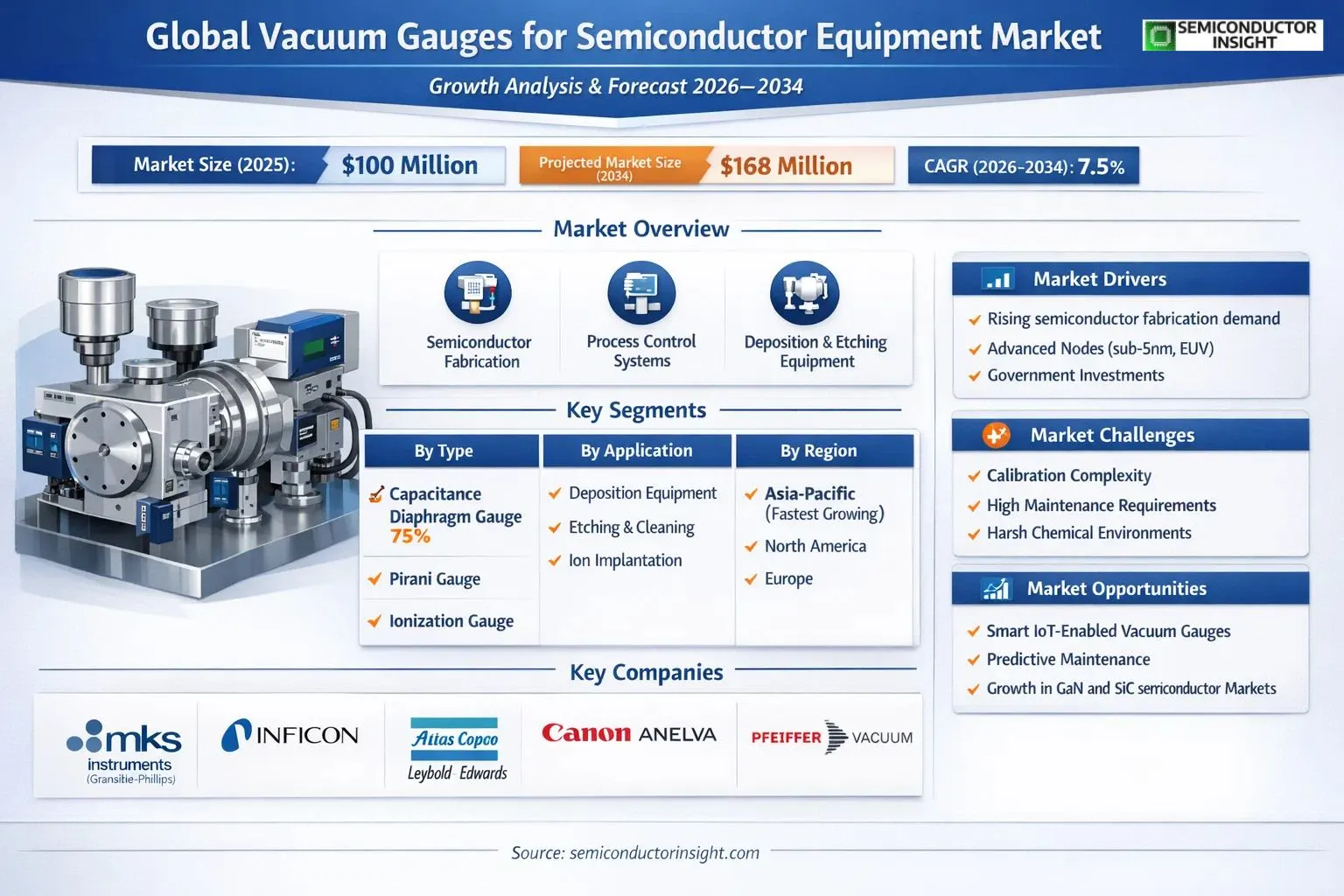
Global Vacuum Gauges for Semiconductor Equipment market size was valued at USD 100 million in 2025. The market is projected to grow from USD 107.5 million in 2026 to USD 168 million by 2034, exhibiting a CAGR of 7.5% during the forecast period.
Vacuum gauges for semiconductor equipment, also known as vacuum sensors, are precision instruments engineered to measure pressure levels in vacuum states — conditions where gas pressure falls below atmospheric levels. These devices typically consist of a grid, a filament, and a collector, and operate on the fundamental principle that higher pressure corresponds to lower vacuum, while lower pressure reflects higher vacuum. Widely deployed across semiconductor fabrication processes, vacuum gauges serve as critical components in equipment such as Physical Vapor Deposition (PVD), Chemical Vapor Deposition (CVD), Atomic Layer Deposition (ALD), and etching systems. Among the various gauge technologies available, Capacitance Diaphragm Gauges represent the dominant product type, accounting for over 75% of the market, owing to their superior accuracy and compatibility with corrosive process environments.
The market is witnessing sustained growth driven by accelerating semiconductor manufacturing activity globally and rising demand for advanced process control instrumentation. Europe and the United States collectively maintain a dominant position, controlling nearly 80% of global production of vacuum gauges for semiconductor equipment. Japan follows as a significant contributor, holding approximately 11% of the market share. Key players shaping the competitive landscape include MKS Instruments (Granville-Phillips) and Inficon, which together account for more than 50% of global market share, alongside Atlas Copco (Leybold and Edwards), Canon ANELVA, and Pfeiffer Vacuum GmbH.
MARKET DRIVERS
Surging Semiconductor Fabrication Activity Driving Demand for Precision Vacuum Measurement
The global expansion of semiconductor fabrication capacity remains one of the most significant forces propelling the Vacuum Gauges for Semiconductor Equipment Market. As chipmakers invest heavily in new fabs and technology node transitions, the need for highly accurate vacuum measurement instrumentation has intensified. Vacuum gauges are indispensable across critical process steps including physical vapor deposition (PVD), chemical vapor deposition (CVD), atomic layer deposition (ALD), and ion implantation, where even marginal deviations in vacuum pressure can compromise yield and device performance. The accelerating buildout of advanced logic and memory manufacturing facilities across Asia-Pacific, North America, and Europe is directly expanding the installed base of vacuum gauge systems.
Transition to Advanced Technology Nodes Elevating Process Control Requirements
As semiconductor manufacturers advance toward sub-5nm and sub-3nm technology nodes, process environments demand increasingly stringent vacuum conditions and real-time pressure monitoring with tighter tolerances. The migration to extreme ultraviolet (EUV) lithography, in particular, requires ultra-high vacuum (UHV) environments, making sophisticated vacuum gauges for semiconductor equipment a non-negotiable process control component. This technological evolution is pushing demand toward high-accuracy capacitance manometers, ionization gauges, and combination gauge systems capable of measuring across wide pressure ranges with exceptional repeatability and minimal contamination risk.
➤ The proliferation of EUV lithography tools and multi-patterning processes at leading-edge fabs is creating sustained long-term demand for advanced vacuum measurement solutions capable of operating reliably in chemically aggressive and plasma-rich environments.
Government-backed semiconductor self-sufficiency programs in the United States, European Union, Japan, South Korea, India, and China are catalyzing unprecedented capital expenditure in new wafer fabrication plants. These programs are not only increasing the total number of operational process chambers worldwide but are also driving adoption of next-generation vacuum gauge technologies that meet the precise process control standards required for competitive device manufacturing. The resulting expansion of the semiconductor equipment supply chain is creating durable, multi-year demand tailwinds for vacuum pressure measurement instrumentation.
MARKET CHALLENGES
Calibration Complexity and Maintenance Demands in High-Throughput Semiconductor Environments
One of the central challenges confronting the Vacuum Gauges for Semiconductor Equipment Market is the rigorous calibration and maintenance requirements inherent to high-precision vacuum measurement in semiconductor manufacturing. Gauges deployed in process chambers are subjected to harsh chemical exposure, reactive plasma environments, and thermal cycling, all of which can cause drift in measurement accuracy over time. Maintaining gauge calibration within acceptable tolerances requires frequent validation cycles that can interrupt production schedules, increase operational costs, and demand specialized technical expertise. As fabs seek to maximize tool uptime and throughput, the maintenance burden associated with vacuum gauges presents an ongoing operational challenge for process engineers and equipment managers.
Other Challenges
Compatibility with Next-Generation Process Chemistries
The introduction of novel precursor materials, high-k dielectrics, and increasingly aggressive etch chemistries in advanced node manufacturing creates material compatibility challenges for conventional vacuum gauge sensor technologies. Gauge components exposed to corrosive fluorine-based or chlorine-based process gases are particularly susceptible to accelerated degradation, necessitating the development and qualification of new sensor materials and protective coatings. This ongoing compatibility challenge increases product development costs and extends the qualification timelines for new vacuum gauge designs entering the semiconductor equipment ecosystem.
Integration with Digital Fab Architectures
Modern semiconductor fabs are increasingly adopting connected, data-driven manufacturing architectures that require vacuum gauges to interface seamlessly with advanced process control (APC) systems, fab automation networks, and equipment health monitoring platforms. Legacy vacuum gauge instruments with limited digital communication capabilities face significant integration barriers, while newer smart gauge solutions must meet stringent cybersecurity and data integrity standards imposed by leading-edge chipmakers. Bridging the gap between established gauge hardware and evolving digital fab requirements represents a meaningful technical and commercial challenge for suppliers in the vacuum gauges for semiconductor equipment market.
MARKET RESTRAINTS
High Product Development and Qualification Costs Constraining Market Entry and Innovation Pace
The Vacuum Gauges for Semiconductor Equipment Market is subject to substantial barriers arising from the extensive time and investment required to develop, qualify, and certify new vacuum gauge products for use in semiconductor process equipment. Leading chipmakers and original equipment manufacturers (OEMs) impose rigorous qualification protocols before new gauge models are approved for deployment in production environments, a process that can span multiple years and require considerable engineering resources. These high qualification costs and extended timelines limit the frequency with which suppliers can introduce new products and effectively constrain the pace of innovation, particularly for smaller or emerging gauge manufacturers seeking to establish themselves in the semiconductor equipment supply chain.
Cyclical Nature of Semiconductor Capital Expenditure Creating Demand Volatility
Demand for vacuum gauges deployed in semiconductor equipment is closely tied to the capital expenditure cycles of major chipmakers and equipment manufacturers, which are inherently subject to cyclical fluctuations driven by end-market demand shifts, inventory corrections, and macroeconomic conditions. During periods of reduced fab investment, procurement of vacuum measurement instrumentation can be deferred or reduced, exposing gauge suppliers to revenue volatility that complicates long-term capacity planning and research and development investment. This cyclicality represents a structural restraint on sustained, linear market growth and requires vacuum gauge suppliers to maintain flexible operational models capable of responding to rapid changes in order volumes across the semiconductor equipment value chain.
MARKET OPPORTUNITIES
Emergence of Smart and IoT-Enabled Vacuum Gauge Solutions for Predictive Maintenance Applications
The increasing adoption of Industry 4.0 principles within semiconductor manufacturing environments is creating significant opportunities for suppliers of intelligent, connected vacuum gauge solutions. Next-generation vacuum gauges embedded with onboard diagnostics, real-time data logging, and digital communication interfaces such as EtherCAT, PROFINET, or IO-Link are well-positioned to capture growing demand from fabs prioritizing predictive maintenance, equipment health monitoring, and process optimization. By enabling continuous vacuum system performance tracking and early anomaly detection, smart vacuum gauges for semiconductor equipment can deliver measurable reductions in unplanned downtime and maintenance costs, a compelling value proposition that is accelerating their adoption across leading-edge fab environments.
Expansion of Compound Semiconductor and Wide Bandgap Device Manufacturing Creating New Application Segments
The rapidly growing market for compound semiconductors, including gallium nitride (GaN) and silicon carbide (SiC) power devices, as well as III-V materials used in photonics and radio frequency applications, is generating new demand vectors for vacuum gauge instrumentation beyond traditional silicon wafer fabs. These emerging device categories require specialized deposition and etch process environments with distinct vacuum pressure profiles and chemical exposure characteristics, creating opportunities for vacuum gauge suppliers to develop and market purpose-engineered solutions tailored to compound semiconductor process requirements. As investment in wide bandgap device manufacturing accelerates globally, the Vacuum Gauges for Semiconductor Equipment Market stands to benefit from expanding addressable opportunities outside its traditional silicon-centric customer base.
Aftermarket Services and Gauge Refurbishment Programs Offering Recurring Revenue Potential
Beyond initial equipment sales, the large and growing installed base of vacuum gauges across global semiconductor fabrication facilities represents a substantial and relatively resilient aftermarket opportunity for calibration services, sensor replacement, gauge refurbishment, and extended service contracts. As fabs seek to optimize total cost of ownership and extend the operational life of installed vacuum measurement hardware, suppliers offering comprehensive aftermarket programs are well-positioned to generate predictable, recurring revenue streams that partially offset the impact of capital expenditure cycle volatility. Building out robust service and support capabilities represents a strategically important growth avenue for established players in the vacuum gauges for semiconductor equipment market seeking to diversify and stabilize their revenue profiles.
Need proxies cheaper than the market? https://op.wtfVacuum Gauges for Semiconductor Equipment Market () Trends
Dominance of Capacitance Diaphragm Gauges in Semiconductor Vacuum Measurement
One of the most defining trends shaping the Vacuum Gauges for Semiconductor Equipment Market is the overwhelming adoption of capacitance diaphragm gauges (CDGs). This gauge type commands over 75% of the total product segment, owing to its superior accuracy, wide measurement range, and gas-independent pressure sensing capabilities. In precision-critical semiconductor processes such as physical vapor deposition (PVD), chemical vapor deposition (CVD), and atomic layer deposition (ALD), CDGs offer stable and repeatable vacuum measurements that are essential to maintaining process integrity. As semiconductor fabrication nodes continue to shrink, the demand for ultra-precise vacuum control is intensifying, further reinforcing the dominance of CDGs in the market. Equipment manufacturers and fab operators are increasingly specifying CDGs as the default measurement technology in new tool configurations, which is expected to sustain this segment’s leading position throughout the forecast period.
Other Trends
Regional Concentration and Supply Chain Dynamics
From a regional perspective, Europe and the United States together account for approximately 80% of global production of vacuum gauges for semiconductor equipment, establishing a dominant supply base. Japan follows as a significant contributor, holding roughly an 11% production share. This geographic concentration has important implications for global supply chain resilience, particularly as semiconductor manufacturing expands in Asia. China, currently a net importer of these precision instruments — primarily sourcing from European and American manufacturers — represents an emerging area of strategic interest. The Chinese market is presently led by MKS (Granville-Phillips) and Inficon, with MKS holding a particularly strong position in corrosive process environments and etching equipment applications, where its products are often the only viable option.
Consolidation Among Leading Manufacturers
Market consolidation has been a notable trend in the Vacuum Gauges for Semiconductor Equipment Market, with leading players actively pursuing mergers and acquisitions to strengthen their technological portfolios and global reach. Inficon’s acquisition of InstruTech in 2016, MKS Instruments’ acquisition of Granville-Phillips from Brooks Automation in 2014, and Atlas Copco’s sequential acquisitions of UK-based vacuum businesses in 2013 and 2016 are illustrative of this consolidation wave. Together, Inficon and MKS (Granville-Phillips) account for more than 50% of the global market share, underscoring the oligopolistic nature of this specialized segment. Other established players, including Atlas Copco (through its Leybold and Edwards brands), Canon ANELVA, and Pfeiffer Vacuum GmbH, continue to play meaningful roles in shaping competitive dynamics.
Growing Demand Across Deposition and Etching Process Equipment
Application-driven demand across key semiconductor manufacturing processes is another pivotal trend in the Vacuum Gauges for Semiconductor Equipment Market. Deposition equipment, including PVD, CVD, and ALD tools, and etching and cleaning equipment represent the primary end-use segments driving volume consumption of vacuum gauges. As global semiconductor capital expenditure rises in response to accelerating chip demand across automotive, artificial intelligence, and consumer electronics sectors, the installed base of these process tools is expanding. This directly translates into increased procurement of vacuum measurement instruments. Furthermore, the growing complexity of etch chemistries — particularly in high-aspect-ratio etching — is elevating requirements for chemically resistant gauge solutions, a need that only a select group of manufacturers, notably MKS, are currently equipped to address comprehensively.
Key Industry Players
Vacuum Gauges for Semiconductor Equipment Market , Global Competitive Overview and Leading Manufacturer Analysis
The global Vacuum Gauges for Semiconductor Equipment market is characterized by a high degree of consolidation, with two dominant players — MKS Instruments (Granville-Phillips) and Inficon — collectively commanding more than 50% of the worldwide market share. Europe and the United States together account for approximately 80% of global production capacity, underscoring the geographic concentration of technological expertise and manufacturing capability in this specialized segment. Capacitance diaphragm gauges represent the largest product category, accounting for over 75% of total market revenue, and leading manufacturers have continued to reinforce their positions through strategic mergers, acquisitions, and R&D investments. Notable consolidation moves include Inficon’s acquisition of InstruTech in 2016, MKS’s acquisition of Granville-Phillips from Brooks Automation in 2014, and Atlas Copco’s successive acquisitions of Leybold and Edwards in 2013 and 2016, respectively. These strategic moves have enabled top-tier players to broaden their product portfolios, expand geographic reach, and deepen integration across critical semiconductor process applications including PVD, CVD, ALD, etching, and ion implantation equipment.
Beyond the two market leaders, several other established players maintain significant and specialized competitive positions. Atlas Copco — operating through its Leybold and Edwards brands — along with Canon ANELVA and Pfeiffer Vacuum GmbH, represent the next tier of influential competitors with strong footholds in European and Asian markets. In corrosive process environments such as etching equipment, MKS products hold a particular technological advantage, while Inficon addresses broader deposition application needs effectively. Japan contributes approximately 11% of global production, with manufacturers such as ULVAC, Azbil Corporation, and Canon ANELVA playing important regional roles. Emerging players from China, including Shanghai Zhentai Instrument, ATOVAC, and Reborns, are gradually increasing their domestic presence, though the Chinese market remains heavily import-dependent, primarily sourcing from established European and North American manufacturers. The global market, valued at approximately US$ 100 million in 2025, is projected to reach US$ 168 million by 2034, reflecting a CAGR of 7.5%, driven by accelerating semiconductor fabrication investments and expanding advanced process node adoption worldwide.
List of Key Vacuum Gauges for Semiconductor Equipment Companies Profiled
- MKS Instruments (Granville-Phillips)
- Inficon
- Atlas Copco (Leybold and Edwards)
- Canon ANELVA
- Pfeiffer Vacuum GmbH
- Agilent Technologies
- ULVAC, Inc.
- SATO VAC INC
- Azbil Corporation
- Arun Microelectronics Ltd.
- Teledyne Hastings Instruments
- Kurt J. Lesker Company
- Setra Systems
- EBARA Corporation
- ATOVAC
- Reborns
- Shanghai Zhentai Instrument
Segment Analysis:
| Segment Category | Sub-Segments | Key Insights |
| By Type |
|
Capacitance Diaphragm Gauge is the dominant segment in the vacuum gauges for semiconductor equipment market, commanding a commanding lead over other gauge types. Key qualitative drivers include:
|
| By Application |
|
Deposition Equipment represents the leading application segment for vacuum gauges in the semiconductor equipment market. This dominance is driven by several critical factors:
|
| By End User |
|
Semiconductor Device Manufacturers (IDMs) represent the primary end-user segment, driving the bulk of demand for vacuum gauges across global markets. The following insights underline this leadership:
|
| By Technology |
|
Direct Measurement Technology leads this segment, underpinned by its superior precision and reliability in semiconductor-grade environments. Key insights include:
|
| By Operating Environment |
|
Corrosive Environment Compatible Gauges constitute the most strategically significant sub-segment within this category, reflecting the demanding chemical conditions prevalent across key semiconductor fabrication processes:
|
Analysis: Vacuum Gauges for Semiconductor Equipment Market
China’s strategic drive toward domestic semiconductor production is reshaping regional demand dynamics. Significant national investment in new wafer fabrication plants and equipment localization programs has created a rapidly growing addressable market for vacuum gauges for semiconductor equipment. Local manufacturers are increasingly seeking reliable vacuum measurement solutions to support yield improvement and process control across advanced node production lines.
Taiwan and South Korea collectively house some of the world’s most advanced semiconductor fabrication facilities. The continuous scaling of transistor architectures and the expansion of memory and logic chip capacity in these markets require increasingly precise vacuum control instrumentation. Vacuum gauges for semiconductor equipment deployed in these fabs must meet stringent process repeatability and reliability standards, elevating the quality benchmark for the entire regional supply chain.
Japan maintains a leading position in high-precision vacuum gauge manufacturing, with several globally recognized instrumentation companies headquartered in the country. Japanese firms bring decades of engineering excellence to the development of capacitance manometers, Pirani gauges, and ionization gauges tailored for semiconductor process environments. This technological depth strengthens Asia-Pacific’s competitive advantage in both domestic adoption and global export of vacuum measurement technologies.
Nations such as Malaysia, Vietnam, and India are emerging as secondary growth hubs within the Asia-Pacific vacuum gauges for semiconductor equipment market. Increasing foreign direct investment in semiconductor assembly and packaging operations, combined with favorable government incentives for electronics manufacturing, is broadening the regional demand base. These markets are expected to progressively integrate advanced vacuum instrumentation as their fabrication capabilities mature over the forecast horizon.
North America
North America represents the second most significant regional market for vacuum gauges for semiconductor equipment, underpinned by a strong concentration of leading semiconductor companies, equipment manufacturers, and research institutions. The United States, in particular, has intensified domestic chip manufacturing investment following strategic policy measures aimed at reducing reliance on overseas semiconductor supply chains. New and expanded fabrication facilities in states such as Arizona, Ohio, and Texas are driving incremental demand for high-precision vacuum measurement systems. The region is also home to several pioneering vacuum instrumentation companies that supply both domestic and international semiconductor manufacturers. Canada contributes through a growing photonics and compound semiconductor research sector. North America’s emphasis on advanced node development, coupled with robust research and development activity in next-generation semiconductor processes, positions the region as a key innovation hub in the global vacuum gauges for semiconductor equipment market through the forecast period.
Europe
Europe occupies a notable position in the vacuum gauges for semiconductor equipment market, characterized by a strong legacy in precision engineering and a resurgent focus on regional semiconductor sovereignty. The European Chips Act has catalyzed significant investment in domestic wafer fabrication capacity across Germany, the Netherlands, Ireland, and France, all of which are expected to generate meaningful demand for vacuum process monitoring equipment. Germany’s mechanical engineering heritage and the Netherlands’ deep semiconductor equipment ecosystem — anchored by globally influential equipment makers — provide a fertile environment for advanced vacuum gauge adoption. European semiconductor fabs, though smaller in aggregate volume compared to Asia-Pacific, place a premium on process accuracy and instrumentation reliability, driving demand for high-specification vacuum gauges for semiconductor equipment. Growing research activity in quantum computing, power electronics, and advanced packaging further expands the application landscape for vacuum measurement technologies across the region.
South America
South America remains a nascent but gradually developing market within the global vacuum gauges for semiconductor equipment landscape. Brazil leads the region in terms of electronics manufacturing activity and semiconductor packaging operations, providing a modest but growing base of demand for vacuum measurement solutions. Regional governments are increasingly recognizing the strategic importance of building domestic technology manufacturing capabilities, and early-stage investment in electronics infrastructure is beginning to create awareness and appetite for precision instrumentation. While the region currently relies heavily on imported semiconductor equipment and components, improving industrial capabilities and expanding academic research in materials science and electronics engineering are expected to gradually support market development. South America’s long-term potential in the vacuum gauges for semiconductor equipment market will depend on the pace of industrial policy execution and foreign investment attraction over the 2026–2034 period.
Middle East & Africa
The Middle East and Africa region currently represents the smallest share of the global vacuum gauges for semiconductor equipment market, yet early signs of market formation are beginning to emerge. The Middle East, particularly the United Arab Emirates and Saudi Arabia, is investing in technology diversification as part of broader economic transformation agendas. Initiatives focused on building local electronics manufacturing capabilities and attracting high-technology industries are laying the groundwork for future semiconductor-related infrastructure. Israel stands out as a notable exception within the broader region, hosting a mature and globally competitive semiconductor design and fabrication sector that actively utilizes advanced vacuum measurement instrumentation. Africa’s market remains largely underdeveloped at present, though growth in telecommunications infrastructure and electronics assembly is creating peripheral demand. Over the long-term forecast horizon, targeted investment and technology transfer programs could meaningfully elevate the region’s engagement with the vacuum gauges for semiconductor equipment market.
Report Scope
This market research report provides a comprehensive analysis of the Vacuum Gauges for Semiconductor Equipment Market, covering the forecast period 2026–2034. It offers detailed insights into market dynamics, technological advancements, competitive landscape, and key trends shaping the industry.
Key focus areas of the report include:
- Market Overview: The report begins with an overview outlining its current market scenario, key growth indicators, and industry transformation drivers. It discusses macroeconomic factors, demand–supply balance, regulatory landscape, and the strategic role of semiconductors in powering advancements across industries such as automotive, telecommunications, consumer electronics, and industrial automation.
- Market Size & Forecast: Historical data and future projections for revenue, unit shipments, and market value across major regions and segments.
- Segmentation Analysis: Detailed breakdown by product type, technology, application, and end-user industry to identify high-growth segments and investment opportunities.
- Regional Insights: Insights into market performance across North America, Europe, Asia-Pacific, Latin America, and the Middle East & Africa, including country-level analysis where relevant.
- Competitive Landscape: Profiles of leading market participants, including their product offerings, R&D focus, manufacturing capacity, pricing strategies, and recent developments such as mergers, acquisitions, and partnerships.
- Technology Trends & Innovation: Assessment of emerging technologies, integration of AI/IoT, semiconductor design trends, fabrication techniques, and evolving industry standards.
- Market Drivers & Restraints: Evaluation of factors driving market growth along with challenges, supply chain constraints, regulatory issues, and market-entry barriers.
- Stakeholder Insights: Insights for component suppliers, OEMs, system integrators, investors, and policymakers regarding the evolving ecosystem and strategic opportunities.
Primary and secondary research methods are employed, including interviews with industry experts, data from verified sources, and real-time market intelligence to ensure the accuracy and reliability of the insights presented.
FREQUENTLY ASKED QUESTIONS:
What is the current market size of Vacuum Gauges for Semiconductor Equipment Market?
-> Global Vacuum Gauges for Semiconductor Equipment Market was valued at USD 100 million in 2025 and is expected to reach USD 168 million by 2034, growing at a CAGR of 7.5% during the forecast period.
Which key companies operate in Vacuum Gauges for Semiconductor Equipment Market?
-> Key players include MKS (Granville-Phillips), Inficon, Atlas Copco (Leybold and Edwards), Canon ANELVA, Pfeiffer Vacuum GmbH, Agilent, ULVAC, Teledyne Hastings Instruments, Kurt J. Lesker, Setra Systems, and EBARA, among others. Inficon and MKS (Granville-Phillips) are the world’s two largest manufacturers, together accounting for more than 50% of the global market share.
What are the key growth drivers?
-> Key growth drivers include rising demand for semiconductor equipment such as PVD, CVD, ALD, and etching systems, increasing investments in semiconductor fabrication facilities, growing adoption of advanced vacuum measurement technologies, and expanding semiconductor manufacturing activities across Asia, North America, and Europe.
Which region dominates the market?
-> Europe and the United States occupy a dominant position, together controlling nearly 80% of the world’s production of vacuum gauges for semiconductor equipment. Japan is also an important producer with a market share of approximately 11%. China is currently relatively weak in this field, mainly relying on imports from Europe and the United States.
What are the emerging trends?
-> Emerging trends include increasing dominance of capacitance diaphragm gauges (accounting for over 75% of the market by product type), consolidation through mergers and acquisitions among leading players, growing demand for vacuum gauges capable of operating in corrosive environments, and rising adoption in deposition, etching, cleaning, and ion implantation semiconductor equipment processes.
Need proxies cheaper than the market? https://op.wtf

Get Sample Report PDF for Exclusive Insights
Report Sample Includes
- Table of Contents
- List of Tables & Figures
- Charts, Research Methodology, and more...
 Download Sample Report PDF