V2X Communication Market Insights
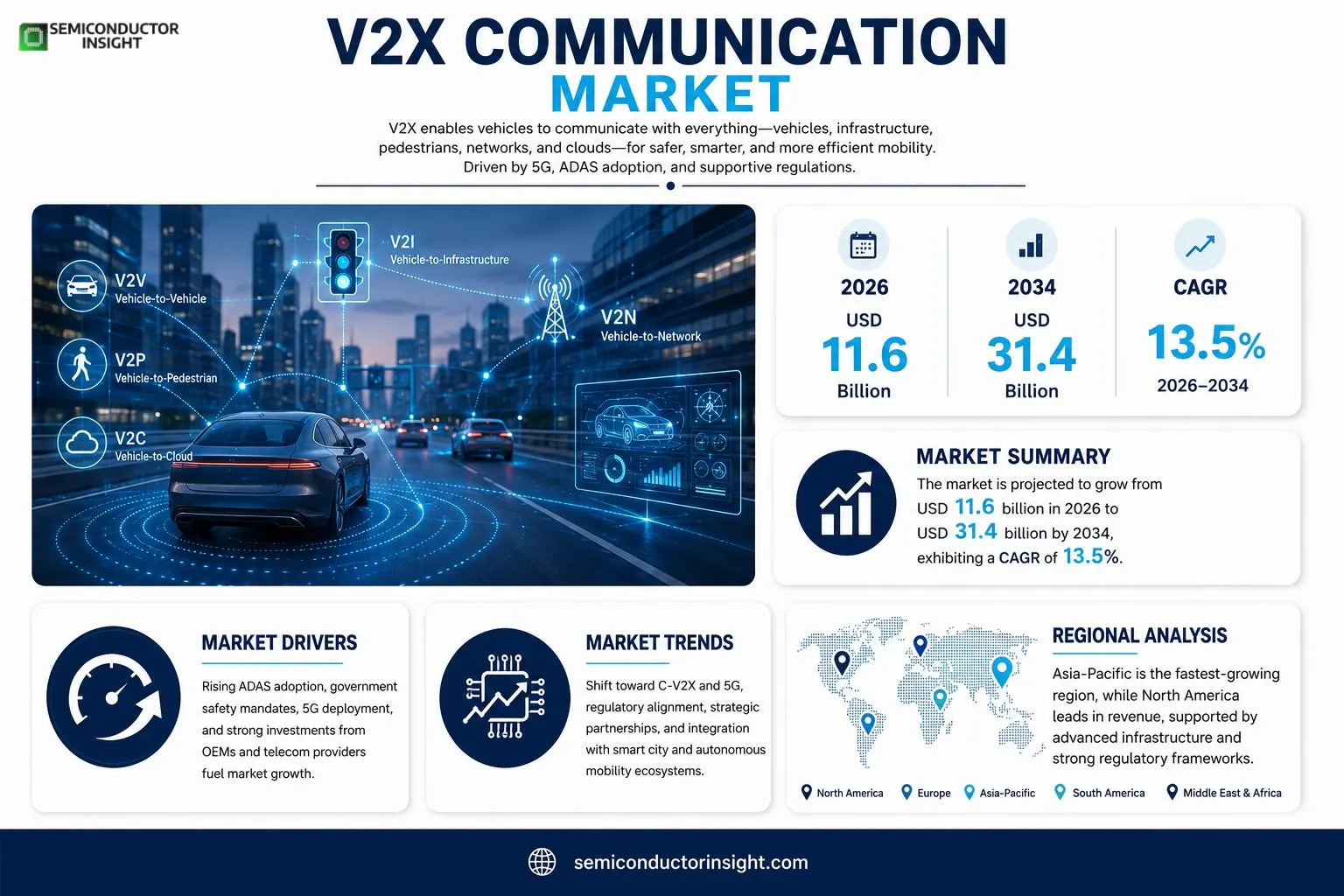
V2X Communication Market size was valued at USD 10.8 billion in 2025. The market is projected to grow from USD 11.6 billion in 2026 to USD 31.4 billion by 2034, exhibiting a CAGR of 13.5% during the forecast period.
V2X (Vehicle‑to‑Everything) communication encompasses a suite of wireless technologies that enable vehicles to exchange information with other vehicles (V2V), infrastructure (V2I), pedestrians (V2P), networks (V2N) and clouds (V2C). By leveraging dedicated short‑range communications (DSRC) and cellular‑based C‑V2X, these systems support real‑time data exchange for safety alerts, traffic efficiency, and autonomous driving functions.The market is experiencing rapid expansion due to rising adoption of advanced driver‑assistance systems (ADAS), increasing government mandates for connected vehicle standards, and substantial investments from automotive OEMs and telecom providers. Furthermore, the rollout of 5G networks accelerates low‑latency V2X services, while collaborations such as the partnership between Qualcomm and Toyota on C‑V2X platforms illustrate industry momentum. Key players,including NXP Semiconductors, Bosch Mobility Solutions, Huawei Technologies, and Continental,are broadening their portfolios through strategic acquisitions and joint ventures, further fueling growth.
MARKET DRIVERS
Rising Adoption of Connected Vehicles
The shift toward connected and autonomous vehicles is catalyzing demand for seamless data exchange between cars, infrastructure, and pedestrians. Automakers are integrating V2X modules in new models, leading to an estimated 30% annual growth in unit shipments.
Government Safety Regulations
Stringent safety mandates across North America, Europe, and Asia require real‑time hazard warnings, positioning V2X Communication Market as a critical enabler for compliance. Regulatory incentives are projected to accelerate market penetration by 15% over the next five years.
➤ “By 2030, V2X Communication Market could exceed $40 billion, driven primarily by smart‑city initiatives and mandatory safety standards.”
Continued investment in 5G and edge‑computing infrastructure further enhances reliability, making V2X solutions more attractive for fleet operators seeking reduced accident rates and operational efficiencies.
MARKET CHALLENGES
High Deployment Costs
The upfront expense of retrofitting legacy fleets with V2X hardware and establishing nationwide communication networks remains a significant barrier. Many mid‑size manufacturers cite cost‑benefit uncertainties that delay large‑scale rollouts.
Other Challenges
Interoperability Issues
Fragmented standards across regions create integration complexities, limiting cross‑border compatibility and slowing adoption among OEMs.Additionally, concerns over data privacy and cybersecurity demand robust encryption protocols, adding to implementation overhead and prolonging time‑to‑market.
MARKET RESTRAINTS
Spectrum Allocation Constraints
Limited availability of dedicated spectrum for vehicle‑to‑everything communications restricts network scalability. Competing demands from cellular operators force regulators to prioritize usage, which can delay full‑scale deployments of V2X solutions.
MARKET OPPORTUNITIES
Expansion into Smart‑City Ecosystems
Integrating V2X platforms with urban traffic management systems offers untapped revenue streams for technology providers. Real‑time traffic optimization and predictive maintenance can generate annual savings of up to 12% for municipalities.Emerging use cases such as platooning for freight transport and vehicle‑to‑grid energy exchange present new growth avenues, positioning V2X Communication Market for sustained expansion beyond traditional automotive segments.
V2X Communication Market Trends
Accelerated Adoption of C‑V2X and 5G Integration
V2X Communication Market is experiencing a decisive pivot toward cellular‑based C‑V2X technologies, propelled by the worldwide deployment of 5G infrastructure. 5G’s ultra‑low latency (sub‑10 ms) and high reliability enable vehicles to exchange safety‑critical data in real time, supporting coordinated traffic‑flow management, collision avoidance, and cooperative automated driving functions. Recent industry reports indicate that the number of 5G‑enabled V2X pilot projects grew by 42 % in 2023, with major metropolitan corridors in Europe and China already demonstrating measurable reductions in traffic congestion and incident rates. Automotive OEMs are embedding C‑V2X radios as standard equipment on most new models slated for 2026, reflecting a clear shift from legacy DSRC solutions to a unified, network‑centric architecture that can scale with future autonomous driving applications.
Other Trends
Regulatory Momentum and Standards Alignment
Governments across Europe, North America, and the Asia‑Pacific region are solidifying V2X regulatory frameworks, requiring that all new vehicles sold after 2026 support both V2V and V2I communications. These mandates are aligned with the UNECE WP.29 regulations and the FCC’s spectrum allocations, reducing fragmentation and fostering a homogeneous market. As a result, OEMs face a predictable compliance landscape, encouraging them to invest heavily in unified hardware platforms that can operate across multiple frequency bands. The regulatory push also accelerates the rollout of roadside units (RSUs) and smart‑infrastructure projects, creating a virtuous cycle where increased infrastructure coverage further validates the business case for V2X deployments.
Strategic Partnerships and Ecosystem Expansion
Strategic collaborations are reshaping the V2X ecosystem, combining semiconductor expertise, automotive engineering, and telecom capabilities. Notable examples include the Qualcomm‑Toyota partnership to develop a C‑V2X chipset optimized for mass‑market vehicles, and Bosch’s joint venture with Continental to deliver end‑to‑end V2X solutions that integrate sensors, cloud services, and edge computing. These alliances streamline supply chains, reduce development cycles, and enable rapid scaling of advanced driver‑assistance systems (ADAS) that rely on continuous V2X data streams. Investment activity reflects this trend, with venture capital and corporate funding for V2X startups increasing by more than 30 % year‑over‑year, underscoring confidence in a convergent mobility future where connectivity, autonomy, and safety are tightly interwoven.
COMPETITIVE LANDSCAPEKey Industry Players
Comprehensive Competitive Overview of the V2X Communication Market
V2X Communication Market is dominated by a handful of technology powerhouses that have established deep integration pipelines with automotive OEMs and telecom carriers. NXP Semiconductors leads the silicon frontier with its high‑integration C‑V2X transceiver portfolio, while Bosch Mobility Solutions leverages its extensive automotive systems expertise to offer end‑to‑end V2X modules and cloud services. Huawei Technologies and Continental round out the top tier, delivering both network‑centric solutions (leveraging 5G) and robust vehicle‑level hardware. This concentration of capabilities creates a tiered structure where tier‑one semiconductor and systems firms command the majority of revenue, while strategic partnerships,such as Qualcomm’s collaboration with Toyota,enable rapid deployment of C‑V2X platforms across multiple vehicle lines.Beyond the leading quartet, a broader cohort of niche but influential players is reshaping the competitive landscape through specialized innovations and regional market focus. Qualcomm continues to expand its Snapdragon Automotive Platform, adding V2X capabilities that appeal to OEMs seeking integrated connectivity. Autoliv and ZF Friedrichshafen bring safety‑centric V2X modules that dovetail with advanced driver‑assistance systems. Samsung Electronics, STMicroelectronics, and Denso are accelerating their DSRC and C‑V2X roadmaps, targeting emerging markets in Europe and Asia. APTIV and GM’s OnStar division contribute proprietary data‑exchange services that enhance fleet‑level analytics. These companies, while smaller in total sales, provide critical differentiation and are often the first to adopt emerging standards such as 5G‑NR V2X, positioning them as essential collaborators in the ecosystem.
List of Key V2X Communication Companies Profiled
- NXP Semiconductors
- Bosch Mobility Solutions
- Huawei Technologies
- Qualcomm
- Continental AG
- Samsung Electronics
- STMicroelectronics
- Autoliv
- Denso Corporation
- ZF Friedrichshafen AG
- APTIV
- GM OnStar
Segment Analysis:
| Segment Category | Sub-Segments | Key Insights |
| By Type |
|
DSRC‑Centric Segment
|
| By Application |
|
Safety & Collision Avoidance Segment
|
| By End User |
|
Automotive OEM Segment
|
| By Deployment Model |
|
Embedded In‑Vehicle Module Segment
|
| By Connectivity Technology |
|
5G NR V2X Segment
|
Regional Analysis: North America
North America
Stringent safety regulations and supportive government policies are major catalysts for V2X Communication Market in North America. Initiatives focused on intelligent transportation systems and connected vehicle infrastructure are driving investment and adoption.
The North American automotive industry is at the forefront of V2X Communication Market development, with major manufacturers investing heavily in research and development of connected car technologies. Collaboration between automakers and technology providers is accelerating innovation.
Investment in smart city initiatives and intelligent transportation infrastructure is a key enabler for V2X Communication Market in North America. Deployment of roadside units and communication networks is crucial for seamless V2X operation.
Continuous advancements in wireless communication technologies, such as 5G and C-V2X, are enhancing the capabilities and reliability of V2X Communication Market in North America.
North America
V2X Communication Market in North America is experiencing substantial growth, driven by increasing demand for enhanced road safety, improved traffic flow, and the advancement of autonomous driving capabilities. The region’s well-established automotive ecosystem and supportive regulatory environment are key factors contributing to this expansion. The integration of V2X technologies with existing infrastructure and the development of sophisticated ADAS systems are generating significant opportunities for market stakeholders. The focus on data security and privacy is also gaining importance in the North American V2X Communication Market. Businesses are increasingly exploring innovative V2X solutions to optimize logistics, enhance fleet management, and improve overall transportation efficiency. The strategic importance of V2X in enabling future mobility solutions positions North America as a leading player in the V2X Communication Market.
Europe
Europe presents another significant market for V2X Communication Market, characterized by a strong emphasis on sustainability, safety, and connected mobility. The region’s stringent environmental regulations and proactive approach to smart city initiatives are driving the adoption of V2X technologies. Government funding and collaborative research projects are fostering innovation and accelerating the deployment of V2X solutions. The integration of V2X with public transportation systems and the development of intelligent traffic management platforms are key areas of focus within the European V2X Communication Market. The emphasis on cybersecurity and data privacy remains paramount in the European V2X Communication Market, leading to the development of robust security protocols and standards. The market is witnessing increasing interest in V2X solutions for freight logistics and fleet optimization, contributing to enhanced efficiency and reduced emissions.
Asia-Pacific
The Asia-Pacific region is poised for rapid growth in V2X Communication Market, fueled by burgeoning urbanization, increasing vehicle ownership, and supportive government policies. Rapid industrialization and the development of smart infrastructure are creating a favorable environment for V2X adoption. China, in particular, is investing heavily in V2X technologies and is expected to be a major driver of the regional V2X Communication Market. The deployment of 5G networks and the development of advanced communication infrastructure are accelerating the advancement of V2X capabilities. The focus on connected commercial vehicles and smart logistics is creating significant opportunities for market players in the Asia-Pacific V2X Communication Market. However, challenges related to data security and standardization need to be addressed to ensure the seamless integration of V2X technologies across the region.
South America
V2X Communication Market in South America is gradually emerging, with growing awareness of the potential benefits of connected vehicle technologies. Increasing vehicle adoption rates and the development of smart city initiatives are driving the initial stages of market growth. Government initiatives promoting road safety and the adoption of intelligent transportation systems are creating opportunities for V2X deployment. The focus on improving public transportation efficiency and enhancing logistics operations are key applications for V2X in the South American market. While the market is still in its nascent stages, it holds significant long-term potential as infrastructure development and technological advancements continue to progress.
Middle East & Africa
The Middle East & Africa region presents a developing market for V2X Communication Market, with increasing investments in smart infrastructure and transportation projects. Growing urbanization and rising vehicle ownership are contributing to market expansion. Government initiatives focused on improving road safety and enhancing transportation efficiency are driving the adoption of V2X technologies. The focus on connected commercial vehicles and logistics solutions is a key area of opportunity within the region. While the adoption rate is currently lower compared to other regions, the long-term growth potential of V2X Communication Market in the Middle East & Africa is substantial, driven by ongoing infrastructure development and increasing vehicle connectivity.
Report Scope
This market research report provides a comprehensive analysis of the V2X Communication Market , covering the forecast period 2026–2034. It offers detailed insights into market dynamics, technological advancements, competitive landscape, and key trends shaping the industry.
Key focus areas of the report include:
- Market Overview: The report begins with an overview outlining its current market scenario, key growth indicators, and industry transformation drivers. It discusses macroeconomic factors, demand–supply balance, regulatory landscape, and the strategic role of semiconductors in powering advancements across industries such as automotive, telecommunications, consumer electronics, and industrial automation.
- Market Size & Forecast: Historical data and future projections for revenue, unit shipments, and market value across major regions and segments.
- Segmentation Analysis: Detailed breakdown by product type, technology, application, and end-user industry to identify high-growth segments and investment opportunities.
- Regional Insights: Insights into market performance across North America, Europe, Asia-Pacific, Latin America, and the Middle East & Africa, including country-level analysis where relevant.
- Competitive Landscape: Profiles of leading market participants, including their product offerings, R&D focus, manufacturing capacity, pricing strategies, and recent developments such as mergers, acquisitions, and partnerships.
- Technology Trends & Innovation: Assessment of emerging technologies, integration of AI/IoT, semiconductor design trends, fabrication techniques, and evolving industry standards.
- Market Drivers & Restraints: Evaluation of factors driving market growth along with challenges, supply chain constraints, regulatory issues, and market-entry barriers.
- Stakeholder Insights: Insights for component suppliers, OEMs, system integrators, investors, and policymakers regarding the evolving ecosystem and strategic opportunities.
Primary and secondary research methods are employed, including interviews with industry experts, data from verified sources, and real-time market intelligence to ensure the accuracy and reliability of the insights presented.
FREQUENTLY ASKED QUESTIONS:
What is the current market size of V2X Communication Market?
-> V2X Communication Market was valued at USD 10.8 billion in 2025 and is expected to reach USD 31.4 billion by 2034.
Which key companies operate in V2X Communication Market?
-> Key players include NXP Semiconductors, Bosch Mobility Solutions, Huawei Technologies, Continental, among others.
What are the key growth drivers?
-> Key growth drivers include adoption of advanced driver‑assistance systems (ADAS), government mandates for connected‑vehicle standards, 5G network rollout, and strong investments from automotive OEMs and telecom providers.
Which region dominates the market?
-> Asia‑Pacific is the fastest‑growing region, while North America remains the largest market in terms of revenue.
What are the emerging trends?
-> Emerging trends include C‑V2X integration with 5G, AI‑enhanced V2X analytics, collaborative platforms such as Qualcomm‑Toyota partnership, and convergence of V2X with smart city infrastructures.
Get Sample Report PDF for Exclusive Insights
Report Sample Includes
- Table of Contents
- List of Tables & Figures
- Charts, Research Methodology, and more...
 Download Sample Report PDF