Key Statistics
Key Takeaways
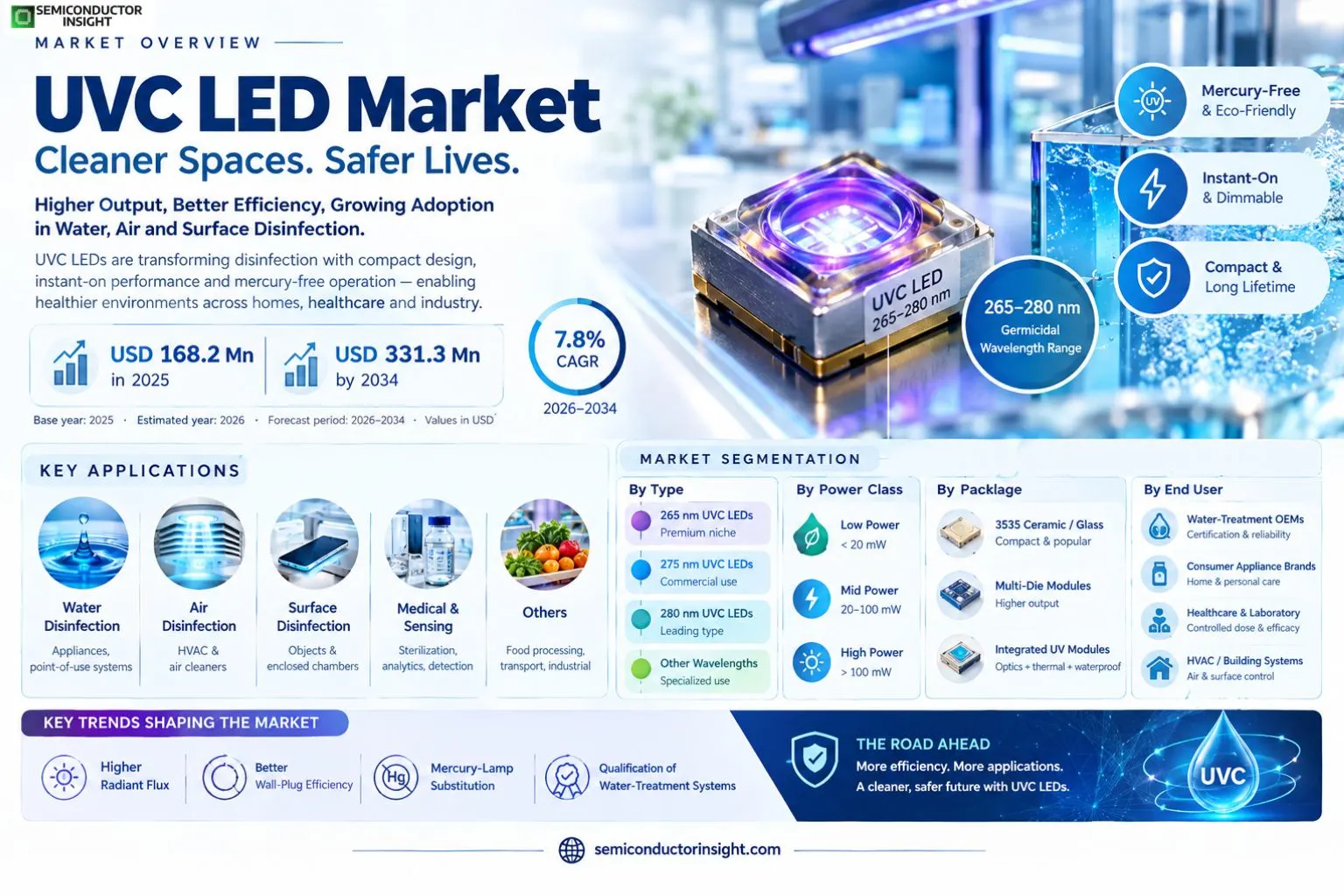
- Market size and growth: the market is valued at USD 168.2 million in 2025 and is projected to reach USD 331.3 million by 2034, with a 7.8% CAGR over 2026–2034.
- 280 nm UVC LEDs leads by type because 280 nm products combine mature output power, lifetime and manufacturability for water, air and surface disinfection systems.
- Water Disinfection is the leading application because compact solid-state UV sources offer instant-on operation, controllability and mercury-free integration in point-of-use systems.
- North America leads regionally, while Asia Pacific offers the strongest incremental growth.
- Primary driver: water, air and surface disinfection systems increasingly value compact, mercury-free and electronically controllable UV sources
- Principal restraint: wall-plug efficiency, thermal management and UVC LED cost remain challenging compared with mature mercury-lamp systems
Market Overview
The UVC LED market was valued at USD 168.2 million in 2025 and is projected to reach USD 331.3 million by 2034, expanding at a 7.8% CAGR over 2026–2034. North America leads in 2025, while the market is being reshaped by higher radiant flux, better wall-plug efficiency, mercury-lamp substitution and qualification of LED-based water-treatment systems..
UVC LEDs emit short-wavelength ultraviolet light used to inactivate microorganisms by damaging nucleic acids. Commercial devices commonly operate around 265–280 nm, with wavelength selection balancing germicidal effectiveness, semiconductor efficiency and lifetime. Unlike mercury lamps, LEDs are compact, instant-on, electronically dimmable and mercury-free, which makes them attractive for small water-treatment systems, air handling, appliances and surface disinfection.
Nichia’s current 280 nm portfolio reaches 135 mW in a 3.5 mm package and 200 mW in a four-die device, illustrating the rise in radiant output available to system designers. ams OSRAM’s OSLON UV 3535 device operates at 275 nm and is currently used in a baby-bottle sterilization platform, while Stanley offers a 265 nm module for stored-water and surface disinfection. These examples show that the market is differentiating by wavelength, power class and system integration.
Water-treatment qualification is becoming increasingly important. NSF’s current NSF/ANSI 55 listings include LED UV components and complete LED-based water-treatment products, indicating that solid-state UV is moving into formal certification frameworks. This supports adoption in residential and commercial water systems, but designers still need careful thermal management, optical dose control and safety interlocks because UVC radiation can harm skin and eyes.
Segment Analysis: By Type
By type, the market is segmented into 265 nm UVC LEDs, 275 nm UVC LEDs, 280 nm UVC LEDs, Other UVC Wavelengths. 280 nm UVC LEDs holds the leading position based on current performance requirements and deployment economics.
| Type | Function / role | Market position |
|---|---|---|
| 265 nm UVC LEDs | Wavelength close to peak DNA/RNA absorption and strong germicidal action. | Premium niche where microbial dose efficiency is prioritized. |
| 275 nm UVC LEDs | Balances germicidal effect with improving semiconductor efficiency. | Strong commercial use in appliances and compact disinfection products. |
| 280 nm UVC LEDs | High-output product class with broad availability from leading suppliers. | Leading type due to mature power, lifetime and cost trade-offs. |
| Other UVC Wavelengths | Includes lower or higher UVC wavelengths optimized for specific materials or organisms. | Specialized segment for sensing, research and tailored treatment systems. |
Commercial implications by type
The best wavelength depends on system-level dose economics rather than germicidal action alone. A 265 nm LED may be biologically efficient but a 275–280 nm device can deliver more optical power or better lifetime at a given cost. Designers therefore compare electrical efficiency, radiant flux, aging, thermal resistance and target-organism dose together.
Segment Analysis: By Application
By application, demand is segmented into Water Disinfection, Air Disinfection, Surface Disinfection, Medical & Sensing, Others. Water Disinfection is the leading application because it directly links the technology to measurable bandwidth, positioning, power, disinfection or system-efficiency benefits.
| Application | Demand characteristics |
|---|---|
| Water Disinfection | Largest application across dispensers, appliances and point-of-use treatment systems. |
| Air Disinfection | HVAC and compact air-cleaning systems use LEDs for controlled irradiation. |
| Surface Disinfection | Appliances and enclosed chambers treat objects without chemicals. |
| Medical & Sensing | Sterilization, analytical instruments and fluorescence or bio-detection create specialized demand. |
| Others | Food processing, transport and industrial treatment add niche uses. |
By Power Class
| Power Class | Commercial relevance |
|---|---|
| Low Power (<20 mW) | Sensors, small chambers and localized disinfection. |
| Mid Power (20–100 mW) | Mainstream appliance and water-treatment modules. |
| High Power (>100 mW) | High-flow water, larger chambers and demanding industrial systems. |
By Package
| Package | Commercial relevance |
|---|---|
| 3535 Ceramic / Glass | Popular compact form factor for single-chip UVC LEDs. |
| Multi-Die Modules | Combine several emitters to increase radiant output. |
| Integrated UV Modules | Add optics, thermal management and waterproof packaging for direct system use. |
By End User
| End User | Commercial relevance |
|---|---|
| Water-Treatment OEMs | Need reliable dose, waterproofing and certification. |
| Consumer Appliance Brands | Use compact LEDs in sterilizers and household products. |
| Healthcare & Laboratory | Require controlled dose and high confidence in efficacy. |
| HVAC / Building Systems | Integrate UVC into air-treatment and surface-control systems. |
Regional Analysis
North America leads the market because the controlling market page identifies North America as the largest consumption region, driven by early adoption in water and air disinfection. Asia Pacific has the strongest growth profile as demand expands through Japan, South Korea, China and Taiwan combine UVC semiconductor development, appliance manufacturing and growing disinfection-system demand.
How does regional demand differ across this market?
North America leads current consumption through water-treatment, healthcare and commercial disinfection. Japan and the broader Asia Pacific region have strong UVC LED manufacturing and application development, while Europe emphasizes chemical-free treatment and safety compliance. South America and the Middle East & Africa are smaller but offer water-treatment opportunities where compact, low-maintenance systems are valuable.
| Region | Position | Growth outlook | Demand profile | Supplier selection |
|---|---|---|---|---|
| North America | Largest | Strong | Water and air treatment | Certification, output, lifetime |
| Asia Pacific | Second | Fastest | LED manufacturing and appliances | Power, efficiency, cost |
| Europe | Third | Moderate | Water, healthcare and HVAC | Safety, compliance, efficiency |
| South America | Smaller | Moderate | Water treatment | Cost and service |
| Middle East & Africa | Emerging | Strong | Water scarcity and hygiene | Durability, dose, cost |
Competitive Landscape
Competition is concentrated among specialized deep-UV semiconductor companies and large LED manufacturers with expertise in AlGaN epitaxy, packaging and thermal management.
Nichia, ams OSRAM, Stanley, Seoul Viosys, Crystal IS, DOWA and other specialists compete on wavelength, radiant output, efficiency, lifetime and package reliability. The strongest suppliers can also provide application guidance for optical dose and thermal design.
Nichia’s current 280 nm products range from 62 mW to 200 mW, showing a clear move toward higher optical output. ams OSRAM’s 275 nm OSLON device is designed for disinfection applications and combines compact packaging with higher output, while Stanley’s 265 nm modules target stored-water treatment.
Certification and system integration are becoming more important competitive dimensions. NSF/ANSI 55 listings for LED UV components and systems show that customers increasingly expect verified product performance, not only emitter datasheets.
| Competitive tier | Representative participants | Competitive focus |
|---|---|---|
| Global LED leaders | Nichia, ams OSRAM, Seoul Viosys | Scale, packaging, reliability and product breadth |
| Deep-UV specialists | Crystal IS, Stanley, DOWA | UVC materials, wavelength expertise and system modules |
| Emerging suppliers | Violumas and regional vendors | High-output modules and application-specific products |
Companies Profiled
Nichia, ams OSRAM, Seoul Viosys, Crystal IS, Stanley Electric, DOWA Electronics Materials, Violumas
Production Capacity Analysis
Capacity depends on AlGaN epitaxy, deep-UV LED wafer processing, high-reflectivity packaging, thermal substrates, optical test and binning.
UVC LED fabrication is more difficult than visible LED production because high-aluminum-content AlGaN creates crystal defects and high electrical resistance. Yield, internal quantum efficiency and light extraction therefore have a large effect on cost.
Packaging must also survive intense UVC radiation and remove heat efficiently. Glass, ceramic and metal materials are preferred where common plastics would degrade. As output rises, module designers need better heat spreading and optical uniformity, so packaging capacity can become as important as epitaxy.
Market Dynamics
The market is moving from low-power proof-of-concept emitters toward higher-output devices and certified modules that can displace mercury lamps in selected applications.
Solid-state advantages are strongest in compact, intermittent and digitally controlled systems because LEDs can switch instantly and be arranged in application-specific geometries. Mercury lamps remain competitive in high-flow treatment where cost per optical watt is critical, so UVC LED growth depends on continued efficiency and lifetime improvements.
Market Drivers
Drivers Impact Analysis
| Driver | Impact | Commercial mechanism |
|---|---|---|
| Water disinfection | High | LEDs enable compact mercury-free treatment inside appliances and point-of-use systems. |
| Higher radiant output | High | New 100–200 mW devices reduce the number of LEDs required per system. |
| Chemical-free hygiene | Medium | Air and surface systems avoid residual disinfectant chemicals. |
| Certification progress | Medium | Formal water-treatment listings improve buyer confidence. |
Water disinfection
LEDs enable compact mercury-free treatment inside appliances and point-of-use systems.
Higher radiant output
New 100–200 mW devices reduce the number of LEDs required per system.
Chemical-free hygiene
Air and surface systems avoid residual disinfectant chemicals.
Certification progress
Formal water-treatment listings improve buyer confidence.
Market Restraints
Restraints Impact Analysis
| Restraint | Impact | Commercial mechanism |
|---|---|---|
| Wall-plug efficiency | High | Electrical-to-UVC conversion remains lower than mature visible LEDs. |
| Thermal management | High | Junction temperature strongly affects lifetime and output. |
| Cost per optical watt | High | Mercury lamps remain economical in some high-output applications. |
| Safety requirements | Medium | UVC exposure requires shielding and interlocks. |
Wall-plug efficiency
Electrical-to-UVC conversion remains lower than mature visible LEDs.
Thermal management
Junction temperature strongly affects lifetime and output.
Cost per optical watt
Mercury lamps remain economical in some high-output applications.
Safety requirements
UVC exposure requires shielding and interlocks.
Market Opportunities
Point-of-use water
Small flow systems benefit from instant-on solid-state UV.
High-output arrays
Multi-die devices can address higher flow and larger chambers.
Consumer sterilization
Compact packages enable bottle, toothbrush and appliance sanitation.
HVAC integration
LED arrays can target coils and air paths with electronic control.
Supply Chain Analysis
AlN/AlGaN substrates and epitaxial layers
Mesa, contacts, passivation
Ceramic/glass packages, lenses, thermal interfaces
Water, air, surface and medical systems
Epitaxy
Crystal quality and aluminum composition determine UVC efficiency and wavelength.
LED processing
Contact resistance and light extraction strongly influence usable output.
Packaging
UV-resistant materials and thermal paths determine lifetime.
System integration
Optical dose, flow, chamber geometry and safety controls determine disinfection performance.
Recent Developments
2026 — ams OSRAM UVC LEDs enter premium bottle sterilization
The 275 nm OSLON UV 3535 provides 26.5 mW typical radiant flux in a compact package. Source
Current — Nichia 280 nm portfolio reaches 135 mW and 200 mW classes
Current products target air, water, surface disinfection and mold control. Source
Current — NSF lists LED UV water-treatment systems
Current NSF/ANSI 55 listings include LED UV components and certified treatment products. Source
Report Scope & Segmentation
| Attribute | Coverage |
|---|---|
| Market | UVC LED |
| Base Year | 2025 |
| Estimated Year | 2026 |
| Forecast Period | 2026–2034 |
| 2025 Market Size | USD 168.2 million |
| 2026 Estimated Size | USD 181.4 million |
| 2034 Forecast Size | USD 331.3 million |
| CAGR | 7.8% (2026–2034) |
| By Type | 265 nm UVC LEDs, 275 nm UVC LEDs, 280 nm UVC LEDs, Other UVC Wavelengths |
| By Application | Water Disinfection, Air Disinfection, Surface Disinfection, Medical & Sensing, Others |
| By Power Class | Low Power (<20 mW), Mid Power (20–100 mW), High Power (>100 mW) |
| By Package | 3535 Ceramic / Glass, Multi-Die Modules, Integrated UV Modules |
| By End User | Water-Treatment OEMs, Consumer Appliance Brands, Healthcare & Laboratory, HVAC / Building Systems |
| Regions | North America, Asia Pacific, Europe, South America, Middle East & Africa |
| Companies Profiled | Nichia, ams OSRAM, Seoul Viosys, Crystal IS, Stanley Electric, DOWA Electronics Materials, Violumas |
Frequently Asked Questions
What is the UVC LED market size in 2025?
The market is valued at USD 168.2 million in 2025.
What is the projected market size by 2034?
The market is projected to reach USD 331.3 million by 2034.
What is the CAGR from 2026 to 2034?
The market is expected to expand at a 7.8% CAGR.
Which region leads the market?
North America is the largest regional market in 2025.
Which type leads the market?
280 nm UVC LEDs is the leading type.
Which application leads demand?
Water Disinfection is the leading application.
What is the main growth driver?
water, air and surface disinfection systems increasingly value compact, mercury-free and electronically controllable UV sources.
What is the principal restraint?
wall-plug efficiency, thermal management and UVC LED cost remain challenging compared with mature mercury-lamp systems.
Where are the strongest opportunities?
certified LED water treatment, high-output 265–280 nm devices, appliance sterilization and compact HVAC disinfection.
Which companies are active in the market?
Nichia, ams OSRAM, Seoul Viosys, Crystal IS, Stanley Electric, DOWA Electronics Materials, Violumas.
Research Sources & Evidence Base
View primary and official evidence used in this overview
- Nichia: UV-C 280 nm LED Portfolio — Current 62–200 mW UVC products and disinfection applications.
- Nichia: NCSU434D 280 nm — Current production status and 3535-package product information.
- ams OSRAM: OSLON UV 3535 in bottle sterilization — 275 nm product performance and commercial application.
- Stanley Electric: UV-C Product Lineup — 265 nm module for stored-water and surface disinfection.
- NSF: NSF/ANSI 55 UV Listings — Current certification listings including LED UV systems.
- DOWA Electronics Materials: Semiconductor Business / UV LED — Deep-UV LED development and semiconductor materials capability.

Get Sample Report PDF for Exclusive Insights
Report Sample Includes
- Table of Contents
- List of Tables & Figures
- Charts, Research Methodology, and more...
 Download Sample Report PDF