UV – LED Light Source Market Insights
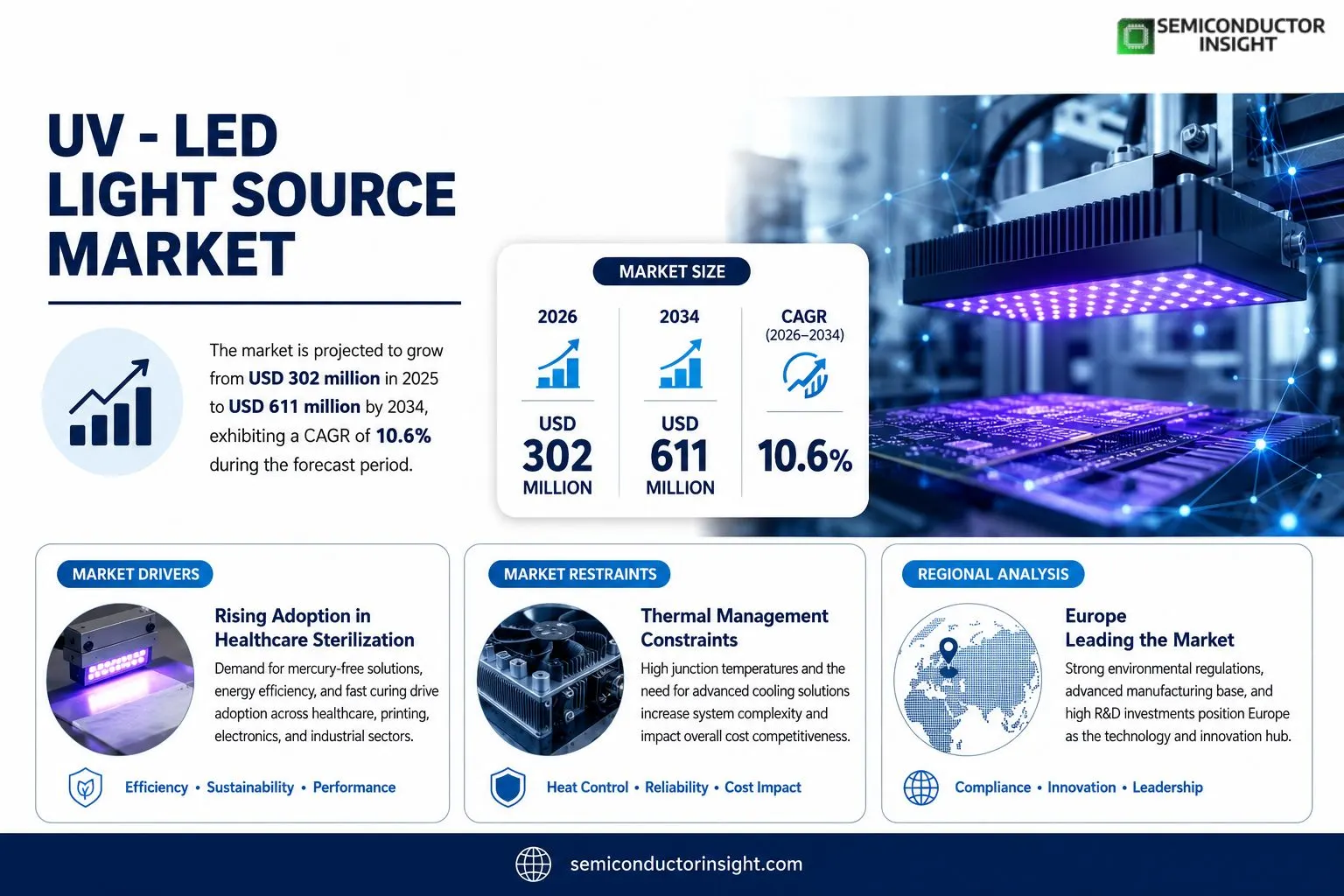
UV – LED Light Source market size was valued at USD 302 million in 2025 and is forecasted to reach USD 611 million by 2034, reflecting a CAGR of 10.6 % over the period.
UV‑LED curing light source refers to an industrial device or module that employs ultraviolet LEDstypically UVA wavelengths of 365 nm, 385 nm, 395 nm or 405 nmto deliver precise irradiance and dose control for photopolymerisation processes. The technology enables rapid curing of inks, coatings, adhesives and resins within seconds and is offered in spot, line and area/flood configurations. Up‑stream components comprise LED chips or packages, optics, thermal‑management solutions (air‑ or water‑cooled), power electronics and radiometric sensors; mid‑stream integration adds safety interlocks, shutters or dimming functions and communication interfaces; downstream users span printing & packaging, electronics assembly, medical device bonding, wood coating and fiber‑optic cable production. Pricing varies according to curing width, peak irradiance, cooling architecture and required certifications.
MARKET DRIVERS
Rising Adoption in Healthcare Sterilization
Hospitals and biotech facilities are replacing conventional mercury lamps with UV – LED Light Source Market offerings because the devices emit narrow‑band radiation that inactivates pathogens without the hazardous waste associated with mercury. This shift shortens validation cycles and aligns procurement policies with stricter environmental standards, creating a durable demand tail for LED‑based sterilizers.
Efficiency Gains in Industrial Curing
Manufacturers of polymers and inks cite the higher photon efficiency of UV‑LED arrays as a catalyst for faster line speeds. The ability to pulse light selectively reduces thermal load on substrates, which in turn lowers cycle‑time penalties and improves product throughput. Companies that retrofit legacy equipment with LED modules report measurable reductions in energy spend, reinforcing the business case for capital allocation.
➤ “When the total cost of ownership is calculated over a five‑year horizon, LED‑based curing systems frequently outperform traditional mercury units by 20‑30%.”
Beyond these immediate benefits, the broader sustainability agenda within large corporations is prompting procurement heads to prioritize technologies that support carbon‑reduction targets. UV – LED Light Source Market participants that can demonstrate lower lifecycle emissions are therefore positioned to capture incremental share from environmentally conscious buyers.
MARKET CHALLENGES
Regulatory Hurdles in Sensitive Applications
Medical device regulators continue to demand rigorous validation of UV‑LED outputs, particularly for applications involving direct patient exposure. The necessity to certify wavelength stability across temperature extremes adds layers of documentation, extending time‑to‑market for new product launches and inflating development budgets.
Other Challenges
Cost Competitiveness
While the efficiency of LED chips has improved, the bill of materials for high‑power UV arrays remains higher than that of established mercury solutions. End‑users with tight capital constraints often hesitate to adopt the newer technology until price parity is achieved at scale.
MARKET RESTRAINTS
Thermal Management Constraints
UV – LED Light Source Market devices generate concentrated heat in a compact footprint. Without sophisticated heat‑sink designs, junction temperatures can climb rapidly, accelerating lumen depreciation and shortening operational life. This technical barrier forces system integrators to allocate additional budget for cooling solutions, which can erode the perceived cost advantage.Furthermore, the lack of standardized thermal‑design guidelines across manufacturers creates variability in product reliability. OEMs that cannot guarantee consistent performance under harsh industrial conditions may face resistance from conservative buyers who prioritize proven durability over marginal efficiency gains.
MARKET OPPORTUNITIES
Emerging Applications in Water Treatment
Municipal and industrial water utilities are experimenting with UV‑LED reactors to address disinfection requirements while reducing chemical usage. The modular nature of LED assemblies allows for retrofitting existing pipelines, providing a low‑disruption pathway to upgrade aging infrastructure. Early pilots have demonstrated comparable microbial kill rates to conventional lamps, hinting at a scalable market segment.Integration with IoT platforms presents another growth vector. Smart sensors that monitor output power, wavelength drift, and temperature in real time enable predictive maintenance, lowering unplanned downtime and extending asset life. Vendors that bundle connectivity services with their LED hardware are able to differentiate on value‑added analytics.Geographic expansion into emerging economies offers untapped demand. Rapid urbanization and rising awareness of water‑borne diseases are prompting governments to invest in advanced treatment technologies. Companies that can navigate local supply‑chain realities and offer competitively priced LED modules stand to secure a foothold in these high‑growth markets.
UV – LED Light Source Market Trends
Regulatory Momentum Drives Adoption
Stringent controls on mercury‑based illumination have reshaped procurement policies across printing, coating and electronics firms. As authorities tighten emission limits, plant managers are compelled to replace legacy lamps with mercury‑free alternatives. UV – LED Light Source units satisfy compliance checklists while delivering comparable cure performance, which reduces the risk of regulatory penalties. The shift is not merely a compliance exercise; it also frees manufacturers from the logistical burden of hazardous waste handling. Consequently, equipment budgets are being re‑allocated toward LED‑based curing heads, and supply chains are seeing a steady uptick in orders for certified, low‑ozone modules.
Other Trends
Precision Demands in Electronics
Modern PCB assembly and semiconductor packaging rely on ultra‑accurate wavelength control and uniform irradiance to avoid rework. UV – LED Light Source devices, especially those operating at 365‑405 nm, can be tuned to within a few nanometers, delivering the repeatability required for fine‑pitch interconnects and 3‑D‑printed resin structures. Manufacturers are integrating real‑time feedback loops that adjust drive current based on temperature sensors, thereby stabilizing output even under continuous operation. This level of control translates into higher first‑pass yields and lower scrap rates, prompting OEMs to favor LED curing modules over traditional arc lamps for high‑value electronic products.
Thermal Management Advances Expand High‑Power Adoption
Recent breakthroughs in heat‑sink architecture and liquid‑cooling technologies have mitigated one of the longest‑standing barriers for UV – LED Light Source deployment: excess thermal load. By embedding micro‑channel cooling plates directly into the LED package, vendors can sustain higher drive currents without sacrificing lifespan. The result is a new class of high‑power emitters that can service large‑area coating lines and rapid‑cure industrial processes previously reserved for mercury lamps. Companies that invest in these thermally robust designs gain a competitive edge, as they can offer customers faster cycle times and lower total‑cost‑of‑ownership. This evolution is reshaping the equipment selection criteria and opening revenue streams for firms that can deliver dependable, high‑intensity solutions.
COMPETITIVE LANDSCAPE
Key Industry Players
Competitive Dynamics in the UV‑LED Light Source Market
Excelitas Technologies dominates the high‑power UV‑LED chip segment, leveraging a vertically integrated supply chain that couples proprietary AlGaN epitaxy with advanced thermal management modules. Its ability to offer tightly specified wavelengths (365‑405 nm) and scalable output powers has entrenched the company as the go‑to supplier for precision‑cure applications in semiconductor packaging and medical device assembly. By controlling both chip fabrication and driver electronics, Excelitas creates a pricing advantage that pressures pure‑play module assemblers, compelling them to focus on value‑added optics or niche form factors such as compact line‑source units for printed electronics. The market structure therefore reflects a bifurcation: a few chip‑centric giants supplying the high‑spec tier, and a broader set of system integrators competing on customization, cost efficiency, and regional service coverage.Beyond the dominant chip makers, a diverse cohort of specialists fuels market expansion. Shenzhen YongChen Guang Electronics and Wuhan UVLEDTEK supply mid‑range packages that balance output power with aggressive price points, satisfying the large‑volume printing and packaging segment. European firms such as IST‑METZ and Hamamatsu Photonics differentiate through precision optics and validated safety certifications, gaining footholds in automotive coating and aerospace composite curing. Niche players including Dymax, CoolUV Technology, and Height‑LED focus on handheld or area flood solutions, where ergonomic design and rapid start‑up are paramount. This layered ecosystem generates competitive pressure across the value chain, prompting incumbents to invest in higher‑efficiency heat‑sink architectures while challengers exploit emerging standards around wavelength stability and IoT‑enabled control interfaces.
List of Key UV‑LED Light Source Companies Profiled
- Excelitas Technologies
- Shenzhen YongChen Guang Electronics
- Wuhan UVLEDTEK
- IST‑METZ
- Hamamatsu Photonics
- Dymax
- CoolUV Technology
- Height‑LED
- Kyocera
- Uvitron International
- AVENTK
- COUSZ Suzhou Precision
- Banwo Technology
- Shenzhen LAMPLIC Technology
Segment Analysis:
| Segment Category | Sub-Segments | Key Insights |
| By Type |
|
UV‑LED Point Light Source is the leading sub‑segment because it delivers precise wavelength control and compact form‑factor, enabling tight integration in high‑density electronic assemblies.
|
| By Application |
|
Printing & Packaging emerges as the dominant application because UV‑LED curing delivers instantaneous ink set‑off, eliminating the need for post‑process ovens.
|
| By End User |
|
OEM Equipment Manufacturers lead this segment by integrating UV‑LED modules directly into next‑generation curing machines.
|
| By Cooling Method |
|
Air‑cooled dominates due to its simplicity, lower upfront cost, and ease of integration in compact curing units.
|
| By Market Trend |
|
Environmental Compliance is the primary driver because regulatory pressures to eliminate mercury‑based lamps are intensifying ly.
|
Regional Analysis: UV – LED Light Source Market
Europe
The EU’s tightening of hazardous substance directives forces manufacturers to redesign UV equipment, accelerating the shift toward LED sources. Compliance audits now emphasize durability and waste reduction, prompting vendors to embed traceability features that simplify end‑of‑life reporting for customers.
Electronics assembly and medical device sterilization dominate European adoption, driven by high‑volume production cycles and stringent hygiene standards. The automotive paint curing sector also shows rising interest as manufacturers seek faster cycle times with lower thermal footprints.
Mid‑range power densities are gaining traction, balancing cost and performance for medium‑scale production lines. Collaborative projects between universities and startups are delivering next‑generation AlGaN substrates that promise higher output at lower drive currents.
Proximity of silicon and sapphire wafer fabs to major OEM clusters reduces transit delays. European distributors increasingly offer value‑added services, such as on‑site calibration, which differentiate them from lower‑cost Asian alternatives.
North America
North America’s UV – LED Light Source Market is shaped by a vigorous venture‑capital ecosystem that fuels rapid product iteration. Silicon Valley firms prioritize integration of UV LEDs into autonomous sensor platforms, unlocking new use cases in environmental monitoring. Meanwhile, the pharmaceutical sector leverages LED germicidal properties to meet heightened sterility requirements post‑pandemic. Though regulatory pressure is less prescriptive than in Europe, industry consortia publish best‑practice guidelines that encourage manufacturers to pursue higher efficacy metrics. The region’s expansive logistics network supports large‑scale deployments, but price sensitivity among mid‑tier manufacturers drives interest in cost‑effective driver electronics sourced from Asia.
Asia‑Pacific
Asia‑Pacific presents a heterogeneous landscape where emerging economies adopt UV – LED Light Source technology to overcome legacy infrastructure constraints. In China, government incentives for energy‑saving technologies accelerate retrofits in textile curing, while Japan’s precision optics firms embed UV LEDs in high‑resolution lithography tools. The market is further energized by a surge in consumer‑grade sanitization devices, reflecting heightened public awareness of hygiene. Supply chains benefit from local semiconductor fabs, yet quality variations persist, prompting multinational buyers to implement rigorous supplier qualification programs.
South America
South America’s engagement with UV – LED Light Source solutions is largely driven by water treatment and agricultural packaging needs. Countries such as Brazil are piloting LED‑based disinfection units to address urban water safety challenges, aligning with broader sustainability agendas. In the food‑processing sector, LED curing reduces reliance on chemical preservatives, offering a cleaner label appeal that resonates with regional consumer trends. Market growth is moderated by limited access to high‑precision components, encouraging partnerships with European firms that can deliver calibrated modules and technical support.
Middle East & Africa
The Middle East & Africa region sees UV – LED Light Source adoption concentrated in high‑temperature industrial environments where conventional lamps suffer rapid degradation. Oil‑field service companies are experimenting with LED curing for pipeline coating, attracted by the technology’s lower heat output. In the Gulf, hospitality chains increasingly deploy UV‑LED air sterilization to meet luxury‑grade hygiene standards. African markets, while still nascent, are exploring low‑cost LED solutions for solar‑powered water purification, capitalizing on the technology’s minimal energy draw to address off‑grid community needs.
Report Scope
This market research report provides a comprehensive analysis of the UV – LED Light Source Market , covering the forecast period 2026–2034. It offers detailed insights into market dynamics, technological advancements, competitive landscape, and key trends shaping the industry.
Key focus areas of the report include:
- Market Overview: The report begins with an overview outlining its current market scenario, key growth indicators, and industry transformation drivers. It discusses macroeconomic factors, demand–supply balance, regulatory landscape, and the strategic role of semiconductors in powering advancements across industries such as automotive, telecommunications, consumer electronics, and industrial automation.
- Market Size & Forecast: Historical data and future projections for revenue, unit shipments, and market value across major regions and segments.
- Segmentation Analysis: Detailed breakdown by product type, technology, application, and end-user industry to identify high-growth segments and investment opportunities.
- Regional Insights: Insights into market performance across North America, Europe, Asia-Pacific, Latin America, and the Middle East & Africa, including country-level analysis where relevant.
- Competitive Landscape: Profiles of leading market participants, including their product offerings, R&D focus, manufacturing capacity, pricing strategies, and recent developments such as mergers, acquisitions, and partnerships.
- Technology Trends & Innovation: Assessment of emerging technologies, integration of AI/IoT, semiconductor design trends, fabrication techniques, and evolving industry standards.
- Market Drivers & Restraints: Evaluation of factors driving market growth along with challenges, supply chain constraints, regulatory issues, and market-entry barriers.
- Stakeholder Insights: Insights for component suppliers, OEMs, system integrators, investors, and policymakers regarding the evolving ecosystem and strategic opportunities.
Primary and secondary research methods are employed, including interviews with industry experts, data from verified sources, and real-time market intelligence to ensure the accuracy and reliability of the insights presented.
FREQUENTLY ASKED QUESTIONS:
What is the current market size of UV – LED Light Source Market?
-> UV – LED Light Source Market was valued at USD 302 million in 2025 and is expected to reach USD 611 million by 2034 at a CAGR of 10.6%.
Which key companies operate in UV – LED Light Source Market?
-> Key players include Excelitas Technologies, ShenZhen YongChen Guang Electronics Joint Stock, Henkel (Loctite), BW Converting, Hoenle, Hamamatsu Photonics, IST METZ, Xiamen Thray Technology, Dymax, Wuhan UVLEDTEK, Shanghai Yuewei Electronic Equipment, GEW, Kyocera, AVENTK, Uvitron International, CoolUV Technology, Futansi (ShangHai)Electronic Technogy, COUSZ Suzhou Precision, Height-LED, UVATA, Shenzhen Yishuziguang Technology, BANWO TECHNOLOGY, DAOYI, Shenzhen LAMPLIC technology, WEIHAILIXIN.
What are the key growth drivers?
-> Key growth drivers include environmental regulations phasing out mercury lamps, demand for energy‑saving solutions, technological advancements in high‑power chips and heat‑dissipation, and increasing adoption in printing, coating, electronics, and medical device sectors.
Which region dominates the market?
-> Asia holds the largest market share, driven by rapid industrial upgrading in China, Japan, and South Korea, while Europe remains a major market with strong environmental compliance initiatives.
What are the emerging trends?
-> Emerging trends include integration of intelligent light control, development of water‑cooled high‑power UV‑LED modules, and expansion into high‑precision applications such as semiconductor packaging and 3D‑printing.
Get Sample Report PDF for Exclusive Insights
Report Sample Includes
- Table of Contents
- List of Tables & Figures
- Charts, Research Methodology, and more...