MARKET INSIGHTS
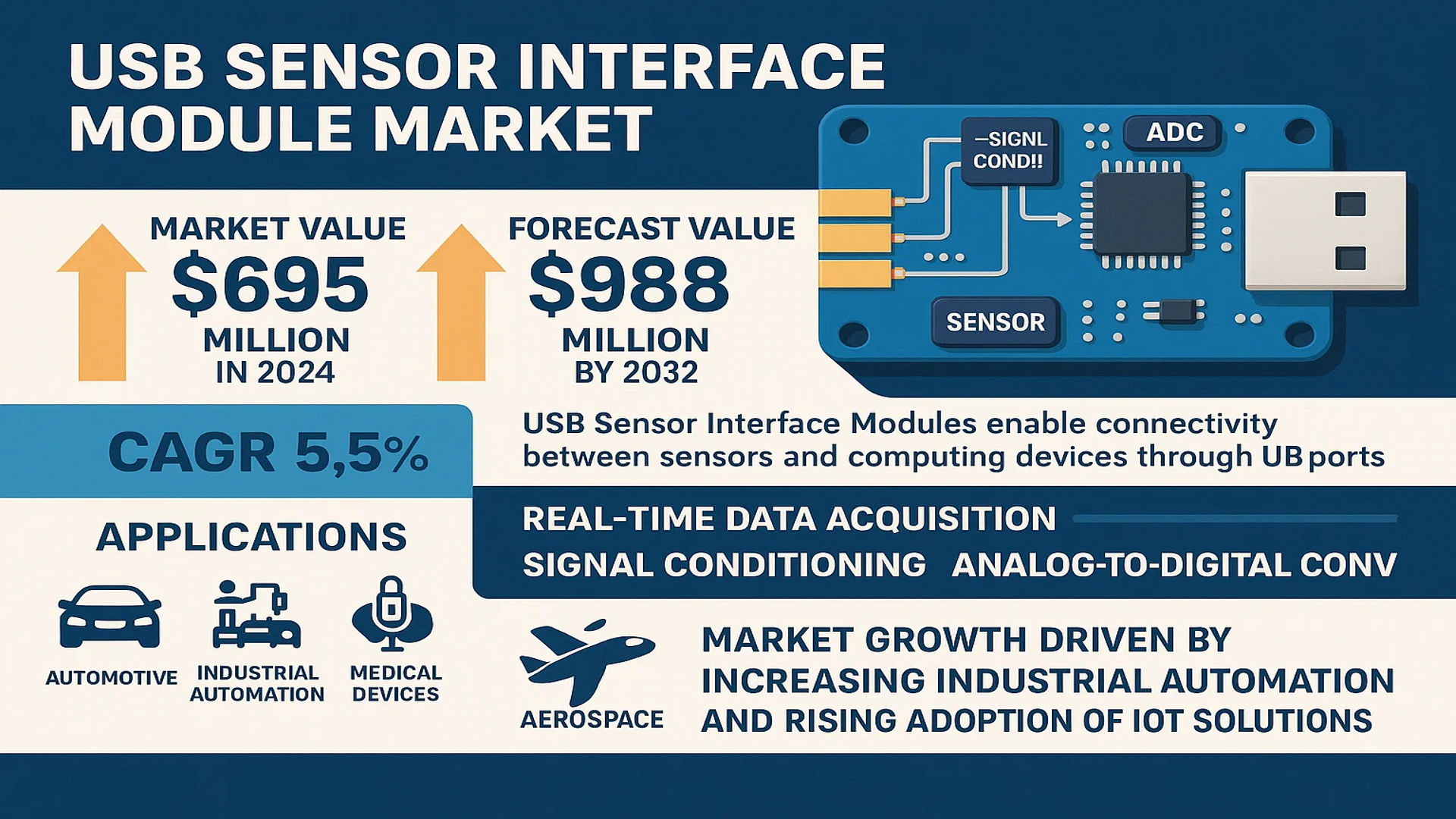
The global USB Sensor Interface Module market was valued at 695 million in 2024 and is projected to reach US$ 988 million by 2032, at a CAGR of 5.5% during the forecast period.
USB Sensor Interface Modules are hardware components that enable seamless connectivity between various sensors and computing devices through USB ports. These modules perform critical functions such as real-time data acquisition, signal conditioning, and analog-to-digital conversion, making them essential for monitoring environmental parameters and equipment performance. They find applications across diverse industries including automotive, industrial automation, medical devices, and aerospace.
The market growth is primarily driven by increasing industrial automation and the rising adoption of IoT solutions. However, challenges such as compatibility issues with legacy systems and data security concerns persist. Key players like Bosch, Siemens, and Omega Engineering are actively expanding their product portfolios through technological innovations. For instance, in 2023, Siemens launched a new line of USB interface modules with enhanced cybersecurity features for industrial applications.
MARKET DYNAMICS
MARKET DRIVERS
Expansion of Industrial Automation Fueling USB Sensor Interface Demand
The rapid adoption of Industry 4.0 technologies is creating significant growth opportunities for USB sensor interface modules. With global industrial automation investments projected to exceed $500 billion by 2027, the need for real-time data acquisition and processing is accelerating across manufacturing facilities. USB sensor interfaces provide plug-and-play connectivity for condition monitoring sensors, enabling predictive maintenance strategies that reduce unplanned downtime by up to 45%. Major automotive and electronics manufacturers are increasingly integrating these modules into their production lines for quality control and process optimization.
Medical Device Digitalization Driving Healthcare Adoption
The healthcare sector’s digital transformation is substantially increasing demand for medical-grade USB sensor interfaces. These modules enable seamless integration of vital sign monitors, imaging equipment, and diagnostic devices with hospital information systems. With telemedicine adoption growing at over 25% annually and connected medical devices becoming standard in patient care, USB sensor interfaces are becoming critical components in modern healthcare infrastructure. Their ability to maintain data integrity while complying with stringent medical regulations makes them particularly valuable in clinical environments.
Advancements in USB Technology Expanding Application Scope
The evolution from USB 2.0 to USB4 standards has significantly enhanced the capabilities of sensor interface modules, with data transfer speeds increasing from 480 Mbps to 40 Gbps. This technological leap enables high-speed streaming from multiple sensors simultaneously while supporting advanced features like real-time analytics and edge computing. The introduction of USB-C connectors with power delivery up to 100W has further expanded use cases, allowing single-cable solutions for both data and power in industrial and scientific applications. These developments are critical as sensor networks become more complex and data-intensive across industries.
MARKET RESTRAINTS
Cybersecurity Vulnerabilities Limiting Critical Sector Adoption
While USB sensor interfaces offer convenience, their vulnerability to cyber threats remains a significant concern for industries handling sensitive data. Studies indicate that USB-based attacks account for nearly 30% of industrial cybersecurity incidents, causing enterprises to hesitate in deploying these solutions without robust encryption and authentication protocols. The lack of standardized security features across manufacturers creates additional challenges for IT departments managing large-scale sensor networks, particularly in sectors like energy and healthcare where data breaches can have severe consequences.
Other Restraints
Compatibility Issues Across Operating Systems
The diversity of operating systems in industrial and scientific environments often leads to driver conflicts and functionality gaps with USB sensor interfaces. Many legacy systems still in operation cannot support modern USB standards without costly upgrades, creating barriers to widespread implementation.
Physical Connectivity Limitations
Despite USB’s ubiquity, the maximum reliable cable length of 5 meters for standard connections restricts deployment in large-scale industrial facilities. This limitation forces companies to invest in signal boosters or alternative connectivity solutions, increasing system complexity and cost.
MARKET CHALLENGES
Supply Chain Volatility Affecting Component Availability
The global semiconductor shortage continues to impact USB sensor interface module production, with lead times for critical components extending to 52 weeks in some cases. This supply chain disruption is particularly challenging for manufacturers needing to maintain inventory for diverse industry requirements. The situation is compounded by fluctuating raw material costs, forcing suppliers to implement frequent price adjustments that disrupt long-term customer budgeting and project planning.
Intense Competition from Wireless Alternatives
The growing adoption of industrial IoT and wireless sensor networks presents a competitive challenge to wired USB solutions. With wireless technologies offering installation flexibility and reduced infrastructure costs, many new deployments are opting for Bluetooth and Wi-Fi based sensor interfaces. This shift is especially noticeable in retrofit applications where running new cables is cost-prohibitive. USB interface manufacturers must demonstrate clear advantages in reliability and latency to justify their continued use in an increasingly wireless industrial landscape.
MARKET OPPORTUNITIES
Emerging Applications in Autonomous Vehicles Creating New Demand Centers
The development of autonomous vehicle testing platforms presents significant growth opportunities for ruggedized USB sensor interfaces. These modules are becoming essential for connecting LiDAR, radar, and camera arrays in prototype vehicles during the development phase. With over 300 autonomous vehicle testing projects currently active worldwide and investment in this sector exceeding $100 billion annually, specialized USB interfaces capable of handling multiple high-bandwidth sensor streams are seeing rapidly increasing demand.
Research & Education Sector Expansion Fueling Growth
Universities and research institutions are driving demand for modular USB sensor interfaces in scientific applications. These solutions provide affordable, flexible platforms for experimental setups across physics, chemistry, and engineering departments. With global research and development expenditure reaching $2.5 trillion annually and STEM education initiatives increasing worldwide, academic applications represent a high-growth segment. The ability to quickly reconfigure measurement systems without specialized hardware makes USB interfaces particularly valuable in educational settings where budget and versatility are key considerations.
USB SENSOR INTERFACE MODULE MARKET TRENDS
Rising Adoption Across Industrial Automation and Automotive Sectors to Drive Market Growth
The increasing automation across industries is significantly boosting demand for USB sensor interface modules, particularly in manufacturing, automotive, and aerospace applications. These modules facilitate real-time data acquisition and seamless connectivity between sensors and control systems, enhancing operational efficiency. In the automotive sector, USB sensor interfaces are increasingly integrated into electric vehicle (EV) battery management systems and autonomous driving technologies, contributing to a projected market expansion of over 6.2% CAGR in the automotive segment by 2032. Industrial automation, which accounted for 28% of total market share in 2024, continues to dominate applications due to widespread Industry 4.0 adoption.
Other Trends
Miniaturization and Enhanced Connectivity Standards
The development of compact, high-speed USB interfaces compatible with IoT ecosystems is reshaping the market landscape. Modern USB sensor modules now support protocols like USB 3.2 and USB-C, enabling faster data transfer rates up to 20 Gbps for high-frequency sensor applications. This evolution aligns with the growing need for portable diagnostic tools in medical devices and aerospace testing equipment. A key innovation includes plug-and-play modules with built-in signal conditioning, eliminating the need for additional hardware in 67% of new industrial installations as of 2024.
Advancements in Smart Manufacturing and Predictive Maintenance
Integration with AI-powered analytics platforms is transforming USB sensor modules into critical components for predictive maintenance systems. Manufacturers are increasingly adopting these solutions to monitor equipment health, with predictive maintenance applications expected to capture 35% of the industrial automation segment by 2027. Furthermore, the emergence of wireless USB sensor hubs has expanded deployment flexibility in hard-to-access environments, particularly in oil & gas and renewable energy infrastructure monitoring. This wireless segment grew by 18% YoY in 2023, signaling a shift toward hybrid wired-wireless industrial networks.
COMPETITIVE LANDSCAPE
Key Industry Players
Innovation and Strategic Expansion Drive Competition in the USB Sensor Interface Module Market
The global USB Sensor Interface Module market exhibits a dynamic and moderately fragmented competitive landscape, characterized by the presence of multinational corporations, mid-sized enterprises, and niche players. Siemens and Bosch dominate the market with their diversified industrial automation portfolios and extensive R&D capabilities. These companies leverage their brand reputation and technological expertise to secure a strong foothold, particularly in Europe and North America.
Omega Engineering and Pepperl+Fuchs have established themselves as key competitors due to their specialization in precision measurement solutions and robust customer support networks. Their ability to cater to evolving industry requirements, especially in sectors like automotive and industrial automation, strengthens their market position.
Smaller yet agile players, such as Lorenz Messtechnik GmbH and Applied Measurements, compete by offering customized USB sensor interfaces with high flexibility and cost-effectiveness. These firms often target niche applications, including aerospace and medical devices, where specialized signal conditioning is critical.
Recent developments highlight strategic partnerships and product diversification as primary growth drivers. For instance, Beckhoff Automation expanded its USB interface module lineup in 2024 with enhanced data acquisition speeds, catering to the rising demand for real-time monitoring solutions. Meanwhile, Japanese manufacturer Kyowa Electronic Instruments has been focusing on integrating AI-driven diagnostics into its sensor modules, addressing the increasing automation needs in smart manufacturing.
List of Key USB Sensor Interface Module Manufacturers
- Bosch (Germany)
- Siemens (Germany)
- Omega Engineering (U.S.)
- Pepperl+Fuchs (Germany)
- Lorenz Messtechnik GmbH (Germany)
- Hydronix (U.K.)
- Unipulse Corporation (Japan)
- Kyowa Electronic Instruments (Japan)
- Beckhoff Automation (Germany)
- Applied Measurements Ltd. (U.K.)
Segment Analysis:
By Type
Automatic Type Segment Leads the Market Due to Rising Demand for Smart Sensor Solutions
The market is segmented based on type into:
- Automatic Type
- Manual Type
By Application
Industrial Automation Segment Dominates Due to High Adoption in Smart Manufacturing
The market is segmented based on application into:
- Automotives
- Industrial Automation
- Medical Devices
- Electronics and Consumer Products
- Aerospace
- Research and Education
- Others
Regional Analysis: USB Sensor Interface Module Market
Asia-Pacific
The Asia-Pacific region dominates the global USB sensor interface module market, accounting for the highest revenue share due to rapid industrialization and the expansion of automation across key economies like China, Japan, and India. The automotive and electronics sectors, particularly in China, drive significant demand as manufacturers integrate IoT-based sensor solutions for smart manufacturing. Additionally, government initiatives such as China’s “Made in China 2025” and India’s focus on digital infrastructure modernization are accelerating adoption rates. While cost-efficient manual-type modules remain prevalent, the shift toward automated solutions is growing, supported by increasing investments in Industry 4.0 technologies.
North America
North America remains a critical market for USB sensor interface modules, primarily due to its advanced industrial automation landscape and thriving aerospace sector. The U.S. leads the region, with companies increasingly adopting high-precision sensor modules for applications in robotics, medical devices, and automotive testing. Stringent data security and connectivity standards further push innovation in USB-based interfaces. However, market growth is tempered by the maturity of end-user industries and competition from wireless alternatives. Key manufacturers like Omega and Bosch continue to invest in R&D to maintain technological leadership.
Europe
Europe’s market thrives on strong regulatory frameworks and a well-established industrial base, particularly in Germany and the U.K. The region emphasizes energy efficiency and sustainability, driving demand for USB sensor modules in smart buildings and renewable energy systems. The presence of major players like Siemens and Pepperl+Fuchs supports localized innovation, though the market faces challenges from slower industrial growth compared to Asia-Pacific. Adoption in aerospace and research sectors remains robust, with collaborations between universities and manufacturers fostering next-generation sensor solutions.
South America
South America exhibits gradual but steady growth, led by Brazil and Argentina’s expanding automotive and agricultural automation sectors. Limited local manufacturing capabilities result in reliance on imports, primarily from North America and Europe. Economic instability and underdeveloped infrastructure hinder broader adoption; however, niche applications in environmental monitoring and food processing present opportunities. Governments are gradually investing in industrial digitization, which could unlock future demand for USB sensor interfaces.
Middle East & Africa
This region shows nascent potential, with growth centered in Gulf Cooperation Council (GCC) countries like the UAE and Saudi Arabia, where smart city projects and oil & gas automation drive demand. Elsewhere, market penetration remains low due to limited awareness and budget constraints. South Africa leads in industrial and research applications, though political and economic uncertainties slow progress. Long-term prospects depend on increased foreign investment and infrastructure development.
Report Scope
This market research report provides a comprehensive analysis of the Global USB Sensor Interface Module Market, covering the forecast period 2024–2032. It offers detailed insights into market dynamics, technological advancements, competitive landscape, and key trends shaping the industry.
Key focus areas of the report include:
- Market Size & Forecast: Historical data and future projections for revenue, unit shipments, and market value across major regions and segments. The market was valued at USD 695 million in 2024 and is projected to reach USD 988 million by 2032, growing at a CAGR of 5.5%.
- Segmentation Analysis: Detailed breakdown by product type (Automatic and Manual), application (Automotive, Industrial Automation, Medical Devices, etc.), and end-user industry to identify high-growth segments.
- Regional Outlook: Insights into market performance across North America, Europe, Asia-Pacific, Latin America, and Middle East & Africa. The U.S. and China are key markets with significant growth potential.
- Competitive Landscape: Profiles of leading market participants including Encelium, Omega, Bosch, Siemens, and Pepperl+Fuchs, covering their product portfolios, market share, and strategic initiatives.
- Technology Trends: Assessment of emerging innovations in sensor integration, USB interface standards, and smart data acquisition solutions.
- Market Drivers & Restraints: Analysis of factors such as industrial automation growth, IoT adoption, and USB standardization versus challenges like cybersecurity concerns.
- Stakeholder Analysis: Strategic insights for sensor manufacturers, system integrators, and industrial automation providers.
The research employs primary interviews with industry experts and analysis of verified market data to ensure accuracy and reliability.
FREQUENTLY ASKED QUESTIONS:
What is the current market size of Global USB Sensor Interface Module Market?
-> USB Sensor Interface Module market was valued at 695 million in 2024 and is projected to reach US$ 988 million by 2032, at a CAGR of 5.5% during the forecast period.
Which key companies operate in this market?
-> Major players include Bosch, Siemens, Omega, Pepperl+Fuchs, Encelium, Helvar, and Beckhoff Automation.
What are the key growth drivers?
-> Growth is driven by industrial automation trends, USB standardization, and increasing demand for real-time data acquisition across industries.
Which region dominates the market?
-> Asia-Pacific shows the fastest growth, while North America and Europe remain technology and innovation leaders.
What are the emerging trends?
-> Key trends include USB-C adoption, integration with IIoT platforms, and development of multi-sensor interface modules.

Get Sample Report PDF for Exclusive Insights
Report Sample Includes
- Table of Contents
- List of Tables & Figures
- Charts, Research Methodology, and more...