Key Statistics
Key Takeaways
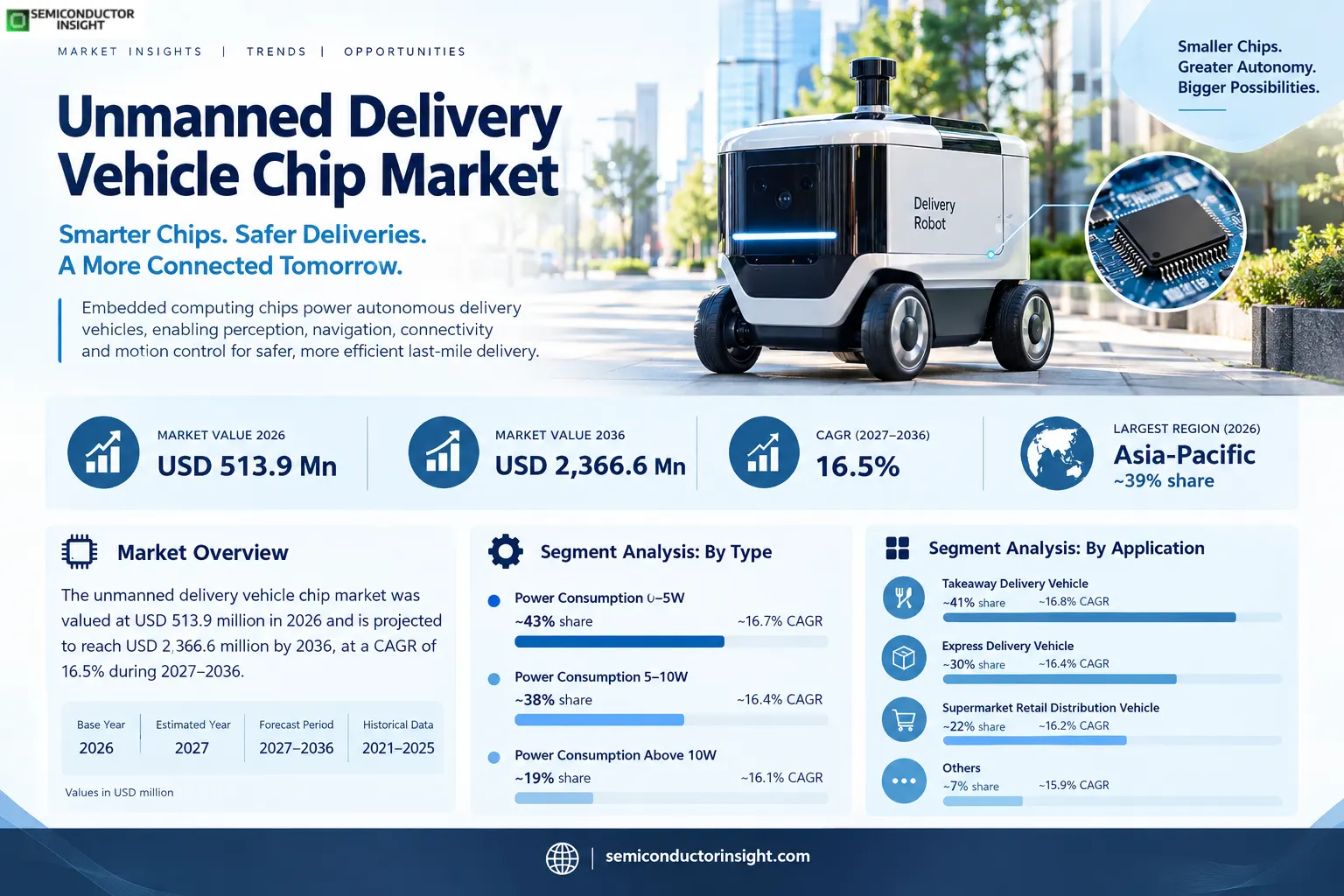
- Market value: The unmanned delivery vehicle chip market reached USD 513.9 million in 2026 and is projected to reach USD 2,366.6 million by 2036, representing a CAGR of 16.5% for 2027–2036 as customers adopt embedded computing chips used in low-speed driverless ground vehicles that transport food, parcels and local retail goods, integrating perception, path planning, connectivity and motion control.
- Power Consumption 0-5W: The largest type category commands an estimated ~43% of 2026 revenue; its commercial significance arises from autonomous last-metre and last-mile navigation that can scale without a proportional increase in remote human driving. Adjacent designs compete on performance, qualification and total installed cost.
- Takeaway Delivery Vehicle: The leading application accounts for an estimated ~41% of 2026 sales, driven by end-user requirements for repeatable local perception at low watts, deterministic control loops, robust connectivity and qualified safety performance. Purchase decisions are typically channelled through robot OEMs, autonomous mobility developers, contract electronics assemblers and local delivery-fleet operators.
- Asia-Pacific: Leading regional expenditure accounts for an estimated ~39% of 2026 revenue, with regional growth close to ~17.0% annually. Geography reflects China’s robotics and smart-driving chip development contributes manufacturing depth; Japan and South Korea add disciplined pilot operations, while Indian operators test logistics automation.
- Commercial restraint: Street-level navigation reliability, limited battery capacity, vulnerable pedestrians, remote operations and uneven city permission processes shape adoption. For ground-robot suppliers, a strong customer pipeline does not automatically turn into processor or aircraft orders until qualification, safety and installation conditions are satisfied.
Unmanned Delivery Vehicle Chip Market Overview
Unmanned delivery vehicle chip market was valued at USD 513.9 million in 2026 and is projected to reach USD 2,366.6 million by 2036, at a CAGR of 16.5% during 2027–2036. Asia-Pacific is the largest regional market, with an estimated ~39% of 2026 expenditure. The market boundary covers processor and controller devices within the vehicle bill of materials rather than the fleet operator’s delivery fees or the robot’s total hardware cost, rather than revenue from loosely connected service activities.
Unmanned delivery vehicle chip market covers embedded computing chips used in low-speed driverless ground vehicles that transport food, parcels and local retail goods, integrating perception, path planning, connectivity and motion control. The accounting boundary is semiconductor content purchased for unmanned ground delivery platforms, including processing and safety-control chips, but not the vehicle chassis, batteries, paid delivery service, restaurant commissions or aerial drone systems. Customers evaluating a supplier measure repeatable local perception at low watts, deterministic control loops, robust connectivity and qualified safety performance. These selection criteria affect not only purchase price but also which parts of the value chain can earn recurring demand from sidewalk-delivery operators, grocery chains, restaurant platforms, parcel logistics companies and industrial campus fleets.
Product scope should follow the transaction being priced: processor and controller devices within the vehicle bill of materials rather than the fleet operator’s delivery fees or the robot’s total hardware cost. For that reason the analysis separates hardware purchases from wider economic activities such as safe delivery trips, navigation decisions, obstacle avoidance events and uptime per charging cycle. Large end users generally specify delivery and support through robot OEMs, autonomous mobility developers, contract electronics assemblers and local delivery-fleet operators. Across sidewalk-robot fleets, this distinction prevents comparisons against adjacent markets that monetise the same deployments through different bills of materials and contracts.
Engineering advances focus on Horizon Robotics Journey processors, NVIDIA Jetson robotics compute and Qualcomm Dragonwing robotic SoCs. Equipment designers are balancing street-level navigation reliability, limited battery capacity, vulnerable pedestrians, remote operations and uneven city permission processes. With delivery-chip integration, the most competitive solution is not necessarily the highest-throughput product: platform fit, environmental resilience and validation effort can dominate the field decision. In delivery-robot programmes, the revenue mix therefore depends on deployment class, software release maturity and an ability to maintain technical service across successive equipment generations.
Demand originates in autonomous last-metre and last-mile navigation that can scale without a proportional increase in remote human driving. At robotic-delivery sites, as programmes move from test demonstrations to repeatable installation, operators must procure and qualify hardware at consistent volumes rather than ordering bespoke demonstration units. Across sidewalk-robot fleets, this creates a larger role for standard modules, design-support documentation and distributors with verified configuration control. At robotic-delivery sites, commercial buyers also compare integration and maintenance expenditure over several years, which can outweigh the initial hardware invoice.
The immediate market transition is toward more practical and verifiable deployments of embedded computing chips used in low-speed driverless ground vehicles that transport food, parcels and local retail goods, integrating perception, path planning, connectivity and motion control. Across sidewalk-robot fleets, leading firms have begun to offer more integrated product families while buyers require evidence of operability under real workloads. The binding constraints are street-level navigation reliability, limited battery capacity, vulnerable pedestrians, remote operations and uneven city permission processes. For delivery-robot chip buyers, product roadmaps are becoming closely aligned with certification milestones, installed asset cycles and the economics of reliable field operation rather than isolated engineering demonstrations.
Segment Analysis: By Type
By type, unmanned delivery vehicle chip is segmented into Power Consumption 0-5W, Power Consumption 5-10W, Power Consumption Above 10W. Power Consumption 0-5W leads with an estimated ~43% of 2026 revenue and demand across sidewalk-delivery operators, grocery chains, restaurant platforms, parcel logistics companies and industrial campus fleets. In delivery-robot programmes, the other types address alternative power, functional or mission requirements and are not interchangeable in system design. Each class has a different qualification pathway and unit-value profile.
| Type | Function | Market position |
|---|---|---|
| Power Consumption 0-5W | Power Consumption 0-5W addresses a defined performance and integration tier within unmanned delivery vehicle chip. For Power Consumption 0-5W, the purchasing case depends on the customer’s target operating envelope and the integration tasks implied by repeatable local perception at low watts, deterministic control loops, robust connectivity and qualified safety performance. The Power Consumption 0-5W approval programme includes development-tool compatibility, power and thermal measurements and expected fault behaviour during normal service. Buyers of Power Consumption 0-5W additionally examine supplier continuity and whether the package can be substituted during future maintenance or design updates. | This type carries an estimated ~43% of 2026 market revenue and ~16.7% annual growth over the model window. Across sidewalk-robot fleets, it is the largest type and provides the reference price point. The Power Consumption 0-5W procurement category competes on repeatable local perception at low watts, deterministic control loops, robust connectivity and qualified safety performance. A sustainable Power Consumption 0-5W supply programme depends on component availability, system-level qualification and repeat contracts won through robot OEMs, autonomous mobility developers, contract electronics assemblers and local delivery-fleet operators. |
| Power Consumption 5-10W | Power Consumption 5-10W addresses a defined performance and integration tier within unmanned delivery vehicle chip. For Power Consumption 5-10W, the purchasing case depends on the customer’s target operating envelope and the integration tasks implied by repeatable local perception at low watts, deterministic control loops, robust connectivity and qualified safety performance. The Power Consumption 5-10W approval programme includes development-tool compatibility, power and thermal measurements and expected fault behaviour during normal service. Buyers of Power Consumption 5-10W additionally examine supplier continuity and whether the package can be substituted during future maintenance or design updates. | This type carries an estimated ~38% of 2026 market revenue and ~16.4% annual growth over the model window. In delivery-robot programmes, it addresses a narrower deployment profile with differentiated value per unit. The Power Consumption 5-10W procurement category competes on repeatable local perception at low watts, deterministic control loops, robust connectivity and qualified safety performance. A sustainable Power Consumption 5-10W supply programme depends on component availability, system-level qualification and repeat contracts won through robot OEMs, autonomous mobility developers, contract electronics assemblers and local delivery-fleet operators. |
| Power Consumption Above 10W | Power Consumption Above 10W addresses a defined performance and integration tier within unmanned delivery vehicle chip. For Power Consumption Above 10W, the purchasing case depends on the customer’s target operating envelope and the integration tasks implied by repeatable local perception at low watts, deterministic control loops, robust connectivity and qualified safety performance. The Power Consumption Above 10W approval programme includes development-tool compatibility, power and thermal measurements and expected fault behaviour during normal service. Buyers of Power Consumption Above 10W additionally examine supplier continuity and whether the package can be substituted during future maintenance or design updates. | This type carries an estimated ~19% of 2026 market revenue and ~16.1% annual growth over the model window. For customers assessing Power Consumption Above 10W market position, it addresses a narrower deployment profile with differentiated value per unit. The Power Consumption Above 10W procurement category competes on repeatable local perception at low watts, deterministic control loops, robust connectivity and qualified safety performance. A sustainable Power Consumption Above 10W supply programme depends on component availability, system-level qualification and repeat contracts won through robot OEMs, autonomous mobility developers, contract electronics assemblers and local delivery-fleet operators. |
Segment Analysis: By Application
By application, unmanned delivery vehicle chip is divided among Takeaway Delivery Vehicle, Express Delivery Vehicle, Supermarket Retail Distribution Vehicle, Others. Takeaway Delivery Vehicle has the largest estimated ~41% share in 2026. Customer requirements differ as strongly as sidewalk-delivery operators, grocery chains, restaurant platforms, parcel logistics companies and industrial campus fleets differ from one another. At robotic-delivery sites, suppliers adapt their service, training and qualification plans to these individual purchasing environments.
| Application | Demand characteristics |
|---|---|
| Takeaway Delivery Vehicle | Takeaway Delivery Vehicle accounts for an estimated ~41% of 2026 market value and is modelled at roughly ~16.8% annual growth. Orders for Takeaway Delivery Vehicle are triggered by requirements for safe delivery trips, navigation decisions, obstacle avoidance events and uptime per charging cycle, as well as repeatable local perception at low watts, deterministic control loops, robust connectivity and qualified safety performance. Before purchasing for Takeaway Delivery Vehicle, operators review operating conditions, application software, platform resilience and how field maintenance will be handled. The commercial success of Takeaway Delivery Vehicle follows actually deployed applications rather than broad technical specifications alone. |
| Express Delivery Vehicle | Express Delivery Vehicle accounts for an estimated ~30% of 2026 market value and is modelled at roughly ~16.4% annual growth. Orders for Express Delivery Vehicle are triggered by requirements for safe delivery trips, navigation decisions, obstacle avoidance events and uptime per charging cycle, as well as repeatable local perception at low watts, deterministic control loops, robust connectivity and qualified safety performance. Before purchasing for Express Delivery Vehicle, operators review operating conditions, application software, platform resilience and how field maintenance will be handled. The commercial success of Express Delivery Vehicle follows actually deployed applications rather than broad technical specifications alone. |
| Supermarket Retail Distribution Vehicle | Supermarket Retail Distribution Vehicle accounts for an estimated ~22% of 2026 market value and is modelled at roughly ~16.2% annual growth. Orders for Supermarket Retail Distribution Vehicle are triggered by requirements for safe delivery trips, navigation decisions, obstacle avoidance events and uptime per charging cycle, as well as repeatable local perception at low watts, deterministic control loops, robust connectivity and qualified safety performance. Before purchasing for Supermarket Retail Distribution Vehicle, operators review operating conditions, application software, platform resilience and how field maintenance will be handled. The commercial success of Supermarket Retail Distribution Vehicle follows actually deployed applications rather than broad technical specifications alone. |
| Others | Others accounts for an estimated ~7% of 2026 market value and is modelled at roughly ~15.9% annual growth. Orders for Others are triggered by requirements for safe delivery trips, navigation decisions, obstacle avoidance events and uptime per charging cycle, as well as repeatable local perception at low watts, deterministic control loops, robust connectivity and qualified safety performance. Before purchasing for Others, operators review operating conditions, application software, platform resilience and how field maintenance will be handled. The commercial success of Others follows actually deployed applications rather than broad technical specifications alone. |
The route to market usually passes through robot OEMs, autonomous mobility developers, contract electronics assemblers and local delivery-fleet operators. With delivery-chip integration, customer qualification can take longer than component or airframe production, especially where safety and interoperability are important. Across sidewalk-robot fleets, a fast-growing end market does not always translate into a similar component-revenue growth rate because replacement cycles, configuration standards and negotiated prices vary. For delivery-robot chip buyers, the channel analysis therefore separates equipment demand from downstream service earnings and investigates which firms actually own the purchasing decision.
Regional Analysis
Asia-Pacific leads the global unmanned delivery vehicle chip market in 2026 with an estimated ~39% share. The three largest regions are Asia-Pacific (~39%), North America (~26%), Europe (~23%), while Asia-Pacific has the fastest modelled growth at ~17.0% CAGR. Regional supply and demand are concentrated in Asia-Pacific through local investment and distribution networks. At robotic-delivery sites, smaller regions have different adoption gates rather than simply representing scaled-down versions of leading markets.
How does the commercial logic differ by region in the unmanned delivery vehicle chip market?
Global demand varies because street-level navigation reliability, limited battery capacity, vulnerable pedestrians, remote operations and uneven city permission processes. For ground-robot suppliers, north America, Europe, Asia-Pacific, South America and the Middle East and Africa therefore differ in qualification practice, operating geography and available procurement channels. With delivery-chip integration, local supplier support and customer experience can matter as much as technology capability when systems must be deployed and serviced at scale. With delivery-chip integration, consequently the regional estimate is a distribution of equipment expenditure, not a count of every related downstream service transaction.
| Region | Position | Growth outlook | Demand profile | What decides supplier selection |
|---|---|---|---|---|
| Asia-Pacific | Largest (~39%) | Fastest (~17.0% CAGR) | Local chip supply and dense urban delivery | Supplier selection in Asia-Pacific depends on local chip supply and dense urban delivery. China’s robotics and smart-driving chip development contributes manufacturing depth; Japan and South Korea add disciplined pilot operations, while Indian operators test logistics automation. In Asia-Pacific, supply awards depend on repeatable local perception at low watts, deterministic control loops, robust connectivity and qualified safety performance, performance under field workloads and dependable local technical support. At robotic-delivery sites, asia-Pacific procurement policies determine whether equipment purchases move directly from OEMs, via distributors or through larger system contracts. |
| North America | Second (~26%) | Measured (~16.6% CAGR) | Platform pilots and customer utilisation | Supplier selection in North America depends on platform pilots and customer utilisation. U.S. robot-delivery programmes link autonomous fleet operations with restaurant software and dense university or urban catchments; chip demand follows fleet additions and hardware refreshes. In North America, supply awards depend on repeatable local perception at low watts, deterministic control loops, robust connectivity and qualified safety performance, performance under field workloads and dependable local technical support. For ground-robot suppliers, north America procurement policies determine whether equipment purchases move directly from OEMs, via distributors or through larger system contracts. |
| Europe | Third (~23%) | Measured (~15.9% CAGR) | Pedestrian safety and municipal permission | Supplier selection in Europe depends on pedestrian safety and municipal permission. European automation suppliers emphasise system safety, predictable low-speed behaviour, serviceability and compliance before scaling robots across mixed-use pedestrian environments. In Europe, supply awards depend on repeatable local perception at low watts, deterministic control loops, robust connectivity and qualified safety performance, performance under field workloads and dependable local technical support. Across sidewalk-robot fleets, europe procurement policies determine whether equipment purchases move directly from OEMs, via distributors or through larger system contracts. |
| Middle East & Africa | Fourth (~6%) | Measured (~16.0% CAGR) | Controlled-route robotics adoption | Supplier selection in Middle East & Africa depends on controlled-route robotics adoption. Gulf retail developments and managed campuses provide defined operating environments while hot climates increase demands on heat dissipation and enclosure engineering. In Middle East & Africa, supply awards depend on repeatable local perception at low watts, deterministic control loops, robust connectivity and qualified safety performance, performance under field workloads and dependable local technical support. Across sidewalk-robot fleets, middle East & Africa procurement policies determine whether equipment purchases move directly from OEMs, via distributors or through larger system contracts. |
| South America | Fifth (~6%) | Measured (~16.0% CAGR) | Economics-led pilot deployments | Supplier selection in South America depends on economics-led pilot deployments. Brazilian retail logistics can benefit from lower labour-independent route costs, but pavements, weather and variable connectivity make reliable autonomous navigation difficult. In South America, supply awards depend on repeatable local perception at low watts, deterministic control loops, robust connectivity and qualified safety performance, performance under field workloads and dependable local technical support. Across sidewalk-robot fleets, south America procurement policies determine whether equipment purchases move directly from OEMs, via distributors or through larger system contracts. |
Competitive Landscape
Competitive dynamics in unmanned delivery vehicle chip span silicon or vehicle manufacturers, platform integrators and procurement intermediaries. Leading direct suppliers include Horizon Robotics, Black Sesame Technologies, Nanjing Semidrive Technology, NVIDIA, while other profiled companies participate through adjacent platforms or customer programmes. Competition hinges on repeatable local perception at low watts, deterministic control loops, robust connectivity and qualified safety performance. With delivery-chip integration, buyer access requires field validation, software support and a credible plan for spare parts and technical continuity.
Across sidewalk-robot fleets, product leadership is defined by real implementation experience rather than company-wide revenue. Horizon Robotics, Black Sesame Technologies, Nanjing Semidrive Technology, NVIDIA have portfolios relevant to the sector, although each operates across a broader collection of products. Across sidewalk-robot fleets, it is important to assess only the relevant platform or device families when comparing supplier positions. With delivery-chip integration, procurement wins also depend on reference designs, channel access and capability to fix deployment issues after installation.
Suppliers compete across multiple qualification thresholds. Buyers seek repeatable local perception at low watts, deterministic control loops, robust connectivity and qualified safety performance and increasingly request integration toolchains, compliance records and known configurations. For delivery-robot chip buyers, continuous product revisions must be compatible with the customer’s service life and existing assets. In delivery-robot programmes, as a result, early price discounts do not guarantee a design win unless a supplier can maintain support through complete deployment cycles.
Adjacent companies are influential without necessarily supplying the market-defining device. HUAWEI, ZTE Corporation can affect platform specifications, distribution or adoption economics, while other manufacturers supply supporting electronics. For delivery-robot chip buyers, including the entire revenue of a service platform or parent company would overstate the equipment market. In delivery-robot programmes, tier comparisons distinguish direct hardware suppliers, niche specialists and system-level ecosystem participants.
For delivery-robot chip buyers, the most durable commercial advantage comes from repeatable delivery rather than isolated demonstrations. For ground-robot suppliers, component traceability, repair logistics, manufacturing capacity and the ability to meet an OEM testing protocol are material competitive factors. When street-level navigation reliability, limited battery capacity, vulnerable pedestrians, remote operations and uneven city permission processes, customers favour suppliers capable of maintaining stable product revisions. In delivery-robot programmes, this favours vendors that combine technical capability with dependable field support and contract discipline.
Tier structure
| Tier | Companies | Basis of competition |
|---|---|---|
| Tier 1 | Horizon Robotics, Black Sesame Technologies, Nanjing Semidrive Technology, NVIDIA | Direct hardware suppliers compete on a combination of validated product capability and timely deliveries. The relevant offering must satisfy repeatable local perception at low watts, deterministic control loops, robust connectivity and qualified safety performance. For ground-robot suppliers, when evaluating the Tier 1 category, purchasers consider interoperability, component life and testing evidence, not simply the supplier’s brand. The Tier 1 business grows through repeated orders from established robot OEMs, autonomous mobility developers, contract electronics assemblers and local delivery-fleet operators. |
| Tier 2 | Horizon Robotics, Black Sesame Technologies | Specialised vendors concentrate on narrower functional or customer niches. Their products may offer favourable trade-offs against street-level navigation reliability, limited battery capacity, vulnerable pedestrians, remote operations and uneven city permission processes. For delivery-robot chip buyers, for the Tier 2 supplier group, sales opportunities depend on the buyer’s willingness to support additional integration and qualification work. For delivery-robot chip buyers, for Tier 2 providers, long-term service arrangements can offset their smaller sales organisations and manufacturing footprints. |
| Ecosystem | HUAWEI, ZTE Corporation | Systems and service participants influence the final design without always producing the market-defining hardware. The Ecosystem participants shape customer requirements, installation plans and acceptance criteria connected to safe delivery trips, navigation decisions, obstacle avoidance events and uptime per charging cycle. For ground-robot suppliers, including the full revenue of these Ecosystem participants as direct product-market sales would double-count adjacent activity. At robotic-delivery sites, the supplier model therefore treats these participants separately from manufacturers of the primary hardware. |
Key companies profiled
- Horizon Robotics
- Black Sesame Technologies
- Nanjing Semidrive Technology
- HUAWEI
- NVIDIA
- ZTE Corporation
Production Capacity Analysis
Production in the unmanned delivery vehicle chip market combines product development, contracted manufacture, test and field qualification. Capacity must be evaluated for the equipment covered by semiconductor content purchased for unmanned ground delivery platforms, including processing and safety-control chips, but not the vehicle chassis, batteries, paid delivery service, restaurant commissions or aerial drone systems. In delivery-robot programmes, supplier output depends on reliable upstream components and the availability of teams able to certify each platform generation. For delivery-robot chip buyers, installed production lines are not equivalent to saleable market output when customer acceptance testing and configuration restrictions remain binding.
Upstream manufacturing begins with specialised equipment and electronics matched to embedded computing chips used in low-speed driverless ground vehicles that transport food, parcels and local retail goods, integrating perception, path planning, connectivity and motion control. Across sidewalk-robot fleets, designs are converted into repeatable builds using supplier-qualified parts, automated verification and controlled firmware releases. For delivery-robot chip buyers, factories operating multiple programmes must schedule production batches according to expected customer acceptance and servicing demand. For delivery-robot chip buyers, the resulting throughput can differ substantially from nominal assembly capacity, especially during early qualification and engineering changes.
Diversified production and overseas service centres have a direct effect on the cost of unmanned delivery vehicle chip. Across sidewalk-robot fleets, for customers operating across continents, replacement units and regulatory documentation can be as important as local final assembly. At robotic-delivery sites, companies may therefore dual-source electronics or maintain additional field-stock hubs where import lead times are unpredictable. Across sidewalk-robot fleets, this reduces the operational disruption that can result when equipment is repaired far from its initial manufacturing plant.
The practical bottlenecks include street-level navigation reliability, limited battery capacity, vulnerable pedestrians, remote operations and uneven city permission processes. At robotic-delivery sites, manufacturers must control incoming components, update software securely and demonstrate consistent performance in representative operating conditions. In delivery-robot programmes, a design sold into a regulated mission cannot be readily modified without further validation. For ground-robot suppliers, the commercial effect is a preference for stable approved parts and a need to fund parallel product generations during technology transitions.
Market Dynamics
Market dynamics reflect customer demand for autonomous last-metre and last-mile navigation that can scale without a proportional increase in remote human driving, balanced against street-level navigation reliability, limited battery capacity, vulnerable pedestrians, remote operations and uneven city permission processes. In delivery-robot programmes, the drivers below describe directional factors on growth rather than independently measured contributions to the headline forecast. Across sidewalk-robot fleets, technology choices are mediated by channel access and programme commissioning schedules. At robotic-delivery sites, projected market revenue therefore depends on actual procurement milestones, hardware qualification and completed operational rollouts.
MARKET DRIVERS
Drivers Impact Analysis*
| Driver | (~) % impact on CAGR forecast | Geographic relevance | Impact timeline |
|---|---|---|---|
| Growing service-robot deliveries | +0.3% | Global / selected adopter markets | 2026–2036 |
| Local perception and safety-compute requirements | +0.5% | Global / selected adopter markets | 2026–2036 |
| Robotics chip design standardisation | +0.6% | Global / selected adopter markets | 2026–2036 |
| Commercial fleet electrification | +0.8% | Global / selected adopter markets | 2026–2036 |
| Fleet or installed-base renewal | +0.9% | Global / selected adopter markets | 2026–2036 |
Growing service-robot deliveries
Growing service-robot deliveries supports demand for unmanned delivery vehicle chip. The commercial effect of growing service-robot deliveries is observed when customers require safe delivery trips, navigation decisions, obstacle avoidance events and uptime per charging cycle in a reliable operating environment. Purchasers affected by growing service-robot deliveries translate requirements into specifications for repeatable local perception at low watts, deterministic control loops, robust connectivity and qualified safety performance. In growing service-robot deliveries programmes, the sale depends on field-validation success and the supplier’s ability to sustain volume production rather than demand estimates alone.
Local perception and safety-compute requirements
Local perception and safety-compute requirements supports demand for unmanned delivery vehicle chip. The commercial effect of local perception and safety-compute requirements is observed when customers require safe delivery trips, navigation decisions, obstacle avoidance events and uptime per charging cycle in a reliable operating environment. Purchasers affected by local perception and safety-compute requirements translate requirements into specifications for repeatable local perception at low watts, deterministic control loops, robust connectivity and qualified safety performance. In local perception and safety-compute requirements programmes, the sale depends on field-validation success and the supplier’s ability to sustain volume production rather than demand estimates alone.
Robotics chip design standardisation
Robotics chip design standardisation supports demand for unmanned delivery vehicle chip. The commercial effect of robotics chip design standardisation is observed when customers require safe delivery trips, navigation decisions, obstacle avoidance events and uptime per charging cycle in a reliable operating environment. Purchasers affected by robotics chip design standardisation translate requirements into specifications for repeatable local perception at low watts, deterministic control loops, robust connectivity and qualified safety performance. In robotics chip design standardisation programmes, the sale depends on field-validation success and the supplier’s ability to sustain volume production rather than demand estimates alone.
Commercial fleet electrification
Commercial fleet electrification supports demand for unmanned delivery vehicle chip. The commercial effect of commercial fleet electrification is observed when customers require safe delivery trips, navigation decisions, obstacle avoidance events and uptime per charging cycle in a reliable operating environment. Purchasers affected by commercial fleet electrification translate requirements into specifications for repeatable local perception at low watts, deterministic control loops, robust connectivity and qualified safety performance. In commercial fleet electrification programmes, the sale depends on field-validation success and the supplier’s ability to sustain volume production rather than demand estimates alone.
MARKET RESTRAINTS
Restraints Impact Analysis*
| Restraint | (~) % impact on CAGR forecast | Geographic relevance | Impact timeline |
|---|---|---|---|
| Robot operating rules and pedestrian safety | -0.2% | Selected end markets | 2026–2036 |
| Battery-limited heat and energy budgets | -0.3% | Selected end markets | 2026–2036 |
| Teleoperation and connectivity overhead | -0.4% | Selected end markets | 2026–2036 |
| Chip qualification cost at small volumes | -0.6% | Selected end markets | 2026–2036 |
Robot operating rules and pedestrian safety
Robot operating rules and pedestrian safety can delay expenditure on unmanned delivery vehicle chip. Buyers facing street-level navigation reliability, limited battery capacity, vulnerable pedestrians, remote operations and uneven city permission processes may reduce fleet growth, defer system integration or select lower-cost equipment with longer lead times. The response to robot operating rules and pedestrian safety requires suppliers to prove performance and offer maintainable lifecycle commitments to overcome these constraints. This specific restraint, robot operating rules and pedestrian safety, extends procurement schedules despite the presence of a credible long-term requirement.
Battery-limited heat and energy budgets
Battery-limited heat and energy budgets can delay expenditure on unmanned delivery vehicle chip. Within qualification procedures for Battery-limited heat and energy budgets, buyers facing street-level navigation reliability, limited battery capacity, vulnerable pedestrians, remote operations and uneven city permission processes may reduce fleet growth, defer system integration or select lower-cost equipment with longer lead times. The response to battery-limited heat and energy budgets requires suppliers to prove performance and offer maintainable lifecycle commitments to overcome these constraints. This specific restraint, battery-limited heat and energy budgets, extends procurement schedules despite the presence of a credible long-term requirement.
Teleoperation and connectivity overhead
Teleoperation and connectivity overhead can delay expenditure on unmanned delivery vehicle chip. For commercial projects involving Teleoperation and connectivity overhead, buyers facing street-level navigation reliability, limited battery capacity, vulnerable pedestrians, remote operations and uneven city permission processes may reduce fleet growth, defer system integration or select lower-cost equipment with longer lead times. The response to teleoperation and connectivity overhead requires suppliers to prove performance and offer maintainable lifecycle commitments to overcome these constraints. This specific restraint, teleoperation and connectivity overhead, extends procurement schedules despite the presence of a credible long-term requirement.
Chip qualification cost at small volumes
Chip qualification cost at small volumes can delay expenditure on unmanned delivery vehicle chip. In service networks supporting Chip qualification cost at small volumes, buyers facing street-level navigation reliability, limited battery capacity, vulnerable pedestrians, remote operations and uneven city permission processes may reduce fleet growth, defer system integration or select lower-cost equipment with longer lead times. The response to chip qualification cost at small volumes requires suppliers to prove performance and offer maintainable lifecycle commitments to overcome these constraints. This specific restraint, chip qualification cost at small volumes, extends procurement schedules despite the presence of a credible long-term requirement.
MARKET OPPORTUNITIES
Low-power edge vision acceleration
Low-power edge vision acceleration provides a route into adjacent customer segments for unmanned delivery vehicle chip. The commercial opportunity is to solve a specific deployment problem involving repeatable local perception at low watts, deterministic control loops, robust connectivity and qualified safety performance. New offerings targeting low-power edge vision acceleration need documented interoperability, reliable suppliers and credible post-sale support. For low-power edge vision acceleration, the strongest value proposition combines the desired capability with lower integration risk, not with technical novelty in isolation.
Retail distribution automation
Retail distribution automation provides a route into adjacent customer segments for unmanned delivery vehicle chip. When selecting equipment for Retail distribution automation, the commercial opportunity is to solve a specific deployment problem involving repeatable local perception at low watts, deterministic control loops, robust connectivity and qualified safety performance. New offerings targeting retail distribution automation need documented interoperability, reliable suppliers and credible post-sale support. For retail distribution automation, the strongest value proposition combines the desired capability with lower integration risk, not with technical novelty in isolation.
Robotics reference designs and software kits
Robotics reference designs and software kits provides a route into adjacent customer segments for unmanned delivery vehicle chip. Across supply agreements concerning Robotics reference designs and software kits, the commercial opportunity is to solve a specific deployment problem involving repeatable local perception at low watts, deterministic control loops, robust connectivity and qualified safety performance. New offerings targeting robotics reference designs and software kits need documented interoperability, reliable suppliers and credible post-sale support. For robotics reference designs and software kits, the strongest value proposition combines the desired capability with lower integration risk, not with technical novelty in isolation.
Cybersecurity and remote fleet diagnostics
Cybersecurity and remote fleet diagnostics provides a route into adjacent customer segments for unmanned delivery vehicle chip. For customers assessing Cybersecurity and remote fleet diagnostics, the commercial opportunity is to solve a specific deployment problem involving repeatable local perception at low watts, deterministic control loops, robust connectivity and qualified safety performance. New offerings targeting cybersecurity and remote fleet diagnostics need documented interoperability, reliable suppliers and credible post-sale support. For cybersecurity and remote fleet diagnostics, the strongest value proposition combines the desired capability with lower integration risk, not with technical novelty in isolation.
Supply Chain Analysis
The value chain for unmanned delivery vehicle chip links design and qualification to production, distribution and field support. Its revenue boundary remains processor and controller devices within the vehicle bill of materials rather than the fleet operator’s delivery fees or the robot’s total hardware cost. Product sourcing is complicated by street-level navigation reliability, limited battery capacity, vulnerable pedestrians, remote operations and uneven city permission processes. For ground-robot suppliers, a dependable supply chain must therefore track revisions, validate suppliers and maintain spares for the actual operating life of deployed hardware.
Upstream. The upstream stage influences cost and reliability for unmanned delivery vehicle chip. Upstream participants manage street-level navigation reliability, limited battery capacity, vulnerable pedestrians, remote operations and uneven city permission processes while protecting availability of parts and validated software. With delivery-chip integration, work at the upstream stage must support traceable revisions, acceptance documentation and the customer’s maintenance model. Across sidewalk-robot fleets, the upstream performance record shapes which firms can secure long-lived supply commitments rather than one-time prototype orders.
Manufacturing. The manufacturing stage influences cost and reliability for unmanned delivery vehicle chip. Manufacturing participants manage street-level navigation reliability, limited battery capacity, vulnerable pedestrians, remote operations and uneven city permission processes while protecting availability of parts and validated software. In delivery-robot programmes, work at the manufacturing stage must support traceable revisions, acceptance documentation and the customer’s maintenance model. With delivery-chip integration, the manufacturing performance record shapes which firms can secure long-lived supply commitments rather than one-time prototype orders.
Channel. The channel stage influences cost and reliability for unmanned delivery vehicle chip. Channel participants manage street-level navigation reliability, limited battery capacity, vulnerable pedestrians, remote operations and uneven city permission processes while protecting availability of parts and validated software. At robotic-delivery sites, work at the channel stage must support traceable revisions, acceptance documentation and the customer’s maintenance model. With delivery-chip integration, the channel performance record shapes which firms can secure long-lived supply commitments rather than one-time prototype orders.
Downstream. The downstream stage influences cost and reliability for unmanned delivery vehicle chip. Downstream participants manage street-level navigation reliability, limited battery capacity, vulnerable pedestrians, remote operations and uneven city permission processes while protecting availability of parts and validated software. In delivery-robot programmes, work at the downstream stage must support traceable revisions, acceptance documentation and the customer’s maintenance model. In delivery-robot programmes, the downstream performance record shapes which firms can secure long-lived supply commitments rather than one-time prototype orders.
Recent Developments
- 1 June 2026 Announced
Qualcomm reported robotics reference design on 1 June 2026. In delivery-robot programmes, the first-party statement identifies a concrete product line, commercial release or platform partnership, allowing procurement teams to inspect the named capability instead of relying on broad technology claims. For unmanned delivery vehicle chip customers, the significance is the relationship between robotics reference design and the choice of repeatable local perception at low watts, deterministic control loops, robust connectivity and qualified safety performance. In procurement programmes centred on 1 June 2026 Announced release, the announcement also helps buyers assess supplier capability, real deployments and which product generation can enter their purchasing process. Within field deployments associated with 1 June 2026 Announced release, market impact depends on subsequent adoption, not the existence of a press announcement alone. Source - 9 March 2026 Announced
Qualcomm reported neura collaboration on 9 March 2026. From the perspective of operators using 9 March 2026 Announced release, the first-party statement identifies a concrete product line, commercial release or platform partnership, allowing procurement teams to inspect the named capability instead of relying on broad technology claims. For unmanned delivery vehicle chip customers, the significance is the relationship between neura collaboration and the choice of repeatable local perception at low watts, deterministic control loops, robust connectivity and qualified safety performance. For manufacturers serving 9 March 2026 Announced release, the announcement also helps buyers assess supplier capability, real deployments and which product generation can enter their purchasing process. During integration of 9 March 2026 Announced release, market impact depends on subsequent adoption, not the existence of a press announcement alone. Source - 24 February 2026 Announced
Qualcomm reported robot fleet connectivity on 24 February 2026. In lifecycle planning for 24 February 2026 Announced release, the first-party statement identifies a concrete product line, commercial release or platform partnership, allowing procurement teams to inspect the named capability instead of relying on broad technology claims. For unmanned delivery vehicle chip customers, the significance is the relationship between robot fleet connectivity and the choice of repeatable local perception at low watts, deterministic control loops, robust connectivity and qualified safety performance. Within qualification procedures for 24 February 2026 Announced release, the announcement also helps buyers assess supplier capability, real deployments and which product generation can enter their purchasing process. For commercial projects involving 24 February 2026 Announced release, market impact depends on subsequent adoption, not the existence of a press announcement alone. Source - 21 October 2025 Announced
Uber Eats reported robot delivery operations on 21 October 2025. In service networks supporting 21 October 2025 Announced release, the first-party statement identifies a concrete product line, commercial release or platform partnership, allowing procurement teams to inspect the named capability instead of relying on broad technology claims. For unmanned delivery vehicle chip customers, the significance is the relationship between robot delivery operations and the choice of repeatable local perception at low watts, deterministic control loops, robust connectivity and qualified safety performance. When selecting equipment for 21 October 2025 Announced release, the announcement also helps buyers assess supplier capability, real deployments and which product generation can enter their purchasing process. Across supply agreements concerning 21 October 2025 Announced release, market impact depends on subsequent adoption, not the existence of a press announcement alone. Source - 6 January 2025 Announced
Qualcomm reported connected fleet services on 6 January 2025. For customers assessing 6 January 2025 Announced release, the first-party statement identifies a concrete product line, commercial release or platform partnership, allowing procurement teams to inspect the named capability instead of relying on broad technology claims. For unmanned delivery vehicle chip customers, the significance is the relationship between connected fleet services and the choice of repeatable local perception at low watts, deterministic control loops, robust connectivity and qualified safety performance. In procurement programmes centred on 6 January 2025 Announced release, the announcement also helps buyers assess supplier capability, real deployments and which product generation can enter their purchasing process. Within field deployments associated with 6 January 2025 Announced release, market impact depends on subsequent adoption, not the existence of a press announcement alone. Source - September 2026 Announced
ISO reported updated driverless-truck safety work on September 2026. The official publication documents a specific product, programme or technical requirement, and its date helps distinguish an implemented milestone from a later vendor ambition. For unmanned delivery vehicle chip customers, the significance is the relationship between updated driverless-truck safety work and the choice of repeatable local perception at low watts, deterministic control loops, robust connectivity and qualified safety performance. At robotic-delivery sites, the announcement also helps buyers assess supplier capability, real deployments and which product generation can enter their purchasing process. For delivery-robot chip buyers, market impact depends on subsequent adoption, not the existence of a press announcement alone. Source - June 2023 Announced
ISO reported iso 3691-4 driverless vehicle safety on June 2023. In lifecycle planning for June 2023 Announced release, the official publication documents a specific product, programme or technical requirement, and its date helps distinguish an implemented milestone from a later vendor ambition. For unmanned delivery vehicle chip customers, the significance is the relationship between iso 3691-4 driverless vehicle safety and the choice of repeatable local perception at low watts, deterministic control loops, robust connectivity and qualified safety performance. Within qualification procedures for June 2023 Announced release, the announcement also helps buyers assess supplier capability, real deployments and which product generation can enter their purchasing process. For commercial projects involving June 2023 Announced release, market impact depends on subsequent adoption, not the existence of a press announcement alone. Source - 24 April 2024 Announced
Horizon Robotics reported journey 6 launch on 24 April 2024. From the perspective of operators using 24 April 2024 Announced release, the first-party statement identifies a concrete product line, commercial release or platform partnership, allowing procurement teams to inspect the named capability instead of relying on broad technology claims. For unmanned delivery vehicle chip customers, the significance is the relationship between journey 6 launch and the choice of repeatable local perception at low watts, deterministic control loops, robust connectivity and qualified safety performance. For manufacturers serving 24 April 2024 Announced release, the announcement also helps buyers assess supplier capability, real deployments and which product generation can enter their purchasing process. During integration of 24 April 2024 Announced release, market impact depends on subsequent adoption, not the existence of a press announcement alone. Source
REPORT SCOPE & SEGMENTATION
| Attribute | Details |
|---|---|
| Study Period | 2021–2036 |
| Historical Period | 2021–2025 |
| Base Year | 2026 |
| Estimated Year | 2027 |
| Forecast Period | 2027–2036 |
| 2026 Market Size | USD 513.9 million |
| 2027 Estimated Size | USD 598.7 million |
| 2036 Forecast Size | USD 2,366.6 million |
| CAGR (2027–2036) | 16.5% |
| Unit | USD million; equipment and device sales |
| Market Definition | semiconductor content purchased for unmanned ground delivery platforms, including processing and safety-control chips, but not the vehicle chassis, batteries, paid delivery service, restaurant commissions or aerial drone systems |
| By Type | Power Consumption 0-5W · Power Consumption 5-10W · Power Consumption Above 10W |
| By Application | Takeaway Delivery Vehicle · Express Delivery Vehicle · Supermarket Retail Distribution Vehicle · Others |
| By Region | Regional revenue values are attributed to the procurement geography; the estimate includes five global regions. Asia-PacificChina, Japan, South Korea, India North AmericaUnited States, Canada, Mexico EuropeGermany, France, United Kingdom, Italy Middle East & AfricaSaudi Arabia, United Arab Emirates, South Africa South AmericaBrazil, Argentina, Chile |
| Key Companies Profiled | Horizon Robotics, Black Sesame Technologies, Nanjing Semidrive Technology, HUAWEI, NVIDIA, ZTE Corporation |
| Customization Scope | Country-level type and application revenue, manufacturer capability, buying-channel mapping, technical qualification, systems design and pricing for unmanned delivery vehicle chip. |
Frequently Asked Questions
What is the size and forecast of the unmanned delivery vehicle chip market?
The market is valued at USD 513.9 million in 2026 and is projected to reach USD 2,366.6 million by 2036, representing CAGR of 16.5% over 2027–2036. The category covers embedded computing chips used in low-speed driverless ground vehicles that transport food, parcels and local retail goods, integrating perception, path planning, connectivity and motion control. Across sidewalk-robot fleets, buyers should compare these figures only with similarly bounded product revenue rather than service or system totals from adjacent categories.
Which type has the largest share in the unmanned delivery vehicle chip market?
Power Consumption 0-5W is the largest type with an estimated ~43% share of 2026 value. It is supported by autonomous last-metre and last-mile navigation that can scale without a proportional increase in remote human driving. In delivery-robot programmes, the remaining categories meet different operating envelopes, so an equipment producer may need multiple solutions even when the leading class captures most of the market revenue.
Which application leads unmanned delivery vehicle chip demand?
Takeaway Delivery Vehicle leads with an estimated ~41% of 2026 revenue. This application values repeatable local perception at low watts, deterministic control loops, robust connectivity and qualified safety performance. In delivery-robot programmes, demand is converted into sales when customers pass their engineering and acceptance tests, establish operating procedures and secure a source of spare devices or replacement airframes.
Which is the largest regional market for unmanned delivery vehicle chip?
Asia-Pacific leads with an estimated ~39% of 2026 revenue, while Asia-Pacific has the quickest modeled expansion. In service networks supporting FAQ: Which is the largest regional market for unmanned delivery vehicle chip?, china’s robotics and smart-driving chip development contributes manufacturing depth; Japan and South Korea add disciplined pilot operations, while Indian operators test logistics automation. For ground-robot suppliers, regional share differences reflect purchasing and equipment deployment rather than counting every service enabled by the hardware.
What drives growth in the unmanned delivery vehicle chip market?
The strongest underlying driver is autonomous last-metre and last-mile navigation that can scale without a proportional increase in remote human driving. Equipment must still meet customer requirements for repeatable local perception at low watts, deterministic control loops, robust connectivity and qualified safety performance. Across sidewalk-robot fleets, suppliers that can combine reliable performance with software and integration support are better positioned to convert demonstrations into repeatable procurement programmes.
What limits wider adoption of unmanned delivery vehicle chip?
Important restrictions include street-level navigation reliability, limited battery capacity, vulnerable pedestrians, remote operations and uneven city permission processes. Across sidewalk-robot fleets, these concerns affect schedules and the proportion of potential users ready to fund deployments. With delivery-chip integration, vendors can mitigate part of the risk with documented validation, long-term maintenance agreements and multiple qualified sources, but they cannot remove all policy or operating constraints.
Which companies are profiled in the unmanned delivery vehicle chip market?
The company coverage includes Horizon Robotics, Black Sesame Technologies, Nanjing Semidrive Technology, HUAWEI, NVIDIA, ZTE Corporation. At robotic-delivery sites, some names are directly relevant equipment suppliers while others participate through adjacent technologies, platform procurement or integration partnerships. With delivery-chip integration, commercial assessment should distinguish direct product revenue from other corporate sales to avoid false market-share comparisons.
How is unmanned delivery vehicle chip segmented?
Type segments comprise Power Consumption 0-5W, Power Consumption 5-10W, Power Consumption Above 10W. Application categories comprise Takeaway Delivery Vehicle, Express Delivery Vehicle, Supermarket Retail Distribution Vehicle, Others. For ground-robot suppliers, these dimensions describe the same global expenditure from different perspectives and should not be added together. For delivery-robot chip buyers, geographic coverage spans North America, Europe, Asia-Pacific, South America and Middle East and Africa.
How does innovation affect supplier choice in the unmanned delivery vehicle chip market?
Innovations centre on Horizon Robotics Journey processors, NVIDIA Jetson robotics compute and Qualcomm Dragonwing robotic SoCs. Their commercial value depends on how effectively the customer can deploy them, including repeatable local perception at low watts, deterministic control loops, robust connectivity and qualified safety performance. With delivery-chip integration, companies increasingly choose products with clear technical support, mature software or mission controls and predictable maintenance instead of paying solely for maximum specifications.
What does the unmanned delivery vehicle chip study include and exclude?
The scope includes semiconductor content purchased for unmanned ground delivery platforms, including processing and safety-control chips, but not the vehicle chassis, batteries, paid delivery service, restaurant commissions or aerial drone systems. For ground-robot suppliers, it excludes unrelated revenues from surrounding services and infrastructure so that segment and regional comparisons remain meaningful. For delivery-robot chip buyers, the analysis covers production capability, competitive positioning, procurement practices, growth forces and leading product categories in a 2026 base-year and 2036 forecast framework.
Research Sources & Evidence Base

Get Sample Report PDF for Exclusive Insights
Report Sample Includes
- Table of Contents
- List of Tables & Figures
- Charts, Research Methodology, and more...
 Download Sample Report PDF