Underwater Wet Pluggable Connectors Market Insights
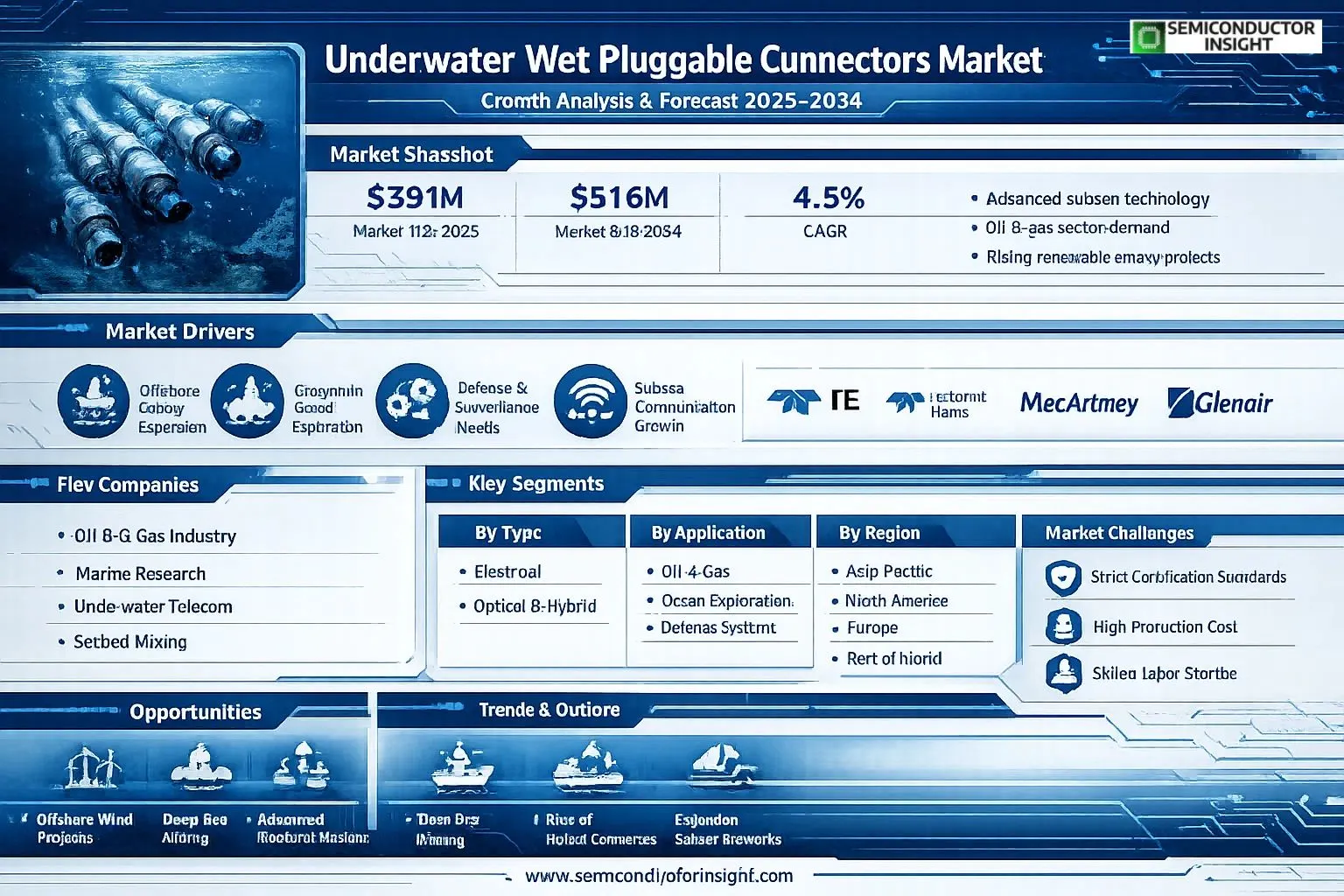
Global Underwater Wet Pluggable Connectors market size was valued at USD 381 million in 2025. The market is projected to grow from USD 398 million in 2026 to USD 516 million by 2034, exhibiting a CAGR of 4.5% during the forecast period.
Underwater wet pluggable connectors are specialized subsea components engineered using advanced materials and precision structures that enable reliable mating and de-mating operations in deep-sea environments without the need to bring equipment to the surface. These connectors are designed to effectively prevent water ingress and contaminant penetration, thereby ensuring the uninterrupted operation of connected systems and enabling seamless transmission of both electrical signals and power at considerable ocean depths. They serve as critical enabling components across large-scale deep-sea infrastructure projects, including submarine oil and gas extraction systems, ocean exploration platforms, and subsea communication networks, directly determining the performance integrity, operational lifespan, and overall reliability of engineering installations deployed in harsh underwater conditions.
The market is advancing steadily, driven by rising global investment in deep-sea resource development and growing deployment of subsea infrastructure across the oil and gas, renewable energy, and defense sectors. The industry maintains a high technical threshold due to demanding performance requirements and elevated R&D and production costs, which has historically limited participation from small and medium-sized enterprises. North American and European manufacturers such as TE Connectivity, Teledyne Marine, and MacArtney continue to hold dominant positions in the high-reliability deep-sea segment, leveraging their first-mover advantage and influence over technical standards. However, competitive dynamics are shifting as Chinese manufacturers accelerate localization efforts , notably, in 2024, AVIC Optronics’ WMR series wet-plug fiber optic connectors received Norwegian Classification Society (DNV) certification, and in 2025, Huahai Communications launched a full range of high-reliability wet-plug connectors, signaling growing regional competition.
MARKET DRIVERS
Expanding Offshore Energy Infrastructure Fueling Demand
Global push toward offshore oil and gas exploration and the accelerating development of offshore wind energy installations are among the most significant forces propelling Underwater Wet Pluggable Connectors Market forward. As operators increasingly deploy subsea production systems, remotely operated vehicles (ROVs), and monitoring equipment in deeper and more challenging marine environments, the requirement for reliable, high-performance wet-mate connector solutions has intensified. These connectors enable critical electrical and optical signal transmission without the need to de-mate systems in dry conditions, dramatically reducing operational downtime and intervention costs on the seabed.
Rising Adoption of Subsea Observation and Defense Systems
Growing investments in underwater surveillance, naval defense infrastructure, and autonomous underwater vehicle (AUV) deployments have created a robust secondary demand stream within Underwater Wet Pluggable Connectors Market. Defense agencies and research institutions worldwide are expanding their underwater sensor networks, oceanographic monitoring systems, and unmanned maritime platforms, all of which rely on dependable wet-mate interconnect technology to maintain continuous data and power links under extreme hydrostatic pressures. The ability of modern wet pluggable connectors to perform reliably at depths exceeding 6,000 meters positions them as indispensable components across both commercial and governmental subsea programs.
➤ The proliferation of subsea fiber optic networks and the integration of high-bandwidth data transmission requirements in underwater systems are compelling connector manufacturers to innovate beyond traditional copper-based solutions, with hybrid electro-optical wet pluggable connectors emerging as a critical enabler for next-generation subsea infrastructure.
Technological advancements in materials science, including the adoption of corrosion-resistant alloys, advanced polymer sealing compounds, and titanium housings, have significantly extended the operational lifespan and reliability of wet pluggable connectors in seawater environments. These engineering improvements, combined with the miniaturization of connector assemblies and the standardization of mating interfaces, are lowering the total cost of ownership for subsea operators and accelerating the broader adoption of wet-mate connector technology across diverse underwater applications.
MARKET CHALLENGES
Stringent Technical Qualification and Certification Barriers
One of the foremost challenges confronting participants in Underwater Wet Pluggable Connectors Market is the highly demanding qualification process required to certify connectors for subsea deployment. Industry standards set by bodies such as the American Petroleum Institute (API) and the International Electrotechnical Commission (IEC) mandate rigorous testing protocols covering pressure cycling, thermal performance, corrosion resistance, and long-term reliability in biologically active seawater. The extensive time and capital investment required to achieve certification can represent a significant barrier for new entrants and can delay the commercialization of innovative connector designs, particularly for smaller manufacturers lacking established testing infrastructure.
Other Challenges
High Manufacturing Complexity and Cost
The precision engineering required to manufacture wet pluggable connectors capable of maintaining watertight integrity and reliable electrical continuity under thousands of pounds per square inch of hydrostatic pressure involves advanced machining tolerances and specialized assembly processes. This manufacturing complexity translates into elevated unit costs, which can restrict adoption in cost-sensitive segments of Underwater Wet Pluggable Connectors Market, particularly among smaller-scale research and academic underwater system operators who must work within constrained procurement budgets.
Limited Pool of Specialized Skilled Labor
The design, manufacture, and field servicing of subsea wet-mate connector systems require a highly specialized workforce with expertise spanning materials engineering, fluid dynamics, and subsea systems integration. Global shortage of professionals with this convergent skill set presents ongoing operational challenges for manufacturers and end-users alike, potentially constraining production capacity expansion and slowing the response time to evolving customer requirements within the competitive landscape of Underwater Wet Pluggable Connectors Market.
MARKET RESTRAINTS
Volatility in Offshore Oil and Gas Capital Expenditure
Underwater Wet Pluggable Connectors Market remains closely linked to capital expenditure cycles within the offshore oil and gas sector, which is historically susceptible to fluctuations driven by global energy commodity prices. Periods of sustained low oil prices have historically prompted operators to defer or cancel subsea field development projects, directly suppressing procurement of specialized subsea components including wet-mate connector systems. This cyclical dependency introduces revenue unpredictability for connector manufacturers and limits the ability of market participants to plan long-term production capacity investments with confidence.
Interoperability Constraints Across Proprietary Connector Ecosystems
A persistent structural restraint within Underwater Wet Pluggable Connectors Market is the prevalence of proprietary connector designs among leading manufacturers, which limits interoperability between systems supplied by different vendors. Subsea operators managing complex multi-vendor equipment configurations often face significant logistical and technical challenges when attempting to integrate connector systems from disparate suppliers, increasing system complexity and maintenance costs. While industry standardization initiatives have made incremental progress, the continued dominance of proprietary interface designs constrains market fluidity and can effectively lock customers into single-supplier relationships, reducing competitive pricing pressure and slowing technology adoption rates.
MARKET OPPORTUNITIES
Offshore Renewable Energy Expansion Opening New Application Frontiers
The rapid global scaling of offshore wind energy, tidal energy, and ocean current energy harvesting projects represents a transformative growth opportunity for Underwater Wet Pluggable Connectors Market. Floating offshore wind platforms, in particular, require dynamic subsea power and data interconnect solutions capable of withstanding continuous mechanical stress and marine biofouling over multi-decade operational lifespans. As offshore renewable energy installations proliferate across European, Asian, and North American waters, connector manufacturers that invest in developing purpose-engineered wet-mate solutions for renewable energy applications stand to capture substantial new revenue streams beyond traditional oil and gas end markets.
Advancement of Deep-Sea Scientific Research and Seabed Mining Programs
Increasing global interest in deep-sea mineral extraction, including polymetallic nodule recovery and seafloor massive sulfide mining, alongside expanded international oceanographic research programs, is generating new demand vectors for advanced wet pluggable connector technology. These applications demand connectors capable of operating reliably at ultra-deep water depths while supporting high-power transmission for extraction equipment and high-bandwidth data links for real-time seabed monitoring. Manufacturers that proactively develop connector platforms optimized for the extreme environmental and operational requirements of deep-sea resource programs and scientific exploration initiatives are well-positioned to establish early-mover advantages in these emerging, high-value segments of Underwater Wet Pluggable Connectors Market.
Underwater Wet Pluggable Connectors Market () Trends
Rising Deep-Sea Energy Development Fueling Demand for Underwater Wet Pluggable Connectors
Underwater Wet Pluggable Connectors Market is experiencing sustained momentum driven by the accelerating global push to develop deep-sea energy resources. As offshore oil and gas extraction operations expand into deeper and more challenging environments, the need for reliable, high-performance connectors capable of withstanding extreme subsea conditions has intensified considerably. Underwater wet pluggable connectors , engineered to be mated and de-mated in fully submerged conditions without compromising signal or power integrity , have become indispensable components across large-scale subsea infrastructure projects. Their ability to prevent water and contaminant ingress while maintaining operational continuity directly determines the performance, working life, and long-term reliability of deep-sea engineering installations. This fundamental role is cementing their position as a critical procurement priority for operators across oil and gas, ocean exploration, and subsea communication network segments.
Other Trends
Localization Efforts and Emerging Regional Manufacturers
A notable trend reshaping the competitive landscape of Underwater Wet Pluggable Connectors Market is the growing emphasis on localization, particularly in Asia. While North American and European manufacturers such as TE Connectivity, Teledyne Marine, and MacArtney have long dominated the high-reliability deep-sea connector segment through established technical standards and first-mover advantages, new regional players are closing the gap. In 2024, AVIC Optronics’ WMR series wet-plug fiber optic connectors achieved Norwegian Classification Society (DNV) certification , a significant quality benchmark in the subsea industry. Further reinforcing this shift, Huahai Communications launched a comprehensive range of high-reliability wet-plug connectors in 2025. These developments signal a meaningful transition toward a more diversified global supply base, offering end-users broader sourcing options while intensifying competitive pressure on incumbent Western suppliers.
Expansion of Optical and Hybrid Connector Variants Across Subsea Applications
Underwater Wet Pluggable Connectors Market is also seeing growing adoption of optical wet pluggable and optoelectronic hybrid connector types, reflecting the rising data transmission demands of modern subsea infrastructure. As ocean exploration programs expand and subsea communication networks require higher bandwidth capacity, purely electrical connectors are increasingly supplemented , or replaced , by fiber optic and hybrid variants capable of delivering faster, more reliable data links across extended underwater distances. Applications spanning oil and gas extraction, national defense, and subsea network communication are all contributing to this diversification in connector type demand. The high technical threshold associated with developing and certifying these advanced connector variants continues to limit new market entrants, sustaining a competitive environment where established players with deep R&D capabilities and proven field performance maintain a structural advantage. This dynamic is expected to persist as operators prioritize reliability and certification credentials over cost considerations alone when selecting subsea connector solutions.
COMPETITIVE LANDSCAPE
Key Industry Players
Underwater Wet Pluggable Connectors Market , Global Competitive Landscape and Leading Manufacturer Analysis
Global Underwater Wet Pluggable Connectors market is characterized by a moderately consolidated competitive structure, dominated by a core group of technologically advanced North American and European manufacturers. Companies such as TE Connectivity, Teledyne Marine, MacArtney, Amphenol, and Eaton have established strong market positions through decades of engineering expertise, proprietary sealing technologies, and compliance with stringent international certification standards applicable to deep-sea environments. These incumbents benefit from first-mover advantages, long-standing relationships with oil and gas majors, defense contractors, and oceanographic institutions, as well as their ability to meet demanding performance requirements across electrical, optical, and optoelectronic hybrid connector segments. The high technical threshold for product development , encompassing pressure resistance, corrosion-proof materials, and reliable signal integrity at extreme depths , continues to act as a significant barrier to entry, limiting competition from smaller or less-capitalized manufacturers. Valued at approximately USD 381 million in 2025, the market is projected to expand to USD 516 million by 2034 at a CAGR of 4.5%, sustaining investment interest among established players and encouraging incremental innovation across product lines.
Beyond the market leaders, a number of specialized niche players contribute meaningfully to the competitive ecosystem. GISMA Steckverbinder, BIRNS, Hydro Group, Glenair, Marshall Underwater, and Seascape Subsea cater to specific application verticals including underwater robotics, defense systems, and deep-sea scientific instrumentation, differentiating through custom engineering capabilities and rapid-prototyping services. RMSpumptools and Northrop Grumman address highly specialized subsea and defense-oriented connector demand, respectively. Notably, Asian manufacturers are gaining traction: AVIC Optronics’ WMR series wet-plug fiber optic connectors received DNV certification in 2024, and Huahai Communications launched a comprehensive range of high-reliability wet-plug connectors in 2025, signaling an accelerating localization drive in China that is beginning to challenge Western incumbency in certain market segments. As global investment in subsea oil and gas extraction, offshore renewable energy, and underwater communication networks intensifies, competitive differentiation increasingly hinges on depth rating, connector longevity, material innovation, and the ability to deliver certified, application-specific solutions at scale.
List of Key Underwater Wet Pluggable Connectors Companies Profiled
- TE Connectivity
- Teledyne Marine
- Eaton
- GISMA Steckverbinder
- MacArtney
- Glenair
- Amphenol
- Hydro Group
- BIRNS
- RMSpumptools
- Marshall Underwater
- Northrop Grumman
- Seascape Subsea
- AVIC Optronics
- Huahai Communications
Segment Analysis:
| Segment Category | Sub-Segments | Key Insights |
| By Type |
|
Electrical Wet Pluggable connectors serve as the foundational choice for reliable power delivery in submerged environments, prized for their straightforward design and proven durability.
|
| By Application |
|
Oil and Gas Extraction stands out as the primary driver, fueled by the intricate demands of subsea infrastructure in offshore developments.
|
| By End User |
|
Oil and Gas Operators represent the core user base, leveraging these connectors for seamless connectivity in expansive underwater energy projects.
|
| By Operating Depth |
|
Deep Ocean connectors dominate in sophisticated applications requiring utmost pressure resistance and precision engineering.
|
| By Deployment Platform |
|
ROVs and AUVs lead the segment with growing autonomous operations necessitating quick-connect reliability.
|
Regional Analysis: Underwater Wet Pluggable Connectors Market
North America
Robust offshore energy sector growth propels demand for Underwater Wet Pluggable Connectors Market in North America. Innovations in ROV tethering and subsea monitoring systems require dependable wet mate technologies. Regulatory emphasis on safety and reliability encourages adoption of advanced connectors for prolonged underwater operations.
North American firms lead in developing hybrid wet pluggable connectors combining fiber optics and power transmission. Enhanced sealing technologies withstand extreme pressures, vital for deepwater applications in Underwater Wet Pluggable Connectors Market. R&D investments yield compact, high-reliability designs.
Intense competition among North American suppliers in Underwater Wet Pluggable Connectors Market drives quality improvements. Strategic partnerships with oil majors ensure customized solutions for subsea trees and umbilicals. Market consolidation enhances innovation and global reach.
Expansion into offshore wind and marine renewables positions North America strongly in Underwater Wet Pluggable Connectors Market. Digital twins and AI integration for predictive maintenance will redefine connector applications. Sustainable practices will sustain regional dominance.
Europe
Europe holds a significant share in Underwater Wet Pluggable Connectors Market, fueled by North Sea oil and gas fields and emerging offshore wind farms. Mature infrastructure demands reliable wet mate connectors for subsea production systems and dynamic umbilicals. Stringent environmental regulations promote eco-friendly materials in connector manufacturing. Key players innovate in multi-pin configurations for complex sensor arrays in ROVs. Collaborative EU-funded projects advance standardization, easing cross-border deployments. The shift toward decommissioning and renewable energy transitions creates new opportunities for versatile Underwater Wet Pluggable Connectors Market solutions, maintaining Europe’s competitive edge.
Asia-Pacific
Asia-Pacific exhibits rapid growth in Underwater Wet Pluggable Connectors Market, driven by expanding offshore exploration in the South China Sea and Australian basins. Rising investments in LNG projects necessitate robust connectors for subsea tie-backs and flowlines. Local manufacturers develop cost-effective wet pluggable options tailored to regional depths and currents. Government initiatives in marine tech hubs foster innovation in high-voltage power connectors. The burgeoning aquaculture and defense sectors further diversify applications, positioning Asia-Pacific as a dynamic hub in Underwater Wet Pluggable Connectors Market.
South America
South America, particularly Brazil’s pre-salt fields, drives demand in Underwater Wet Pluggable Connectors Market through ultra-deepwater developments. Harsh environmental conditions require specialized connectors with superior pressure and thermal resistance for FPSO integrations. Regional players collaborate with global firms to localize production, reducing lead times. Emerging gas monetization projects amplify needs for reliable data transmission solutions. Sustainable practices in offshore operations encourage advanced wet mate technologies, strengthening South America’s role in Underwater Wet Pluggable Connectors Market.
Middle East & Africa
The Middle East & Africa region advances in Underwater Wet Pluggable Connectors Market via Persian Gulf mega-projects and African marginal fields. Focus on enhanced oil recovery deploys sophisticated subsea networks reliant on wet pluggable connectors. Extreme temperatures challenge designs, spurring heat-tolerant innovations. Strategic alliances with international suppliers build local expertise. Diversification into blue economy initiatives like ocean observatories expands market potential for Underwater Wet Pluggable Connectors Market in the region.
Report Scope
This market research report provides a comprehensive analysis of Underwater Wet Pluggable Connectors Market, covering the forecast period 2025–2034. It offers detailed insights into market dynamics, technological advancements, competitive landscape, and key trends shaping the industry.
Key focus areas of the report include:
- Market Overview: The report begins with an overview outlining its current market scenario, key growth indicators, and industry transformation drivers. It discusses macroeconomic factors, demand–supply balance, regulatory landscape, and the strategic role of underwater wet pluggable connectors in powering advancements across industries such as oil and gas extraction, ocean exploration, network communication, and national defense industry.
- Market Size & Forecast: Historical data and future projections for revenue, unit shipments, and market value across major regions and segments.
- Segmentation Analysis: Detailed breakdown by product type, technology, application, and end-user industry to identify high-growth segments and investment opportunities.
- Regional Insights: Insights into market performance across North America, Europe, Asia-Pacific, Latin America, and the Middle East & Africa, including country-level analysis where relevant.
- Competitive Landscape: Profiles of leading market participants, including their product offerings, R&D focus, manufacturing capacity, pricing strategies, and recent developments such as mergers, acquisitions, and partnerships.
- Technology Trends & Innovation: Assessment of emerging technologies, integration of AI/IoT, semiconductor design trends, fabrication techniques, and evolving industry standards.
- Market Drivers & Restraints: Evaluation of factors driving market growth along with challenges, supply chain constraints, regulatory issues, and market-entry barriers.
- Stakeholder Insights: Insights for component suppliers, OEMs, system integrators, investors, and policymakers regarding the evolving ecosystem and strategic opportunities.
Primary and secondary research methods are employed, including interviews with industry experts, data from verified sources, and real-time market intelligence to ensure the accuracy and reliability of the insights presented.
FREQUENTLY ASKED QUESTIONS:
What is the current market size of Underwater Wet Pluggable Connectors Market?
-> Underwater Wet Pluggable Connectors Market was valued at USD 381 million in 2025 and is expected to reach USD 516 million by 2034, at a CAGR of 4.5% during the forecast period.
Which key companies operate in Underwater Wet Pluggable Connectors Market?
-> Key players include TE Connectivity, Teledyne Marine, Eaton, MacArtney, Glenair, Amphenol, among others.
What are the key growth drivers?
-> Key growth drivers include global development of deep-sea resources in oil and gas, renewable energy, ocean exploration, and communication networks.
Which region dominates the market?
-> North America and Europe dominate the market, while Asia shows rapid growth due to localization efforts.
What are the emerging trends?
-> Emerging trends include China’s localization breakthroughs, such as AVIC Optronics’ DNV-certified connectors and high-reliability advancements.

Get Sample Report PDF for Exclusive Insights
Report Sample Includes
- Table of Contents
- List of Tables & Figures
- Charts, Research Methodology, and more...
 Download Sample Report PDF