MARKET INSIGHTS
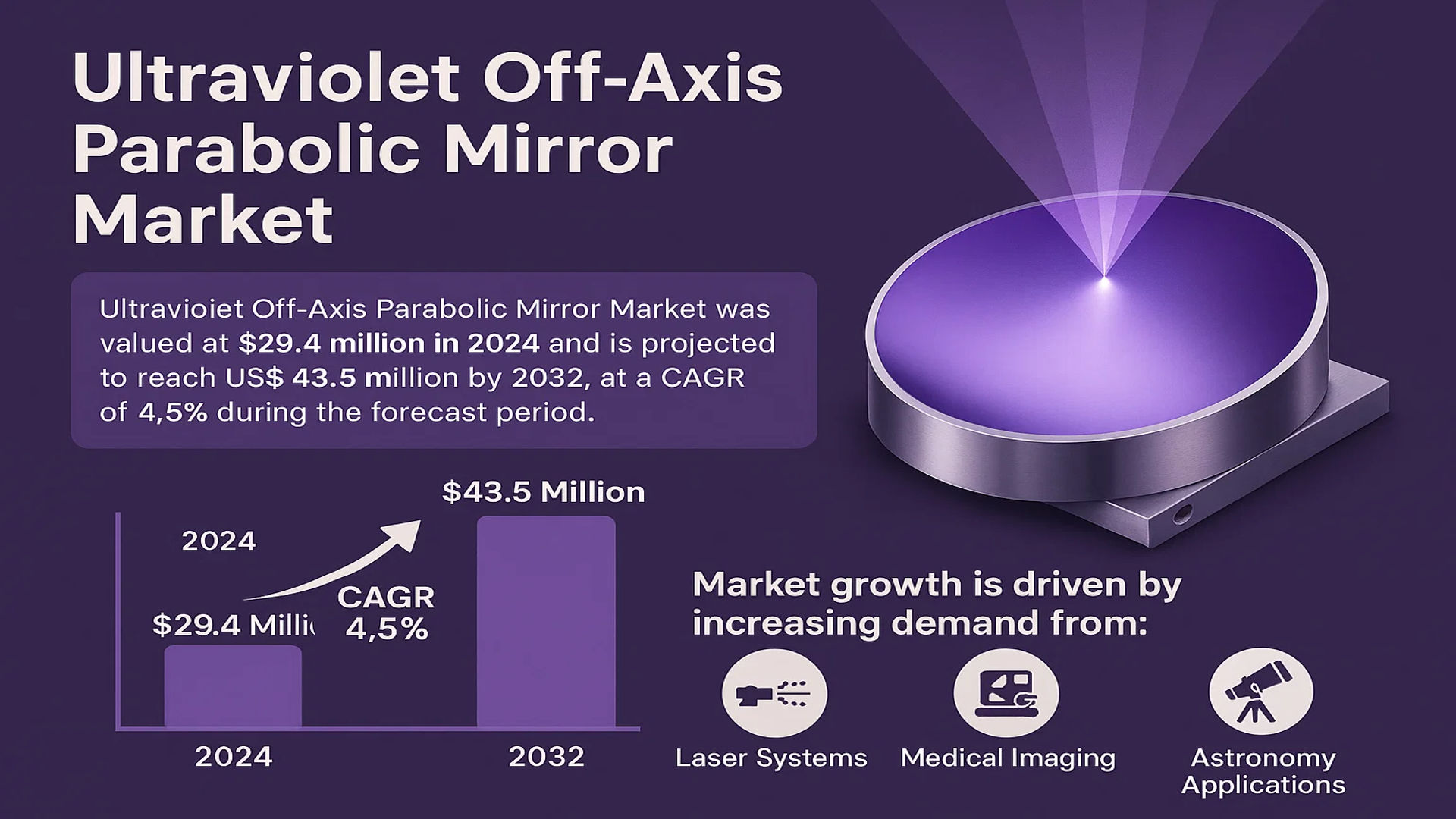
The global Ultraviolet Off-Axis Parabolic Mirror Market was valued at 29.4 million in 2024 and is projected to reach US$ 43.5 million by 2032, at a CAGR of 4.5% during the forecast period.
An Ultraviolet Off-Axis Parabolic Mirror is a specialized optical component engineered to focus ultraviolet (UV) light with high precision while eliminating chromatic aberrations. These mirrors feature an off-axis design, meaning the reflective surface is offset from the central optical axis, allowing more flexible integration in compact optical systems. This configuration removes the central obstruction typical in conventional parabolic mirrors, enhancing light collection efficiency and beam quality.
The market growth is driven by increasing demand from laser systems, medical imaging, and astronomy applications. Advancements in UV-based technologies, such as semiconductor lithography and spectroscopy, further contribute to adoption. North America currently leads the market, with the U.S. accounting for the largest regional share, while Asia-Pacific shows the fastest growth due to expanding industrial and research infrastructure in China and Japan. Key players like Edmund Optics, Newport Corporation, and Thorlabs dominate the competitive landscape through continuous product innovation and strategic partnerships.
MARKET DYNAMICS
MARKET DRIVERS
Expansion of Laser-Based Applications Fuels Demand for Precision Optics
The ultraviolet off-axis parabolic mirror market is experiencing significant growth due to increasing applications in laser systems across medical, industrial, and scientific disciplines. UV laser applications are projected to grow at approximately 6.2% annually through 2030, creating substantial demand for high-performance focusing optics. These mirrors enable precise beam shaping critical for applications such as laser cutting of medical devices, semiconductor lithography, and spectroscopy systems. The off-axis design proves particularly valuable in modern laser setups where traditional centered optics would interfere with beam paths or detection systems.
Advancements in Astronomy and Space Observation Technologies
Space agencies and research institutions worldwide are investing heavily in next-generation ultraviolet astronomy systems, with NASA allocating over $2.8 billion for astrophysics programs in 2024 alone. UV off-axis parabolic mirrors play a crucial role in these systems by providing unobstructed light collection and minimizing scattered light in spectrographs and telescopes. The cutting-edge James Webb Space Telescope’s success has spurred development of specialized UV imaging systems, where these mirrors enable compact, high-performance designs. Private space ventures and increasing astronomical research budgets globally are creating sustained demand for these optical components.
Medical Diagnostic and Therapeutic Applications Drive Innovation
UV-based medical technologies such as fluorescence spectroscopy and phototherapy are seeing expanded clinical adoption, with the medical optics segment growing at approximately 7.1% annually. Off-axis parabolic mirrors enable precise light delivery in instruments analyzing biological samples or treating dermatological conditions. The COVID-19 pandemic accelerated development of UV sterilization systems, where these mirrors proved essential for creating uniform illumination patterns. As healthcare providers continue adopting advanced diagnostic modalities, the medical sector presents a robust growth avenue for UV mirror manufacturers.
➤ Recent product launches, such as Edmund Optics’ Ultraviolet Enhanced Aluminum Off-Axis Parabolic Mirrors with >90% reflectivity at 193nm, demonstrate the industry’s response to increasing performance demands.
MARKET RESTRAINTS
High Production Costs Limit Market Penetration
The precision manufacturing requirements for ultraviolet off-axis parabolic mirrors create significant cost barriers. Single-point diamond turning and specialized coating processes can account for 60-75% of production expenses. While large research institutions and well-funded corporations can absorb these costs, smaller laboratories and developing markets often opt for less expensive alternatives. Material costs for high-purity substrates have increased by approximately 18-22% since 2022, further exacerbating price pressures. These economic factors constrain market growth among budget-sensitive customers despite the technical advantages offered.
Technical Complexities in Alignment and Integration
The off-axis design that provides performance benefits also introduces significant implementation challenges. Proper alignment typically requires specialized optomechanical mounts and experienced technicians, adding to system costs. Industry surveys indicate that nearly 35% of first-time users encounter alignment difficulties that degrade optical performance. These technical hurdles discourage adoption among organizations lacking in-house optical expertise. As system integrators seek plug-and-play solutions, the need for custom alignment procedures presents an ongoing adoption barrier.
Limited Awareness in Emerging Applications
Many potential users in developing sectors remain unaware of off-axis parabolic mirror capabilities. Traditional optical solutions continue dominating industrial applications where cost outweighs performance considerations. Educational institutions often standardize curricula around conventional optics, creating a knowledge gap that limits market expansion. While awareness is improving in laser and astronomy sectors, significant untapped potential exists in fields like quantum computing and advanced manufacturing where these mirrors could provide substantial benefits.
MARKET OPPORTUNITIES
Emerging UV Photolithography Techniques in Semiconductor Fabrication
The semiconductor industry’s transition to extreme ultraviolet (EUV) lithography creates significant opportunities for advanced mirror solutions. With foundries investing over $20 billion annually in next-generation lithography equipment, demand for precision UV optics continues growing. Off-axis parabolic mirrors enable more compact optical trains in stepper systems while minimizing light loss. As chip manufacturers push towards 2nm and smaller nodes, these components will play an increasingly critical role in maintaining optical performance at shrinking wavelengths.
Development of Compact Spectroscopy Systems
Field-deployable spectroscopy instruments represent a growing market segment projected to exceed $1.2 billion by 2026. UV off-axis parabolic mirrors enable miniaturization without sacrificing optical performance, making them ideal for portable analyzers used in environmental monitoring, pharmaceutical quality control, and food safety inspection. Manufacturers developing handheld spectrometers increasingly incorporate these mirrors to achieve laboratory-grade results in compact form factors. The ability to eliminate optical obstructions proves particularly valuable in designs requiring high signal-to-noise ratios.
Expansion of Quantum Technology Research
Government investments in quantum computing and communication technologies exceeded $3.7 billion globally in 2023, with UV optical systems playing an important role in qubit manipulation and readout. The off-axis parabolic mirror’s ability to provide unobstructed optical access makes it valuable for complex quantum experiments requiring multiple laser paths. As research transitions from academic labs to commercial applications, demand grows for reliable UV optical components that can maintain precise alignment under varied environmental conditions.
MARKET CHALLENGES
Supply Chain Vulnerabilities for Specialized Materials
The manufacture of high-performance UV mirrors depends on specialized materials like ultra-low expansion glass and precisely controlled coating materials. Recent global supply chain disruptions have caused lead times for some substrates to extend beyond six months. Certain dielectric coating materials face export restrictions in some regions, complicating procurement for manufacturers. These material challenges force companies to maintain larger inventories, increasing working capital requirements and product costs throughout the value chain.
Intense Competition from Alternative Technologies
Emerging technologies such as freeform optics and holographic optical elements present competitive challenges. While off-axis parabolic mirrors offer excellent performance, some applications increasingly adopt alternative solutions that provide greater design flexibility. The development of advanced manufacturing techniques for complex optical surfaces enables competing approaches at potentially lower costs. Mirror manufacturers must continually demonstrate the performance advantages of their products to justify premium pricing in this evolving competitive landscape.
Workforce Skill Shortages in Precision Optics
The specialized nature of UV mirror manufacturing and integration requires highly skilled optical engineers and technicians. Industry surveys indicate a projected 15-20% gap in qualified personnel through 2030, particularly in coating technology and precision metrology. This shortage threatens to constrain production capacity just as demand grows across multiple industries. Companies face increasing wage pressures to retain experienced staff while simultaneously investing in training programs to develop the next generation of optical manufacturing specialists.
ULTRAVIOLET OFF-AXIS PARABOLIC MIRROR MARKET TRENDS
Advancements in Laser and Optical Technologies Driving Market Growth
The increasing adoption of high-precision optical systems in laser applications is significantly boosting demand for ultraviolet (UV) off-axis parabolic mirrors. These mirrors play a crucial role in UV laser focusing and beam shaping, particularly in industrial and medical applications. Manufacturers are improving coating technologies to enhance reflectivity and durability, with some achieving reflectivity levels exceeding 98% in the UV spectrum. The rise of ultrafast laser systems, which require minimal distortion, has further propelled innovation in mirror surface accuracy. Leading companies are now producing mirrors with surface roughness below 5 nm, ensuring optimal performance in sensitive UV applications.
Other Trends
Medical and Scientific Instrumentation Demand
The medical sector is witnessing growing applications for UV off-axis parabolic mirrors in diagnostic equipment and therapeutic devices. These components are essential in spectroscopic systems used for disease detection and in UV sterilization equipment that requires precise light direction. Research institutions and pharmaceutical companies are increasingly utilizing these mirrors in analytical instruments, particularly for fluorescence spectroscopy and DNA analysis. The ability of off-axis designs to eliminate central obstruction makes them ideal for sensitive measurements where even minimal light loss could compromise results.
Aerospace and Defense Applications Creating New Opportunities
Aerospace industries are incorporating UV off-axis parabolic mirrors in advanced surveillance and detection systems, where their compact design and high performance under extreme conditions are critical. Military applications including threat detection and night vision technologies are driving specialized requirements for these optical components. The growing emphasis on space exploration has also created demand for radiation-resistant mirrors capable of maintaining performance in extra-terrestrial environments. Meanwhile, commercial satellite operators are adopting these components for high-resolution Earth observation systems that require precise UV imaging capabilities.
COMPETITIVE LANDSCAPE
Key Industry Players
Market Leaders Expand Technological Capabilities to Gain Competitive Edge
The global ultraviolet (UV) off-axis parabolic mirror market features a competitive landscape dominated by specialized optical component manufacturers and diversified industrial suppliers. While the space remains moderately fragmented, larger players are increasingly consolidating their positions through strategic acquisitions and technology partnerships. Edmund Optics and Newport Corporation have emerged as frontrunners, collectively holding over 25% of the global market share in 2024. Their leadership stems from extensive distribution networks and the ability to provide customized solutions across multiple wavelength ranges.
Thorlabs has demonstrated particularly strong growth in the laser applications segment due to its vertically integrated manufacturing approach. The company’s continuous R&D investment in improving UV reflectivity and durability has allowed it to capture significant market share in scientific research institutions. Meanwhile, Shimadzu and Coherent have strengthened their positions through specialized coating technologies that enhance performance in medical and industrial UV applications.
Smaller niche players like Avantier and Optical Surfaces Ltd. compete effectively by focusing on ultra-precision mirrors for astronomy and defense applications. Their ability to manufacture mirrors with surface accuracies below λ/20 (at 632.8 nm) gives them distinct advantages in high-performance segments. Meanwhile, Chinese manufacturers such as Shanghai Optics are becoming increasingly competitive in medium-grade UV optics through aggressive pricing strategies and improving technical capabilities.
The market is witnessing increased competition in coating technologies, with companies vying to develop more durable and efficient reflective surfaces. Recent innovations include protected aluminum coatings that maintain over 90% reflectivity in the UV-C spectrum (200-280 nm), a critical requirement for medical sterilization equipment. Such technological advancements are reshaping the competitive dynamics, pushing manufacturers to accelerate their product development cycles.
List of Key Ultraviolet Off-Axis Parabolic Mirror Manufacturers
- Edmund Optics (U.S.)
- Newport Corporation (U.S.)
- Thorlabs (U.S.)
- Shimadzu Corporation (Japan)
- Coherent, Inc. (U.S.)
- OptoSigma (Japan)
- Avantier (U.S.)
- Optical Surfaces Ltd. (UK)
- Shanghai Optics (China)
- TYDEX (Russia)
Segment Analysis:
By Type
Uncoated Segment Holds Strong Market Position Due to Cost-Effectiveness and Broad Wavelength Compatibility
The market is segmented based on type into:
- Uncoated
- Gold Substrates
- Aluminum Substrates
- Silver Plated Substrates
- Others (Copper Substrates, etc)
By Application
Laser Applications Lead Due to Precision Requirements in High-Power UV Laser Systems
The market is segmented based on application into:
- Medical
- Laser
- Astronomy
- Others
By End User
Research Institutions Dominate Market Share Due to Extensive Use in Scientific Applications
The market is segmented based on end user into:
- Research Institutions
- Industrial Manufacturing
- Medical Facilities
- Aerospace & Defense
- Others
Regional Analysis: Ultraviolet Off-Axis Parabolic Mirror Market
Asia-Pacific
The Asia-Pacific region dominates the global Ultraviolet Off-Axis Parabolic Mirror market, accounting for the largest revenue share in 2024. This leadership position is driven by rapid industrialization, particularly in semiconductor manufacturing and laser technology applications across China, Japan, and South Korea. China’s aggressive investments in advanced optical components for its growing photonics industry, coupled with Japan’s strong presence in precision optics manufacturing, create a robust demand environment. However, intense price competition among regional manufacturers presents both challenges and opportunities for market players seeking to balance quality and cost-effectiveness.
North America
North America represents the second-largest market for Ultraviolet Off-Axis Parabolic Mirrors, driven by cutting-edge research applications in astronomy, medical diagnostics, and defense systems. The United States remains the key contributor, with major research institutions and laser manufacturers demanding high-performance optical components. Recent advancements in UV lithography for semiconductor fabrication are creating new growth avenues. While the market is mature, it continues to benefit from strong R&D spending in photonics and optics technologies across both academic and industrial sectors.
Europe
Europe maintains a technically sophisticated market for Ultraviolet Off-Axis Parabolic Mirrors, characterized by strict quality standards and specialized applications in scientific instrumentation. Germany and the UK lead in adoption, supported by their strong photonics industries and research infrastructure. The region has seen increasing demand for these mirrors in environmental monitoring systems and space telescopes, though growth is tempered by higher costs compared to Asian manufacturers. European companies continue to focus on niche, high-value applications where precision and reliability outweigh cost considerations.
South America
The South American market for Ultraviolet Off-Axis Parabolic Mirrors remains relatively small but shows steady growth potential. Brazil and Argentina are emerging as localized centers for optical technology adoption, primarily serving academic and limited industrial applications. Market expansion is constrained by limited domestic manufacturing capabilities and reliance on imports, but growing awareness of advanced optical solutions in mining and environmental sectors suggests future opportunities for market development with proper investment in technical infrastructure.
Middle East & Africa
This region presents an emerging but fragmented market for Ultraviolet Off-Axis Parabolic Mirrors, with demand primarily concentrated in select research institutions and industrial applications in Israel, Turkey, and South Africa. While the overall market size remains modest, increasing investments in scientific infrastructure and gradual industrialization could drive future growth. Currently, adoption is limited by budget constraints and the specialized nature of these optical components, but strategic partnerships with global suppliers are beginning to improve accessibility to this technology across the region.
Report Scope
This market research report provides a comprehensive analysis of the global and regional Ultraviolet Off-Axis Parabolic Mirror markets, covering the forecast period 2024–2032. It offers detailed insights into market dynamics, technological advancements, competitive landscape, and key trends shaping the industry.
Key focus areas of the report include:
- Market Size & Forecast: Historical data and future projections for revenue, unit shipments, and market value across major regions and segments. The global market was valued at USD 29.4 million in 2024 and is projected to reach USD 43.5 million by 2032, growing at a CAGR of 4.5%.
- Segmentation Analysis: Detailed breakdown by product type (Uncoated, Gold Substrates, Aluminum Substrates, etc.), application (Medical, Laser, Astronomy), and end-user industry to identify high-growth segments.
- Regional Outlook: Insights into market performance across North America, Europe, Asia-Pacific, Latin America, and Middle East & Africa. The U.S. and China are key markets with significant growth potential.
- Competitive Landscape: Profiles of leading market participants including Edmund Optics, Newport Corporation, Thorlabs, Shimadzu, and Coherent, covering their product portfolios, R&D focus, and strategic developments.
- Technology Trends & Innovation: Assessment of advanced optical coating technologies, precision manufacturing techniques, and emerging applications in UV spectroscopy and laser systems.
- Market Drivers & Restraints: Analysis of factors driving growth such as increasing demand in medical diagnostics and laser applications, along with challenges like high manufacturing costs.
- Stakeholder Analysis: Strategic insights for optical component manufacturers, system integrators, research institutions, and investors regarding market opportunities.
The report employs both primary and secondary research methodologies, including interviews with industry experts and analysis of verified market data, to ensure accuracy and reliability.
FREQUENTLY ASKED QUESTIONS:
What is the current market size of Global Ultraviolet Off-Axis Parabolic Mirror Market?
-> Ultraviolet Off-Axis Parabolic Mirror Market was valued at 29.4 million in 2024 and is projected to reach US$ 43.5 million by 2032, at a CAGR of 4.5% during the forecast period.
Which key companies operate in this market?
-> Major players include Edmund Optics, Newport Corporation, Thorlabs, Shimadzu, Coherent, OptoSigma, and Photonics Industries.
What are the key growth drivers?
-> Growth is driven by increasing demand in medical imaging, laser technology advancements, and expanding applications in scientific research.
Which region dominates the market?
-> North America currently leads the market, while Asia-Pacific is expected to show the highest growth rate during the forecast period.
What are the emerging trends?
-> Emerging trends include development of high-reflectivity coatings, precision manufacturing techniques, and integration with advanced optical systems.

Get Sample Report PDF for Exclusive Insights
Report Sample Includes
- Table of Contents
- List of Tables & Figures
- Charts, Research Methodology, and more...
 Download Sample Report PDF