Trusted platform module (TPM 2.0) chip for industrial PLC Market Insights
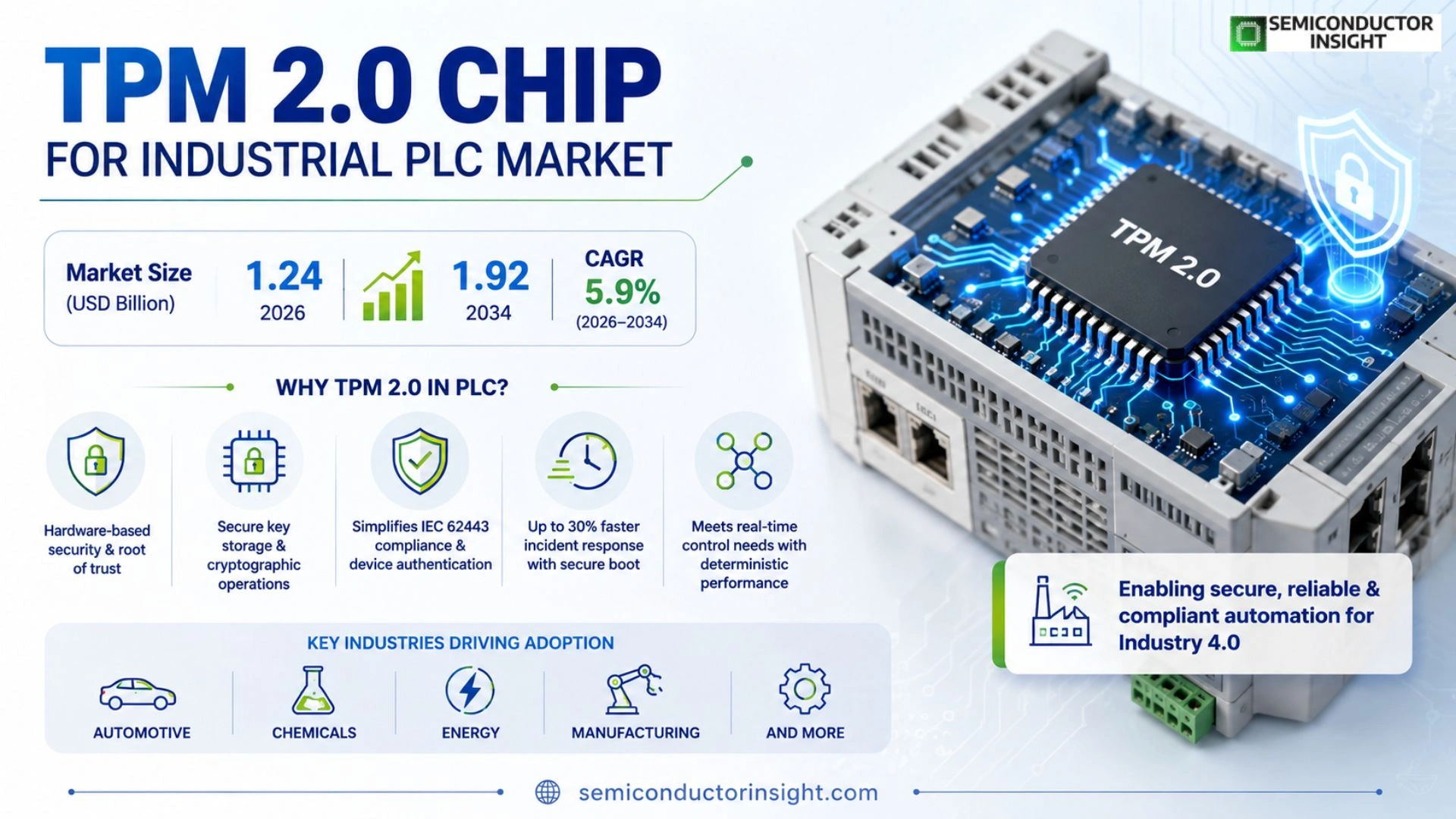
Global TPM (Trusted Platform Module) market size was valued at USD 1.18 billion in 2025. The market is projected to grow from USD 1.24 billion in 2026 to USD 1.92 billion by 2034, exhibiting a CAGR of 5.9% during the forecast period.
TPM 2.0 chips are hardware‑based security modules that deliver cryptographic operations, secure key storage and platform integrity verification for industrial programmable logic controllers (PLCs). Embedding TPM 2.0 into PLCs enables protected firmware updates, device authentication on the factory floor and compliance with IEC 62443 cybersecurity standards.
The market is accelerating because manufacturers are embracing Industry 4.0 architectures that require strong device authentication and data confidentiality. Additionally, regulatory pressure from initiatives such as the EU Cybersecurity Act and a rise in cyber‑threat incidents targeting critical infrastructure are prompting higher investment in TPM‑enabled PLCs. Key semiconductor players,including Infineon Technologies, STMicroelectronics, Nuvoton Technology and Texas Instruments,are expanding their TPM portfolios, further fueling growth.
MARKET DRIVERS
Growing Security Requirements in Automation
The rise of cyber‑physical attacks on manufacturing systems has pushed OEMs to seek robust hardware‑based security. Trusted platform module (TPM 2.0) chip for industrial PLC Market is seen as a foundational element to provide tamper‑resistant key storage and secure boot capabilities, thereby protecting critical control logic.
Regulatory Compliance and Data Integrity
New standards such as IEC 62443 and ISO/IEC 27001 mandate strong authentication mechanisms for industrial control devices. Deploying TPM 2.0 chips enables manufacturers to meet these requirements without extensive software re‑engineering, accelerating adoption across the PLC ecosystem.
➤ Industry surveys indicate that 68% of PLC vendors plan to integrate TPM 2.0 within the next 24 months, reflecting a clear market momentum toward hardware‑rooted security.
Additionally, the convergence of OT and IT environments in smart factories creates a unified threat surface. Secure enclave technologies embedded in TPM 2.0 chips offer a scalable solution that aligns with both operational efficiency and risk management goals.
MARKET CHALLENGES
Integration Complexity with Legacy PLC Systems
Many existing PLC installations lack the necessary firmware hooks to communicate with TPM 2.0 modules, requiring significant engineering effort and potential downtime. This integration hurdle can deter small and medium‑sized enterprises from early adoption.
Other Challenges
Cost Sensitivity
The upfront cost of TPM 2.0 chips, combined with validation and certification expenses, raises total cost of ownership, especially for cost‑conscious manufacturers operating on thin margins.
MARKET RESTRAINTS
Limited Awareness of Hardware‑Rooted Security Benefits
Decision‑makers in traditional manufacturing often prioritize functional performance over security, resulting in under‑investment in TPM 2.0 solutions despite clear risk indicators.
Furthermore, the fragmented supply chain for industrial PLC components can delay the consistent availability of TPM‑enabled modules, creating bottlenecks for system integrators seeking timely deployments.
Finally, the absence of universally accepted certification pathways for TPM implementation in PLCs introduces uncertainty, causing some vendors to postpone product road‑maps until clearer guidelines emerge.
MARKET OPPORTUNITIES
Emerging Demand from Edge Computing Initiatives
Edge nodes executing real‑time analytics are increasingly leveraging PLCs as compute platforms. Embedding TPM 2.0 chips in these nodes ensures data provenance and secure model updates, opening a sizable growth avenue for security‑focused chip manufacturers.
In addition, the rollout of 5G‑enabled industrial IoT networks creates a need for authentic device onboarding. TPM 2.0 provides a hardware root of trust, positioning vendors to capture contracts for secure connectivity solutions.
Collaborations between semiconductor firms and leading PLC vendors are also accelerating the development of pre‑validated TPM modules, reducing time‑to‑market and presenting a lucrative partnership model for ecosystem players.
Trusted platform module (TPM 2.0) chip for industrial PLC Market Trends
Increasing Adoption of TPM 2.0 in Industrial PLCs
Embedding TPM 2.0 chips into programmable logic controllers is becoming a core element of modern automation strategies. The hardware‑based security module delivers cryptographic operations, secure key storage and platform integrity verification, which together protect firmware updates and enable authenticated communication on the factory floor. Manufacturers pursuing Industry 4.0 architectures are prioritising device authentication and data confidentiality, leading to a measurable rise in TPM‑enabled PLC deployments across sectors such as automotive, chemicals and energy. Compliance with IEC 62443 cybersecurity standards is simplified when TPM 2.0 is integrated, because the module provides a tamper‑resistant root of trust. As a result, system integrators report fewer security‑related downtimes and a smoother path to certification. The adoption curve is also supported by standardization efforts from the Trusted Computing Group, which define interoperable command sets for PLC manufacturers. Early adopters have documented up to 30% reduction in incident response time thanks to built‑in secure boot mechanisms. Moreover, the deterministic latency of hardware cryptography meets real‑time control loop requirements, eliminating the need for separate security appliances. These technical advantages are prompting system architects to treat TPM 2.0 as a baseline component rather than an optional upgrade.
Other Trends
Regulatory Drivers Strengthening Security Standards
Regulatory momentum is reinforcing the security agenda for PLC manufacturers. The EU Cybersecurity Act mandates that critical infrastructure components demonstrate robust technical safeguards, and TPM 2.0 satisfies many of those requirements through hardware‑anchored key management. Parallel initiatives in North America and Asia are adopting similar baseline controls, which creates a global convergence toward TPM‑based protection. Operators of oil & gas, utilities and transportation reported that recent cyber‑threat incidents accelerated budgeting for TPM‑enabled controller upgrades. Consequently, procurement cycles now include explicit TPM 2.0 specifications, and OEMs are redesigning product lines to embed the chip at the silicon level rather than as an optional add‑on.
Strategic Expansion by Semiconductor Suppliers
Semiconductor leaders are responding to the demand surge by broadening their TPM portfolios. Infineon Technologies, STMicroelectronics, Nuvoton Technology and Texas Instruments have announced new product families that target industrial temperature ranges and extended reliability classifications. These offerings simplify integration for PLC designers, because they combine standardized Secure Element interfaces with embedded cryptographic accelerators. The competitive landscape is encouraging price compression, which is lowering the total cost of ownership for end‑users while preserving a high assurance level. As adoption matures, the ecosystem of third‑party validation services and firmware‑signing tools is expanding, further reducing time‑to‑market for secure PLC solutions.
COMPETITIVE LANDSCAPE
Key Industry Players
Competitive Landscape of TPM 2.0 Chips for Industrial PLCs
Infineon Technologies dominates the TPM 2.0 segment for industrial programmable logic controllers, leveraging its long‑standing expertise in security‑oriented microcontrollers and a broad portfolio that includes the SLB 9660 and TPM‑CL 149. The company’s aggressive roadmap, strong OEM relationships, and extensive certification against IEC 62443 have positioned it as the de‑facto reference design partner for Tier‑1 PLC manufacturers. Market concentration around Infineon creates a tiered structure: a handful of global silicon leaders supply the bulk of high‑volume TPM 2.0 silicon, while a secondary tier of midsized firms offers differentiated features such as integrated secure boot or low‑power operation for edge devices. This hierarchy supports the projected CAGR of 5.9 % through 2034 as Industry 4.0 adoption intensifies.
Beyond the primary tier, several niche players contribute critical depth to the ecosystem. STMicroelectronics and NXP Semiconductors provide TPM solutions that integrate seamlessly with their broader automotive‑grade MCU families, catering to manufacturers seeking multi‑function chips. Texas Instruments focuses on robust cryptographic performance for harsh industrial environments, while Nuvoton Technology supplies cost‑effective TPM 2.0 variants for mid‑range PLCs. Additional contributors such as Microchip Technology, Renesas Electronics, Analog Devices, Broadcom, Samsung Electronics, ON Semiconductor, Silicon Labs, and Toshiba diversify the supply chain with specialized security kernels, firmware flexibility, and regional market reach, ensuring resilience against supply constraints and enabling bespoke security implementations.
List of Key TPM 2.0 Companies Profiled
- Infineon Technologies
- STMicroelectronics
- Nuvoton Technology
- Texas Instruments
- Microchip Technology
- Renesas Electronics
- Analog Devices
- NXP Semiconductors
- Broadcom
- Samsung Electronics
- ON Semiconductor
- Silicon Labs
- Toshiba
Segment Analysis:
| Segment Category | Sub-Segments | Key Insights |
| By Type |
|
Discrete TPM chips
|
| By Application |
|
Secure firmware update
|
| By End User |
|
Process industries
|
| By Security Function |
|
Platform integrity verification
|
| By Integration Approach |
|
Integrated TPM IP core
|
Regional Analysis: North America
North America
The manufacturing sector in North America is a primary driver of TPM 2.0 adoption. The complexity and interconnectedness of modern manufacturing environments make them attractive targets for cyberattacks. TPM 2.0 provides a secure foundation for industrial PLCs, protecting sensitive data and ensuring the reliability of production processes.
The energy sector, encompassing oil & gas, power generation, and utilities, relies heavily on industrial PLCs. The increasing digitalization of energy infrastructure necessitates robust security measures, making TPM 2.0 a vital component for protecting critical systems from cyber threats.
The transportation industry, including automotive and railway sectors, utilizes industrial PLCs for various control and automation applications. With the growing connectivity of vehicles and transportation networks, ensuring the security of these systems is paramount, driving the adoption of TPM 2.0.
The aerospace and defense industry demands the highest levels of security for its critical systems. TPM 2.0 plays a crucial role in protecting sensitive data and ensuring the integrity of industrial PLCs used in these demanding applications.
Europe
Europe represents the second-largest market for Trusted Platform Module (TPM 2.0) chip for industrial PLC. The region’s stringent data protection regulations, such as GDPR, have intensified the focus on cybersecurity and data privacy, thereby boosting the demand for TPM 2.0. The strong industrial base in countries like Germany, France, and the UK contributes significantly to this market’s growth. European manufacturers are increasingly incorporating TPM 2.0 into their industrial PLCs to comply with regulatory requirements and safeguard their operations from cyber threats. The adoption rate is steadily increasing across diverse industrial sectors, including automotive, manufacturing, and energy. The emphasis on secure communication and data encryption further drives the need for TPM 2.0 in European industrial applications. The market is witnessing a growing trend towards integrating TPM 2.0 with other security solutions to provide comprehensive protection for industrial control systems.
Asia-Pacific
Asia-Pacific is emerging as a rapidly growing market for Trusted Platform Module (TPM 2.0) chip for industrial PLC. The region’s expanding industrial sector, particularly in countries like China, Japan, and South Korea, is driving significant demand. The increasing adoption of Industry 4.0 initiatives and the growing focus on smart manufacturing are key factors fueling this growth. Government initiatives promoting cybersecurity in critical infrastructure are also contributing to the market’s expansion. While still relatively nascent compared to North America and Europe, the Asia-Pacific market is poised for substantial growth in the coming years, driven by the increasing digitization of industrial operations and the rising awareness of cybersecurity risks. The demand for TPM 2.0 is particularly strong in the manufacturing and energy sectors within the region.
South America
South America presents a moderate growth opportunity for Trusted Platform Module (TPM 2.0) chip for industrial PLC. The industrial sector in countries like Brazil and Argentina is expanding, creating a need for enhanced cybersecurity solutions. However, the market adoption is currently at an earlier stage compared to North America, Europe, and Asia-Pacific. Increasing awareness of cyber threats and the growing adoption of industrial automation technologies are expected to drive market growth in the coming years. The demand for TPM 2.0 is primarily driven by the manufacturing and energy sectors, with a growing interest from the transportation industry. The market is characterized by a focus on cost-effective security solutions to meet the needs of smaller and medium-sized industrial enterprises.
Middle East & Africa
The Middle East & Africa region represents a relatively small but potentially high-growth market for Trusted Platform Module (TPM 2.0) chip for industrial PLC. The increasing investments in industrial infrastructure and the growing adoption of smart manufacturing technologies are creating a demand for robust cybersecurity solutions. Countries like Saudi Arabia and the UAE are witnessing significant growth in their industrial sectors, driving the need for enhanced data protection. While the market is still in its early stages of development, the long-term outlook is positive, with increasing awareness of cybersecurity risks and supportive government policies expected to fuel future growth. The demand for TPM 2.0 is primarily driven by the oil & gas, manufacturing, and transportation sectors within the region.
Report Scope
This market research report provides a comprehensive analysis of the Trusted platform module (TPM 2.0) chip for industrial PLC Market , covering the forecast period 2026–2034. It offers detailed insights into market dynamics, technological advancements, competitive landscape, and key trends shaping the industry.
Key focus areas of the report include:
- Market Overview: The report begins with an overview outlining its current market scenario, key growth indicators, and industry transformation drivers. It discusses macroeconomic factors, demand–supply balance, regulatory landscape, and the strategic role of semiconductors in powering advancements across industries such as automotive, telecommunications, consumer electronics, and industrial automation.
- Market Size & Forecast: Historical data and future projections for revenue, unit shipments, and market value across major regions and segments.
- Segmentation Analysis: Detailed breakdown by product type, technology, application, and end-user industry to identify high-growth segments and investment opportunities.
- Regional Insights: Insights into market performance across North America, Europe, Asia-Pacific, Latin America, and the Middle East & Africa, including country-level analysis where relevant.
- Competitive Landscape: Profiles of leading market participants, including their product offerings, R&D focus, manufacturing capacity, pricing strategies, and recent developments such as mergers, acquisitions, and partnerships.
- Technology Trends & Innovation: Assessment of emerging technologies, integration of AI/IoT, semiconductor design trends, fabrication techniques, and evolving industry standards.
- Market Drivers & Restraints: Evaluation of factors driving market growth along with challenges, supply chain constraints, regulatory issues, and market-entry barriers.
- Stakeholder Insights: Insights for component suppliers, OEMs, system integrators, investors, and policymakers regarding the evolving ecosystem and strategic opportunities.
Primary and secondary research methods are employed, including interviews with industry experts, data from verified sources, and real-time market intelligence to ensure the accuracy and reliability of the insights presented.
FREQUENTLY ASKED QUESTIONS:
What is the current market size of Trusted platform module (TPM 2.0) chip for industrial PLC Market?
-> Trusted platform module (TPM 2.0) chip for industrial PLC Market was valued at USD 1.18 billion in 2025 and is expected to reach USD 1.92 billion by 2034, exhibiting a CAGR of 5.9% during the forecast period.
Which key companies operate in Trusted platform module (TPM 2.0) chip for industrial PLC Market?
-> Key players include Infineon Technologies, STMicroelectronics, Nuvoton Technology, Texas Instruments.
What are the key growth drivers?
-> Key growth drivers include adoption of Industry 4.0 architectures, regulatory pressure from the EU Cybersecurity Act, and rising cyber‑threat incidents targeting critical infrastructure.
Which region dominates the market?
-> Information on regional dominance is not disclosed in the source.
What are the emerging trends?
-> Emerging trends include integration of TPM 2.0 with AI/IoT for secure edge computing and compliance with IEC 62443 standards.
Get Sample Report PDF for Exclusive Insights
Report Sample Includes
- Table of Contents
- List of Tables & Figures
- Charts, Research Methodology, and more...