
Market Insights
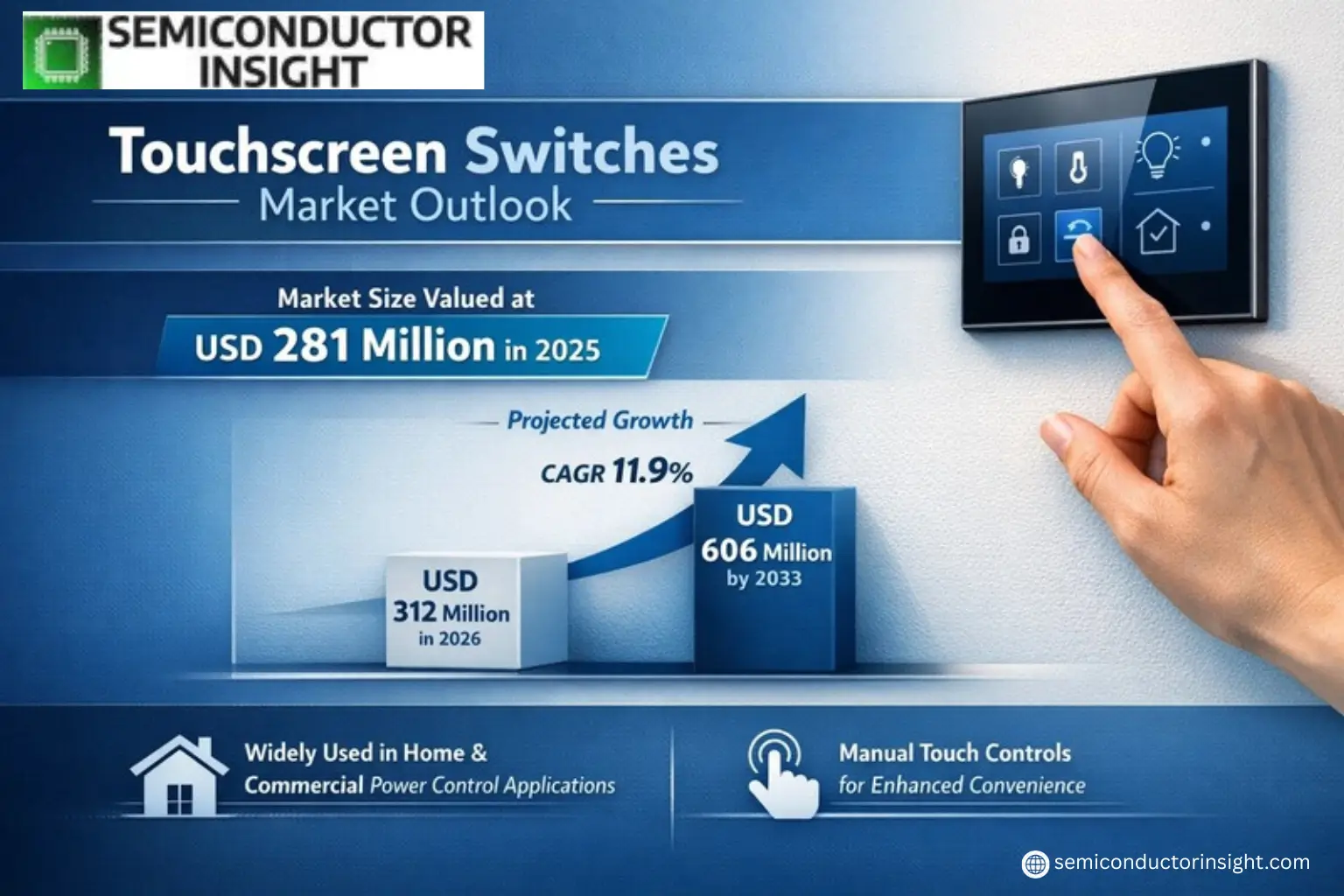
Global Touchscreen Switches Market size was valued at USD 281 million in 2025. The market is projected to grow from USD 312 million in 2026 to USD 606 million by 2033, exhibiting a CAGR of 11.9% during the forecast period.
Touchscreen switches are electrical momentary or latching contacts manually controlled by tapping, widely used in home and commercial power control applications for enhanced convenience. These switches integrate capacitive or resistive touch technology, enabling seamless interaction without physical buttons. Key product segments include touchscreen light switches, electromotion curtains switches, and integration switches.
The market growth is driven by increasing demand for smart home automation, rising adoption of IoT-enabled devices, and advancements in human-machine interface technologies. China dominates the market with over 30% share, followed by the USA and Europe collectively holding more than 45%. Leading manufacturers such as Legrand, Zennio, and Basalte are expanding their portfolios with energy-efficient solutions to capitalize on the growing commercial segment, which accounts for over 60% of application demand.
MARKET DRIVERS
Rising Demand for Smart Home Automation
Touchscreen Switches Market is witnessing significant growth due to increasing adoption of smart home automation systems. Consumers are prioritizing convenience and energy efficiency, driving demand for intuitive touch-based control solutions. Global smart home market is projected to grow at 12% CAGR, directly benefiting touchscreen switch manufacturers.
Advancements in Human-Machine Interface Technology
Technological improvements in capacitive touch sensors and gesture recognition are enhancing the reliability of touchscreen switches. Leading manufacturers are integrating multi-touch capabilities and haptic feedback to improve user experience in both residential and commercial applications.
Stringent energy efficiency regulations worldwide are accelerating replacement of traditional switches with smart touchscreen alternatives that offer better power management features.
MARKET CHALLENGES
High Initial Costs and Installation Complexities
The premium pricing of touchscreen switches compared to mechanical alternatives remains a barrier for mass adoption, particularly in price-sensitive markets. Installation often requires professional expertise for integration with existing electrical systems and smart home networks.
Other Challenges
Durability Concerns in High-Traffic Environments
Commercial applications face challenges with screen wear and accidental damage, requiring frequent replacements that impact total cost of ownership.
Technical Compatibility Issues
Integration challenges with legacy electrical systems and various smart home protocols create installation hurdles and limit retrofit opportunities.
MARKET RESTRAINTS
Limited Consumer Awareness in Emerging Markets
Despite rapid urbanization, developing regions show slower adoption due to unfamiliarity with smart switch technology and preference for conventional switches. Manufacturers face the challenge of educating consumers about long-term benefits versus higher upfront costs.
MARKET OPPORTUNITIES
Expansion in Commercial and Industrial Applications
Touchscreen Switches Market is finding new growth avenues in industrial control panels and smart building management systems. Integration with IoT platforms presents opportunities for remote monitoring and predictive maintenance features that enhance value proposition.
Development of Energy-Harvesting Solutions
Emerging technologies like piezoelectric and solar-powered touchscreen switches are creating innovative, sustainable alternatives that appeal to environmentally-conscious consumers and comply with stricter energy regulations.
Touchscreen Switches Market Trends
Rapid Market Expansion with 11.9% CAGR Projection
Global Touchscreen Switches Market is experiencing robust growth, valued at USD 281 million in 2025 and projected to reach USD 606 million by 2033. This growth is driven by increasing demand for smart home automation solutions and energy-efficient control systems. China currently dominates the market with 30% share, while North America and Europe collectively hold over 45% market penetration.
Other Trends
Dominance of Touchscreen Light Switches
Touchscreen light switches account for over 75% of product segment revenue, as they provide intuitive control and modern aesthetics for both residential and commercial applications. The convenience of programmable lighting scenes and remote operation capabilities continues to drive adoption across smart building projects.
Commercial Sector Leading Application Growth
Commercial applications lead touchscreen switch adoption with over 60% market share, particularly in office buildings, hotels, and retail spaces. The technology enables centralized control, energy monitoring, and improved user experience. Residential adoption is growing steadily as smart home penetration increases worldwide, with key manufacturers focusing on intuitive interfaces for homeowners.
Asia-Pacific as Key Growth Region
With China representing 30% of global demand, the Asia-Pacific region shows the highest growth potential. Increasing urbanization, construction activity, and government smart city initiatives are accelerating adoption. Major manufacturers are expanding production facilities in the region to meet rising demand while reducing costs.
Integration with Smart Building Ecosystems
Advanced touchscreen switches now integrate with IoT platforms, enabling voice control and automation through systems like KNX and Zigbee. This trend reflects growing consumer preference for interconnected smart environments. Market leaders Legrand, Basalte, and Gira are developing products with enhanced connectivity features and energy monitoring capabilities.
COMPETITIVE LANDSCAPE
Key Industry Players
Global Touchscreen Switches Market Dominated by Smart Home Technology Leaders
Legrand leads Global Touchscreen Switches Market with a significant share, offering innovative solutions across residential and commercial segments. The market exhibits a fragmented structure with top five manufacturers collectively holding over 15% share. European players like Gira and Basalte dominate the premium segment with advanced design-focused solutions, while Chinese manufacturers such as Lvhua and AODSN compete aggressively on price-performance ratio.
Niche players like Zennio and IVOR specialize in IoT-integrated touch switches, catering to smart home automation demands. North American vendors focus on commercial applications with rugged touch interfaces, while Asia-Pacific manufacturers are expanding their footprint through OEM partnerships. The competitive landscape is witnessing increased R&D investments in capacitive touch technology and voice control integrations.
List of Key Touchscreen Switches Companies Profiled
- Legrand
- Zennio
- Ibestek
- AVE s.p.a
- Gira
- Basalte
- Lvhua
- AODSN
- Savekey
- Oulu
- IVOR
- Wulian
- YIL Electronic
- Perlux
- Deriq
Segment Analysis:
| Segment Category | Sub-Segments | Key Insights |
| By Type |
|
Touchscreen Light Switches dominate due to widespread residential and commercial adoption.
|
| By Application |
|
Commercial Sector shows strongest growth potential with notable trends:
|
| By End User |
|
Business Segment leads with distinctive characteristics:
|
| By Technology |
|
Capacitive Technology represents the preferred choice because:
|
| By Installation |
|
Retrofit Applications show significant growth due to:
|
Regional Analysis: Touchscreen Switches Market
Asia-Pacific boasts concentrated electronics manufacturing clusters that streamline touchscreen switch production. The region’s supply chain efficiency allows for competitive pricing while maintaining technological sophistication in capacitive and resistive touch interfaces.
Rising middle-class demand for home automation drives touchscreen switch installations. Localized designs incorporating regional aesthetic preferences and multilingual interfaces give Asian manufacturers an edge in this rapidly growing consumer segment.
Hospitality and office sectors increasingly adopt touchscreen control panels for lighting and HVAC systems. The region’s focus on energy efficiency aligns well with smart switch capabilities, creating strong institutional demand.
Asian manufacturers lead in developing affordable yet reliable capacitive touch switches. Continuous R&D focuses on improving touch sensitivity and integrating IoT connectivity while maintaining cost advantages over Western competitors.
North America
The North American Touchscreen Switches Market shows steady growth, particularly in premium residential and commercial installations. The United States leads adoption, with high consumer awareness of smart home technologies and willingness to invest in premium products. Luxury home builders increasingly incorporate touchscreen control panels as standard features. Commercial applications in corporate offices and educational institutions also drive demand, with a focus on energy management systems. The region sees strong competition between established electrical component manufacturers and emerging smart home specialists.
Europe
Europe maintains a strong position in the Touchscreen Switches Market, with Germany and the UK at the forefront. The region emphasizes design aesthetics and integration with existing home automation systems. Stringent energy efficiency regulations encourage adoption in both retrofits and new constructions. Nordic countries show particular interest in smart lighting controls with touch interfaces. European manufacturers differentiate through premium materials and advanced haptic feedback technologies in their switch offerings.
Middle East & Africa
The MEA region presents growing opportunities for touchscreen switches, particularly in luxury developments and smart city projects. Gulf countries lead adoption with high-profile commercial installations and premium residential projects. The market shows preference for branded, high-end touch control solutions from international manufacturers. Africa’s emerging middle class in urban centers begins showing interest in affordable touch switch options for modern home fittings.
South America
South America’s touchscreen switch market develops gradually, with Brazil as the primary growth driver. Upper-middle-class consumers in major cities adopt smart home technologies, with touchscreen switches gaining popularity in gated communities. Economic conditions influence the preference for mid-range products balancing quality and affordability. Commercial installations in corporate offices and upscale hospitality venues contribute to steady market expansion.
Report Scope
This market research report provides a comprehensive analysis of the Touchscreen Switches Market, covering the forecast period 2026–2033. It offers detailed insights into market dynamics, technological advancements, competitive landscape, and key trends shaping the industry.
Key focus areas of the report include:
- Market Overview: The report begins with an overview outlining its current market scenario, key growth indicators, and industry transformation drivers. It discusses macroeconomic factors, demand–supply balance, regulatory landscape, and the strategic role of semiconductors in powering advancements across industries such as automotive, telecommunications, consumer electronics, and industrial automation.
- Market Size & Forecast: Historical data and future projections for revenue, unit shipments, and market value across major regions and segments.
- Segmentation Analysis: Detailed breakdown by product type, technology, application, and end-user industry to identify high-growth segments and investment opportunities.
- Regional Insights: Insights into market performance across North America, Europe, Asia-Pacific, Latin America, and the Middle East & Africa, including country-level analysis where relevant.
- Competitive Landscape: Profiles of leading market participants, including their product offerings, R&D focus, manufacturing capacity, pricing strategies, and recent developments such as mergers, acquisitions, and partnerships.
- Technology Trends & Innovation: Assessment of emerging technologies, integration of AI/IoT, semiconductor design trends, fabrication techniques, and evolving industry standards.
- Market Drivers & Restraints: Evaluation of factors driving market growth along with challenges, supply chain constraints, regulatory issues, and market-entry barriers.
- Stakeholder Insights: Insights for component suppliers, OEMs, system integrators, investors, and policymakers regarding the evolving ecosystem and strategic opportunities.
Primary and secondary research methods are employed, including interviews with industry experts, data from verified sources, and real-time market intelligence to ensure the accuracy and reliability of the insights presented.
FREQUENTLY ASKED QUESTIONS:
What is the current market size of Touchscreen Switches Market?
-> Touchscreen Switches Market size was valued at USD 281 million in 2025. The market is projected to grow from USD 312 million in 2026 to USD 606 million by 2033, exhibiting a CAGR of 11.9% during the forecast period.
Which key companies operate in Touchscreen Switches Market?
-> Key players include Legrand, Zennio, Lvhua, Basalte, AODSN, Ibestek, AVE s.p.a, Gira, Savekey, Oulu, IVOR, Wulian, YIL Electronic, Perlux, and Deriq, among others. Global top five manufacturers hold a share over 15%.
What are the key growth drivers?
-> Key growth drivers include increasing demand for smart home solutions, convenience in power control applications, and technological advancements in touch switch designs.
Which region dominates the market?
-> China is the largest market with a share over 30%, followed by USA and Europe, which collectively hold over 45% market share.
What are the emerging trends?
-> Emerging trends include integration with smart home systems, development of multi-functional touchscreen switches, and increased adoption in commercial applications.

Get Sample Report PDF for Exclusive Insights
Report Sample Includes
- Table of Contents
- List of Tables & Figures
- Charts, Research Methodology, and more...




