MARKET INSIGHTS
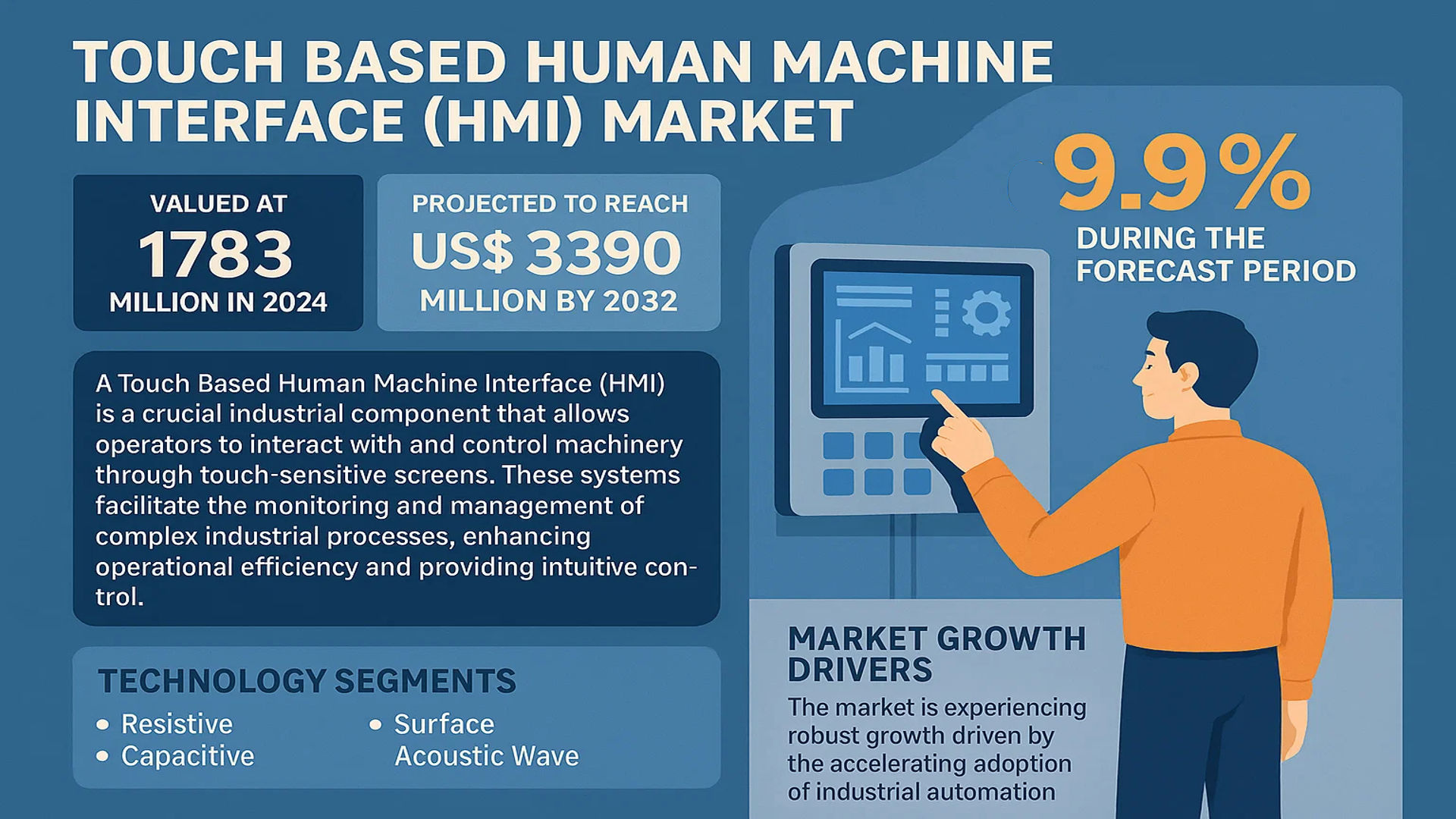
The global Touch Based Human Machine Interface (HMI) Market was valued at 1783 million in 2024 and is projected to reach US$ 3390 million by 2032, at a CAGR of 9.9% during the forecast period.
A Touch Based Human Machine Interface (HMI) is a crucial industrial component that allows operators to interact with and control machinery through touch-sensitive screens. These systems facilitate the monitoring and management of complex industrial processes, enhancing operational efficiency and providing intuitive control. The primary technology segments include Resistive, Capacitive, and Surface Acoustic Wave touchscreens.
The market is experiencing robust growth driven by the accelerating adoption of industrial automation and the ongoing Industry 4.0 revolution. Furthermore, the demand for user-friendly and efficient control systems across discrete industries like automotive and aerospace, as well as process industries such as oil & gas and food & beverage, is a significant contributor. Europe currently dominates the market with a share of approximately 25%, largely because of its strong manufacturing base and early adoption of advanced automation technologies. Key players such as Siemens, Advantech, and ABB are continuously innovating, with recent developments focusing on integrating multi-touch capabilities and enhanced connectivity for smarter factory environments.
MARKET DYNAMICS
MARKET DRIVERS
Accelerated Industrial Automation Adoption to Fuel Market Expansion
The global push toward Industry 4.0 and smart manufacturing is significantly driving the touch-based HMI market. Industrial facilities are increasingly implementing touch-based interfaces to enhance operational efficiency, reduce human error, and enable real-time monitoring of complex processes. The manufacturing sector’s digital transformation investment is projected to exceed $1.2 trillion annually by 2026, with touch HMI systems representing a critical component of this expenditure. These interfaces provide intuitive control solutions that streamline operations across automotive assembly lines, food processing plants, and pharmaceutical manufacturing facilities. The ability to monitor multiple processes through a single touch interface reduces operator training time by approximately 40% while improving overall equipment effectiveness by up to 15%.
Growing Demand for Operational Efficiency in Process Industries
Process industries including oil & gas, chemicals, and pharmaceuticals are increasingly adopting touch-based HMI solutions to enhance operational visibility and control. These industries require robust interfaces that can withstand harsh environments while providing clear visualization of complex processes. The implementation of touch HMIs in these sectors has demonstrated measurable improvements in productivity, with some facilities reporting up to 20% reduction in downtime through improved monitoring capabilities. The need for precise control in critical processes such as refinery operations, chemical mixing, and batch processing has driven specialized HMI development featuring multi-touch capabilities, gesture controls, and enhanced security features.
Furthermore, regulatory compliance requirements in highly regulated industries are prompting increased adoption of advanced HMI systems that provide comprehensive audit trails and operational documentation.
➤ For instance, pharmaceutical manufacturers are implementing touch HMI systems with built-in compliance features that automatically record and timestamp all operator interactions, meeting stringent regulatory requirements for process validation and quality control.
The integration of touch HMIs with industrial IoT platforms is creating new value propositions, enabling predictive maintenance and remote monitoring capabilities that further enhance operational efficiency across various industrial sectors.
MARKET RESTRAINTS
High Implementation Costs and Technical Complexity to Hinder Market Penetration
The implementation of advanced touch-based HMI systems involves substantial capital investment, particularly for small and medium-sized enterprises. The total cost of ownership includes not only the hardware acquisition but also integration expenses, software licensing, training costs, and ongoing maintenance. Industrial-grade touch HMIs designed for harsh environments can cost 3-5 times more than commercial-grade equivalents, creating significant budget constraints for many potential adopters. The technical complexity of integrating these systems with legacy equipment presents additional challenges, often requiring specialized engineering expertise and custom interface development.
Additionally, the need for continuous software updates and cybersecurity measures adds to the operational expenses, making some organizations hesitant to upgrade from traditional control systems. The return on investment period for comprehensive HMI implementations typically ranges from 2-4 years, which can be prohibitive for companies with limited capital resources or shorter investment horizons.
MARKET CHALLENGES
Cybersecurity Vulnerabilities Pose Significant Operational Risks
As touch-based HMI systems become increasingly connected to corporate networks and cloud platforms, they face growing cybersecurity threats that could compromise industrial operations. Industrial control systems have become prime targets for cyber attacks, with reported incidents increasing by over 200% in the past three years. Touch HMIs often serve as entry points for potential security breaches, particularly when they interface with both operational technology and information technology networks. The consequences of security breaches can be severe, including production stoppages, safety incidents, and substantial financial losses.
Other Challenges
Environmental Durability Requirements
Industrial touch HMIs must operate reliably in challenging conditions including extreme temperatures, moisture, dust, and chemical exposure. Developing interfaces that maintain sensitivity and accuracy while meeting IP67 or higher protection standards requires advanced engineering and materials, increasing both development costs and technical challenges. The failure rate of touch interfaces in harsh industrial environments remains approximately 15-20% higher than in controlled settings, necessitating robust design and frequent maintenance.
Interoperability Issues
The lack of standardized communication protocols across different manufacturers’ equipment creates significant integration challenges. Many touch HMI systems require custom interface development to communicate with legacy machinery or equipment from multiple vendors, increasing implementation time and costs while potentially introducing compatibility issues that affect system reliability and performance.
MARKET OPPORTUNITIES
Emerging Technologies Creating New Application Frontiers
The integration of advanced technologies such as augmented reality, artificial intelligence, and predictive analytics with touch-based HMI systems is creating substantial growth opportunities. These technological convergences enable the development of next-generation interfaces that provide enhanced situational awareness, predictive maintenance capabilities, and intuitive operation through natural user interfaces. The market for AR-enhanced HMIs is projected to grow at approximately 28% annually as manufacturers seek to improve operator training and reduce errors through immersive visualization techniques.
Additionally, the increasing adoption of edge computing in industrial settings is driving demand for touch HMIs with enhanced processing capabilities that can perform local data analysis and decision-making without relying on cloud connectivity. This trend is particularly significant for applications requiring real-time response or operating in environments with limited network availability.
The expansion of renewable energy infrastructure and smart grid technologies represents another significant opportunity, with touch HMIs playing crucial roles in monitoring and controlling distributed energy resources, substation automation, and grid management systems. These applications require specialized interfaces capable of handling complex data visualization and providing operators with comprehensive situational awareness across widely distributed assets.
TOUCH BASED HUMAN MACHINE INTERFACE (HMI) MARKET TRENDS
Integration of Multi-Touch and Haptic Feedback Technologies to Emerge as a Trend in the Market
The global Touch Based HMI market is witnessing a significant transformation driven by the integration of advanced multi-touch and haptic feedback technologies. These innovations are enhancing user interaction by providing more intuitive and responsive control systems, which is critical in high-stakes industrial environments. For instance, the adoption of projected capacitive touch technology, which offers superior durability and multi-touch capability, has seen a substantial uptick, particularly in manufacturing and process industries. This is because it allows for complex gestures and commands, improving operational efficiency. Furthermore, the incorporation of haptic feedback—which provides tactile responses to user inputs—is reducing errors and increasing operator confidence, especially in settings where visual attention is divided. This trend is supported by increased R&D investments from leading manufacturers aiming to differentiate their products in a competitive landscape. The demand for these sophisticated interfaces is projected to grow in parallel with the broader industrial automation market, which is expanding at a robust pace globally.
Other Trends
Rising Adoption in Oil & Gas and Healthcare Sectors
While manufacturing has traditionally been a stronghold for Touch Based HMI systems, there is a notable and rapid expansion into high-value process industries like oil & gas and healthcare. In the oil & gas sector, the need for robust, reliable interfaces that can withstand harsh environments is driving the adoption of specialized resistive and capacitive touch panels. These panels are often integrated with explosion-proof certifications and are designed to function flawlessly in extreme temperatures and conditions. Conversely, the healthcare sector demands high hygiene and precision, leading to a surge in the use of optical and infrared-based touch screens that can be easily sanitized and offer high clarity. This diversification into new verticals is a key growth vector, accounting for an increasing share of revenue as industries prioritize operational safety and efficiency through advanced human-machine interaction.
Accelerated Shift Towards Industrial IoT and Industry 4.0
The overarching movement towards Industrial IoT (IIoT) and Industry 4.0 is arguably the most powerful driver for the Touch Based HMI market. These interfaces are evolving from simple control panels into central data visualization hubs, connecting operators to a network of smart machines and sensors. This integration enables real-time monitoring, predictive maintenance, and data-driven decision-making on the factory floor. Because of this, modern HMIs are increasingly equipped with higher processing power, better connectivity options like 5G and Wi-Fi 6, and enhanced security features to protect critical infrastructure. The European market, in particular, is at the forefront of this adoption due to strong governmental and institutional support for smart manufacturing initiatives. This trend is creating a sustained demand for next-generation touch interfaces that are not just input devices but integral components of a connected, intelligent industrial ecosystem.
COMPETITIVE LANDSCAPE
Key Industry Players
Companies Strive to Strengthen their Product Portfolio to Sustain Competition
The global Touch Based Human Machine Interface (HMI) market exhibits a semi-consolidated competitive structure, characterized by the presence of multinational industrial automation giants alongside specialized medium and small-sized manufacturers. This dynamic is driven by the critical role HMIs play in industrial digitization and the ongoing transition towards Industry 4.0. The top five producers—Siemens, Advantech, Mitsubishi Electric Corporation, Schneider Electric, and ABB—collectively command a significant portion of the market, accounting for approximately 40% of the global revenue share in 2024. Their dominance is largely attributed to extensive product portfolios, robust global distribution networks, and deep-rooted relationships across key verticals like automotive, food & beverage, and oil & gas.
Siemens AG, a German conglomerate, continues to be a frontrunner, leveraging its comprehensive SIMATIC HMI line and deep integration capabilities within its Totally Integrated Automation (TIA) portal. Similarly, Rockwell Automation (though not in the top five list provided, it is a major global player) and ABB Ltd. maintain strong positions through their focus on high-performance, ruggedized panels designed for harsh industrial environments. Their growth is further propelled by strategic acquisitions and a focus on developing HMIs with enhanced connectivity for IoT and cloud-based analytics.
Meanwhile, other key players are aggressively expanding their market presence through innovation and strategic market initiatives. Companies like Emerson Electric Co. and Omron Corporation are strengthening their positions by introducing advanced capacitive touch screens with multi-touch functionality and higher brightness displays for outdoor applications. Furthermore, Asian manufacturers, including Advantech and Delta Electronics, are competing effectively on a global scale by offering cost-competitive yet reliable solutions, which has accelerated their penetration into price-sensitive markets and emerging economies.
The competitive intensity is expected to increase further as companies invest heavily in R&D to incorporate emerging technologies like artificial intelligence and augmented reality into their HMI offerings. Partnerships for technological integration and expansions into high-growth regions are also key strategies being employed to capture a larger market share in this rapidly evolving landscape.
List of Key Touch Based HMI Companies Profiled
- Siemens AG (Germany)
- Advantech Co., Ltd. (Taiwan)
- Mitsubishi Electric Corporation (Japan)
- Pro-Face (Japan)
- ABB Ltd. (Switzerland)
- Emerson Electric Co. (U.S.)
- Schneider Electric SE (France)
- WEINVIEW (China)
- Omron Corporation (Japan)
- Delta Electronics, Inc. (Taiwan)
- MCGS (China)
- KEYENCE CORPORATION (Japan)
- Beijer Electronics Group (Sweden)
- Kinco Automation (China)
- Touchwo (China)
- Fuji Electric Co., Ltd. (Japan)
- Panasonic Corporation (Japan)
- LS Electric Co., Ltd. (South Korea)
- Red Lion Controls, Inc. (U.S.)
Segment Analysis:
By Type
Capacitive Technology Leads the Market Due to Superior Durability and Multi-Touch Capabilities
The market is segmented based on technology type into:
- Resistive
- Subtypes: Analog Resistive, Matrix Resistive, and others
- Capacitive
- Subtypes: Surface Capacitive, Projected Capacitive (PCAP), and others
- Surface Acoustic Wave
- Others
- Includes Infrared, Optical Imaging, and emerging technologies
By Application
Industrial Automation Segment Dominates Owing to Widespread Adoption in Manufacturing and Process Control
The market is segmented based on application into:
- Industrial Automation
- Healthcare
- Oil & Gas
- Food & Beverage
- Automotive
- Others
By End-User Industry
Discrete Manufacturing Holds Significant Share Driven by High Precision and Operational Efficiency Needs
The market is segmented based on end-user industry into:
- Discrete Industries
- Subtypes: Automotive, Aerospace & Defense, Packaging, Metal & Mining
- Process Industries
- Subtypes: Oil & Gas, Chemicals, Pharmaceuticals, Food & Beverage
- Healthcare
- Others
- Includes Transportation, Utilities, and Building Automation
By Interface Size
Medium-Sized Interfaces are Prevalent Due to Optimal Balance Between Functionality and Space Constraints
The market is segmented based on screen size into:
- Small (Less than 7 inches)
- Medium (7 inches to 12 inches)
- Large (More than 12 inches)
Regional Analysis: Touch Based Human Machine Interface (HMI) Market
Europe
Europe is the dominant market for Touch Based HMI systems, holding approximately 25% of the global market share. This leadership is driven by a mature industrial automation sector, stringent operational safety standards, and a strong emphasis on Industry 4.0 adoption, particularly in Germany, France, and Italy. The region’s advanced manufacturing base, especially in automotive (e.g., Volkswagen, BMW) and pharmaceuticals, demands sophisticated, high-reliability HMIs for process control and monitoring. Furthermore, supportive EU-wide initiatives for smart manufacturing and digital transformation are accelerating the replacement of traditional panels with advanced capacitive and surface acoustic wave touch interfaces. The presence of major global players like Siemens and Schneider Electric, who are headquartered in the region, fosters continuous innovation and provides a robust supply chain, solidifying Europe’s position as a technology and revenue leader.
North America
North America represents a highly advanced and lucrative market, accounting for roughly 24% of global revenue. The market is characterized by early adoption of cutting-edge technologies and a strong focus on enhancing operational efficiency across key sectors like oil & gas, food & beverage, and aerospace & defense. Significant investments in industrial IoT and automation, driven by a need to optimize supply chains and reduce operational costs, are primary growth drivers. The region has a high concentration of end-users who prioritize robust, secure, and interoperable HMI solutions that can integrate seamlessly with complex control systems from providers like Emerson Electric and Rockwell Automation. While the market is mature, growth persists through the modernization of aging industrial infrastructure and the integration of predictive maintenance capabilities into HMI platforms.
Asia-Pacific
The Asia-Pacific region is the fastest-growing market for Touch Based HMIs, propelled by massive industrialization, expansive manufacturing infrastructure, and government initiatives like ‘Make in India’ and ‘China Manufacturing 2025’. While China alone holds an 18% global share, the entire region is a volume-driven powerhouse. Growth is predominantly fueled by the discrete industries, including automotive, electronics, and heavy machinery manufacturing. However, the market is highly price-sensitive, leading to strong demand for cost-effective resistive touch panels alongside a rapidly growing adoption of more advanced capacitive screens. Local manufacturers such as Advantech and Delta Electronics are key players, competing effectively by offering tailored solutions. The ongoing industrial automation surge across Southeast Asian nations further expands the market’s potential, though it faces challenges related to varying technology adoption rates and intellectual property concerns.
South America
The South American market for Touch Based HMIs is emerging and is primarily driven by the mining, oil & gas, and food processing industries in countries like Brazil and Argentina. Market growth is steady but is often constrained by economic volatility and political uncertainty, which can delay large-scale capital investments in industrial automation. The adoption of advanced HMI technology is selective, often focused on essential upgrades within large-scale process industries to improve safety and yield. While there is a recognized need to modernize industrial operations, buyers in the region are highly value-conscious, which can slow the penetration of premium, feature-rich HMI systems. Nonetheless, the market presents a long-term opportunity for suppliers offering durable and cost-optimized solutions suited for harsh industrial environments.
Middle East & Africa
The MEA region is a developing market where demand is primarily linked to large-scale infrastructure and industrial projects, particularly in the GCC countries (e.g., Saudi Arabia, UAE) and South Africa. Key drivers include investments in water treatment, power generation, and oil & gas refining facilities, which require reliable HMI systems for plant supervision and control. The market growth is incremental, as industrial automation penetration is still evolving compared to other regions. Projects are often tied to national development plans, leading to sporadic but significant demand. A major challenge is the reliance on international suppliers, as local manufacturing is limited. The focus for most end-users is on acquiring robust and serviceable systems that can withstand extreme environmental conditions, presenting opportunities for vendors with strong service and distribution networks.
Report Scope
This market research report provides a comprehensive analysis of the global and regional Touch Based Human Machine Interface (HMI) markets, covering the forecast period 2025–2032. It offers detailed insights into market dynamics, technological advancements, competitive landscape, and key trends shaping the industry.
Key focus areas of the report include:
- Market Size & Forecast: Historical data and future projections for revenue, unit shipments, and market value across major regions and segments.
- Segmentation Analysis: Detailed breakdown by product type, technology, application, and end-user industry to identify high-growth segments and investment opportunities.
- Regional Outlook: Insights into market performance across North America, Europe, Asia-Pacific, Latin America, and the Middle East & Africa, including country-level analysis where relevant.
- Competitive Landscape: Profiles of leading market participants, including their product offerings, R&D focus, manufacturing capacity, pricing strategies, and recent developments such as mergers, acquisitions, and partnerships.
- Technology Trends & Innovation: Assessment of emerging technologies, integration of AI/IoT, semiconductor design trends, fabrication techniques, and evolving industry standards.
- Market Drivers & Restraints: Evaluation of factors driving market growth along with challenges, supply chain constraints, regulatory issues, and market-entry barriers.
- Stakeholder Analysis: Insights for component suppliers, OEMs, system integrators, investors, and policymakers regarding the evolving ecosystem and strategic opportunities.
Primary and secondary research methods are employed, including interviews with industry experts, data from verified sources, and real-time market intelligence to ensure the accuracy and reliability of the insights presented.
FREQUENTLY ASKED QUESTIONS:
What is the current market size of Global Touch Based Human Machine Interface (HMI) Market?
->Touch Based Human Machine Interface (HMI) Market was valued at 1783 million in 2024 and is projected to reach US$ 3390 million by 2032, at a CAGR of 9.9% during the forecast period.
Which key companies operate in Global Touch Based Human Machine Interface (HMI) Market?
-> Key players include Siemens, Advantech, Mitsubishi Electric Corporation, Schneider Electric, and ABB, among others.
What are the key growth drivers?
-> Key growth drivers include Industry 4.0 adoption, demand for intuitive industrial controls, and automation across manufacturing sectors.
Which region dominates the market?
-> Europe is the largest market with approximately 25% share, followed by North America and China with 24% and 18% shares respectively.
What are the emerging trends?
-> Emerging trends include multi-touch capabilities, integration with IoT platforms, enhanced durability for harsh environments, and AI-powered predictive maintenance interfaces.

Get Sample Report PDF for Exclusive Insights
Report Sample Includes
- Table of Contents
- List of Tables & Figures
- Charts, Research Methodology, and more...
 Download Sample Report PDF