Time-of-Flight Sensor IC Market Insights
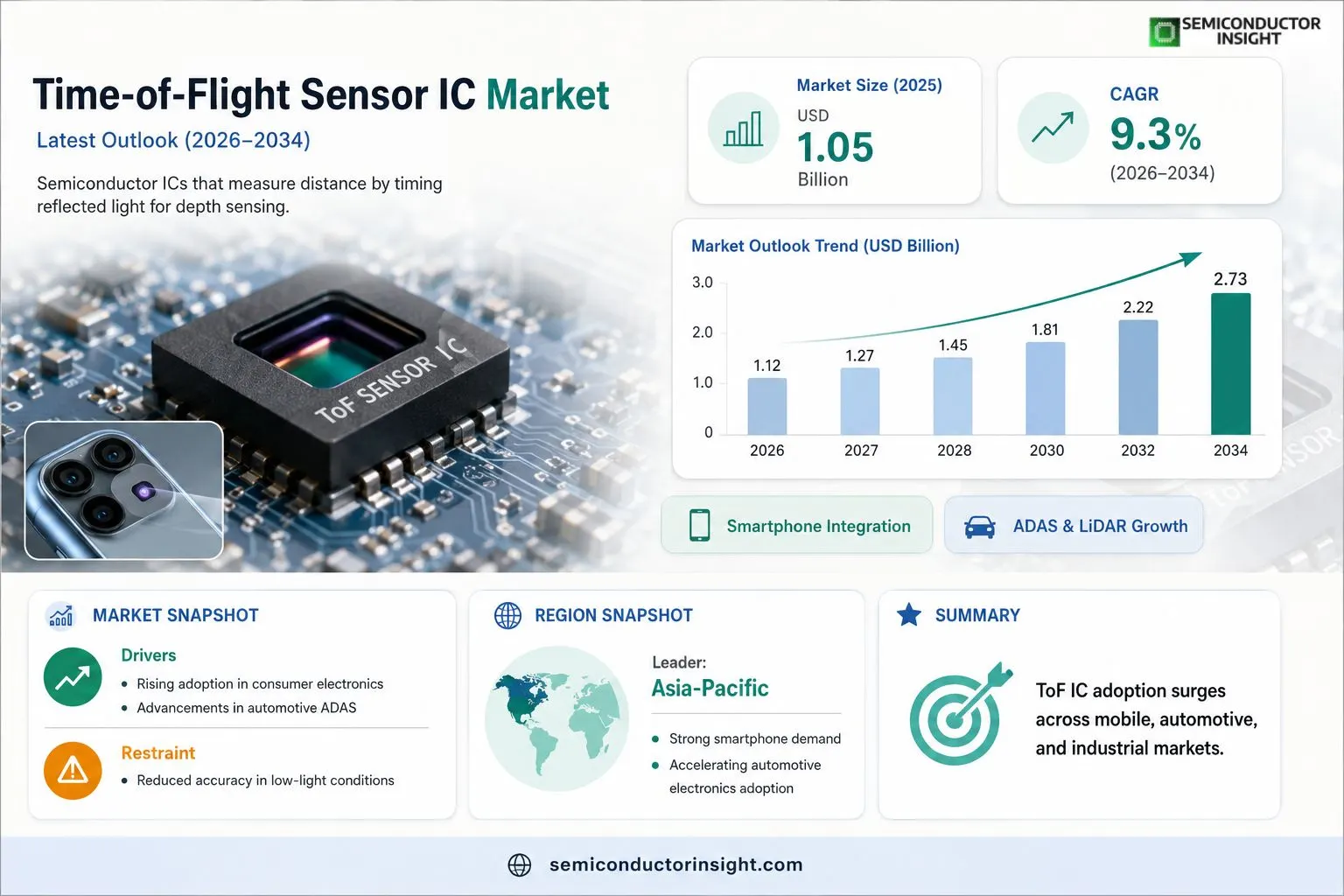
Global Time-of-Flight Sensor IC market size was valued at USD 1.05 billion in 2025. The market is projected to grow from USD 1.12 billion in 2026 to USD 2.73 billion by 2034, exhibiting a CAGR of 9.3% during the forecast period.
Time‑of‑Flight (ToF) sensor integrated circuits are semiconductor devices that emit light pulses and measure the time taken for photons to return after reflecting off an object, thereby calculating precise distance information. These ICs integrate laser diodes, photodetectors, and signal‑processing blocks on a single chip, enabling compact depth‑sensing solutions for smartphones, automotive driver‑assistance systems, industrial robotics, and augmented‑reality headsets.The market is experiencing rapid growth because consumer smartphones increasingly embed ToF modules for facial authentication and advanced photography,over 70 % of flagship devices launched in 2023 featured ToF sensors. Meanwhile, automotive manufacturers are accelerating adoption of ToF‑based LiDAR for Level‑2+ ADAS functions, driving demand for high‑performance, low‑power ICs. Furthermore, advancements in CMOS technology have reduced cost per unit by roughly 15 % year‑over‑year since 2020, making large‑scale deployment feasible across IoT devices. Key players such as STMicroelectronics, Sony Semiconductor Solutions, AMS AG, and Texas Instruments continue to expand their portfolios through strategic partnerships and new product launches aimed at enhancing range accuracy and power efficiency.
MARKET DRIVERS
Rising Adoption in Consumer Electronics
Time-of-Flight Sensor IC Market is being propelled by the rapid integration of depth‑sensing technology in smartphones, tablets, and wearables. Manufacturers are leveraging these sensors to enable immersive AR experiences, facial recognition, and gesture control, which creates a strong demand for compact, low‑power IC solutions.
Advancements in Automotive ADAS
Automakers are increasingly incorporating Time‑of‑Flight sensors to enhance Advanced Driver‑Assistance Systems (ADAS), providing reliable obstacle detection and precise ranging for parking assistance and autonomous driving features. This trend adds a substantial layer of demand for robust, high‑resolution sensor ICs.
➤ Integration of Time‑of‑Flight Sensor ICs enables precise depth mapping, directly driving market expansion.
Overall, the convergence of consumer‑centric innovations and safety‑critical automotive applications creates a synergistic environment that accelerates growth across the entire Time-of-Flight Sensor IC Market.
MARKET CHALLENGES
Cost Sensitivity in High‑Volume Applications
While performance requirements are rising, many OEMs remain highly price‑sensitive, especially in mass‑market segments such as smartphones and IoT devices. Balancing cost with the need for high accuracy and low power consumption poses a significant challenge for suppliers.
Other Challenges
Supply Chain Constraints
Global semiconductor shortages and limited availability of high‑purity wafers can delay product launches, forcing manufacturers to adopt inventory buffers that increase overall costs.
MARKET RESTRAINTS
Technical Limitations in Low‑Light Conditions
Time‑of‑Flight sensors can experience reduced accuracy in environments with minimal ambient light or strong infrared interference, limiting their applicability in certain industrial and outdoor scenarios. Ongoing R&D is required to mitigate these performance gaps.
MARKET OPPORTUNITIES
Emerging Opportunities in Robotics and Drones
The push toward autonomous navigation in robotics, warehouse automation, and aerial drones creates a compelling opportunity for Time-of-Flight Sensor IC Market. Precise ranging and obstacle avoidance capabilities are critical, and advancements in miniaturization and power efficiency are opening new market segments that were previously inaccessible.
Time-of-Flight Sensor IC Market Trends
Smartphone Integration Accelerates Market Momentum
Time-of-Flight Sensor IC Market is being propelled by the rapid diffusion of ToF modules in premium smartphones. More than 70 % of flagship devices launched in 2023 incorporated a ToF sensor for facial authentication, high‑dynamic‑range photography, and gesture control. This widespread integration creates a steady demand pipeline for ICs that combine laser diodes, photodetectors, and signal‑processing blocks on a single chip, enabling manufacturers to reduce bill‑of‑materials while delivering depth‑aware features that differentiate consumer experiences.
Other Trends
Automotive ADAS and Level‑2+ LiDAR Expansion
Automotive manufacturers are scaling ToF‑based LiDAR solutions to support Level‑2+ driver‑assistance functions such as adaptive cruise control and automated emergency braking. The shift toward low‑power, high‑accuracy ICs aligns with vehicle electrification goals, prompting suppliers like STMicroelectronics and Texas Instruments to launch product families that emphasize millimeter‑level range precision and robust ambient‑light rejection. As a result, Time-of-Flight Sensor IC Market sees increasing orders from tier‑one OEMs seeking to embed depth‑sensing directly into vehicle sensor stacks.
CMOS Advances Lower Unit Costs for IoT Scale
Recent advances in CMOS processing have driven a cumulative cost reduction of roughly 15 % year‑over‑year since 2020. This efficiency gain makes it feasible to embed ToF ICs in a broader class of IoT devices, from industrial robots to augmented‑reality headsets. Key players are leveraging strategic partnerships to co‑develop ultra‑low‑power architectures that extend battery life while preserving distance accuracy. The combined effect of cheaper silicon and broader application portfolios positions Time-of-Flight Sensor IC Market for sustained expansion across consumer, automotive, and industrial segments.
COMPETITIVE LANDSCAPEKey Industry Players
Competitive Overview of the Time‑of‑Flight Sensor IC Market
Time‑of‑Flight (ToF) Sensor IC Market is currently led by a handful of semiconductor powerhouses that command the majority of revenue and technology leadership. STMicroelectronics, Sony Semiconductor Solutions, AMS AG, and Texas Instruments together account for roughly 55 % of global shipments, leveraging deep CMOS expertise and extensive automotive and mobile OEM relationships. Their product portfolios span low‑power mobile modules to high‑precision automotive LiDAR ICs, creating a tiered market structure where premium, performance‑driven designs dominate automotive and industrial segments while cost‑optimized chips serve mass‑market smartphones. The rapid adoption of ToF modules in flagship smartphones,over 70 % of 2023 releases,has accelerated volume demand, reinforcing the leading players’ scale advantages and prompting ongoing M&A activity to consolidate IP around laser‑diode integration and on‑chip signal processing.Beyond the tier‑one tier, a diverse set of niche innovators contributes specialized know‑how that enriches the ecosystem. Broadcom, Infineon Technologies, Himax Technologies, Melexis, ON Semiconductor, Panasonic, and Qualcomm each target distinct verticals such as consumer wearables, automotive safety, industrial robotics, and augmented‑reality headsets. These companies differentiate through ultra‑low‑power architectures, custom 3D‑stacked sensor arrays, or strategic partnerships with device manufacturers. For example, Himax’s focus on compact, high‑resolution depth sensors complements the larger automotive‑grade offerings of Infineon, while Qualcomm integrates ToF IP directly into its Snapdragon platform to streamline smartphone design. This multiplicity of specialized players sustains healthy competition, drives incremental innovation, and expands the total addressable market as new applications emerge.
List of Key Time-of-Flight Sensor IC Companies Profiled
- STMicroelectronics
- Sony Semiconductor Solutions
- AMS AG
- Texas Instruments
- Broadcom Inc.
- Infineon Technologies
- Himax Technologies
- Melexis
- ON Semiconductor
- Panasonic
- Qualcomm
- Ambiq Micro
- Vishay Intertechnology
- Samsung Electro‑Mechanics
- Lattice Semiconductor
Segment Analysis:
| Segment Category | Sub-Segments | Key Insights |
| By Type |
|
Direct Time‑of‑Flight dominates due to its inherent ability to deliver precise depth measurement with minimal latency.
|
| By Application |
|
Smartphones & Wearables drive the most visible adoption, leveraging ToF for intuitive user experiences.
|
| By End User |
|
Consumer Electronics remain the primary end‑user segment, driven by demand for richer interactive features.
|
| By Technology |
|
CMOS‑based ToF leads due to its mature fabrication ecosystem and integration flexibility.
|
| By Functional Requirement |
|
Low Power Consumption is increasingly pivotal as devices seek longer battery life and broader IoT deployment.
|
Regional Analysis: North America
United States
The automotive sector is a primary driver for Time-of-Flight Sensor IC Market in the US, with increasing integration in advanced driver-assistance systems (ADAS) and autonomous driving technologies. ToF sensors enable precise distance measurement and object detection, enhancing safety features like blind-spot monitoring, pedestrian detection, and collision avoidance.
The demand for ToF Sensor ICs in consumer electronics, particularly smartphones and wearables, continues to rise. These sensors facilitate features like enhanced autofocus, 3D scanning, and gesture recognition, enriching user experiences and driving product differentiation.
In industrial settings, ToF sensors are utilized for applications such as robotics, warehouse automation, and quality control, offering non-contact distance measurement and object recognition capabilities. This contributes to increased efficiency and precision in manufacturing processes.
The healthcare sector is exploring the use of ToF sensors for applications like depth sensing in medical imaging, patient monitoring, and assistive devices, opening up new avenues for innovation and improved patient care.
Europe
Europe presents a significant and steadily growing market for Time-of-Flight Sensor IC Market. The region’s strong focus on innovation, particularly in automotive and industrial sectors, is driving demand. Increasing investments in smart city initiatives and the adoption of advanced manufacturing technologies further contribute to market expansion. The European Union’s emphasis on environmental sustainability is also fueling demand in areas like autonomous vehicles and smart energy management where ToF sensors play a vital role. The market is characterized by a strong presence of established players and a growing number of specialized regional manufacturers. The demand for high-precision, reliable, and cost-effective ToF Sensor ICs is a key trend shaping the European market dynamics.
Asia-Pacific
Asia-Pacific is emerging as the fastest-growing market for Time-of-Flight Sensor IC Market, driven by rapid industrialization, increasing disposable incomes, and significant investments in technology. China, in particular, is a dominant force in the region, with substantial demand from the consumer electronics, automotive, and industrial automation sectors. The proliferation of 5G networks and the growing adoption of Internet of Things (IoT) devices are also contributing to market expansion. The region witnesses intense competition among manufacturers, leading to price sensitivity and a focus on cost optimization. The demand for compact, high-performance, and energy-efficient ToF Sensor ICs is a key trend in the Asia-Pacific market.
South America
South America represents a relatively nascent but promising market for Time-of-Flight Sensor IC Market. The automotive and consumer electronics sectors are key drivers of demand. Growing urbanization and increasing disposable incomes are contributing to the adoption of advanced sensing technologies. The region’s focus on infrastructure development and industrial growth presents future opportunities for market expansion. However, economic uncertainties and varying regulatory landscapes pose challenges to market growth. The demand for cost-effective and robust ToF Sensor ICs is a significant trend in South America.
Middle East & Africa
The Middle East & Africa region exhibits moderate growth potential for Time-of-Flight Sensor IC Market. Increasing investments in infrastructure projects, particularly in automotive and defense sectors, are driving demand. The growing adoption of smart city initiatives and the increasing use of consumer electronics are also contributing to market expansion. The region’s focus on technological advancement and its strategic investments in various industries create a favorable environment for the adoption of advanced sensing solutions. The demand for durable and reliable ToF Sensor ICs is a key trend in this region.
Report Scope
This market research report provides a comprehensive analysis of the Time-of-Flight Sensor IC Market , covering the forecast period 2026–2034. It offers detailed insights into market dynamics, technological advancements, competitive landscape, and key trends shaping the industry.
Key focus areas of the report include:
- Market Overview: The report begins with an overview outlining its current market scenario, key growth indicators, and industry transformation drivers. It discusses macroeconomic factors, demand–supply balance, regulatory landscape, and the strategic role of semiconductors in powering advancements across industries such as automotive, telecommunications, consumer electronics, and industrial automation.
- Market Size & Forecast: Historical data and future projections for revenue, unit shipments, and market value across major regions and segments.
- Segmentation Analysis: Detailed breakdown by product type, technology, application, and end-user industry to identify high-growth segments and investment opportunities.
- Regional Insights: Insights into market performance across North America, Europe, Asia-Pacific, Latin America, and the Middle East & Africa, including country-level analysis where relevant.
- Competitive Landscape: Profiles of leading market participants, including their product offerings, R&D focus, manufacturing capacity, pricing strategies, and recent developments such as mergers, acquisitions, and partnerships.
- Technology Trends & Innovation: Assessment of emerging technologies, integration of AI/IoT, semiconductor design trends, fabrication techniques, and evolving industry standards.
- Market Drivers & Restraints: Evaluation of factors driving market growth along with challenges, supply chain constraints, regulatory issues, and market-entry barriers.
- Stakeholder Insights: Insights for component suppliers, OEMs, system integrators, investors, and policymakers regarding the evolving ecosystem and strategic opportunities.
Primary and secondary research methods are employed, including interviews with industry experts, data from verified sources, and real-time market intelligence to ensure the accuracy and reliability of the insights presented.
FREQUENTLY ASKED QUESTIONS:
What is the current market size of Time-of-Flight Sensor IC Market?
-> Time-of-Flight Sensor IC Market was valued at USD 1.05 billion in 2025 and is expected to reach USD 2.73 billion by 2034, representing a compound annual growth rate of 9.3% over the forecast period.
Which key companies operate in Time-of-Flight Sensor IC Market?
-> Key players include STMicroelectronics, Sony Semiconductor Solutions, AMS AG, and Texas Instruments, among others.
What are the key growth drivers?
-> Key growth drivers include mass adoption of ToF modules in flagship smartphones for facial authentication and advanced photography, increasing integration of ToF‑based LiDAR in automotive ADAS systems, and continuous cost reductions in CMOS technology (approximately 15 % YoY since 2020).
Which region dominates the market?
-> Asia‑Pacific holds the largest market share driven by strong smartphone demand and accelerating automotive electronic adoption, while Europe remains a significant contributor.
What are the emerging trends?
-> Emerging trends include integration of AI‑enabled depth sensing, development of ultra‑low‑power ToF ICs for IoT devices, and convergence of ToF technology with AR/VR platforms.

Get Sample Report PDF for Exclusive Insights
Report Sample Includes
- Table of Contents
- List of Tables & Figures
- Charts, Research Methodology, and more...
 Download Sample Report PDF