Thermopile Infrared Gas Detectors Market Insights
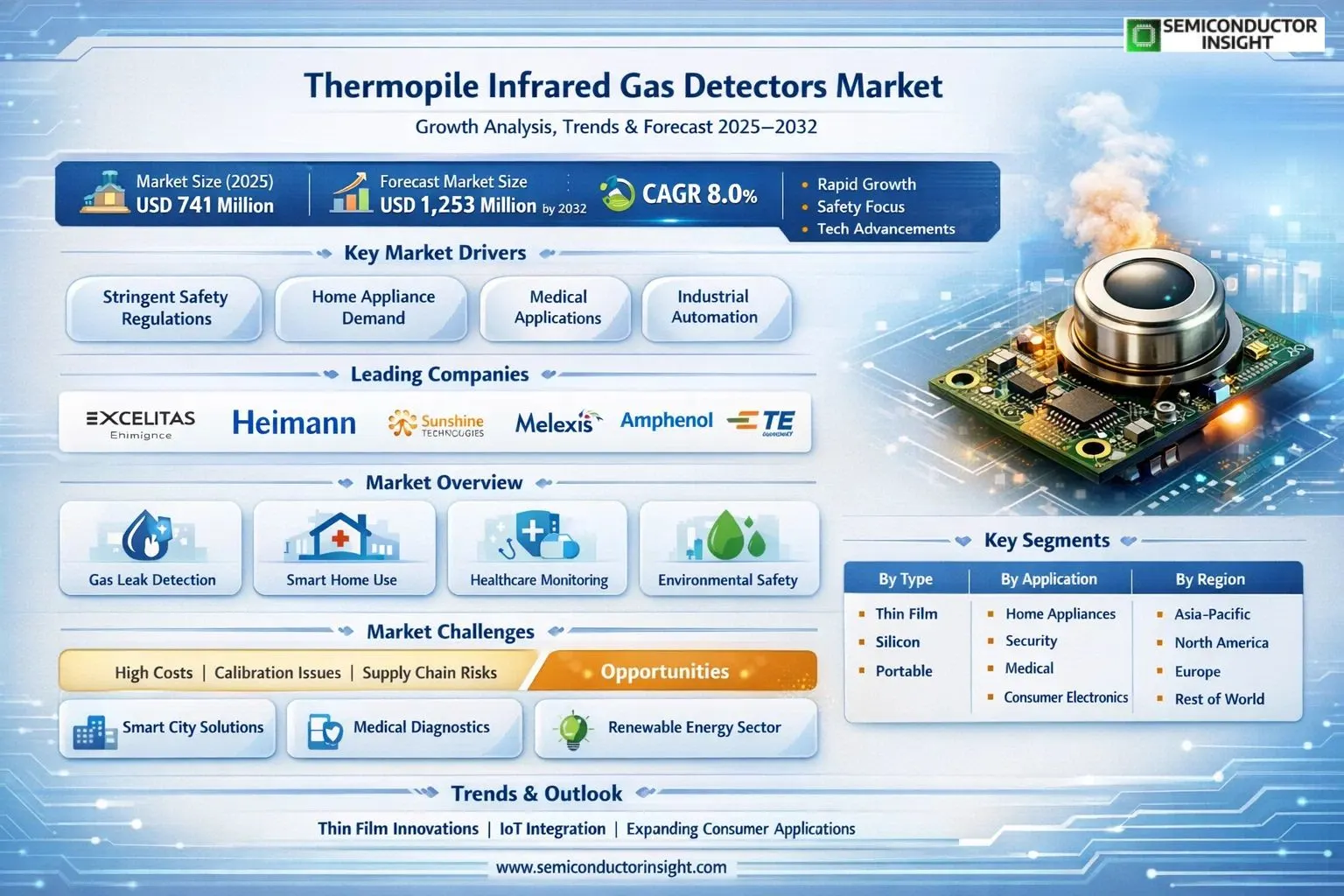
Global Thermopile Infrared Gas Detectors market size was valued at USD 741 million in 2025. The market is projected to reach USD 1,253 million by 2032, exhibiting a CAGR of 8.0% during the forecast period.
Thermopile infrared gas detectors operate based on the thermoelectric effect. When infrared radiation hits the thermopile sensing element, the sensing element absorbs energy and generates a temperature difference, which in turn generates a thermoelectric potential. This thermoelectric potential is proportional to the intensity of the infrared radiation, so the intensity of the infrared radiation can be inferred by measuring the thermoelectric potential, thereby detecting the presence or concentration of gas.
The market is experiencing rapid growth due to several factors, including stringent safety regulations across industries, rising demand for reliable gas detection in home appliances, security, and medical applications, and advancements in compact infrared sensing technologies. Furthermore, increasing industrialization and focus on environmental monitoring are driving expansion. Excelitas, Heimann, Sunshine Technologies, Melexis, Amphenol, TE Connectivity, Orisystech, Semitec, Hamamatsu Photonics, and Nicera are some of the key players operating in the market with diverse portfolios.
MARKET DRIVERS
Heightened Safety Regulations
Thermopile Infrared Gas Detectors Market is propelled by stringent global safety standards in industrial and residential sectors. Regulatory bodies like OSHA and EU ATEX directives mandate reliable gas detection systems to prevent leaks of hazardous gases such as methane and CO2, driving adoption in oil & gas and chemical industries.
Industrial Automation Surge
Advancements in Industry 4.0 have increased demand for non-contact, real-time monitoring solutions. Thermopile infrared gas detectors offer high sensitivity and low power consumption, integrating seamlessly with IoT platforms for predictive maintenance in manufacturing plants.
➤ Market growth is projected at a 6.2% CAGR through 2030, fueled by expanding HVAC applications where precise CO2 detection enhances energy efficiency.
Rising environmental concerns boost deployment in emissions monitoring, with thermopile sensors providing accurate, maintenance-free performance over traditional electrochemical alternatives.
MARKET CHALLENGES
Technical Limitations in Harsh Environments
Thermopile Infrared Gas Detectors Market faces hurdles from sensitivity to dust, humidity, and temperature fluctuations in demanding settings like mining and refineries, requiring frequent recalibration that elevates operational costs.
Other Challenges
Competition from laser-based detectors offering higher specificity challenges market share, as they provide faster response times for multi-gas detection despite higher prices.
Supply Chain Disruptions
Global semiconductor shortages impact thermopile sensor production, delaying deployments and inflating costs in Thermopile Infrared Gas Detectors Market by up to 15% in recent years.Skill gaps in installation and data interpretation among end-users further complicate widespread adoption.
MARKET RESTRAINTS
High Initial Costs
Premium pricing of thermopile components restrains entry into cost-sensitive markets like developing economies, where alternatives like semiconductor sensors dominate due to affordability.Complex calibration needs and limited detection range for certain gases, such as low-concentration VOCs, hinder broader Thermopile Infrared Gas Detectors Market penetration in environmental monitoring.Regulatory compliance variations across regions add certification burdens, slowing product launches and market expansion.Dependence on rare earth materials in sensor manufacturing poses supply risks amid geopolitical tensions.
MARKET OPPORTUNITIES
Smart City Integration
Thermopile Infrared Gas Detectors Market holds potential in urban air quality networks, where wireless connectivity enables real-time data for pollution control in megacities.Expansion into medical diagnostics, leveraging non-invasive breath analysis for disease detection, could capture a 12% share in healthcare by 2028.Growth in renewable energy sectors like hydrogen fueling stations demands robust leak detection, positioning thermopile sensors advantageously.Emerging markets in Asia-Pacific offer untapped demand driven by rapid industrialization and green building standards.
Thermopile Infrared Gas Detectors Market Trends
Rising Demand in Industrial and Security Applications
Thermopile Infrared Gas Detectors Market is experiencing robust growth driven by heightened emphasis on safety across industrial sectors. These detectors operate on the thermoelectric effect, where infrared radiation absorbed by the thermopile generates a temperature differential, producing a measurable voltage proportional to gas concentration. This non-contact detection method ensures reliable performance in harsh environments, making them indispensable for monitoring combustible and toxic gases in manufacturing facilities and oil & gas operations. Industry surveys highlight increasing regulatory pressures for enhanced leak detection, boosting adoption and positioning Thermopile Infrared Gas Detectors Market for sustained expansion.
Other Trends
Advancements in Thin Film Type Segments
Within Thermopile Infrared Gas Detectors Market, Thin Film Type detectors are emerging as a preferred choice due to their superior sensitivity and compact design. These sensors excel in applications requiring high precision, such as medical devices for breath analysis and non-invasive diagnostics. Silicon Type variants continue to serve demanding industrial uses with their durability. Key manufacturers like Excelitas, Heimann, and Hamamatsu Photonics are focusing on refining these technologies, improving response times and integration capabilities to meet diverse needs.Several factors contribute to the prominence of Thin Film innovations, including miniaturization trends that align with portable device requirements. Distributors and suppliers report steady demand shifts, reflecting broader industry evolution toward efficient, low-power solutions.
Expansion in Consumer Electronics and Home Appliances
Thermopile Infrared Gas Detectors Market is also seeing accelerated integration into consumer electronics, home appliances, and security systems. In home appliances, these detectors enable early warning for gas leaks, enhancing residential safety. Security applications leverage their accuracy for environmental monitoring in smart buildings. Leading players such as Melexis, TE Connectivity, and Nicera are developing IoT-compatible models, facilitating seamless connectivity in consumer products. Regional dynamics show strong momentum in Asia, particularly China and Japan, where manufacturing hubs drive volume uptake, while North America emphasizes high-end medical and industrial deployments. This multi-faceted adoption underscores the versatility of thermopile technology, with ongoing developments in product types and applications signaling further market maturation.
COMPETITIVE LANDSCAPE
Key Industry Players
Top Thermopile Infrared Gas Detectors Manufacturers and Strategic Market Positioning
Thermopile Infrared Gas Detectors Market features a moderately concentrated competitive landscape dominated by a handful of established global leaders, including Excelitas and Heimann Sensor, which alongside the top five players collectively hold a substantial revenue share as of 2025. These frontrunners leverage advanced thermoelectric sensing technologies, particularly thin film and silicon types, to serve high-demand applications in industrial safety, home appliances, and security systems. With the global market valued at US$741 million in 2025 and forecasted to reach US$1,253 million by 2032 at an 8.0% CAGR, leading firms prioritize innovation in infrared absorption efficiency and integration with IoT-enabled devices to maintain market dominance amid rising regulatory pressures for gas leak detection.
Beyond the top tier, niche and regional players such as Sunshine Technologies, Melexis, and Amphenol contribute through specialized product lines tailored for medical, consumer electronics, and emerging industrial uses. Asian manufacturers like Suzhou Sinan Sensing, Senba Sensing Technology, and Oriental System Technology are rapidly expanding via cost-competitive solutions, challenging incumbents in high-growth regions like China and Southeast Asia. This dynamic fosters ongoing mergers, R&D investments, and supply chain optimizations, with firms like Hamamatsu Photonics and TE Connectivity enhancing portfolio depth through precision optics and connectivity integrations, ensuring a fragmented yet innovative ecosystem.
List of Key Thermopile Infrared Gas Detectors Companies Profiled
- Excelitas
- Heimann
- Sunshine Technologies
- Melexis
- Amphenol
- TE Connectivity
- Orisystech
- Semitec
- Hamamatsu Photonics
- Nicera
- KODENSHI
- Winson
- Suzhou Sinan Sensing
- Senba Sensing Technology
- Oriental System Technology
Segment Analysis:
| Segment Category | Sub-Segments | Key Insights |
| By Type |
|
Thin Film Type
|
| By Application |
|
Industrial
|
| By End User |
|
Industrial Sector
|
| By Portability |
|
Stationary
|
| By Gas Type |
|
CO2 Detection
|
Regional Analysis: Thermopile Infrared Gas Detectors Market
North America
Stringent OSHA and EPA standards mandate reliable gas detection in high-risk industries, spurring thermopile infrared adoption. Compliance drives investments in fail-safe systems, reducing false alarms and enhancing accuracy in hazardous environments like refineries.
R&D hubs in Silicon Valley and Texas pioneer miniaturization and multi-gas detection capabilities. Integration with AI algorithms improves response times, positioning North American firms as global tech leaders in Thermopile Infrared Gas Detectors Market.
Oil and gas exploration, alongside manufacturing booms, fuels demand for rugged, maintenance-free detectors. Customization for extreme conditions ensures reliability, supporting seamless operations in diverse applications from pipelines to cleanrooms.
Collaborations between detector makers and system integrators expand market reach. Focus on sustainability integrates low-power thermopile sensors into green building projects, enhancing energy efficiency and safety protocols.
Europe
Europe exhibits strong growth in Thermopile Infrared Gas Detectors Market, propelled by rigorous EU directives on industrial emissions and worker safety. Countries like Germany and the UK lead with advanced manufacturing and automotive sectors adopting these detectors for leak monitoring and quality control. The push for renewable energy transitions integrates thermopile technology in biogas plants and hydrogen facilities. Innovation centers emphasize energy-efficient designs compliant with RoHS standards. Collaborative frameworks under Horizon Europe fund next-gen sensors for smart cities. Challenges include supply chain dependencies, yet localization efforts mitigate risks. Residential applications gain traction amid air quality concerns, with HVAC integrations becoming standard. Overall, Europe’s regulatory harmony and green tech focus solidify its competitive stance.
Asia-Pacific
Asia-Pacific emerges as a dynamic hub in Thermopile Infrared Gas Detectors Market, driven by rapid industrialization in China, India, and Japan. Petrochemical expansions and urban development heighten needs for affordable, scalable gas detection solutions. Local manufacturers leverage cost advantages to penetrate domestic markets, focusing on portable units for mining and construction. Government incentives for safety infrastructure support widespread deployment. Technological transfers from Western firms accelerate local R&D, yielding hybrid detectors for humid climates. Rising middle-class awareness boosts consumer-grade products for home safety. Infrastructure projects like smart grids incorporate IoT-linked thermopile sensors. Despite fragmented regulations, harmonization efforts promise sustained expansion in this high-potential region.
South America
South America shows promising potential in Thermopile Infrared Gas Detectors Market, centered on Brazil and Argentina’s energy sectors. Offshore oil exploration and agricultural processing demand robust detectors for volatile organic compounds. Economic recovery post-challenges enhances investments in safety equipment. Partnerships with international suppliers introduce advanced thermopile models tailored to tropical environments. Mining operations prioritize non-contact infrared sensing to minimize downtime. Urbanization drives commercial HVAC adoptions amid pollution controls. Local assembly initiatives reduce import costs, fostering market penetration. While infrastructure gaps persist, growing regulatory enforcement signals upward trajectory for reliable gas detection technologies.
Middle East & Africa
The Middle East & Africa region advances in Thermopile Infrared Gas Detectors Market, anchored by Gulf states’ oil and gas dominance. Saudi Arabia and UAE invest heavily in upstream safety amid diversification strategies. Harsh desert conditions necessitate durable, heat-resistant sensors for pipeline integrity. Africa’s mining boom in South Africa and Zambia integrates detectors for toxic gas vigilance. Visionary projects like NEOM incorporate cutting-edge thermopile tech for sustainable habitats. Capacity-building programs train local technicians, reducing reliance on expatriates. Emerging regulations align with global norms, spurring quality upgrades. Strategic OEM collaborations bridge technology gaps, positioning the region for balanced growth in industrial safety applications.
Report Scope
This market research report provides a comprehensive analysis of Thermopile Infrared Gas Detectors Market, covering the forecast period 2025–2032. It offers detailed insights into market dynamics, technological advancements, competitive landscape, and key trends shaping the industry.
Key focus areas of the report include:
- Market Overview: The report begins with an overview outlining its current market scenario, key growth indicators, and industry transformation drivers. It discusses macroeconomic factors, demand–supply balance, regulatory landscape, and the strategic role of thermopile sensors in powering advancements across industries such as home appliances, security, medical, consumer electronics, and industrial.
- Market Size & Forecast: Historical data and future projections for revenue, unit shipments, and market value across major regions and segments.
- Segmentation Analysis: Detailed breakdown by product type, technology, application, and end-user industry to identify high-growth segments and investment opportunities.
- Regional Insights: Insights into market performance across North America, Europe, Asia-Pacific, Latin America, and the Middle East & Africa, including country-level analysis where relevant.
- Competitive Landscape: Profiles of leading market participants, including their product offerings, R&D focus, manufacturing capacity, pricing strategies, and recent developments such as mergers, acquisitions, and partnerships.
- Technology Trends & Innovation: Assessment of emerging technologies, integration of AI/IoT, semiconductor design trends, fabrication techniques, and evolving industry standards.
- Market Drivers & Restraints: Evaluation of factors driving market growth along with challenges, supply chain constraints, regulatory issues, and market-entry barriers.
- Stakeholder Insights: Insights for component suppliers, OEMs, system integrators, investors, and policymakers regarding the evolving ecosystem and strategic opportunities.
Primary and secondary research methods are employed, including interviews with industry experts, data from verified sources, and real-time market intelligence to ensure the accuracy and reliability of the insights presented.
FREQUENTLY ASKED QUESTIONS:
What is the current market size of Thermopile Infrared Gas Detectors Market?
-> Thermopile Infrared Gas Detectors Market was valued at USD 741 million in 2025 and is expected to reach USD 1253 million by 2032, at a CAGR of 8.0% during the forecast period.
Which key companies operate in Thermopile Infrared Gas Detectors Market?
-> Key players include Excelitas, Heimann, Sunshine Technologies, Melexis, Amphemol, TE Connectivity, among others.
What are the key growth drivers?
-> Key growth drivers include demand in home appliances, security, medical, consumer electronics, and industrial applications.
Which region dominates the market?
-> Asia is the fastest-growing region, while North America remains a dominant market.
What are the emerging trends?
-> Emerging trends include thin film type segments, advancements in thermoelectric sensing, and expansion in IoT-enabled gas detection.

Get Sample Report PDF for Exclusive Insights
Report Sample Includes
- Table of Contents
- List of Tables & Figures
- Charts, Research Methodology, and more...
 Download Sample Report PDF